
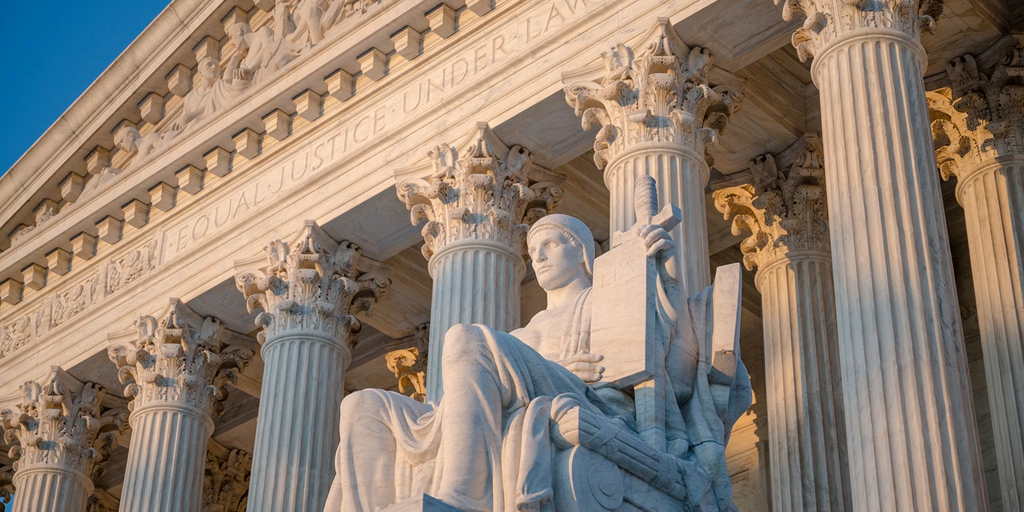
The highest court in the United States has officially stepped in to put a stop to a massive political fight. In a major decision released right as voting is getting under way, the U.S. Supreme Court blocked a controversial, Trump-backed congressional district map from being used in Missouri for the upcoming midterm elections.
This decision brings an abrupt end to months of wild legal chaos, conflicting court orders, and deep confusion for local voters. State officials and judges had been trading legal blows for weeks over which boundaries should decide who goes to Washington.
In an unsigned order with no noted dissents, the Supreme Court made its position crystal clear. Forcing a brand new voting map onto the state while absentee and mail-in ballots are already being cast would cause complete electoral chaos. As a result, Missouri will stick with its existing 2022 congressional lines for the November election.
Here is the complete breakdown of how this intense legal battle unfolded, why President Donald Trump pushed so hard for the changes, and what this means for voters and political power across the country.
The Battle Over Missouri’s Political Map Explained
Every ten years, states across America redraw their voting boundaries based on new population counts from the national census. Missouri completed that process back in 2022. Under those 2022 maps, Republicans held a strong hold on the state, winning six out of the eight seats in the U.S. House of Representatives, while Democrats held two.
The $0 Secret To Launching Your Entire Online Empire
Why pay hundreds every month for separate software? Build funnels, send emails, and make sales with Systeme.io completely free.
Get Started For $0Free Forever • No Credit Card Needed • Beginner-Friendly
However, political battles rarely stay quiet for long. Last year, President Donald Trump and Republican Governor Mike Kehoe urged Missouri lawmakers to pass a brand new map in the middle of the decade. The goal was simple: reshape district lines to give Republicans an advantage in seven of the eight districts instead of six.
Gaining an extra seat in Missouri was a crucial piece of a broader nationwide strategy. With control of the U.S. House of Representatives balanced on a razor-thin margin, every single seat counts. Winning one more seat in Missouri could easily mean the difference between holding power or losing it in Washington.
To make that extra seat happen, lawmakers targeted the 5th Congressional District in the Kansas City area. Longtime Democratic Representative Emanuel Cleaver has held that seat for years. Under the proposed Trump-backed map, large sections of Kansas City were cut out of Cleaver’s district and moved into surrounding districts held by Republicans.
At the same time, what remained of Cleaver’s district was stretched far to the east into rural, heavily Republican areas. According to news reports from the Associated Press, nearly 59% of the potential voters in that redrawn district were completely new. This drastic redrawing made it far harder for a Democrat to win the seat.
The Timeline of Chaos: How We Got to This Point
The story behind this Supreme Court ruling is full of unexpected twists and legal drama. Understanding how Missouri ended up in this situation requires looking back at the events of the past year.
State lawmakers originally passed the redrawn, Trump-backed map in September. But in Missouri, citizens have a constitutional right to challenge new laws through a referendum process. If opponents gather enough signatures from registered voters, the new law is put on pause until the public gets to vote on it in a statewide election.
Opponents of the new map worked tirelessly and gathered more than 300,000 voter signatures to force a public vote. They submitted those signatures in December.
Instead of processing the signatures quickly, Republican Secretary of State Denny Hoskins waited months. He finally made a decision on August 4—the exact day Missouri was holding its primary elections. Hoskins rejected the petition, claiming that citizen referendums could not be used to overturn congressional maps.
Because of that delay, the state actually used the new, Trump-backed map during the August primary election. Candidates ran for office and voters cast their primary ballots based on those redrawn boundary lines.
That is when the courts stepped in. On September 3, the Missouri Supreme Court unanimously ruled that the voter petition was completely valid. The state justices explained that under Missouri law, the new map was retroactively suspended the moment the signatures were turned in back in December.
Because the map was suspended, the state supreme court ruled that it could not be used for the November general election unless voters approved it first. They ordered election officials to immediately switch back to the older 2022 map.
Legal Ping-Pong: Federal Courts vs. State Courts
What happened next was a chaotic clash between state and federal judges.
Just minutes after the Missouri Supreme Court ordered the state to use the 2022 map, U.S. District Judge Stephen Clark—a federal judge appointed by Trump—issued a conflicting order. He told state officials that they must use the new Trump-backed map instead.
This created an unprecedented standoff. Secretary of State Denny Hoskins followed the federal judge’s order and told local election clerks to prepare for the new map. In response, the Missouri Supreme Court threatened Hoskins with contempt charges for ignoring their directions.
State officials appealed to the U.S. Supreme Court to step in. Supreme Court Justice Brett Kavanaugh, who handles emergency requests from Missouri, initially rejected the state’s request on September 10. He let the state supreme court decision stand, meaning the 2022 map was back in play.
Send, Spend & Hold Money Worldwide Without Hidden Fees
Transfer money internationally at the real exchange rate and hold 40+ currencies in one account.
Open a Wise AccountMid-market rate • Fast transfers • 40+ currencies
Yet the legal fight kept going. Republican candidates, including state Senator Rick Brattin and U.S. Representative Bob Onder, took the case to the 8th U.S. Circuit Court of Appeals. On September 21, a three-judge panel from the 8th Circuit ruled in their favor. The appeals court argued that switching voting maps between the August primary and the November general election violated the U.S. Constitution.
That 8th Circuit ruling threatened to flip the rules once again, forcing election offices to discard the 2022 maps and rush back to the redrawn 2025 maps. That set the stage for the final showdown at the U.S. Supreme Court.
Why the U.S. Supreme Court Said “No More”
Faced with mounting chaos just weeks before election day, the U.S. Supreme Court put a firm end to the back-and-forth battle.
The high court issued an unsigned opinion stating clearly that the clock had run out. Election offices across Missouri had already printed thousands of physical ballots using the 2022 district lines. In fact, military personnel serving overseas and citizens using absentee voting had already begun casting their votes.
The justices pointed out that ordering another map change in the middle of an active election would create unbearable confusion for voters and election workers alike.
In legal circles, this idea is known as the Purcell Principle. It is a long-standing rule that federal courts should avoid changing voting laws or district lines right before an election because doing so causes widespread voter confusion and disrupts administrative processes.
By shutting down the 8th Circuit’s ruling, the Supreme Court ensured that Missouri voters will use the familiar 2022 map for the upcoming November election.
What This Means for Candidates and Voters
This ruling has major consequences for everyone involved in Missouri politics, from top lawmakers down to everyday citizens.
First, long-time Democratic Congressman Emanuel Cleaver keeps his traditional Kansas City-focused district. Under the 2022 map, his district remains heavily Democratic, giving him a strong advantage to keep his seat in Congress.
On the Republican side, candidates find themselves in an unusual spot. Republican state Senator Rick Brattin won a competitive six-way primary back in August under the redrawn map. Now, he is running in a general election where the district lines have shifted back to where they were two years ago.
The $0 Secret To Launching Your Entire Online Empire
Why pay hundreds every month for separate software? Build funnels, send emails, and make sales with Systeme.io completely free.
Get Started For $0Free Forever • No Credit Card Needed • Beginner-Friendly
Even though the boundary lines shifted, the candidates on the ballot remain the same. Voters will still see the primary winners listed on their general election ballots, but some voters will find themselves voting for candidates in a district they were not in during August.
For ordinary voters, the ruling brings much-needed clarity. Nearly one in four Missouri voters—more than one million people—were shifted into new districts under the Trump-backed map. With the Supreme Court blocking that map, those voters are back in their familiar 2022 districts.
Furthermore, Missouri citizens will still have their say on the matter. Because the citizen referendum petition was validated, the redrawn map will appear on the November ballot as a ballot measure. Voters can decide whether they want to adopt the new map for future elections starting in 2028, or discard it entirely.
The Bigger Picture: Midterm Power Struggles Across the Country
What happened in Missouri is not taking place in a vacuum. It is part of a high-stakes, nationwide game of political chess.
In recent years, both major political parties have pushed hard to redraw congressional lines mid-decade whenever they hold legislative power in key states. President Trump has publicly urged Republican-controlled state governments across the country to redraw their maps to gain extra seats in Congress.
States like Texas, Alabama, and North Carolina have all seen fierce court battles over redistricting. In some states, courts have struck down maps for violating civil rights laws or state constitutions. In others, redrawn lines have been allowed to stand.
Because the balance of power in the House of Representatives is so close, winning or losing just one seat in a state like Missouri can change which party controls key legislative committees, passes major federal budgets, or sets national policy.
That is why top state leaders fought so hard in court. Republican Governor Mike Kehoe expressed disappointment with the Supreme Court’s decision but confirmed that the state would respect the order and proceed with the 2022 map. Meanwhile, voter rights groups and Democratic leaders celebrated the ruling as a victory for the popular petition process.
How Real Missourians Are Reacting
On the ground, local election workers are letting out a sigh of relief.
Running an election is a massive logistical task. Election clerks must print correct ballots, configure voting machines, update address databases, and train poll workers. Having the map change multiple times in a single month created an enormous administrative headache.
Some election officials in major counties had previously advised voters to hold off on turning in absentee ballots until the courts made a final decision. Now that the highest court in the nation has spoken, those officials can move forward with confidence.
For voters who felt confused over the past few weeks, the message is straightforward: check your local election board website to confirm your district and voting location before casting your ballot.
Frequently Asked Questions (FAQs)
Which map will Missouri actually use for the November midterm election?
Missouri will use the congressional map adopted in 2022. This is the exact same set of district boundaries that was used during the 2022 and 2024 congressional elections.
Why did the Supreme Court reject the Trump-backed map?
The Supreme Court ruled that changing district boundaries while voting is actively under way would cause severe electoral chaos. With absentee and military ballots already printed and mailed out, switching maps at such a late stage would confuse voters and disrupt the election process.
Did voters use a different map during the August primary?
Yes. Because state officials delayed reviewing the citizen petition, the redrawn Trump-backed map was used during the August 2026 primary election. However, courts determined that those boundaries cannot be used for the November general election.
Will Missouri voters get a say on the new map in the future?
Yes. A referendum will appear on the November ballot. Citizens will vote on whether to accept the redrawn map for future election cycles or reject it permanently.
What happens if I already sent in an absentee ballot?
Ballots sent in under the 2022 map guidelines are valid. Local election authorities are processing absentee and mail-in ballots using the official 2022 district lines confirmed by the Supreme Court order.
Staying informed on major news stories like this helps ensure your voice is heard at the ballot box. To learn more about our team and how we break down complex national events, visit our About Us page. If you have questions, feedback, or news tips, feel free to reach out directly through our Contact Us page. You can also follow all our latest updates on Instagram, join the conversation on Facebook, or connect with us on X (formerly Twitter) to stay up to date on everything happening across the country.
