
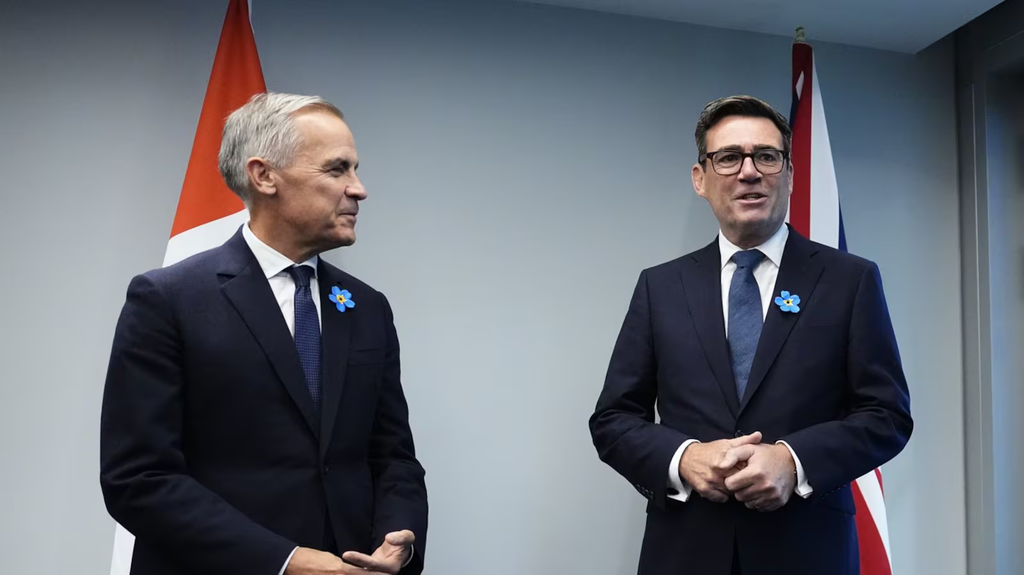
Canada has formally applied to become a full-time member of the United Kingdom-led Joint Expeditionary Force, marking one of the biggest moves in the nation’s defense policy in decades. Prime Minister Mark Carney made the official announcement during a high-stakes bilateral meeting with British Prime Minister Andy Burnham in Liverpool. This decision signals a clear shift in how Canada plans to protect its northern borders, strengthen international security, and diversify its military partnerships beyond traditional North American frameworks.
For years, Canada participated in exercises with this British-led force as an outside observer. Moving from guest status to full permanent membership shows that Ottawa is serious about building deeper military ties across the North Atlantic and Baltic regions. The Joint Expeditionary Force is a high-readiness military coalition designed to respond rapidly to emerging security threats. By seeking full membership, Canada is placing itself right at the decision-making table with key European allies.
This news comes at a time when traditional international alliances are under significant strain. Economic disputes, shifting trade relationships, and rising security challenges in the Arctic have forced national leaders to reconsider their global strategies. Canada is looking across the Atlantic for reliable partners who share its vision for security, technological innovation, and joint defense investment. This strategic realignment is closely connected to Canada’s broader initiative to strengthen its European ties, a trend seen when Mark Carney traveled to Brussels to expand European ties earlier this year.
What Is the Joint Expeditionary Force?
To understand why this application is such a major step, it helps to look at what the Joint Expeditionary Force actually is. Formed in 2014, this coalition is a group of ten like-minded nations led by the United Kingdom. The core members include Denmark, Estonia, Finland, Iceland, Latvia, Lithuania, the Netherlands, Norway, Sweden, and the UK. Every single member shares a direct interest in the security of Northern Europe, the Baltic Sea, and the North Atlantic.
Unlike larger international bodies that require lengthy political debates before taking action, the Joint Expeditionary Force was designed for speed and flexibility. It functions as a rapid-reaction military capability. If a crisis breaks out in Northern Europe or the Arctic, member nations can quickly assemble military forces, share intelligence, and deploy resources without waiting for complex bureaucratic approval processes.
The $0 Secret To Launching Your Entire Online Empire
Why pay hundreds every month for separate software? Build funnels, send emails, and make sales with Systeme.io completely free.
Get Started For $0Free Forever • No Credit Card Needed • Beginner-Friendly
Up until now, Canada supported this coalition through joint training drills and observer roles. Canadian commanders participated in planning sessions and sent troops to military exercises across Europe. However, formal application for full membership changes the game. It transforms Canada from an occasional participant into a permanent co-decision maker. This gives Ottawa an active voice in setting defense priorities, planning Northern European security operations, and coordinating joint responses to regional threats.
Why Canada Is Making the Move Now
The decision to join this military coalition is not happening in a vacuum. It is part of a larger, deliberate attempt by Canadian leaders to build stronger bonds outside North America. Over the past few years, shifting global politics and trade tensions have shown Ottawa that relying heavily on a single primary ally carries significant risk. When diplomatic or economic friction arises, having strong alternative partnerships becomes vital for national security.
Economic issues and trade policy changes have pushed Canada to expand its international footprint. As detailed in our coverage on how Canada plans to navigate trade challenges, diversification has become a central focus for the government. Joining a European-led defense coalition fits right into this broader push for balance.
Additionally, Canada is actively seeking closer economic and political integration with Europe. This military bid aligns directly with the nation’s effort regarding Canada’s push for EU associate status. By demonstrating a real commitment to European defense, Canada builds goodwill and political capital that can help secure better trade and technology agreements across the continent.
Another crucial factor is Arctic security. As polar ice melts and shipping lanes open up across the North, competition for control over northern waters has intensified. Countries like Russia and China are increasing their activity in the High North. Canada shares the Arctic region with Nordic members of the Joint Expeditionary Force, such as Norway, Sweden, Finland, and Denmark. Joining this group allows Canada to coordinate Arctic defense with nations that face the exact same geographic challenges.
Inside the High-Stakes Meeting in Liverpool
The official application was delivered during a warm meeting between Prime Minister Mark Carney and British Prime Minister Andy Burnham in Liverpool. The two leaders discussed a wide range of shared priorities, including defense cooperation, bilateral trade, and the rapid development of artificial intelligence.
Burnham praised Carney as a progressive leader and expressed full British support for Canada’s membership bid. The personal rapport between the two prime ministers was obvious throughout their public remarks. Beyond formal policy discussions, the leaders bonded over shared personal experiences and common values, creating a positive atmosphere for diplomatic progress.
Deepening Military and Economic Ties
During the meeting, officials discussed how the two nations can expand their existing military collaboration. A key topic was the British Army Training Unit Suffield, located at Canadian Forces Base Suffield in Alberta. Covering 2,700 square kilometers, this vast training ground has been used by British forces for decades to conduct large-scale armored exercises and weapons tests.
The UK government plans to invest approximately $18.7 million into the Suffield facility through 2031. Both leaders signaled their intention to create a new permanent arrangement that modernizes the base. This updated agreement will focus heavily on testing cutting-edge military hardware, advanced drone technology, and next-generation tactical systems.
Defense Procurement and Air Power
The discussion also touched on military industrial cooperation. Prime Minister Carney highlighted Canada’s interest in the Global Combat Air Programme, an international initiative aimed at developing advanced stealth fighter jets and unmanned aerial combat systems. Canada joined the program as an observer earlier this year, marking a serious step toward modernizing its air force. Working alongside the UK on high-tech defense projects helps Canada keep its military updated while creating skilled technology jobs at home.
Funding Defense: The Battle Over Financial Models
Beyond troops and military exercises, one of the most interesting aspects of the Canada-UK agreement involves defense financing. Both nations realize that modernizing armies and buying advanced military gear costs billions of dollars. To address this challenge, both Ottawa and London have proposed innovative financial mechanisms, and they are now in active talks to merge their ideas into a single, powerful institution.
Prime Minister Mark Carney has been promoting the creation of a global Defence, Security and Resilience Bank. The goal of this bank is to provide allied nations with low-cost borrowing so they can fund defense purchases without destroying their national budgets. Carney has already secured support from several European nations, including Latvia, Luxembourg, Belgium, Greece, and Ukraine. However, Canada remains the only G7 nation fully behind this specific model so far.
Meanwhile, the United Kingdom created its own initiative called the Multilateral Defence Mechanism. Designed as a shared funding vehicle for joint military equipment purchases, the UK program has gained support from nations like the Netherlands, Finland, and Poland. London plans to commit $749 million to start this program by 2027.
Merging the Financial Visions
Instead of competing against each other, Canadian and British officials are negotiating to blend these two models together. During recent NATO meetings, both countries issued a joint statement pledging to ensure their financial initiatives develop in a complementary way.
If Ottawa and London successfully combine their funding models, it could create a massive financial institution capable of supporting allied military spending across Europe and North America. Money invested through this proposed defense bank would also count toward the NATO target requiring member states to allocate five percent of their GDP to defense by 2035.
Send, Spend & Hold Money Worldwide Without Hidden Fees
Transfer money internationally at the real exchange rate and hold 40+ currencies in one account.
Open a Wise AccountMid-market rate • Fast transfers • 40+ currencies
This financial strategy reflects Canada’s growing economic confidence. Strong underlying economic metrics, such as those highlighted when Canada’s GDP posted strong growth, give the government the flexibility needed to commit serious funds to international defense frameworks.
Arctic Sovereignty, AI, and Tech Collaboration
Joining the Joint Expeditionary Force isn’t just about infantry and naval ships. Modern defense relies heavily on technology, cybersecurity, artificial intelligence, and rapid data sharing. Both Canada and the UK are prioritizing technological innovation to stay ahead of potential adversaries.
During their Liverpool talks, Carney and Burnham discussed how governments and tech companies must work together to protect online safety and develop responsible AI systems. You can read more about how cutting-edge tools are reshaping various sectors in our Technology & AI category.
In the military context, artificial intelligence and autonomous systems are transforming Northern European and Arctic defense. Remote sensors, autonomous surveillance drones, and real-time satellite tracking are crucial for monitoring vast, uninhabited polar regions. By combining resources through the Joint Expeditionary Force, member states can develop these technologies faster and at a lower cost.
This push for technological and energy security also connects with domestic policy changes in North America. For instance, Canada’s efforts to streamline major infrastructure projects, as seen in how Canada overhauled its energy rules for fast-tracking projects, demonstrate a commitment to building resilient national infrastructure capable of supporting long-term defense goals.
What Full Membership Means for the Future
Canada’s formal application to join the Joint Expeditionary Force represents a major shift in northern defense dynamics. While NATO remains the cornerstone of Western defense, smaller, highly agile coalitions like the Joint Expeditionary Force offer distinct advantages. They allow nations with shared regional interests to act quickly without navigating complex voting requirements.
For Canada, becoming a permanent member provides several clear advantages:
- Direct involvement in Northern European and Baltic security planning.
- Enhanced cooperation on Arctic defense with Nordic neighbors.
- Access to joint defense procurement and cutting-edge military technology.
- Stronger political leverage when negotiating trade and economic deals with European partners.
- Opportunities to attract defense investment, similar to discussions at the Canada Investment Summit.
Before Canada officially joins, all ten existing member nations must formally approve the application. Given the strong endorsement from the United Kingdom and positive reactions from Nordic partners, approval is widely expected. Once finalized, Canada will take its place as the first non-European permanent member of this rapid-response alliance.
Frequently Asked Questions
What is the Joint Expeditionary Force?
The Joint Expeditionary Force is a UK-led military coalition formed in 2014. It consists of ten nations focused on rapid-response operations in Northern Europe, the Baltic region, and the North Atlantic.
Why did Canada decide to join the Joint Expeditionary Force now?
Canada wants to diversify its defense partnerships, strengthen Arctic security alongside Nordic allies, and build deeper economic and military connections with European partners.
The $0 Secret To Launching Your Entire Online Empire
Why pay hundreds every month for separate software? Build funnels, send emails, and make sales with Systeme.io completely free.
Get Started For $0Free Forever • No Credit Card Needed • Beginner-Friendly
Does joining this coalition mean Canada is leaving NATO?
No. The Joint Expeditionary Force is designed to complement NATO, not replace it. All current members of the coalition are NATO allies, and the group works within the broader framework of Western security.
How does this move affect British military operations in Canada?
The UK operates the British Army Training Unit Suffield in Alberta. The two nations are working on a new agreement that includes $18.7 million in UK investment to test advanced weapons and drone technology at the base.
What is the proposed Defence, Security and Resilience Bank?
It is a financial initiative championed by Prime Minister Mark Carney designed to help allied nations borrow money at low interest rates to fund military defense purchases and meet NATO spending goals.
Conclusion
Canada’s decision to seek full membership in the UK-led Joint Expeditionary Force marks a bold step forward in its national defense strategy. By joining forces with key European allies, Canada is reinforcing its Arctic sovereignty, embracing military technology innovation, and ensuring its voice is heard in global security decisions.
To learn more about our mission to bring you clear, engaging analysis on global news and trending topics, visit our About Us page. If you have questions, feedback, or story tips, feel free to reach out directly on our Contact Us page.
Looking to explore how modern digital media and automation are changing content creation? Check out our dedicated guide on YouTube Automation to see how creators and businesses are building successful channels today.
Stay connected with us across social media for daily updates, viral stories, and breaking news analysis:
