
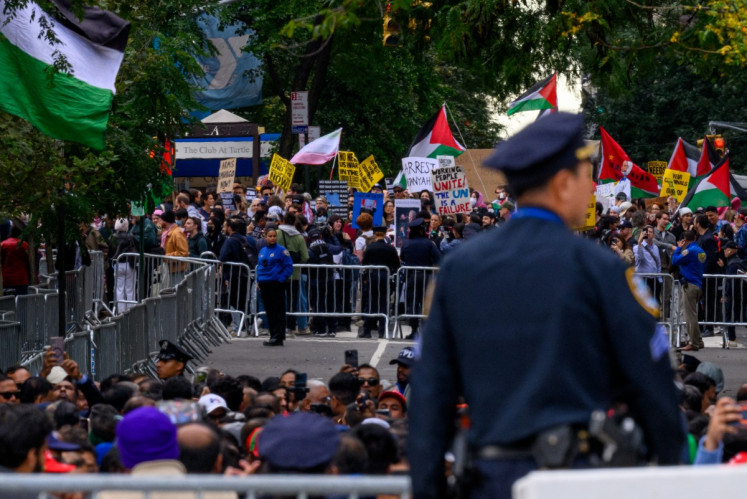
The streets of Midtown Manhattan turned into a scene of intense political drama on Thursday as Israeli Prime Minister Benjamin Netanyahu arrived at the 81st United Nations General Assembly. Hundreds of demonstrators took to the roadways surrounding the UN headquarters, shutting down traffic, blocking official motorcades, and staging sit-ins that led to dozens of high-profile arrests.
People from all walks of life—including Jewish, Palestinian, Iranian, and Lebanese New Yorkers—joined hands alongside Hollywood celebrities, elected officials, and political candidates to voice their outrage over the ongoing war in Gaza. Wearing matching white shirts that read “Fund people, not bombs,” protesters sat down directly on the pavement at 1st Avenue and 42nd Street, forcing police to divert diplomatic traffic heading toward the UN compound.
The widespread civil unrest in New York reflects deep divisions over foreign policy, military aid, and international accountability. It comes at a time when global diplomatic gatherings are increasingly shadowed by domestic political clashes. The tension surrounding high-profile international summits has created major diplomatic headaches, as seen in recent debates over visa denials for Palestinian leaders and fierce battles on Capitol Hill over US weapons transfers to Israel.
How Midtown Manhattan Came to a Standstill Outside UN Headquarters
The demonstrations began early Thursday morning as delegates and foreign leaders started arriving for the high-level UN General Assembly sessions. What started as a crowd gathering near Union Square and Midtown quickly grew into a coordinated effort to surround the UN perimeter. Protesters unfurled massive banners calling for an immediate cease-fire, flew kites bearing the words “Free Palestine,” and filled the streets with loud chants including “Let Gaza live” and “The whole world is watching.”
To make their message impossible to ignore, dozens of demonstrators sat down in the middle of major thoroughfares. For over an hour, traffic on key avenues came to a complete halt. Official motorcades carrying international ministers and foreign dignitaries were forced to make last-minute U-turns and detour through side streets crammed with police officers and news crews.
The $0 Secret To Launching Your Entire Online Empire
Why pay hundreds every month for separate software? Build funnels, send emails, and make sales with Systeme.io completely free.
Get Started For $0Free Forever • No Credit Card Needed • Beginner-Friendly
The protest outside the main UN entrance was only one part of a larger, citywide push. A day before the main UN address, members of the New York chapter of the Democratic Socialists of America held a rally at John F. Kennedy International Airport. That action focused on protesting commercial aircraft being used to carry military equipment and supplies bound for the Middle East. Meanwhile, thousands of additional marchers gathered in Times Square before marching east toward 1st Avenue, creating gridlock across multiple city blocks.
Mass public gatherings of this size require massive coordination from city agencies. When thousands of people decide to form human barricades in public spaces, the logistical impact on a city can be huge, similar to the recent scene where thousands formed a massive human shield during DC protests. In New York, the sudden shutdown of major transit routes created immediate security challenges for local and federal authorities.
Celebrities, Politicians, and Activists Behind the Arrests
One of the most striking aspects of Thursday’s action was the wide range of notable figures who joined the front lines and ended up in handcuffs. The primary sit-in outside the UN was organized by Jewish Voice for Peace Action, a progressive activist group that has consistently mobilized against military action in Palestine.
Beth Miller, the political director for Jewish Voice for Peace Action, explained that the point of the sit-in was to show that many Americans—including thousands of Jewish New Yorkers—do not support hosting Netanyahu in their city. Activists emphasized that tax dollars spent on foreign military funding should instead be directed toward local social needs like housing, healthcare, and education.
Several prominent Hollywood stars and public figures were arrested by the NYPD after refusing orders to clear the road. Among those taken into custody were:
- Oscar-winning actress Susan Sarandon, who has a long history of political activism and has frequently spoken out at civil rights rallies.
- Emmy-winning actress and comedian Hannah Einbinder, who spoke to reporters before her arrest about the moral duty she felt as an American and a Jewish woman to protest.
- Actor Elliot Page, who joined the street sit-in alongside fellow performers.
- Whistleblower and activist Chelsea Manning, who sat on the pavement alongside fellow demonstrators chanting anti-war slogans.
- Comedian Caleb Hearon, who participated in the human barricade blocking 1st Avenue.
It was not just celebrities on the front line; several active politicians and candidates running for public office in the upcoming elections joined the blockade. New York City Council member Chi Ossé and Democratic congressional candidate Darializa Avila Chevalier were both arrested by police. Chevalier pointed out that voters are increasingly eager to see their elected leaders put their bodies on the line to challenge foreign war expenditures.
Other political figures present included New York City Comptroller Brad Lander, Pennsylvania State Representative Chris Rabb, New Jersey congressional candidate Dr. Adam Hamawy, and Colorado candidate Melat Kiros. Dr. Hamawy, an army surgeon who previously completed a medical mission treating wounded civilians in Gaza, told reporters that it felt upside down to watch international bodies invite leaders to give speeches while ordinary people felt forced to risk arrest just to demand basic humanitarian protection.
The willingness of political candidates to take part in civil disobedience highlights a growing rift inside American politics over freedom of speech and political dissent. Many activists involved in these actions have faced sharp pushback, mirroring broader nationwide debates over court battles blocking student deportations over political speech.
The NYPD Response and Police Intelligence Strategy
As the sit-in stretched past the one-hour mark, the New York Police Department moved in to clear the streets. Working alongside the US Secret Service and federal diplomatic protection units, NYPD officers set up metal barricades and issued warnings over bullhorns, ordering the crowd to disperse or face immediate arrest for disorderly conduct and blocking traffic.
While some demonstrators moved onto the sidewalks to continue chanting, a large group remained seated on the asphalt, locking arms and chanting “Netanyahu go to hell” as police officers closed in.
The police response was methodical:
- Officers on bicycles created a physical ring around the seated group to separate them from the surrounding crowd of onlookers.
- Teams of officers walked into the group one by one, separating individual protesters from their peers.
- Officers pulled demonstrators to their feet, secured their hands behind their backs using plastic zip ties, and led them toward white police transport buses parked nearby.
- Additional police buses were brought in as the number of detainees mounted throughout the afternoon.
Organizers estimated that over 100 people were arrested across the day’s various actions, while official police statements confirmed that dozens of core organizers and high-profile participants were processed. Despite the high number of arrests, the demonstrations remained mostly nonviolent, with protesters offering passive resistance by sitting down rather than physically fighting with officers.
Managing large-scale political protests in a crowded city like New York is always a massive test for law enforcement. Police departments face constant scrutiny over how they handle intelligence gathering and crowd control tactics during heated political moments, a topic that has generated nationwide discussion regarding how police handle protest intelligence and public safety.
Inside the UN Chamber: Walkouts and High-Stakes Diplomacy
While noise from the streets echoed across Midtown Manhattan, a separate wave of protest played out inside the United Nations General Assembly hall. When Israeli Prime Minister Benjamin Netanyahu stepped up to the podium to deliver his scheduled address, dozens of foreign diplomats and international delegations stood up from their seats and walked out of the room in a staged protest.
The diplomatic walkout left large sections of the hall noticeably empty as Netanyahu began his speech. During his remarks, Netanyahu strongly defended Israel’s military operations, arguing that the country is defending itself against hostile neighbors and terrorist organizations across the region. He pushed back aggressively against international criticism, rejecting claims made by human rights groups and international courts.
Send, Spend & Hold Money Worldwide Without Hidden Fees
Transfer money internationally at the real exchange rate and hold 40+ currencies in one account.
Open a Wise AccountMid-market rate • Fast transfers • 40+ currencies
Netanyahu also used his speech to directly address domestic American critics and local New York politicians who have voiced opposition to his visit. He argued that international critics are ignoring the security threats facing Israel and insisted that his government would continue its military campaign until its strategic goals are fully met.
The speeches delivered at this year’s General Assembly come during a volatile moment in global security. Outside the UN walls, international observers remain deeply concerned about wider regional instability, including rising fuel prices, shipping disruptions, and questions over whether military conflicts across the Middle East can be brought to a diplomatic end.
Mayor Zohran Mamdani and the Political Battle Over New York’s Streets
The tension surrounding Netanyahu’s arrival in New York was heightened by comments made prior to the event by New York City Mayor Zohran Mamdani. During his campaign, Mamdani had drawn widespread national attention by declaring that Netanyahu was a “war criminal” and stating that he would seek his arrest if the Israeli leader set foot in New York City.
However, as the UN summit approached, Mayor Mamdani acknowledged the legal reality of the situation. City officials clarified that local municipality leaders do not have the legal authority or federal jurisdiction to arrest a foreign head of state attending an official United Nations function, as international diplomatic immunity and federal laws oversee visiting foreign leaders.
Despite these legal boundaries, Mayor Mamdani reaffirmed his strong support for the constitutional rights of everyday New Yorkers to assemble and voice their views publicly. Speaking to reporters ahead of the Thursday demonstrations, Mamdani stressed that New York is a city that respects the First Amendment and that residents have every right to make their voices heard in the streets.
The public clash between local city leadership and visiting foreign dignitaries illustrates how global conflicts routinely spill over into municipal politics. In a city as diverse as New York, local leaders are constantly forced to balance constitutional free speech rights with public safety and federal diplomatic obligations.
Hostage Families and Counter-Demonstrations Demand Action
The demonstrations in Midtown Manhattan were not limited to a single perspective. Gathering nearby, families of Israeli hostages held in Gaza also organized public rallies to call attention to the plight of their loved ones and demand their immediate release.
Former hostages who were previously freed, along with relatives of those still held captive, shared painful personal accounts with the press. Ilana Gritzewsky, who was held in captivity for 55 days before being released, spoke to news outlets about her terrifying experience and appealed for urgent action to bring home those who remain in Gaza, including her partner.
Other family members expressed complex feelings about the political situation. Some relatives stated that they supported Prime Minister Netanyahu’s tough stance, urging him to negotiate a firm agreement that ensures the safety and return of every hostage. Others voiced frustration with political delays, calling on all leaders involved to prioritize human life over political maneuvering.
The presence of multiple demonstration groups in Midtown created an intense emotional atmosphere across the city. On one street corner, activists demanded an immediate end to military funding and military actions, while a few blocks away, families held pictures of missing loved ones and prayed for their return. The side-by-side gatherings served as a vivid reminder of how deeply personal this conflict remains for millions of people around the world.
The $0 Secret To Launching Your Entire Online Empire
Why pay hundreds every month for separate software? Build funnels, send emails, and make sales with Systeme.io completely free.
Get Started For $0Free Forever • No Credit Card Needed • Beginner-Friendly
Frequently Asked Questions (FAQs)
Why were protests held during Benjamin Netanyahu’s speech at the UN?
Protesters gathered in New York to voice opposition to Israel’s military operations in Gaza and to protest US military aid to the Israeli government. Demonstrators called for an immediate cease-fire, an end to military aid, and increased humanitarian assistance for civilians in Gaza.
Who organized the main protests outside the UN headquarters?
The primary sit-in directly outside the UN headquarters was coordinated by Jewish Voice for Peace Action, along with support from Palestinian, Iranian, and Lebanese community organizations in New York. Other groups, including the Democratic Socialists of America, organized supporting rallies at locations like JFK Airport and Times Square.
Were any celebrities or elected officials arrested during the New York protests?
Yes. Several prominent figures were arrested by the NYPD for blocking traffic on 1st Avenue, including Oscar-winning actress Susan Sarandon, Emmy winner Hannah Einbinder, actor Elliot Page, whistleblower Chelsea Manning, NYC Council member Chi Ossé, and Democratic congressional candidate Darializa Avila Chevalier.
What was New York City Mayor Zohran Mamdani’s position on Netanyahu’s visit?
Mayor Zohran Mamdani previously referred to Netanyahu as a war criminal and stated he wished to arrest him. However, he later acknowledged that the city lacks the legal authority to arrest foreign leaders protected by diplomatic immunity. He emphasized that New Yorkers have a constitutional right to assemble and protest peacefully.
Did foreign delegates react inside the UN General Assembly during the speech?
Yes. As Prime Minister Netanyahu walked to the rostrum to deliver his address, dozens of foreign diplomats and international delegates walked out of the General Assembly hall in a organized diplomatic protest, leaving large sections of the seating area empty.
The massive demonstrations outside the United Nations show just how deeply global events impact everyday life on the streets of New York. From peaceful sit-ins led by Hollywood stars to walkouts inside diplomatic halls, the events surrounding the UN General Assembly prove that public demand for accountability remains as strong as ever.
Want to stay informed on breaking world news, viral stories, and clear breakdowns of complex global events? Check out the Whatsbuzzn About Page to learn more about our mission, or reach out directly through our Whatsbuzzn Contact Page. You can also follow our official social media channels on Instagram, Facebook, and X (Twitter) to join the conversation!
