
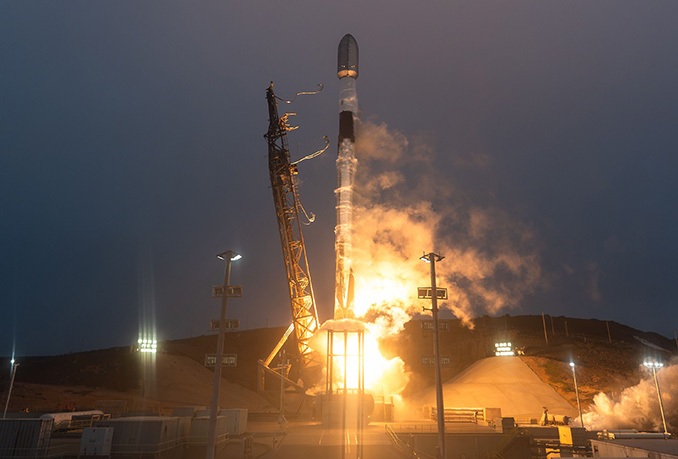
The California night sky lit up once again as SpaceX launched a Falcon 9 rocket from Vandenberg Space Force Base. Packed inside the payload fairing were 27 upgraded Starlink V2 Mini satellites, ready to orbit Earth and boost internet speeds across the globe.
Watching a rocket launch used to feel like a once-in-a-decade event. Today, SpaceX makes it look like taking a bus down the street. Yet every single launch carries technology that reshapes how human beings connect, work, and communicate.
This mission was extra special. It pushed SpaceX deeper into its mission to cover the entire planet with low-cost, high-speed, satellite-based internet. It also showed off the mind-blowing power of reusable rocket technology.
Here is everything that happened during this launch, why these new V2 Mini satellites are a massive big deal, and how this space mission affects your daily internet connection.
What Happened During the Vandenberg Launch?
The launch took place at Space Launch Complex 4 East (SLC-4E) at Vandenberg Space Force Base in California. As the countdown clock hit zero, the Falcon 9 engines roared to life, generating over 1.7 million pounds of thrust.
The $0 Secret To Launching Your Entire Online Empire
Why pay hundreds every month for separate software? Build funnels, send emails, and make sales with Systeme.io completely free.
Get Started For $0Free Forever • No Credit Card Needed • Beginner-Friendly
The rocket rose smoothly into the night sky, curving over the Pacific Ocean as it headed toward low Earth orbit. Within minutes, the rocket reached hypersonic speeds, fighting against the thick layers of Earth’s atmosphere.
After about two and a half minutes of flight, the most critical moment occurred: stage separation. The main first-stage booster shut off its engines and separated from the upper stage. While the second stage continued pushing the 27 satellites into space, the first stage turned around to head back home.
Roughly eight and a half minutes after liftoff, the booster touched down gently on the automated drone ship named “Of Course I Still Love You,” stationed hundreds of miles out in the Pacific Ocean. Meanwhile, the upper stage deployed all 27 Starlink V2 Mini satellites into their planned orbit about an hour later.
The Magic of Rocket Reusability and Booster B1093
To truly understand why SpaceX dominates the space industry, you have to look at the rocket booster that flew this mission. Known as B1093, this single first-stage booster was flying its 17th mission.
Think about that for a second. In the old days of space travel, rockets were single-use items. Engineers built a multi-million-dollar rocket, fired it into space once, and let it fall into the ocean to rust away forever. That would be like buying a brand-new commercial airplane, flying from New York to London, and then throwing the airplane into the trash.
SpaceX changed that whole dynamic by teaching rockets how to land vertically on floating ocean platforms.
Landing a rocket booster on a ocean platform is like trying to land a pencil on its eraser in the middle of a storm. Yet SpaceX turns this wild engineering trick into a daily routine.
By reusing B1093 seventeen times, SpaceX saved tens of millions of dollars. Those savings mean SpaceX can launch satellites far cheaper than any competitor on Earth. Lower launch costs mean cheaper internet prices for everyday users.
What Are Starlink V2 Mini Satellites and Why Do They Matter?
When people hear the word “Mini,” they usually think of something small, weak, or limited. In the world of space engineering, the name V2 Mini is actually a bit misleading.
These satellites are called “Mini” only because they are smaller than the massive next-generation Starlink V2 satellites built for SpaceX’s giant Starship rocket. Compared to the original first-generation Starlink satellites, the V2 Mini is an absolute beast.
Each V2 Mini satellite is heavier, larger, and significantly more powerful than older models. They carry advanced technology designed to solve the biggest problems facing satellite internet today: bandwidth limits and signal interference.
Here is a simple look at what makes the V2 Mini satellite so special:
First, they use argon electric thrusters for propulsion. Most satellites use expensive krypton gas to move around in space. SpaceX switched to argon gas, which is much cheaper and easier to harvest from Earth’s atmosphere. These thrusters allow the satellites to position themselves in orbit and dodge space debris automatically.
Second, they carry powerful new antennas called Doppio Dualband systems. These antennas allow each satellite to talk to ground stations and user dishes with incredible efficiency.
Third, they are mass-optimized. SpaceX redesigned the internal layout of these satellites so engineers could pack up to 27 or 29 units inside a single Falcon 9 nosecone. That means every single launch brings more raw internet power into space than ever before.
Send, Spend & Hold Money Worldwide Without Hidden Fees
Transfer money internationally at the real exchange rate and hold 40+ currencies in one account.
Open a Wise AccountMid-market rate • Fast transfers • 40+ currencies
Faster Speeds and Higher Data Capacity
The main goal of the V2 Mini satellites is to offer four times more bandwidth than older Starlink models.
In basic terms, bandwidth is like a highway. If a highway only has two lanes, traffic slows down when thousands of cars try to drive on it at the same time. The original Starlink satellites were great, but as millions of new subscribers signed up worldwide, the digital highway started getting crowded.
The V2 Mini satellites effectively turn that two-lane road into an eight-lane superhighway. They allow more people in the same town or region to stream high-definition videos, make video calls, and play online games without experiencing annoying lag or speed drops.
Better Beam Steering and Stronger Signal
Satellite internet works by bouncing signals back and forth between a dish on your roof and a satellite floating hundreds of miles in space. If the signal gets blocked or interrupted, your internet drops.
V2 Mini satellites use advanced beam-forming tech. This means the satellite can direct precise beams of internet data straight to individual locations on Earth. Even if you live deep in a valley, surrounded by tall trees, or out on an island in the middle of the ocean, the signal stays locked in.
How Starlink Is Changing Global Connectivity
For decades, people living in rural or remote areas had terrible internet choices. Traditional satellite internet was slow, expensive, and suffered from high latency. Cable and fiber internet companies refused to run expensive wires out to small towns or countryside farms because it was not profitable.
Starlink completely flipped that script. By placing thousands of small satellites in low Earth orbit—just a few hundred miles above Earth rather than thousands of miles away—signals travel back and forth in milliseconds.
Today, Starlink powers remote communities, emergency rescue teams, ocean ships, commercial aircraft, and off-grid homes. Farmers use it to run automated tractors in remote fields. Teachers in remote mountain villages use it to stream educational videos to students.
For digital creators, remote workers, and online entrepreneurs, reliable internet is no longer a luxury—it is an absolute necessity. Whether you are running a remote business, learning new skills, or exploring online ventures like YouTube automation, having access to fast, stable internet opens up income opportunities that simply did not exist a decade ago.
The Growing Starlink Megaconstellation in Numbers
SpaceX is not just launching a couple of satellites now and then. They are building a giant artificial web around Earth known as a megaconstellation.
The $0 Secret To Launching Your Entire Online Empire
Why pay hundreds every month for separate software? Build funnels, send emails, and make sales with Systeme.io completely free.
Get Started For $0Free Forever • No Credit Card Needed • Beginner-Friendly
To give you an idea of how fast this network is growing, consider these amazing numbers:
There are currently over 11,000 active Starlink spacecraft floating in low Earth orbit.
SpaceX launches a Falcon 9 rocket almost every few days. A massive percentage of these missions are dedicated entirely to expanding and upgrading the Starlink network.
Each satellite has an expected lifespan of about five years. When a satellite reaches the end of its life, it uses its argon thrusters to push itself down into Earth’s atmosphere, where it burns up completely without leaving dangerous space junk behind.
This rapid launch cadence allows SpaceX to swap out old, slow tech with brand-new V2 Mini tech on a continuous loop.
What This Means for the Future of Tech and AI
The launch of more V2 Mini satellites isn’t just great news for streaming movies; it is essential for the future of world technology.
We are living in an era dominated by artificial intelligence, smart devices, and real-time data processing. If you want to follow how these technologies are changing our daily life, you can read more in our dedicated technology and AI section.
As artificial intelligence grows, thousands of smart devices will need constant, instant connection to cloud servers. Self-driving cars, environmental monitoring sensors, remote medical equipment, and smart farm equipment all generate gigabytes of data every single minute.
Without a global internet grid that works everywhere, these smart tools cannot operate in remote areas. SpaceX is laying down the invisible digital track that the next generation of AI and technology will run on.
Frequently Asked Questions (FAQs)
What is a Starlink V2 Mini satellite?
A Starlink V2 Mini is an advanced, second-generation satellite designed by SpaceX. It is larger, heavier, and four times more powerful than original Starlink satellites, offering faster internet speeds and lower latency.
Why are they called Mini if they are bigger than old Starlink satellites?
They are called Mini because they are smaller than the full-sized Starlink V2 satellites designed for SpaceX’s massive Starship rocket. Compared to original first-generation satellites, however, the V2 Mini is significantly larger and heavier.
Where did this Falcon 9 rocket launch from?
The rocket launched from Space Launch Complex 4 East (SLC-4E) located at Vandenberg Space Force Base along the central coast of California.
What happened to the rocket booster after launch?
The first-stage booster, serial number B1093, successfully flew back to Earth and landed vertically on the ocean drone ship “Of Course I Still Love You” in the Pacific Ocean.
How does Starlink compare to traditional cable internet?
Starlink provides speeds that rival traditional cable internet in many areas, usually ranging between 50 Mbps and 250 Mbps with low latency. It is designed primarily for areas where cable or fiber internet is unavailable or unreliable.
Is space debris a problem with so many Starlink satellites orbiting Earth?
SpaceX designs its satellites to operate in low Earth orbit. At the end of their operational lifetime, or if a failure occurs, the satellites use thrusters to drop into the upper atmosphere, burning up completely to prevent space clutter.
Final Thoughts on SpaceX’s Latest Achievement
This latest Vandenberg launch is another clear proof that space exploration and satellite internet are moving forward at light speed. By deploying 27 Starlink V2 Mini satellites on a booster that has already flown 17 times, SpaceX showed the world once again how cheap, fast, and reliable space access can be.
As more of these high-powered satellites reach orbit, people around the globe will enjoy faster speeds, lower lag, and better connections, no matter where they live.
If you enjoyed reading this story and want to know more about our publication, head over to our about page. If you have thoughts, tips, or questions about space tech, feel free to drop us a note through our contact page.
Make sure to join our growing community online! Follow along on Instagram, check us out on Facebook, and follow the real-time conversation on Twitter / X.
