
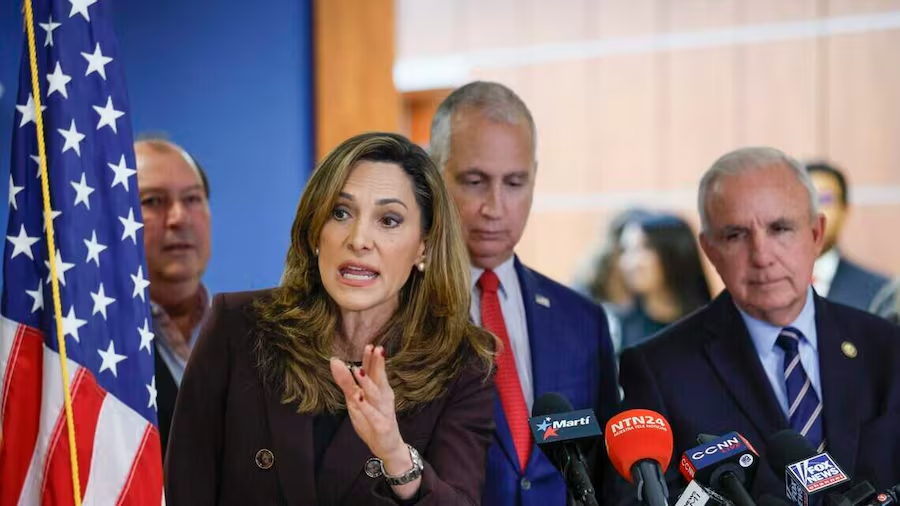
A major political storm just broke out inside the Republican Party. Representative María Elvira Salazar, a high-profile Republican congresswoman from South Florida, released a campaign ad that directly challenges Donald Trump on his immigration policies. In a 30-second video that immediately went viral, she looked straight into the camera and delivered a message that left political commentators in shock. She told the president point-blank that his recent enforcement actions have gone too far.
This is not a message coming from across the political aisle. Salazar is a member of Trump’s own party, representing a heavily Hispanic district in Miami-Dade County. Her decision to publicly call out the White House has turned heads across Washington, sparking an intense back-and-forth between her campaign, top administration officials, and Trump himself.
For months, chatter around immigration reform has been growing quietly behind closed doors. Now, with midterm elections right around the corner, those private worries have burst open into a full public feud. The clash highlights a deep divide over how the administration is handling border security and enforcement against long-time immigrant residents who have lived in the United States for decades without criminal records.
The Campaign Ad That Shocked Washington
The controversial video ad started broadcasting across Florida media markets and online platforms, catching viewers completely off guard. Rather than attacking her Democratic rival, Salazar chose to speak directly to Donald Trump. In the video, she warned the president that his current border enforcement team is giving him bad advice and pushing policies that harm innocent families.
Salazar pointed directly to federal statistics from the Department of Homeland Security to back up her claim. She revealed that in July alone, half of the 50,000 people detained by Immigration and Customs Enforcement (ICE) had no criminal record at all. These were individuals picked up purely for civil immigration violations, meaning they had not committed crimes in the country.
The $0 Secret To Launching Your Entire Online Empire
Why pay hundreds every month for separate software? Build funnels, send emails, and make sales with Systeme.io completely free.
Get Started For $0Free Forever • No Credit Card Needed • Beginner-Friendly
She told Trump that the same Hispanic communities that helped him win key battleground states in 2024 are feeling deeply betrayed today. She urged him to reconsider his strategy before it damages his relationship with Latino voters beyond repair. In one of the most talked-about moments of the ad, she called on Trump to be for immigration what Abraham Lincoln was for ending slavery and what Ronald Reagan was for defeating communism.
She made sure to clarify that she is not asking for blanket amnesty. Instead, she argued for creating a structured pathway for law-abiding immigrants to earn legal status, live with dignity, pay taxes, and stay out of the shadows. Her point was simple: federal agents should focus their energy on dangerous criminals rather than rounding up everyday workers who contribute to local communities.
Trump and Administration Officials Fire Back
It did not take long for the White House to react. Donald Trump responded directly from the Oval Office, making it clear that he disagreed with Salazar’s assessment. He defended his administration’s record, insisting that his aggressive border policies were the main reason he won back the presidency and the reason Salazar won her own seat.
Trump characterized Salazar as getting soft on border security, contrasting her stance with his own commitment to mass deportations. He claimed that voters supported him specifically because of his tough stance on the border, and he maintained that his administration’s actions are completely necessary to keep the nation safe.
Other top officials jumped into the debate as well. Homeland Security Secretary Markwayne Mullin publicly rejected Salazar’s argument during a television interview. Mullin argued that anyone who enters or stays in the country without proper legal authorization is breaking the law, regardless of whether they have a violent criminal record or not. From the administration’s view, breaking immigration law is itself a crime that warrants detention and deportation.
Salazar did not back down after the initial pushback. Appearing on national news broadcasts over the weekend, she doubled down on her warning. She specifically called out top White House advisers, including border official Tom Homan and deputy chief of staff Stephen Miller, arguing that they are failing to show the president the complete picture. She reminded the public that Trump is the only elected official in the executive branch, meaning the final choice resting on his shoulders is how he chooses to treat millions of families.
Why District 27 is the Ultimate Political Battleground
To understand why María Elvira Salazar is taking such a massive political risk, you have to look at the community she represents. Florida’s 27th Congressional District covers a large portion of Miami-Dade County. Nearly 74 percent of the residents in this district are Hispanic, and more than half of the total population was born outside the United States.
In this part of South Florida, national immigration policy is not just an abstract debate on news broadcasts. It is a daily reality that affects families, local businesses, schools, and neighborhoods. Many residents are political exiles who fled authoritarian governments in places like Cuba, Venezuela, and Nicaragua. They came seeking safety, work, and freedom.
Tension in the district boiled over recently following the detention of Luis Galeano, a well-known Nicaraguan journalist living in exile in Miami. Galeano, who fled persecution after reporting on dictator Daniel Ortega’s regime, had a pending asylum application when federal agents taken him into custody. Salazar spoke out strongly against his detention, declaring that the United States must always know the difference between a real criminal and a political exile seeking freedom.
Cases like this have made local residents deeply uneasy. While many Hispanic voters in Miami supported conservative economic policies and backed Trump in 2024, the reality of aggressive enforcement sweeps hitting non-violent neighbors has altered the political mood. Salazar recognizes that if she wants to represent her community effectively, she cannot stay silent while her constituents feel threatened.
The Dignity Act vs. Mass Deportations
At the center of Salazar’s argument is a legislative proposal she has championed in Congress known as the Dignity Act. This bipartisan bill attempts to find a practical middle ground in America’s long-standing immigration debate, balancing strict border security with realistic solutions for undocumented people already living in the country.
The Dignity Act offers a distinct approach compared to both full amnesty and mass deportation. Here are the core pillars of what the proposal aims to do:
- Enhanced Border Protection: The bill allocates significant federal funds to secure border crossings, hire additional personnel, and implement modern screening technology to stop illegal entry and drug smuggling.
- Dignity Legal Status: Undocumented immigrants who have lived in the United States for a long time, pass background checks, pay taxes, and have clean criminal records can apply for a temporary legal status. This allows them to work legally without fear of immediate deportation.
- Restitution and Community Contribution: Participants in the program must pay a regular fee or tax penalty into an infrastructure fund. This ensures that immigrants contribute directly to national revenue while earning their legal standing.
- No Fast-Track Amnesty: The plan does not offer free citizenship or put undocumented immigrants ahead of legal applicants. It provides a long-term, conditional legal status that lets people work and live peacefully without jumping the line over those following standard legal channels.
Salazar argues that mass deportation plans are logistically impossible, economically damaging, and morally wrong when applied to people who have lived peacefully in the country for decades. By pushing the Dignity Act, she hopes to convince her party that offering a structured, dignified solution is better for the economy and better for national unity.
The Pressure of the Upcoming Midterm Elections
Timing is everything in politics, and Salazar’s public break with Trump comes at a critical moment. The midterm elections are right around the corner, and control of both the House of Representatives and the Senate is hanging in the balance.
In Florida’s 27th District, Salazar is facing a tough reelection challenge from Democratic candidate Eliott Rodriguez, a former television news anchor who is well known across the region. Recent internal polling shows the two candidates locked in a tight race. Rodriguez has campaigned heavily on affordability issues, healthcare, and comprehensive immigration reform, accusing Salazar of playing political games with her new ad.
Send, Spend & Hold Money Worldwide Without Hidden Fees
Transfer money internationally at the real exchange rate and hold 40+ currencies in one account.
Open a Wise AccountMid-market rate • Fast transfers • 40+ currencies
Rodriguez claimed that Salazar’s video is merely a political trick to save her seat in a competitive district. He pointed out that despite her recent statements, she has voted alongside party lines on major legislative bills. Salazar’s campaign, however, insists that her stance is genuine and reflects years of work on the Dignity Act.
Beyond Florida, political strategists are watching this feud very closely. Republicans hold a slim majority in the House, and losing moderate or majority-Hispanic districts could hand control back to the Democrats. Salazar is not the only lawmaker worried about how hardline policies might alienate swing voters. If her ad resonates with voters in South Florida, other moderate Republicans in competitive districts might follow her lead and put distance between themselves and the administration’s most aggressive policies.
How Digital Media and News Platforms Are Changing Political Debates
Political campaigns today move faster than ever before. In the past, a congresswoman criticizing a sitting president from her own party might have taken weeks to build momentum through print newspapers or traditional TV interviews. Now, a single 30-second campaign video posted online can generate millions of views and spark a national discussion in hours.
Social media platforms like X, Facebook, and Instagram allow voters to view clips directly, share their opinions, and engage in real-time debates. Candidates no longer rely solely on press conferences to get their point across. They use short, punchy digital content designed to capture short attention spans and spread rapidly through online networks.
This shift in how news is created and consumed is transforming content creation, media reporting, and even online publishing industries. Creators looking to build an audience around breaking news and viral commentary often rely on modern digital strategies to reach viewers fast. Many independent creators learn these modern distribution tactics through specialized training in YouTube automation, using smart algorithms and fast editing tools to cover major breaking stories the moment they happen.
At the same time, the rapid rise of artificial intelligence has made tracking news trends and analyzing political sentiment far more efficient. Digital news outlets and political analysts frequently leverage modern tools highlighted in technology and AI to monitor social media reactions, evaluate polling data, and forecast election outcomes in real time.
For readers who want to stay informed on how fast-moving news stories develop, checking trusted publishing outlets and understanding their editorial mission is key. You can read more on our About Us page to learn about how our editorial team brings you clear, accessible updates on global events. If you ever have feedback or news tips to share, feel free to reach out via our Contact Us page.
You can also join our growing online community across our official social channels. Follow us on Instagram, stay connected on Facebook, and join the ongoing conversation on X (formerly Twitter).
Frequently Asked Questions (FAQs)
Why did Maria Elvira Salazar criticize Donald Trump’s immigration policy?
Representative María Elvira Salazar released a campaign ad stating that federal immigration enforcement efforts have gone too far. She highlighted official data showing that in July, half of the 50,000 people detained had no criminal records. She warned that aggressive enforcement sweeps targeting non-violent, law-abiding individuals are causing Hispanic voters who supported Trump in 2024 to feel betrayed.
What is the Dignity Act proposed by Representative Salazar?
The Dignity Act is a bipartisan immigration reform bill championed by Salazar in the House of Representatives. It aims to secure federal borders while providing a practical legal status for undocumented immigrants who have lived in the U.S. for years without criminal records. The plan requires participants to pass background checks and pay taxes into an infrastructure fund without giving them fast-track amnesty.
The $0 Secret To Launching Your Entire Online Empire
Why pay hundreds every month for separate software? Build funnels, send emails, and make sales with Systeme.io completely free.
Get Started For $0Free Forever • No Credit Card Needed • Beginner-Friendly
How did Donald Trump respond to Salazar’s campaign video?
President Donald Trump responded directly from the White House, rejecting Salazar’s criticism and calling her “soft on the border.” He stated that his border policies were central to his election success and claimed that Salazar won her district largely because of his support. He maintained that strict border enforcement is necessary for national security.
What do statistics show about recent ICE detentions?
According to Department of Homeland Security data cited by Salazar and confirmed by news reports, July marked a significant shift where more than half of the individuals detained by ICE were held solely for civil immigration violations, meaning they had no pending criminal charges or past criminal convictions in the United States.
Who is challenging Maria Elvira Salazar in the upcoming midterm election?
Salazar is running for reelection in Florida’s 27th Congressional District against Democratic nominee Eliott Rodriguez. Rodriguez is a former longtime local television news anchor in Miami. Polling shows a very competitive race in this majority-Hispanic district.
The ongoing clash between Representative María Elvira Salazar and the White House proves that immigration remains one of the most complex, personal, and politically explosive issues in American politics today. As November approaches, all eyes will be on Miami-Dade County to see whether Hispanic voters reward Salazar for taking a stand or choose a different direction at the ballot box. One thing is certain: how political leaders navigate the balance between border security and compassionate enforcement will shape the political landscape for years to come.
