
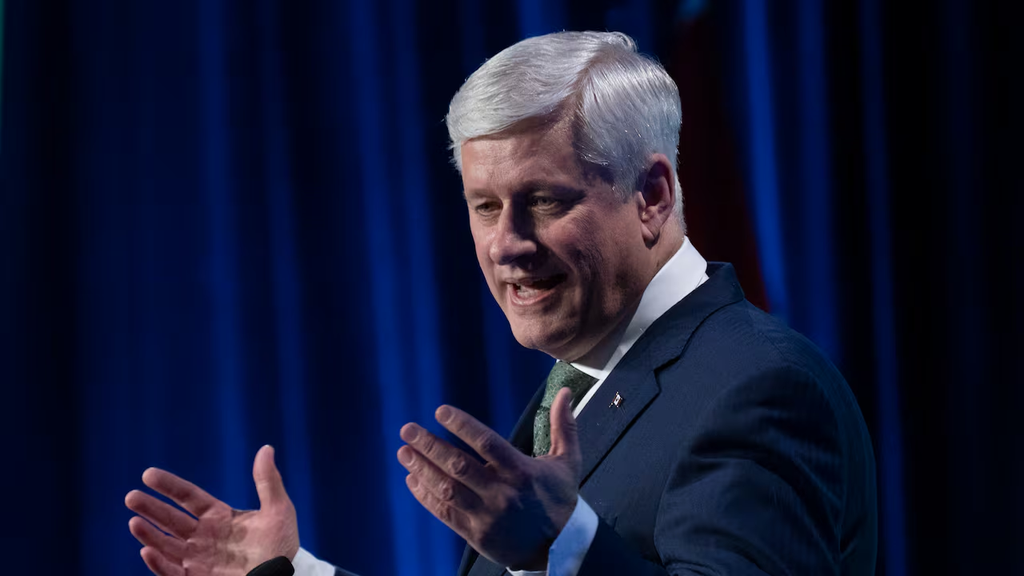
Former Conservative Prime Minister Stephen Harper has delivered a powerful endorsement of Ottawa’s decision to break off high-stakes trade negotiations with the United States. Speaking at the closing session of the national investment summit in Toronto, Harper stated that Canada was left with “no choice” after months of mounting trade violations and aggressive posture from Washington.
The unexpected show of alignment between the former Conservative leader and Prime Minister Mark Carney signals a historic shift in Canadian trade policy. For decades, Canadian economic strategy relied on deep integration with the American market. Today, political figures across party lines are coming together to argue that defending national sovereignty requires reducing economic reliance on the United States.
A Rare Moment of Cross-Party Unity
In Canadian politics, seeing a former Conservative prime minister publicly back a Liberal administration is rare. Yet, as the trade conflict with Washington deepens, conventional party lines are dissolving in favor of a unified national stance.
Harper delivered his closing keynote to hundreds of global investors, executives, and financiers gathered in downtown Toronto. He acknowledged that walking away from talks was a hard decision, but insisted it was the only reasonable path left. The current U.S. administration under President Donald Trump has made it clear that it views deep economic integration as incompatible with Canada maintaining an independent sovereign identity.
When negotiations broke down in August, Ottawa called its negotiating team back home. That decision sparked immediate economic fallout, including new 50 percent U.S. tariffs on Canadian goods and swift counter-tariffs from Ottawa. Despite the heavy costs, recent polling reveals that Canadians strongly stand behind PM Mark Carney’s decision to reject the U.S. trade deal.
Build Funnels, Email Lists & Sell Online With One Free Tool
Create funnels, send emails, and sell online using Systeme.io without paying for multiple tools.
Create Free AccountFree forever • No credit card • Beginner-friendly
Harper framed the government’s stance not as an act of hostility, but as a necessary defense of national independence. He stressed that leadership requires taking accountability for what a country can control rather than placing blame solely on external pressure.
Why Stephen Harper Believes Ottawa Had to Walk Away
Harper’s speech focused on three main pillars: defending sovereignty, protecting domestic industries, and eliminating self-imposed barriers to growth. Having managed trade relations with Washington during his own tenure as prime minister from 2006 to 2015, his insights carry significant weight among business leaders and foreign investors.
Defending Sovereignty Over Deep Integration
For decades, Canadian economic planners assumed that closer supply chain integration with the U.S. would always benefit both nations. Harper argued that this assumption no longer holds true under Washington’s current policy direction.
He pointed out that when a trade partner repeatedly violates signed agreements and uses punitive tariffs to force concessions, remaining at the bargaining table yields diminishing returns. Harper called the rift between the two neighbors “sad,” but maintained that accepting unfair terms would compromise Canada’s ability to govern itself independently.
His stance reflects a growing realization that economic security and political sovereignty are inseparable. If another nation can disrupt entire supply chains at will, reliance turns into vulnerability.
Stopping the Hollowing Out of Canadian Industry
Another major concern highlighted by Harper was the risk of losing Canada’s industrial base. Accepting one-sided U.S. demands would allow American policy to hollow out Canadian manufacturing, energy production, and resource processing.
When Washington imposed aggressive trade restrictions, Ottawa responded by levying its own duties. Earlier in the dispute, Canada introduced 15 to 50 percent tariffs on U.S. goods to level the playing field. Later targeted measures included targeted 50 percent tariffs on U.S. copper wire and wood charcoal.
Harper noted that failing to defend domestic producers would leave Canadian factories at the mercy of foreign policy shifts. Protecting local factories, steel mills, and energy sectors ensures that Canada retains the physical capacity to produce essential goods internally.
The Breakdown of Negotiations and the 50% Tariff Spike
The trade relationship did not deteriorate overnight. Conflict escalated after months of tense exchanges, during which Washington labeled Canada a trade abuser and signaled a desire to reduce imports across multiple sectors.
Tensions reached a boiling point when President Trump publicly criticized Canadian policy, leading to headlines where Trump labeled Canada as a top economic abuser. As talks stalled, Washington expanded its trade restrictions to cover major consumer and industrial goods, prompting a dramatic reaction in North American markets.
The immediate consequences of the talk collapse included:
- Massive U.S. Tariffs: A blanket 50 percent tariff was applied to major categories of Canadian exports entering the American market.
- Canadian Countermeasures: Ottawa responded by placing retaliatory surcharges on key American imports, while provincial governments took direct action.
- Restricted Product Categories: Supply chains faced immediate disruption after Trump banned Canadian dairy, alcohol, and motorcycles from entering select markets.
- Procurement Shifts: Provincial leaders, including New Brunswick Premier Susan Holt, ordered public sector organizations to stop buying American products whenever Canadian alternatives were available.
These rapid developments forced Canadian leaders to rethink their long-term economic strategy. Rather than waiting for trade talks to resume, the federal government launched an ambitious campaign to build internal economic strength.
The $1 Trillion Investment Vision and Economic Diversification
The Toronto summit where Harper spoke was organized around a major initiative: attracting $1 trillion in new private and public investment over the next five years. Prime Minister Mark Carney pitched Canada as a stable, rule-based “safe harbor” for global capital at a time of rising global uncertainty.
The government presented more than 160 major capital projects to over 100 prominent international investors. Details surrounding attendees and project scopes were detailed during the event, as outlined in reports on the Canada Investment Summit 2026 participants and projects.
Building Internal Competitiveness
Harper emphasized that diversifying trade outward requires fixing regulatory slowdowns inward. He urged federal and provincial leaders to streamline project approval processes and eliminate internal trade barriers between provinces.
His recommendations included:
- Fast-Tracking Approvals: Cutting down bureaucratic delays for critical infrastructure, energy projects, and resource extraction.
- Removing Interprovincial Barriers: Making it easier for goods, services, and certified workers to move freely across provincial borders without extra paperwork.
- Providing Investor Certainty: Establishing clear, stable rules so global capital can invest in long-term projects without fear of sudden policy shifts.
- Supporting High-Tech Growth: Investing in modern industries like clean energy, advanced manufacturing, and artificial intelligence. For broader updates on modern tech developments, readers can explore our dedicated Technology and AI category.
By making the domestic economy more agile, Canada aims to reduce costs for local businesses while creating attractive opportunities for global investors.
Pivoting Away From Washington to Global Partners
Relying less on the United States means building stronger connections with other global economies. Prime Minister Carney has taken active steps to expand trade relations across Europe and Asia.
A central element of this strategy involved outreach to the European Union. Carney traveled overseas to seek deeper commercial ties, a move covered in detail when Mark Carney headed to Brussels to expand European trade links.
Canada is actively exploring formal associate status with European trade blocs and securing long-term supply contracts for critical minerals, clean energy, and agricultural goods. To read more about how this pivot is taking shape, see our coverage on Canada’s strategic shift toward European markets.
At the same time, Canadian businesses are exploring global content creation and digital trade opportunities to reach new audiences worldwide. Those interested in building automated digital channels can browse our curated YouTube Automation guides to learn more about expanding digital operations globally.
How Everyday Canadians and Businesses Are Adjusting
The trade conflict is not just an abstract debate among politicians and executives; it directly impacts daily life across the country. From supermarket shelves to factory floors, Canadians are making intentional changes in response to the economic tension.
Consumers across the country are participating in what analysts call the “Great Northern Shift.” Everyday shoppers are choosing locally made goods over imported American products. This widespread consumer response is explored in our feature on why Canadians are leaving U.S. products on store shelves.
The economic adjustment carries real financial consequences:
- Higher Consumer Costs: Import tariffs on U.S. goods have increased prices for certain grocery items, household goods, and vehicles.
- Supply Chain Re-routing: Retailers are sourcing products from domestic producers or importing from European and Asian suppliers.
- Government Relief Measures: To help households handle rising living costs, Ottawa introduced financial cushions. Learn more about these initiatives in our breakdown of government support packages for Canadians amid trade tensions.
- Understanding Overall Costs: Households seeking a detailed breakdown of how tariffs affect daily budgets can review our analysis on what the U.S.-Canada trade war really costs consumers.
Despite these financial pressures, Canadian economic indicators have shown surprising resilience. Recent reports highlight that Canada’s GDP surged with 3.3 percent growth, demonstrating strong underlying momentum despite trade headwinds.
Political Fallout and the Long Road Ahead
The decision to walk away from U.S. trade talks has reshaped political discourse across North America. In Canada, political leaders have maintained a firm stance against external pressure. Conservative Leader Pierre Poilievre echoed national sentiment when he declared to foreign journalists that Canada would never yield its independence, as outlined in our report on Pierre Poilievre’s firm statement on Canadian sovereignty.
Meanwhile, both nations are preparing for a prolonged trade confrontation. Economic analysts project that friction could extend well into upcoming electoral cycles, a topic explored in our analysis of how Canada is preparing for a multi-year trade war.
Build Funnels, Email Lists & Sell Online With One Free Tool
Create funnels, send emails, and sell online using Systeme.io without paying for multiple tools.
Create Free AccountFree forever • No credit card • Beginner-friendly
To counter ongoing tariff pressures, Ottawa relies heavily on its new domestic economic blueprint. You can read more about these policies in our overview of Canada’s Build Here strategy to tackle U.S. tariffs.
While the path ahead will present challenges, the message from Toronto was clear. By combining cross-party unity, regulatory reform, and aggressive international diversification, Canada is setting out to establish a more self-reliant and sovereign economic future.
Frequently Asked Questions (FAQs)
Why did Stephen Harper support walking away from trade talks?
Stephen Harper stated that ongoing U.S. violations of trade agreements and an aggressive diplomatic posture left Ottawa with no alternative. He emphasized that accepting unfair terms would endanger Canadian sovereignty and hollow out domestic manufacturing and energy capacity.
What caused the trade talks between Canada and the U.S. to break down?
Talks collapsed after repeated deadlocks over trade terms, culminating in Washington imposing 50 percent tariffs on major Canadian exports. In response, Prime Minister Mark Carney suspended negotiations, recalled Canadian diplomats, and introduced retaliatory duties on U.S. products.
How is Canada planning to replace trade with the United States?
Canada is actively expanding commercial ties with alternative international partners, particularly in Europe and Asia. Ottawa is also focused on attracting $1 trillion in private and public capital through the Canada Investment Summit to fund major domestic infrastructure, energy, and technology projects.
How does the trade dispute affect everyday consumers?
Tariffs on both sides of the border have raised prices on select imported goods, including food items, raw materials, and manufactured goods. However, many Canadian shoppers are intentionally opting for locally produced alternatives, while the federal government has introduced support measures to ease cost-of-living pressures.
Will Canada resume trade negotiations with the U.S. anytime soon?
Both Canadian officials and political analysts expect the trade standoff to continue for the foreseeable future. Federal leaders across political parties have indicated that talks will only resume if Washington offers fair terms that respect Canadian sovereignty and trade agreements.
The ongoing trade dispute marks a defining moment in modern North American economic relations. By choosing to walk away from unfair negotiations, Canadian leaders across the political spectrum are signaling that national independence and long-term economic self-reliance take priority over short-term compromises. As Canada continues to diversify its global partnerships and strengthen internal industry, the nation is laying the groundwork for a more resilient future.
To learn more about our publication and editorial mission, visit our About Us page or get in touch directly through our Contact page. You can also stay updated with our latest news coverage and analysis by following us on Instagram, connecting with our community on Facebook, and joining the conversation on X (formerly Twitter).
