
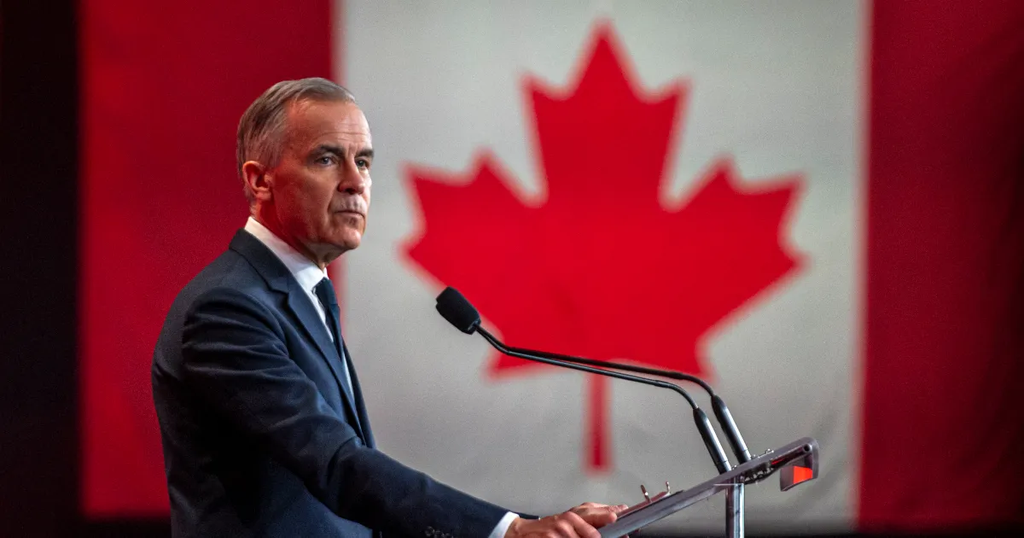
Canadian Prime Minister Mark Carney announced that his government will do whatever it takes to backstop workers, businesses, and entire regions targeted by heavy U.S. tariffs. In a direct video address broadcast across Canada, Carney made it clear that Ottawa is stepping up to protect the national economy as cross-border trade relations hit a critical breaking point.
The announcement came right as Canada’s retaliatory tariffs on roughly $20 billion worth of American products officially kicked into gear. These Canadian counter-measures range between 15% and 50% on selected U.S. imports, directly responding to the 50% tariffs slapped on Canadian goods by Washington.
Trade negotiations between Ottawa and Washington collapsed unexpectedly after months of intense discussions. Both sides were originally close to an agreement, but the talks broke down when the U.S. administration demanded last-minute concessions that Canadian officials argued would cripple domestic industries.
Carney stated plainly that standing firm was the only responsible option. Accepting a bad deal would have permanently weakened vital Canadian sectors like steel, automotive manufacturing, and forestry. As the economic fallout begins to ripple through supply chains on both sides of the border, the Canadian government is preparing a massive financial safety net to keep workers and businesses afloat.
How Canada and the U.S. Ended Up in a Trade Battle
For over four decades, Canada and the United States enjoyed one of the closest and most integrated economic partnerships on earth. Goods, raw materials, parts, and services moved back and forth across the border with minimal friction. However, that long period of predictable trade has now hit a hard stop.
Build Funnels, Email Lists & Sell Online With One Free Tool
Create funnels, send emails, and sell online using Systeme.io without paying for multiple tools.
Create Free AccountFree forever • No credit card • Beginner-friendly
The current breakdown started when the U.S. administration announced widespread duties on Canadian exports, citing trade imbalances and demanding structural changes to existing agreements. Canadian negotiators spent weeks trying to broker a compromise that would shield key industries while keeping cross-border commerce moving smoothly.
By mid-August, insider reports suggested that both nations were on the verge of signing a landmark deal that would offer significant tariff relief. But as final terms were being drafted, Washington insisted on provisions that would force Canada to accept long-term restrictions on its core industrial sectors.
Carney explained that the American proposal was simply untenable. Signing the deal would have meant accepting the slow decline of Canadian manufacturing. Walking away was a tough choice, but Canadian leaders concluded that short-term economic turbulence is far better than permanent industrial damage.
The immediate result is a tit-for-tat tariff war. The U.S. imposed 50% duties on items ranging from raw materials to consumer products like hockey sticks, wine, and cement. Canada responded swiftly with targeted duties on $20 billion worth of U.S. exports, carefully choosing goods that send a strong signal without unnecessarily hurting Canadian consumers.
What “Doing Whatever It Takes” Means for Canadian Workers and Businesses
When a prime minister promises to backstop an economy, people naturally want to know what that means for their jobs, paychecks, and local communities. Carney made it clear that Ottawa is not going to stand by while workers take the brunt of foreign trade penalties.
The government is designing a multi-layered support system intended to bridge affected groups through this period of conflict. The plan focuses on direct aid, operational flexibility, and targeted funding for regions that depend heavily on exports to the American market.
Key Areas targeted for Direct Support
- Automotive and Manufacturing: Auto parts often cross the U.S.-Canada border multiple times before a vehicle is fully assembled. Ottawa is preparing liquidity support and tax deferrals to help auto suppliers maintain payrolls and keep production lines running despite added tariff costs.
- Forestry and Lumber: Canadian timber communities have faced trade friction before, but the current tariffs pose a immediate threat. Emergency regional grants are being rolled out to protect jobs in forest-dependent towns across British Columbia, Quebec, and Ontario.
- Steel and Aluminum Producers: Metal producers are facing high duties that make their products less competitive in U.S. markets. Ottawa plans to absorb part of the temporary cost burden while helping these manufacturers pivot toward domestic construction projects and new foreign buyers.
- Agriculture and Food Processing: Farmers and food processors hit by counter-tariffs will receive direct income stabilization support to ensure crop values and farm operations remain steady throughout the harvest seasons.
Beyond immediate cash injections, the government is looking at wage subsidies designed to prevent mass layoffs. By helping companies keep their staff employed during slow periods, Canada aims to preserve its skilled workforce so that factories can bounce back quickly once new supply chains are established.
The End of an Era: Uncoupling from U.S. Trade Dependence
One of the most striking parts of Carney’s address was his open acknowledgment that Canada’s economic relationship with the United States has permanently shifted. For decades, Canadian businesses relied on easy access to the massive market right next door. While that proximity created tremendous wealth, it also made Canada unusually vulnerable to changes in U.S. political and trade policy.
Carney noted that trade with the U.S. historically accounted for roughly 20% of Canada’s gross domestic product. That intense concentration means any trade wall built in Washington creates immediate shockwaves north of the border.
The prime minister declared that the phase of easy, deep integration is now over. Moving forward, Canada is executing a broad pivot to rewire how and where it sells its goods, services, and resources to the world.
Building New Global Trade Corridors
Canada is not starting from scratch when it comes to international trade. The country already has 16 active free trade agreements giving it access to 51 countries and over 1.5 billion global consumers. The goal now is to rapidly expand these relationships and double market access over the coming years.
Ottawa is accelerating negotiations with major economic blocs and fast-growing nations across Asia, Europe, and Latin America. Active efforts are underway to finalize or expand comprehensive trade deals with key partners:
- The ASEAN Region: Expanding commercial ties with Southeast Asian economies like Thailand and the Philippines to export Canadian agricultural goods, clean energy technology, and raw materials.
- The Mercosur Bloc: Partnering with South American nations, including Brazil and Argentina, to create new bilateral investment and manufacturing pathways.
- India and Broader Asian Markets: Tapping into massive consumer markets that require energy, fertilizer, and high-tech equipment.
- European Union Partnerships: Utilizing existing agreements to ship more Canadian timber, aerospace components, and minerals directly to European buyers.
Recent data shows that global investors are paying close attention to this strategic shift. Foreign direct investment into Canada recently hit a two-decade high. Investors see Canada as a stable, resource-rich nation with top-tier talent and reliable governance. Major aerospace wins, such as massive international orders for Canadian-designed aircraft, prove that Canadian high-value manufacturing can compete globally without relying solely on U.S. buyers.
Tearing Down Internal Trade Barriers
For years, doing business between Canadian provinces was sometimes more complicated than exporting across the international border. Regulatory differences, varying trade rules, and provincial licensing kept goods and services from flowing freely within the country.
The trade war with Washington has pushed Canadian leaders to fix these internal roadblocks. Provincial premiers from across the country met recently in Prince Edward Island to streamline rules and fast-track major infrastructure projects. Nine out of ten provinces have already agreed to unified environmental and project review standards, making it far easier to build pipeline projects, power grids, and transit networks.
Removing these self-imposed barriers keeps capital moving inside Canada and makes Canadian companies far more resilient against external economic pressure.
How This Trade Conflict Hits Everyday Households
Trade disputes sound like high-level political battles fought in boardrooms and government offices, but their real impact is felt at the grocery store, the gas pump, and the local car dealership.
When tariffs kick in, the cost of moving goods increases. Importers pass those expenses down the chain, which means consumers usually end up paying higher prices for everyday items.
What Consumers Can Expect to See
- Higher Prices on Imported Goods: U.S.-made products covered under Canadian retaliatory tariffs, including certain packaged foods, household goods, tools, and consumer products, could see price increases at retail counters.
- Supply Chain Adjustments: Grocery stores and major retailers are shifting their purchasing toward local Canadian suppliers or importing goods from European and Asian partners. While this helps build domestic resilience, shifting supply lines takes time and can create temporary inventory shortages.
- Fluctuations in Currency Values: Currencies react quickly to trade news. The Canadian dollar has shown resilience, but ongoing trade uncertainty can make imported goods more expensive over time.
- Job Market Shift: Sectors that rely heavily on exporting directly to the U.S. may slow down hiring, while industries focused on domestic infrastructure, alternative export markets, and clean technology could see increased job growth.
Carney openly admitted that the coming months will bring economic turbulence. There is always a financial cost to taking a stand, but standing still and accepting bad trade conditions would cause far worse damage to working families in the long run.
Canadian Public Reaction and Political Support
Political leaders rarely gain public support during an economic crisis, but recent polling shows that Canadians are largely united behind the government’s firm stance.
According to fresh data released by the Angus Reid Institute, Prime Minister Carney’s approval rating rose to 62% as news of the tariff standoff spread. Even more telling is that three-quarters of Canadians surveyed agreed that walking away from the unfair U.S. trade proposal was the right decision.
Canadians understand that accepting a bad trade agreement sets a dangerous precedent for future negotiations. Across political parties and regional lines, there is a strong sense of national solidarity. Business groups, labor unions, and provincial premiers have generally backed Ottawa’s play, emphasizing that Canadian sovereignty and industrial capability must be defended at all costs.
While political leaders agree on standing strong against tariffs, the debate in Parliament is shifting toward how government aid money will be spent. Opposition parties are calling for strict oversight to ensure that financial backstops reach individual workers and small business owners directly, rather than getting tied up in corporate bureaucracy.
The Role of Modern Digital Business Models in Economic Resilience
As traditional trade routes face heavy political friction, thousands of workers and entrepreneurs are looking for ways to diversify their own income streams. The current economic climate highlights the importance of adaptable, digital-first business models that do not rely on physical supply chains or cross-border freight tariffs.
Modern technology lets people build global businesses right from their living rooms. Whether it is leveraging advanced software tools or building content platforms, digital work offers flexibility that physical manufacturing simply cannot match.
For example, learning how creators use modern digital channels and automated video workflows opens up direct access to global audiences without worrying about border checks or custom duties. Exploring modern content creation strategies like YouTube Automation shows how modern entrepreneurs are building location-independent income streams that operate completely outside traditional export markets.
At the same time, rapid advancements in artificial intelligence are transforming how small businesses operate. AI tools allow lean teams to handle customer support, marketing, product development, and data analysis at a fraction of the traditional cost. Checking out developments in Technology & AI offers clear insights into how modern software tools help businesses stay lean, productive, and profitable during times of economic change.
Build Funnels, Email Lists & Sell Online With One Free Tool
Create funnels, send emails, and sell online using Systeme.io without paying for multiple tools.
Create Free AccountFree forever • No credit card • Beginner-friendly
When physical trade faces hurdles, digital innovation serves as a vital cushion, giving individuals and small teams the ability to generate revenue from customers around the world.
Financial Markets React to the Trade Standoff
Financial markets on both sides of the border experienced immediate movement as retaliatory tariffs went into effect. Investors are carefully weighing the short-term disruption against the Canadian government’s promised stimulus measures.
The Toronto Stock Exchange saw targeted dips in manufacturing, forestry, and transportation shares. For instance, aerospace giant Bombardier saw its stock fall over 4% in early trading following news of expanded trade friction. Meanwhile, raw materials, energy producers, and domestic infrastructure companies held relatively firm as traders anticipated heavy government investment in local projects.
The Canadian dollar showed surprising strength against the U.S. greenback. Foreign exchange traders attribute this stability to solid foreign direct investment coming into Canada, alongside confidence in Ottawa’s fiscal position. Bank of Canada officials noted that while trade uncertainty creates headwinds for economic momentum, Canada’s strong banking system and low national debt levels give policymakers plenty of room to support the economy through targeted spending.
What Comes Next for Canada-U.S. Trade Relations?
No trade war lasts forever, but resolving this dispute will require a significant shift in diplomatic strategy.
In the short term, both nations are adjusting to new economic realities. Canadian businesses are scrambling to secure domestic buyers and apply for federal relief funds, while U.S. importers in agriculture and construction are realizing that tariffs raise costs for American companies just as much as Canadian ones.
In the medium to long term, Canada is laying the groundwork for a more diversified, self-reliant economy. By removing internal trade barriers, securing new international buyers, and investing heavily in domestic manufacturing, Canada is ensuring it will never again be entirely at the mercy of a single trading partner’s political shifts.
Negotiators from Ottawa and Washington remain in contact through diplomatic channels. While formal trade talks are paused, history shows that economic pressure on both sides of the border often brings leaders back to the bargaining table. Until a fair, balanced agreement is offered, Canada has made its position crystal clear: it will defend its workers, support its industries, and chart its own independent path forward.
Frequently Asked Questions (FAQs)
What triggered the latest Canadian retaliatory tariffs against the U.S.?
Canada imposed retaliatory tariffs on roughly $20 billion in U.S. goods after Washington announced 50% tariffs on Canadian exports. Negotiations between the two countries broke down when Canadian officials refused to accept last-minute U.S. demands that would have permanently damaged key domestic manufacturing sectors.
Which Canadian industries are most affected by this trade row?
The sectors most directly impacted include automotive manufacturing, steel, aluminum, forestry, and certain agricultural products. These industries rely heavily on cross-border supply chains and high-volume exports to American buyers.
Why did Prime Minister Mark Carney walk away from trade negotiations?
Carney walked away from the bargaining table because the proposed U.S. agreement was unfair and would have led to the long-term decline of vital Canadian industries like auto production and steel. He stated that taking a temporary stand is far better for Canada than accepting a bad deal that harms workers for decades.
How will this trade dispute affect prices for regular consumers?
Consumers may notice higher prices on certain imported goods, particularly U.S.-made food, consumer products, and construction materials covered under tariff schedules. However, retailers are actively shifting supply lines to domestic producers and international trading partners to minimize overall price hikes.
What long-term economic strategy is Canada using to reduce U.S. dependence?
Canada is focusing on two main strategies: expanding trade agreements with fast-growing markets in Asia, Europe, and Latin America, and eliminating internal trade barriers between Canadian provinces. The goal is to double global market access and make the domestic economy more self-sustaining.
Staying informed about shifting global events, economic trends, and practical strategies helps you make smart decisions in an ever-changing world. To learn more about our mission and the team behind our coverage, check out our About Us page. If you have questions, feedback, or story ideas you want us to cover, feel free to reach out directly through our Contact Us page.
You can also join the conversation and get updates as they happen by following us across social media on Facebook, Instagram, and X (Twitter).
