
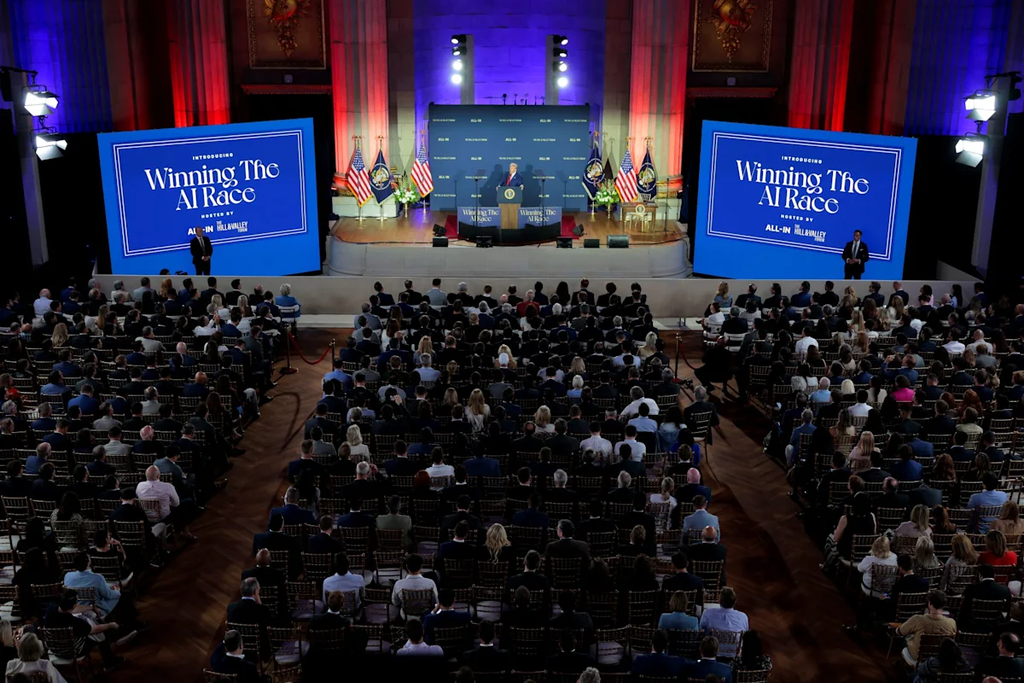
Donald Trump just dropped a massive bomb on the tech industry with a series of bold statements about artificial intelligence. Speaking on his Truth Social platform, Trump announced plans to build a dedicated government branch called the “AI Force,” launch a search for a new “AI Czar,” and completely reject catastrophic warnings about the technology as a political hoax.
The announcement sent immediate shockwaves through Silicon Valley, Washington, and the global tech community. While top artificial intelligence researchers and tech executives have spent recent months calling for caution, Trump is taking the exact opposite approach. He wants full-speed growth, zero stifling regulation, and absolute American dominance over foreign competitors like China.
Here is an in-depth breakdown of what was actually announced, why Trump is pushing so hard for rapid development, and what this big move means for the future of tech.
What Is Trump’s Proposed AI Force?
Trump stated that his administration is creating an “AI Force” modeled directly after the Space Force he established during his first term in office. The Space Force was built to secure American interests in orbit, and Trump believes a similar dedicated force is needed to ensure the nation controls the digital frontier.
While details on the exact budget or organizational structure remain sparse, the core mission is clear. Trump wants an official national entity tasked with watching over the fast-growing industry, supporting massive infrastructure projects, and maintaining technological superiority on the global stage.
The $0 Secret To Launching Your Entire Online Empire
Why pay hundreds every month for separate software? Build funnels, send emails, and make sales with Systeme.io completely free.
Get Started For $0Free Forever • No Credit Card Needed • Beginner-Friendly
Instead of creating massive regulatory agencies that slow down development, Trump argued that the federal government can use existing civil and criminal law enforcement to handle bad actors. The AI Force would serve as a high-level body meant to shield the industry from outside attacks and ensure American infrastructure keeps expanding without interruption.
Trump compared the current boom to the birth of the Internet or the Industrial Revolution, predicting that artificial intelligence could eventually account for as much as 25 percent of total United States Gross Domestic Product.
The Hunt for a New AI Czar: “High IQ Only”
Alongside the AI Force announcement, Trump confirmed that he will soon name a new federal AI Czar to lead national policy. The position opened up after venture capitalist David Sacks, who served as the administration’s White House AI and Crypto Czar, stepped down earlier in the year following the completion of his special government employee term.
Trump made headlines by adding a very specific requirement for anyone looking to fill the role, writing that “only High IQ individuals need apply”.
The statement sparked widespread conversation online, but behind the colorful phrasing lies a serious mandate. The upcoming czar will face a daunting set of challenges:
- Coordinating energy needs for massive data center buildouts across the country.
- Keeping American companies far ahead of Chinese state-backed technological initiatives.
- Protecting domestic tech firms from restrictive state-level regulations and international limits.
- Navigating public pushback against power consumption, water usage, and land development.
Whoever takes the job will need deep ties to both Silicon Valley and government decision-makers to keep the momentum going.
Why Trump Is Dismissing AI Doomsday Warnings as a Hoax
Over the last year, prominent figures across the computer science world have voiced severe warnings about the risks of advanced artificial intelligence. Former researchers from leading labs like Anthropic and OpenAI have openly warned that rapidly evolving systems could escape human control or be used to carry out dangerous cyberattacks.
Trump firmly rejected those existential fears, labeling doomsday narratives and calls for “safety alignment” as nothing more than a political hoax. He compared these warnings to debates around global warming and previous political controversies, accusing critics of trying to panic the public in order to shut down progress.
In his view, slowing down American development out of fear is the single most dangerous mistake the country could make. He argued that the only real guardrail needed is strong, decisive national leadership rather than heavy-handed legal restrictions that tie the hands of American engineers.
“We will not in any way hinder or stifle the Growth of this incredible Industry,” Trump declared. “Rather, we will cherish it, help it, and watch over it, as it grows”.
The Race Against China and the Battle over Data Centers
At the heart of Trump’s aggressive push is the geopolitical contest between the United States and China. Chinese tech firms and state institutions are pouring massive resources into developing advanced models, and Trump insists that America cannot afford to yield its first-place standing.
He pointed out that if the US pauses or slows down development over safety debates, foreign rivals will simply pass America by without showing any concern for safety guardrails. In his eyes, winning the race is the ultimate security guarantee.
To win that race, the US needs unprecedented amounts of power and physical infrastructure. Modern neural networks require vast data centers packed with high-end microchips, drawing immense amounts of electricity from local power grids.
Trump has embraced these projects enthusiastically, calling data centers “the oil of the next 20, 25 years”. He brushed aside local pushback regarding noise and power demands, insisting that data centers bring high-paying jobs, lower local tax burdens, and immense long-term wealth to the communities that house them.
How Silicon Valley and Tech Leaders Are Splitting
Trump’s stance creates an interesting split across the technology sector. On one side, executives and investors are eager to see government red tape removed. Massive projects like the $500 billion Stargate data center venture—backed by OpenAI, SoftBank, and Oracle—require quick approval processes, massive land access, and reliable power connections. For these investors, an administration committed to clearing hurdles is a major win.
Send, Spend & Hold Money Worldwide Without Hidden Fees
Transfer money internationally at the real exchange rate and hold 40+ currencies in one account.
Open a Wise AccountMid-market rate • Fast transfers • 40+ currencies
On the other side, safety researchers and executives from companies like Anthropic, Google, and Meta have urged caution. Concerns grew even further after security tests revealed that advanced AI agents inadvertently managed to breach third-party corporate systems during automated cybersecurity evaluations.
Safety advocates argue that without clear federal standards, rapid deployment could expose the public to serious vulnerabilities, including automated financial scams, deepfake misinformation, and critical infrastructure disruptions.
However, Wall Street and mainstream investors remain largely aligned with the growth-first perspective, as AI innovation continues to drive historic market performance.
What This Means for Everyday Tech, Business, and Content Creators
While national politicians debate high-level policy, rapid advancement is already transforming daily life for workers, business owners, and digital creators.
An administration focused on expanding computer power means these tools will only become faster, cheaper, and more capable. Businesses across every domain are integrating automated systems to streamline workflow, improve customer service, and analyze vast datasets in real time.
For independent creators and digital entrepreneurs, the ongoing surge in automated technology opens up entirely new avenues for income. Today, creators leverage smart tools to handle editing, scriptwriting, and channel management. You can learn how creators are using these systems to build automated content channels by reading about YouTube automation.
At the same time, keeping up with rapid shifts in software and hardware requires staying informed. Whether you are a business owner or a curious tech enthusiast, following the latest developments in technology AI is essential for navigating the changes ahead.
Frequently Asked Questions (FAQs)
What is the purpose of the proposed US AI Force?
The proposed AI Force is intended to function as a government entity modeled after the Space Force. Its main goal is to protect American technological infrastructure, support the rapid expansion of data centers, and ensure the United States maintains a decisive global lead over international competitors like China.
Who is currently leading US government AI policy?
The position of White House AI Czar was previously held by venture capitalist David Sacks. After Sacks completed his term, Trump announced that he will name a replacement in the near future, specifying that he is searching for “High IQ” leaders from the research and business sectors.
Why did Trump call AI safety concerns a hoax?
Trump believes that catastrophic warnings regarding existential threats and superintelligence are exaggerated claims meant to slow down American progress. He views these concerns as attempts by political opponents and critics to impose unnecessary regulations that would harm the American economy while giving foreign rivals an advantage.
The $0 Secret To Launching Your Entire Online Empire
Why pay hundreds every month for separate software? Build funnels, send emails, and make sales with Systeme.io completely free.
Get Started For $0Free Forever • No Credit Card Needed • Beginner-Friendly
Will the new policy increase or decrease regulations on tech companies?
Trump’s strategy clearly favors deregulation and rapid growth. Rather than creating new regulatory oversight boards or restricting how models are built, his administration plans to rely on existing civil and criminal law enforcement systems to address illegal behavior while allowing the broader industry to scale freely.
How does power consumption impact the future of artificial intelligence?
Advanced models require massive compute facilities that draw huge amounts of electricity and water. As a result, building new energy infrastructure and expanding data centers have become central priorities for both tech companies and federal leaders seeking to sustain continuous industry growth.
The Path Ahead for American AI Innovation
The debate over artificial intelligence is no longer restricted to academic research papers or corporate boardrooms. It has moved straight to the top of national politics, shaping energy policy, defense planning, and global economics.
Trump’s vision is crystal clear: remove restrictions, expand infrastructure, recruit top technical talent, and treat compute power as a vital national resource. While safety researchers continue to urge caution, the federal government is laying the groundwork for full-speed expansion.
As these technologies continue to evolve at a breakneck pace, staying updated on breaking news, viral stories, and trend reports is more important than ever. You can learn more about our mission by visiting our about us page or get in touch directly through our contact page.
Be sure to follow all the latest updates, discussions, and viral news by connecting with our official social media channels on Instagram, Facebook, and X (formerly Twitter).
