
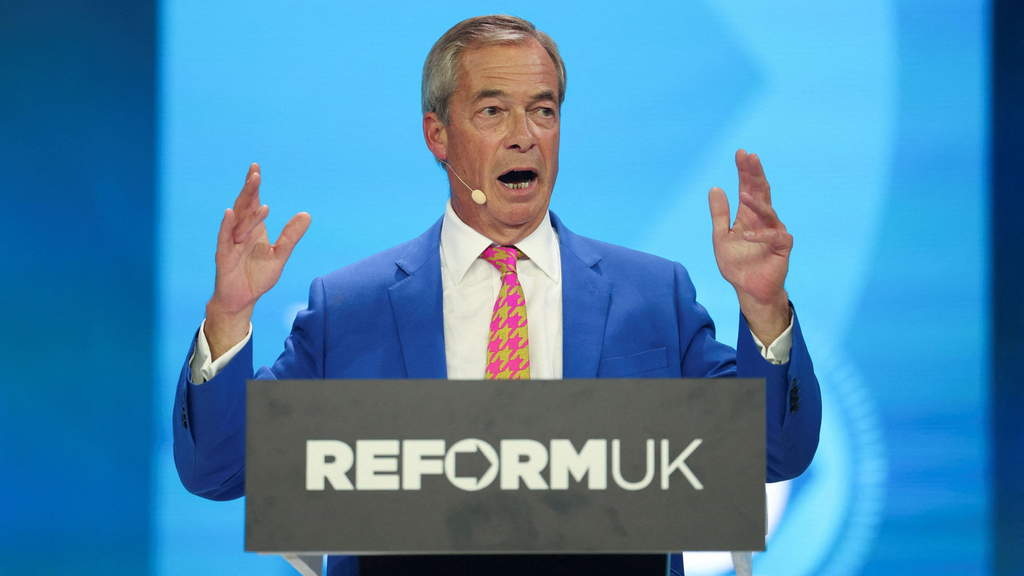
Nigel Farage stood in front of a packed room of loyal followers, stepped up to the microphone, and made the kind of mistake every public speaker dreads. The Reform UK leader was trying to deliver a fiery speech about protecting British coastal towns and local jobs. Instead, he managed to insult the very crowd cheering his name by forgetting where he actually was.
Speaking in the historic port city of Plymouth, Farage confidently told the room how proud he was to stand alongside the hard-working fishing community of Portsmouth.
The reaction was instant. A loud chorus of boos, groans, and shocked laughter echoed across the hall. Farage froze, looked around, and scrambled to fix the blunder, but the damage was already done. Within minutes, mobile phone footage of the awkward incident spread across the internet, sparking a wave of mockery and raising fresh questions about his chaotic national tour.
The Awkward On-Stage Blunder That Silenced the Cheers
The atmosphere inside the venue had started out lively. Farage was in the middle of a national campaign blitz, visiting coastal communities to rally support for his party and highlight issues like border security, fishing rights, and local industry.
He was speaking passionately about British waters and the promises made during the Brexit campaign. Farage leaned into the microphone to deliver what was supposed to be a major applause line.
The $0 Secret To Launching Your Entire Online Empire
Why pay hundreds every month for separate software? Build funnels, send emails, and make sales with Systeme.io completely free.
Get Started For $0Free Forever • No Credit Card Needed • Beginner-Friendly
“One of the things, one of the sensible beliefs we had was that we would get back control of our waters,” Farage declared to the eager audience. “There is a big fishing fleet here in Portsmouth…”
Before he could finish his sentence, the mood in the room flipped completely. Rather than the loud cheer he clearly anticipated, the crowd erupted into immediate boos. Several people in the front rows shouted out corrections, while others shook their heads in disbelief.
Farage stopped talking, visibly caught off guard by the hostile noise from his own supporters. He held up a hand and tried to laugh off the mistake as quickly as possible.
“Sorry, did I say – Plymouth! Plymouth, sorry,” Farage said, trying to recover his footing. He then added a quick joke to dig himself out of the hole: “It is very small in Portsmouth!”
The crowd offered a polite chuckle, but the energy in the room never quite recovered. For a political figure who builds his entire brand on being an authentic man of the people who understands ordinary towns, calling Plymouth by the name of another city 160 miles away was an embarrassing self-inflicted wound. External reporters covering the event for outlets like HuffPost UK and Plymouth Live quickly picked up on the clip as it began racking up hundreds of thousands of views online.
Why Mixing Up Plymouth and Portsmouth Is a Huge Insult to Locals
To anyone unfamiliar with British geography, confusing two coastal cities that start with the letter P might seem like an innocent slip of the tongue. But to the people living in Devon and Hampshire, it is a massive blunder that cuts right to the heart of local identity.
Plymouth sits in the county of Devon in the South West of England. It is famous around the world for its deep maritime history, being the departure point for the Mayflower in 1620 and home to the largest operational naval base in Western Europe, HMNB Devonport. Plymouth also has an active, proud commercial fishing fleet operating out of Sutton Harbour, where generations of local families have made their living on the open sea.
Portsmouth, on the other hand, is located roughly 160 miles east along the southern coast in Hampshire. While Portsmouth also has an incredible naval history, its modern commercial fishing sector is significantly smaller than Plymouth’s. More importantly, both cities have their own distinct culture, heritage, and regional pride.
When a politician travels to a town and gets the name wrong, it sends a clear signal to the audience: you are just another stop on a busy schedule. People who pay money or take time out of their day to attend a political rally want to feel respected and heard. Telling Devon fishermen that they are standing in Hampshire suggests that the speaker did not take five seconds before walking on stage to remember where his car had parked.
Local pride runs deep in the South West. Residents often feel overlooked by Westminster politicians who spend all their time in London studios. Farage has spent years telling these exact voters that mainstream politicians do not care about them. Making such a basic mistake in front of hundreds of loyal followers undermined that exact message.
Protests, Heavy Police Presence, and High Tension Outside the Hall
The drama inside the auditorium was only half the story. Outside the building, the scene was tense long before Farage ever stepped to the microphone.
Dozens of counter-protesters gathered near the venue entrance carrying banners, whistles, and megaphones. Organized under local anti-racism banners declaring Plymouth a Farage-free zone, the demonstrators chanted slogans calling out the Reform UK leader’s controversial rhetoric on immigration and national identity.
Devon and Cornwall Police deployed officers around the perimeter to keep counter-protesters separate from ticket holders entering the building. While the demonstration remained mostly peaceful, there were shouting matches between rally attendees and protesters on the pavement.
This friction comes at a time of heightened political unrest across Britain’s port cities. Over recent months, coastal hubs have seen repeated demonstrations and clashes over border policies and community resources. In fact, authorities have faced growing scrutiny over how they handle demonstrations in coastal areas, as seen in ongoing discussions surrounding intelligence gathering during far-right port protests.
Having to navigate past shouting protesters only to sit inside and hear your own leader call your city Portsmouth left several attendees visibly frustrated as they exited the building after the event ended.
Send, Spend & Hold Money Worldwide Without Hidden Fees
Transfer money internationally at the real exchange rate and hold 40+ currencies in one account.
Open a Wise AccountMid-market rate • Fast transfers • 40+ currencies
A Troubling Pattern for Reform UK and Nigel Farage
While politicians from all parties occasionally trip over their words, Farage’s mix-up comes at an unusually delicate time for Reform UK. The party has been trying to transition from a protest vehicle into a serious national organization capable of challenging both the Conservatives and the Labour government.
However, the pressure of maintaining a relentless campaign schedule appears to be taking a toll. When a party relies almost entirely on the personality and public appearances of a single individual, even minor cracks begin to show very quickly.
Farage has been traveling up and down the country non-stop, holding rallies, speaking at private fundraising dinners, and appearing on television shows. But this rapid expansion has led to serious growing pains behind the scenes.
Recent tracking polls suggest that the novelty of Reform’s summer surge may be wearing thin with the broader public. In recent weeks, pollsters have documented how Nigel Farage hit record low popularity numbers following several controversial public debates and divisive policy announcements. When public patience is already thin, embarrassing gaffes make it much harder to convince undecided voters that your party is ready to run the country.
At the same time, Reform UK has faced questions about who it really represents. The party has received massive sums of money from ultra-wealthy backers, including headlines about how a second crypto billionaire dropped a record 36 million donation on Reform UK. Critics have seized on this contrast, arguing that while Reform’s leadership is courting wealthy tech financiers and venture capitalists, Farage cannot even keep track of working-class fishing towns during his regional visits.
Can You Be the Voice of Coastal Britain If You Mix Up the Coast?
The core appeal of Nigel Farage has always been his supposed connection to ordinary Britain. Throughout the 2016 referendum and subsequent elections, he presented himself as a straight-talking pub regular who understood coastal communities that felt ignored by career politicians.
Farage frequently spoke about the decline of British coastal towns, promising that leaving the European Union would bring back a golden age for British fisheries. In towns like Plymouth, Grimsby, and Brixham, those promises resonated strongly.
Yet eight years after the Brexit vote, many coastal communities feel that those promises never materialized. Fishing businesses have struggled with new red tape, rising fuel costs, and complex export paperwork when selling catch into European markets. Rather than seeing their fleets expand, many skippers have faced shrinking profit margins and tighter quotas.
When Farage returns to these towns years later to ask for their votes again, local voters expect real solutions, deep attention to detail, and genuine respect. Making a careless geographical slip reminds voters of the classic rock star who walks out on stage and screams “Hello Cleveland!” when he is actually performing in Detroit.
It makes the entire appearance feel staged. If a speaker is just reciting the same recycled talking points from a mental script without paying attention to the city he is standing in, it breaks the emotional bond between the speaker and the room.
The $0 Secret To Launching Your Entire Online Empire
Why pay hundreds every month for separate software? Build funnels, send emails, and make sales with Systeme.io completely free.
Get Started For $0Free Forever • No Credit Card Needed • Beginner-Friendly
How Social Media and Political Rivals Reacted
It did not take long for the clip to make the rounds across social media platforms like X, TikTok, and Facebook. Within an hour of the Plymouth rally concluding, political opponents and casual observers were having a field day with the gaffe.
Members of Parliament from rival parties jumped on the clip to question Farage’s commitment to the South West:
- Local political organizers in Devon quickly pointed out that Farage took the train down from London, delivered his speech, and seemed ready to head straight back without spending real time engaging with residents.
- Satirical accounts created mock maps showing Portsmouth located in Devon, Cornwall, and even Scotland to poke fun at the mix-up.
- Conservative commentators, who are locked in a fierce battle with Reform UK for right-of-centre voters, used the moment to argue that Farage is an entertainer rather than a serious administrator.
- Marine policy groups pointed out the irony of using Portsmouth as an example of a massive fishing hub, noting that Portsmouth is far better known for modern commercial ferry ports and historic warships like HMS Victory than for commercial trawler catches.
The clip also sparked wider conversations about the party’s recent headline-grabbing culture war policies. Reform UK has spent substantial time pushing hardline domestic proposals, such as their controversial push where Reform UK calls for a ban on full-face coverings in public spaces. For many observers, Farage’s basic geographic mistake highlighted a growing gap between headline-grabbing political stunts and basic, competent local campaigning.
The Broader Battle for Britain’s Coastal Constituencies
The mistake in Plymouth is more than just a funny ten-second internet video. It highlights the high-stakes political battle currently taking place across Britain’s coastal seats.
For decades, many coastal and port towns were reliable Conservative strongholds. However, years of public spending constraints, hospital waiting lists, and economic stagnation have eroded that loyalty. In the most recent general election, Labour made surprising gains in places previously considered unwinnable, while Reform UK finished second in dozens of constituencies.
The South West is now one of the most competitive political battlegrounds in the UK:
- Labour is desperate to prove that it can rebuild regional economies, bring jobs back to port areas, and protect public services from further decline.
- The Conservatives are fighting tooth and nail to reclaim seats they lost, attempting to win back disaffected voters who drifted toward Reform.
- The Liberal Democrats hold deep historic roots across Devon and Cornwall, presenting themselves as the pragmatic, local alternative to national political drama.
- Reform UK is trying to convince voters that none of the traditional parties can fix the nation’s problems, positioning themselves as radical outsiders.
To win seats in competitive regions like Plymouth Moor View and Plymouth Sutton and Devonport, parties cannot just rely on angry rhetoric. They need disciplined ground campaigns, knowledgeable candidates, and genuine local roots. An unforced error like confusing Plymouth with Portsmouth gives every competing campaign free ammunition to tell voters that Reform UK is treating their community like a prop.
What Politicians Can Learn From Farage’s Plymouth Gaffe
Public speaking is hard, and anyone who has ever stood up in front of a crowd knows how easy it is to let the wrong word slip out. But in high-level politics, context is everything.
There are several straightforward lessons every public speaker and campaigner can take away from this episode:
Always Know Your Room
Before you walk onto a stage, take a minute to ground yourself. Remember the city you are in, the unique history of the venue, and the specific concerns of the people sitting in front of you. Generic speeches rarely land well, and generic speeches with the wrong town name land terribly.
Own the Mistake Immediately and Move On
Farage at least recognized the blunder right away. Trying to pretend you did not say the wrong word usually makes things worse. While his joke about Portsmouth having a small fishing fleet was clumsy, admitting the error directly is the only way to avoid completely losing the room.
Show Genuine Local Respect
People can spot the difference between someone who genuinely cares about their town and someone who is simply dropping by to grab video clips for their social media channels. If you visit a city known for its maritime heritage, take the time to visit the actual harbour, speak with real boat owners, and learn the local concerns before stepping to the microphone.
Frequently Asked Questions (FAQs)
What exactly did Nigel Farage say during the Plymouth rally?
While speaking about the fishing industry and post-Brexit trade, Farage said: “There is a big fishing fleet here in Portsmouth…” He was immediately booed by the crowd, prompting him to stop, apologize, and correct himself by saying: “Sorry, did I say – Plymouth! Plymouth, sorry. It is very small in Portsmouth!”
Where did the incident take place?
The incident happened during a Reform UK campaign event in Plymouth, a historic port city in Devon in the South West of England.
How far apart are Plymouth and Portsmouth?
Plymouth and Portsmouth are roughly 160 miles apart. Plymouth is located in Devon in the South West, while Portsmouth is located in Hampshire on the central southern coast of England. Driving between the two cities takes around three to four hours.
Why did the audience boo Farage?
The audience booed because Plymouth residents are very proud of their local naval and fishing heritage. Calling Plymouth by the name of another city made it sound like Farage did not know where he was or had not bothered to check his location before walking on stage.
Did protesters show up to the rally?
Yes. Protesters gathered outside the venue holding signs and chanting slogans against Reform UK and Farage, calling for a Farage-free zone in Plymouth. Police were stationed outside the building to maintain order and keep opposing groups separated.
Has Nigel Farage made similar mistakes before?
Farage is known for speaking without a rigid teleprompter script, which allows him to sound conversational but also leaves him vulnerable to verbal slips, factual errors, and occasional mix-ups during long national tours.
Public speaking blunders happen to everyone, but when you are trying to convince an entire nation that you are ready to lead, the small details matter. Mixing up two of Britain’s most famous naval cities might produce a temporary wave of laughter online, but it leaves a lasting impression on the voters who were sitting in that hall waiting to be taken seriously.
