
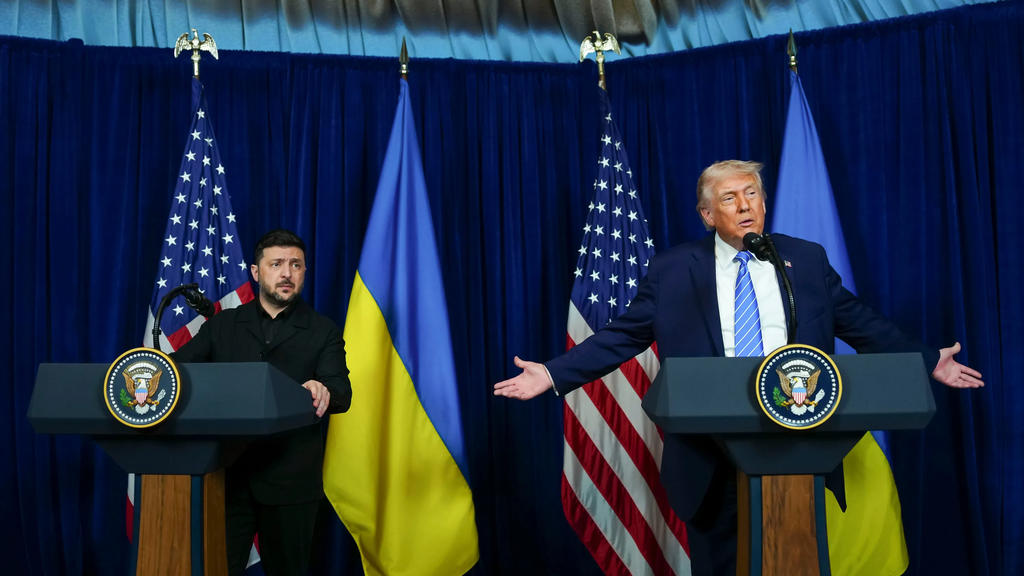
Tensions between Washington and Kyiv have officially reached a boiling point. Speaking directly to reporters from the Oval Office, Donald Trump delivered an unfiltered ultimatum regarding the ongoing war with Russia: wrap up the fighting immediately, regardless of what the final arrangement looks like.
“I don’t care how it’s done,” Trump remarked bluntly when questioned about how Ukrainian President Volodymyr Zelenskyy and Russian President Vladimir Putin could possibly negotiate an end to the bloodshed.
The statement marks one of the sharpest public fractures yet between the United States and Ukraine. It comes at a pivotal moment when frontline battles remain fierce, vital air defense supplies hang in limbo, and high-level envoys are crisscrossing Europe to salvage a diplomatic path forward.
For months, observers debated how far Washington would go to force an agreement. Now, the message coming out of the White House is unmistakable: the clock is running out, patience has worn thin, and the pressure on Ukraine to reach terms with Moscow is higher than it has ever been.
What Did Trump Actually Say?
The fiery exchange unfolded at the White House, where Trump doubled down on his long-standing criticism of how the war has been handled. Rather than focusing purely on battlefield strategy or territorial boundaries, the president turned his focus toward Kyiv’s negotiating posture.
The $0 Secret To Launching Your Entire Online Empire
Why pay hundreds every month for separate software? Build funnels, send emails, and make sales with Systeme.io completely free.
Get Started For $0Free Forever • No Credit Card Needed • Beginner-Friendly
According to reports from Al Jazeera, Trump insisted that Zelenskyy must show real willingness to strike a bargain. He pointed out that the conflict has dragged on for years at immense human and financial expense, claiming that neither the Ukrainian public nor Western allies are willing to keep funding the stalemate indefinitely.
“He is going to have to want to make a deal, because I don’t think his people are going to stand for it any longer,” Trump said.
When reporters asked how two leaders with such deep personal animosity could sit at the same table, Trump waved away the idea of formal diplomatic pleasantries. Acknowledging that the mutual hatred between Putin and Zelenskyy makes sitting in the same room almost impossible, he made it clear that mechanics do not matter to him.
In his view, a deal signed through intermediaries or third-party channels is just as good as a handshake in front of the cameras. The priority for Washington is simply bringing an end to the fighting and stopping the flow of emergency spending.
Trump pointed directly to the billions of dollars allocated by the United States and European nations since the invasion began. He argued that European leaders are exhausted and that continuing to pour cash and arms into a frozen trench war will only lead to worse outcomes for everyone involved.
Inside Zelenskyy’s Dilemma: What Kyiv Is Trying to Protect
For President Volodymyr Zelenskyy, the situation is extraordinarily delicate. Ukraine is caught between an aggressive invading force on its borders and growing political fatigue from its biggest financial backer.
Zelenskyy has insisted that Ukraine wants peace more than anyone else on Earth. However, his administration has repeatedly pushed back against the idea of accepting a settlement that amounts to surrender or concedes vast swathes of sovereign land without solid security guarantees.
Just hours before Trump’s remarks, Zelenskyy concluded high-stakes talks in Oslo, Norway. Meeting alongside key European partners and US special envoy Steve Witkoff, the Ukrainian leader sought to outline a framework that protects his country’s sovereignty while establishing realistic terms for a ceasefire.
Following that summit, Zelenskyy announced on social media that Kyiv had formed several concrete ideas to present to Moscow. He emphasized that Ukrainian and European officials are united in their approach and called on American diplomats to carry these terms directly to Russian negotiators.
One major proposal floated by the Ukrainian side was the creation of a trilateral summit involving the heads of state. The logic is simple: lower-level envoys cannot resolve existential questions regarding territorial borders and regional security pacts without direct executive sign-off.
Yet, the mood in Kyiv remains deeply cautious. Zelenskyy and his advisers have voiced serious concerns that Washington might trade away Ukraine’s long-term defense in exchange for a quick diplomatic victory on paper.
Weapon Delays and the Starshield Mystery
The war of words between Washington and Kyiv is not happening in a vacuum. Behind closed doors, practical military cooperation has run into noticeable friction.
Reports confirmed by coverage from The Wall Street Journal and international agencies reveal growing tension over deliveries of essential air defense munitions. Ukrainian officials have noted serious slowdowns in shipments of interceptor missiles designed for Patriot missile batteries.
These Patriot batteries are Kyiv’s primary shield against incoming ballistic missiles aimed at critical energy grids and civilian apartment blocks. Without a steady supply of interceptors, Ukraine’s major cities become far more vulnerable to sustained aerial barrages.
At the same time, an unexpected controversy has erupted over access to Starshield satellite technology. Starshield, an offshoot of SpaceX’s satellite network tailored for government and security applications, has provided crucial battlefield communications and early-warning intelligence to Ukrainian forces.
Send, Spend & Hold Money Worldwide Without Hidden Fees
Transfer money internationally at the real exchange rate and hold 40+ currencies in one account.
Open a Wise AccountMid-market rate • Fast transfers • 40+ currencies
When reports surfaced that Starshield functionality had been throttled or restricted, blame began flying in every direction:
- Elon Musk publicly stated that Starshield assets are owned and directed by the US government, implying that any operational slowdowns stemmed from Washington.
- US defense officials, including Defense Secretary Pete Hegseth, denied issuing any directive to cut communications, pushing responsibility back toward private contractors.
- Media reports suggested that specific internal directives may have played a role in limiting satellite access during a critical window.
Regardless of who pulled the plug, the disruption hit Ukraine right where it hurts. Early missile detection allows air raid sirens to sound in time and gives air defense crews the minutes they need to lock onto incoming threats.
For Ukrainian commanders, these operational disruptions feel uncomfortably close to economic and military arm-twisting designed to force a seat at the bargaining table.
Why Is the US Shifting Strategy Right Now?
To understand why Trump is taking this hardline approach, you have to look at the broader political and economic landscape.
First and foremost is the financial fatigue inside the United States. Over the course of the war, billions of taxpayer dollars have been directed toward military packages, humanitarian aid, and direct budget support for Ukraine’s civil institutions. With growing domestic economic debates at home, maintaining an open-ended financial commitment has become a political liability.
Second, Washington is pursuing broader geopolitical realignments. Recent moves have shown a willingness to soften certain economic sanctions on Russian energy exports and explore commercial arrangements, including diesel import discussions, as reported by AP News.
The White House appears convinced that keeping Russian oil and fuel flowing smoothly on the international market is necessary to avoid global energy spikes. That delicate balancing act means the administration is seeking de-escalation with Moscow on multiple fronts simultaneously.
Third, there is a clear perception in Washington that neither side has the military strength to achieve a total conventional victory. Russian forces face heavy attrition, while Ukrainian troops are stretched thin across a massive frontline.
From the White House perspective, continuing the war under current conditions will not shift the map dramatically in Ukraine’s favor. As a result, the administration sees immediate negotiations as the only realistic exit strategy.
How Europe Is Responding to the Pressure
European capitals are watching this drama with intense anxiety. For nations bordering Russia and Ukraine, this is not a theoretical foreign policy debate; it is an immediate regional security question.
The $0 Secret To Launching Your Entire Online Empire
Why pay hundreds every month for separate software? Build funnels, send emails, and make sales with Systeme.io completely free.
Get Started For $0Free Forever • No Credit Card Needed • Beginner-Friendly
Leaders in London, Paris, and Berlin have consistently argued that an unjust peace could encourage further military expansion in Eastern Europe down the road. If Ukraine is pushed into signing an agreement that leaves it defenseless or without firm Western backing, the risk of renewed conflict within a few years remains high.
At the same time, many European economies are feeling the strain. Industrial energy costs remain high, manufacturing sectors are adjusting to disrupted supply chains, and public budgets are tight.
Because of this, European leaders find themselves in an awkward spot. While they want to stand firmly behind Kyiv, they rely heavily on American military logistics, intelligence sharing, and heavy weaponry to sustain Ukraine’s defenses.
If Washington reduces its participation or dictates terms, European governments do not have the standalone industrial capacity to replace US supplies overnight. That reality is forcing them to work closely with envoys like Steve Witkoff in an attempt to shape whatever deal might emerge.
What Does This Mean for the People on the Ground?
When politicians in faraway capitals talk about cutting deals and adjusting balance sheets, it is easy to forget what this means for regular people.
For millions of Ukrainian families, the war is an everyday reality of shattered windows, freezing nights, and air sirens sounding in the middle of the night. Towns along the eastern and southern edges of the country have seen entire neighborhoods reduced to dust.
Frontline soldiers are fighting in harsh trenches where artillery shells fall around the clock. The idea of a ceasefire sounds appealing on paper, but soldiers and civilians alike worry about what peace actually looks like if it leaves occupied territories in limbo.
Families separated by frontlines wonder if they will ever be able to return to their hometowns. Business owners who have tried to keep their shops open through blackouts wonder if the investment will survive a fragile political pact.
On the other side of the border, ordinary Russian families have also paid a steep price in lost lives, economic disruption, and severe state control. Yet the official messaging from the Kremlin suggests that Moscow sees the latest developments in Washington as a sign that its strategy of endurance is paying off.
The Road Ahead: Can a Deal Actually Happen?
Reaching an agreement will require resolving issues that have seemed impossible to settle for years.
The first major hurdle is land. Russia currently occupies significant portions of eastern and southern Ukraine. Moscow wants those gains recognized, while Ukraine’s constitution explicitly forbids ceding sovereign territory. Any compromise on this issue risks triggering serious political unrest inside Ukraine.
The second hurdle is security guarantees. Even if fighting stops tomorrow, Ukraine needs ironclad assurances that Russian forces will not simply regroup, rearm, and launch another offensive in the future. Kyiv has consistently pushed for NATO membership or formal defense treaties with major Western powers.
However, keeping Ukraine out of NATO has been one of Moscow’s stated objectives from day one. Finding middle ground between Ukrainian defense needs and Russian red lines is a diplomatic puzzle that no one has solved yet.
Finally, there is the question of personal trust. With zero goodwill remaining between the leadership in Kyiv and Moscow, any pact will rely on outside enforcement. If the United States signals that it wants to step back from European defense obligations, who steps up to enforce the peace?
These questions will dominate diplomatic discussions over the coming weeks as envoys travel between Washington, European capitals, and Moscow.
Frequently Asked Questions (FAQs)
Why did Trump say “I don’t care how it’s done”?
Trump made this comment when asked whether Vladimir Putin and Volodymyr Zelenskyy need to meet in person to negotiate an end to the war. Recognizing the deep hostility between the two leaders, Trump stated that the format does not matter—whether through envoys, indirect talks, or trilateral arrangements—as long as a peace agreement is finalized quickly.
Is the United States stopping military aid to Ukraine?
While military aid has not been cancelled outright, there have been noticeable slowdowns in the delivery of key weapons, including Patriot missile interceptors. These delays, combined with White House calls for negotiations, have raised concerns that Washington is using aid deliveries as leverage to bring Kyiv to the bargaining table.
What is the issue with Starshield satellite technology?
Starshield, operated by SpaceX, provides encrypted communications and surveillance data that Ukrainian forces use to detect Russian missile launches. Recent service restrictions led to public disputes between Elon Musk, the Pentagon, and US officials over who authorized the slowdown, sparking debate over whether satellite access is being used as diplomatic pressure.
What is Ukraine’s current position on peace talks?
Ukraine maintains that it is ready for genuine peace talks, as demonstrated by meetings with American envoys in Oslo. However, President Zelenskyy has repeatedly stated that any agreement must protect Ukrainian independence, prevent future invasions, and not amount to an unconditional capitulation.
How do European countries feel about the US stance?
European leaders generally support a diplomatic resolution but fear that a rushed deal could leave Eastern Europe vulnerable to future Russian aggression. While some countries are feeling the financial weight of the conflict, most European allies emphasize that Ukraine must have a direct voice in determining its own future.
The unfolding standoff over Ukraine’s future proves that global politics can shift overnight. What started as a unified transatlantic front has now evolved into an intense debate about limits, sovereignty, and the true cost of prolonged conflict.
As envoys continue their rounds and world leaders trade sharp words, the path toward ending the war remains as complicated as ever. For the soldiers defending the front and families watching from damaged cities, the decisions made behind closed doors in the coming days will decide the fate of their nation for decades to come.
