
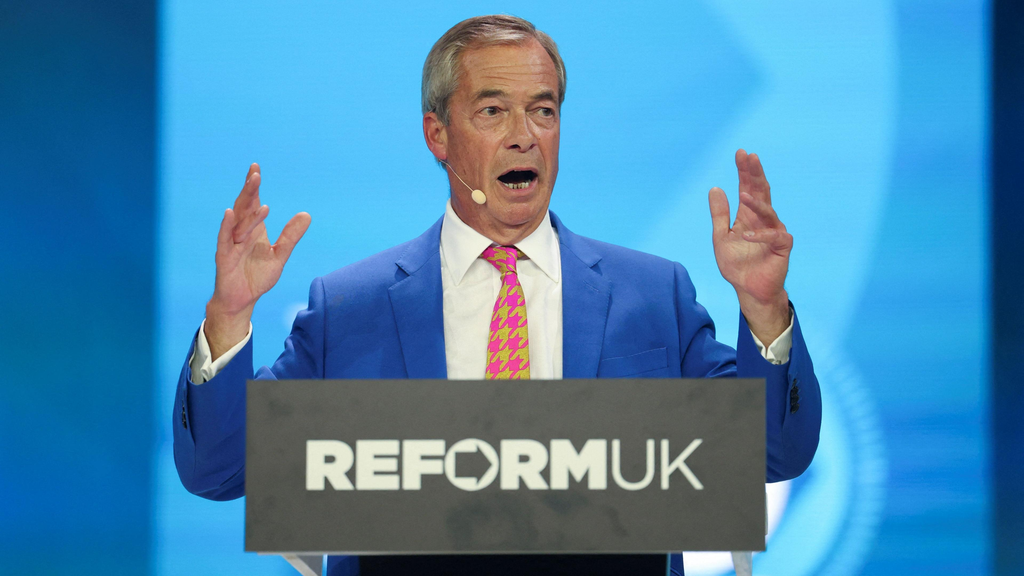
Nigel Farage and his party, Reform UK, have officially called for a complete ban on all full-face coverings in public places across the United Kingdom. Writing in a national newspaper, Farage stated that the party wants to outlaw face coverings “once and for all,” arguing that no one in a modern society should be walking around in public with their identity hidden.
This announcement comes directly after a series of intense anti-migration protests across parts of the UK, including Dover and Portsmouth. During these demonstrations, groups of masked men blocked roads, confronted police officers, damaged official vehicles, and caused widespread disruption. The sight of large crowds wearing heavy balaclavas and dark face masks sparked serious concern among local residents and public officials.
While political parties often debate public safety and crime prevention, Reform UK’s proposal goes much further than simple warning measures. Their plan would make it illegal for anyone to cover their face in public spaces, without exceptions. That means balaclavas, masks used by political groups, street gangs, and religious headwear like the burqa or niqab would all fall under the exact same ban.
The proposal has immediately ignited a massive debate across the political spectrum. Supporters argue that keeping faces visible is essential for safety, stopping crime, and helping police identify troublemakers. On the other hand, critics argue that such a ban breaches personal freedom, harms civil liberties, and unfairly targets religious groups who wear face veils as part of their faith.
Here is a thorough breakdown of what Reform UK is proposing, why this issue has suddenly taken center stage, how it compares to laws in other European countries, and what it could mean for the future of public life in the UK.
Build Funnels, Email Lists & Sell Online With One Free Tool
Create funnels, send emails, and sell online using Systeme.io without paying for multiple tools.
Create Free AccountFree forever • No credit card • Beginner-friendly
What Is Reform UK Proposing?
Reform UK leader Nigel Farage outlined the party’s stance, describing full-face coverings as a growing “menace” on British streets. According to Farage, masked individuals have become far too common in everyday public settings, creating an atmosphere of fear and intimidation.
The proposed policy states that anyone walking in a public space must have their face visible so that they can be easily identified by members of the public and law enforcement officers. Reform UK insists that the rule should apply universally to everyone, regardless of the reason someone might choose to cover their face.
Key Points of the Proposed Ban
- Universal Application: The ban would apply in all public spaces across the country, including public streets, town squares, parks, shopping centers, government buildings, and public transport.
- No Exceptions for Intent: The party argues that the law should not distinguish between why someone is covering their face. Whether it is for political protest, street fashion, criminal activity, or religious custom, the prohibition would be total.
- Focus on Identifiability: Reform UK maintains that being identifiable in public is a basic foundation of a safe, open, and civilized society.
- Enhanced Police Powers: Under this plan, police officers would have clear legal authority to demand that individuals reveal their faces in public areas or face legal penalties.
Farage specifically pointed out that face coverings are frequently used by criminal gangs and political extremists, such as Antifa or radical protest groups, to avoid detection by security cameras and police officers. By removing the ability to hide behind masks, Reform UK claims that street crime, public disorder, and gang activity could be reduced significantly.
However, the inclusion of religious garments in the proposal is what has drawn the strongest reaction. Farage explicitly stated that religious coverings would not receive an exemption, claiming that making special rules for certain groups creates double standards in law enforcement.
Why Is This Debate Happening Right Now?
The debate over face coverings did not appear out of nowhere. It reached a boiling point following recent high-profile events that put street safety and public order under intense national scrutiny.
Over a dramatic weekend, protests linked to concerns over border security and small boat arrivals led to tense standoffs in key locations like Dover and Portsmouth. Reports noted that groups of young men dressed in black, many with their faces completely hidden by balaclavas and neck gaiters, blocked access routes to major port facilities.
Incidents That Sparked the Call
- Port of Dover Blockades: Demonstrators wearing heavy face masks blockaded main access roads leading to the Port of Dover, throwing travel into chaos and frustrating local authorities.
- Violent Clashes in Portsmouth: In Portsmouth, demonstrations turned violent overnight. Masked protesters clashed directly with police forces, leaving official vehicles damaged and several police officers injured.
- CCTV Evasion: Local law enforcement faced major challenges identifying offenders who committed acts of vandalism or assault because so many individuals were wearing identical dark face masks.
Politicians from all major parties quickly condemned the violence and destruction seen during these weekend demonstrations. Government officials described the behavior as unacceptable and chaotic. However, while traditional political parties focused on police tactics and existing public order laws, Reform UK seized the opportunity to push for a broader, permanent law prohibiting all face coverings.
At the same time, tension has surfaced even among right-wing activists. During a media interview following the protests, Zia Yusuf, the home affairs spokesman for Reform UK, was publicly confronted by protest organizers. The incident showed that even groups demanding tougher border policies are divided on how protests should be conducted and how politicians talk about them.
The widespread use of mobile phone cameras, street surveillance, and news broadcasts showing masked crowds clash with police has made the issue top-of-mind for millions of viewers across the UK.
What Types of Face Coverings Would Be Affected?
To understand how sweeping this proposal really is, it helps to look at the different kinds of face coverings currently seen in public life. Reform UK’s stance means several distinct groups of people would be directly impacted by a legal ban.
1. Balaclavas and Hoods
Balaclavas have traditionally been outdoor gear for extreme cold weather or sports like skiing. However, in recent years, they have become popular items in street fashion and urban culture. Unfortunately, they are also heavily associated with street gangs, drug networks, and youth crime.
Under the proposed ban, wearing a balaclava while walking down a high street, riding a bicycle in a town center, or gathering in public parks would become illegal. Proponents argue that banning balaclavas in everyday public settings would remove a major tool used by criminals to intimidate ordinary citizens and evade police identification.
2. Extremist and Protest Masks
During major demonstrations, political activists from various movements often wear masks, bandanas, or neck gaiters to conceal their identity. This practice allows individuals to participate in direct action or violent clashes without fear of being recognized on camera.
Reform UK argues that allowing protesters to cover their faces creates an environment where people feel immune from the consequences of their actions. Banning face coverings during protests would force demonstrators to take personal accountability for their conduct on public streets.
3. Religious Face Coverings
Perhaps the most controversial aspect of Reform UK’s announcement is its inclusion of religious veils, specifically the burqa (a full-body cloak with a mesh screen over the eyes) and the niqab (a face veil that leaves only the eyes exposed).
Farage argued that allowing exemptions for religious clothing would create an unfair legal loophole and undermine the overall effectiveness of the ban. However, human rights organizations and community leaders strongly argue that banning religious dress breaches fundamental rights to freedom of thought, conscience, and religion.
4. Health and Medical Masks
Since the global health crisis, medical masks have become a normal sight in public areas, particularly during cold and flu seasons or among elderly and vulnerable individuals protecting themselves from illness.
While Reform UK’s announcement focused primarily on balaclavas and religious veils, a total ban on face coverings raises practical questions about how medical masks would be handled. Critics wonder if police officers would be required to inspect health claims or whether vulnerable people would feel unsafe using public transit during winter months.
How Other Countries Handle Face Coverings in Public
While the proposal by Reform UK is causing massive debate in Britain, full-face covering bans are not a new concept in global politics. Several countries, particularly in Western Europe, have already introduced similar legislation over the past decade.
Looking at how other nations handle face coverings provides useful context for how a similar law might work in the UK.
France
France was the first European country to pass a national ban on full-face coverings in public spaces back in 2010. The French law makes it illegal for anyone to wear clothing designed to hide their face in public places, including streets, markets, schools, and public transport.
The French government justified the law on the grounds of public safety and secularism. Individuals caught violating the ban can face fines or be required to attend citizenship education courses. The European Court of Human Rights eventually upheld the French law in 2014, ruling that it did not violate international human rights standards.
Belgium
Belgium followed France shortly after, implementing a ban on face coverings in 2011. The Belgian law prohibits wearing clothing in public that hides the identity of the wearer in a way that prevents recognition. Similar to France, the law was challenged in international courts but was ultimately upheld as legally valid for maintaining public safety and social cohesion.
Austria and Denmark
Both Austria in 2017 and Denmark in 2018 enacted their own public face covering bans. In these countries, the laws apply broadly to balaclavas, full masks, and religious veils in public places. Exceptions are generally carved out for specific circumstances, such as cold winter weather gear, safety equipment at work, or traditional carnival costumes.
The Netherlands
The Netherlands took a slightly different approach by passing a targeted ban in 2019. Rather than a total ban in all outdoor spaces, the Dutch law specifically prohibits full-face coverings inside public buildings, schools, hospitals, and on public transport. This partial ban was designed to focus specifically on settings where clear communication and security are deemed essential.
The Arguments in Favor of Banning Face Coverings
Supporters of Reform UK’s policy argue that a full-face covering ban is a sensible, long-overdue measure to restore law and order to British public life. Here are the primary arguments made by those who support the ban:
1. Enhancing Public Safety and Deterring Crime
The core argument for banning face coverings is public safety. Modern law enforcement relies heavily on Closed-Circuit Television (CCTV) cameras, facial recognition technology, and eye-witness accounts to solve crimes and catch offenders.
Build Funnels, Email Lists & Sell Online With One Free Tool
Create funnels, send emails, and sell online using Systeme.io without paying for multiple tools.
Create Free AccountFree forever • No credit card • Beginner-friendly
When criminals or rioters cover their faces with balaclavas or masks, it becomes significantly harder for police to collect evidence and bring charges. Supporters believe that making face coverings illegal in public spaces would act as a powerful deterrent against street robbery, shoplifting, vandalism, and violent protests.
2. Preventing Intimidation in Public Spaces
Many people feel intimidated when walking past groups of individuals whose faces are completely covered. Whether it is a gang of youths on a corner wearing dark balaclavas or masked political activists marching through a city center, concealed identities can make public spaces feel hostile and unsafe.
Proponents of the policy argue that citizens have a right to feel comfortable and secure in their local communities, and that seeing people’s faces is a key part of feeling safe.
3. Promoting Social Cohesion and Trust
In everyday human interaction, non-verbal communication—such as facial expressions, smiles, and eye contact—plays a major role in building trust and mutual understanding.
Supporters argue that living in an open society requires people to show their faces to one another. They maintain that hiding one’s identity creates social barriers and prevents individuals from fully participating in public life.
The Arguments Against Banning Face Coverings
Opponents of the proposed ban raise serious concerns about human rights, personal liberty, practical enforcement, and social division. Here are the main arguments against Reform UK’s proposal:
1. Infringement on Personal Freedom and Choice
A fundamental principle of a liberal democracy is that citizens should be free to dress as they choose, provided they are not harming others.
Critics argue that telling adults what they can or cannot wear in public represents government overreach. Whether someone wants to wear a hood to protect against bad weather, a mask for personal health, or a veil for personal modesty, opponents believe the state should not police individual wardrobe choices.
2. Discrimination Against Religious Minorities
Human rights organizations and civil liberties groups express deep concern that a blanket ban heavily impacts Muslim women who wear the niqab or burqa.
Although Reform UK frames the policy as a general security rule, critics argue that including religious veils turns the law into a form of cultural or religious discrimination. Opponents warn that forcing women to choose between their religious beliefs and being able to leave their homes freely could isolate vulnerable women and push them out of public life altogether.
3. Practical Challenges for Police
Enforcing a total ban on face coverings in public could prove extremely difficult for police forces that are already stretched thin.
Officers would be forced to spend valuable time and resources stopping people on the street to inspect their headwear, issue fines, or demand that they remove face coverings. Critics question how police officers would distinguish between someone wearing a face mask for a medical reason, someone protecting their face from freezing weather, and someone breaking the law.
4. Risk of Escalating Tensions
Critics also warn that attempting to forcibly remove face coverings or fine people in public could lead to increased conflict on the street. Instead of reducing tension, strict enforcement might spark further protests and create friction between local communities and law enforcement.
How Technology and AI Play into the Face Covering Debate
The conversation around face coverings cannot be separated from modern technology. Over the past decade, law enforcement agencies around the world have invested heavily in artificial intelligence and automated facial recognition systems.
Police forces in the UK have increasingly tested live facial recognition cameras at major public events, football matches, and shopping districts to identify wanted suspects in real-time. You can learn more about how tech trends continue to transform modern society by checking out our section on technology and AI news.
However, facial recognition systems rely entirely on clear, unobstructed views of a person’s facial features. When individuals wear balaclavas, deep hoods, or heavy masks, these AI systems become far less effective.
This technological reality creates an ongoing tug-of-war between public surveillance and individual privacy:
- Law Enforcement Perspective: Security agencies argue that without clear facial visibility, expensive surveillance tools and safety networks are severely weakened.
- Privacy Advocate Perspective: Civil liberties campaigners argue that people have a legitimate right to privacy in public, and that wearing face coverings is one of the few remaining ways to protect oneself from pervasive state or corporate surveillance.
As digital tools, automated cameras, and online content platforms continue to grow rapidly—similar to trends seen in digital media and YouTube automation strategy—the conflict between privacy rights and public visibility is likely to grow even more intense in the years ahead.
Frequently Asked Questions (FAQs)
Has Reform UK officially made this policy part of their platform?
Yes. Nigel Farage and senior party officials have publicly stated that a complete ban on full-face coverings in public spaces is now an official policy position for Reform UK.
Would medical masks be illegal under this proposed ban?
Reform UK’s proposal focuses on eliminating full-face coverings in public spaces. While party leaders have emphasized balaclavas and religious veils, they have not provided detailed technical draft legislation yet. However, critics point out that universal bans in other countries often require clear medical exemptions, which can be complicated for police to enforce on the spot.
Are full-face coverings already banned anywhere in the UK?
Currently, there is no nationwide ban on wearing face coverings in public places in the UK. However, police officers already have temporary powers under Section 60AA of the Criminal Justice and Public Order Act 1994 to order the removal of face coverings if they believe a crime is about to be committed or during designated public order incidents. Additionally, private property owners, such as banks or shopping centers, can set their own dress codes.
Which other countries have banned face coverings?
Several European nations have enacted bans on full-face coverings in public spaces, including France, Belgium, Austria, Denmark, and Bulgaria. The Netherlands has a partial ban covering public transport, schools, hospitals, and government buildings.
How would a ban affect religious freedom in the UK?
Critics argue that including religious veils like the burqa or niqab breaches Article 9 of the European Convention on Human Rights, which protects freedom of thought, conscience, and religion. Supporters argue that public safety and social cohesion override individual religious practices in shared public spaces.
The debate surrounding Reform UK’s proposal to ban full-face coverings highlights a fundamental tension in modern society: balancing public safety and law enforcement with personal freedom and individual rights. As street protests, political debates, and security concerns continue to dominate national headlines, this topic will remain one of the most fiercely discussed issues in British politics.
What are your thoughts on this proposal? Should face coverings be banned in public places, or should people have the freedom to dress as they choose? Join the conversation and share your opinion with us on our social media pages on Instagram, Facebook, and X (formerly Twitter).
If you want to read more about our editorial mission and how we cover breaking national news, visit our About Us page. You can also get in touch directly with our writing team through our Contact Us page to share feedback, news tips, or suggestions for future articles.
