
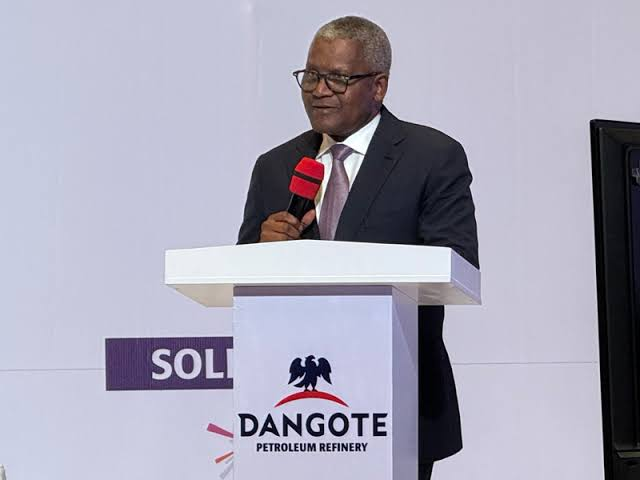
Aliko Dangote has dropped another massive bombshell that is shaking up the global energy industry. The Dangote Petroleum Refinery is officially planning to double its refining capacity, taking its total output from 650,000 barrels per day to an unprecedented 1.4 million barrels per day.
This huge expansion will officially make the facility the single largest oil refinery on earth, surpassing India’s famous Jamnagar refinery. Alongside this massive buildout, the billionaire industrialist revealed plans to list the company’s shares publicly. First on the local Nigerian Exchange, and then seeking major international exposure through dual listings in London and the United States stock markets.
This announcement is a historic turning point. For years, African nations have exported raw crude oil only to buy back expensive refined petrol from overseas. Now, a single African mega-refinery is expanding to supply not just the entire continent, but also major international markets across Europe and the Americas.
Let us break down what this 1.4 million barrels per day expansion really means, why a US listing matters so much for investors, and how this giant project will affect fuel prices, stock markets, and everyday consumers.
The Road to 1.4 Million Barrels Per Day: Doubling Africa’s Energy Powerhouse
When the Dangote Refinery first opened in the Lekki Free Trade Zone near Lagos, it was already a monster of engineering. Built at a cost of over $20 billion, its initial nameplate capacity of 650,000 barrels per day made it the world’s largest single-train refinery.
The $0 Secret To Launching Your Entire Online Empire
Why pay hundreds every month for separate software? Build funnels, send emails, and make sales with Systeme.io completely free.
Get Started For $0Free Forever • No Credit Card Needed • Beginner-Friendly
Now, the vision has expanded even further. The plan is to build a second identical refining line right next to the existing facility. By replicating the exact same proven design rather than starting from scratch, the engineering team can skip months of complicated redesigns and move straight into ordering equipment and construction.
Company executives have confirmed that the target is to complete this 1.4 million bpd expansion within 30 to 36 months. Because the site already has cleared land, expanded sea ports, and heavy-duty power infrastructure in place, construction can happen much faster than traditional greenfield projects.
Surpassing 1 million barrels per day puts the facility in a class of its own globally. For context, most standard refineries around the world process between 100,000 and 300,000 barrels daily. By pushing capacity to 1.4 million barrels daily, the refinery gains massive economies of scale. That means lower processing costs per barrel, making its fuel super competitive on the global stage.
This bold expansion builds on key financial milestones, including when the Dangote Refinery secured $2.5bn equity investment to solidify its capital structure and fuel its long-term growth plans.
Going Global: Why a US and London Listing Matters for Investors
Expanding a giant refinery requires serious capital, and Aliko Dangote is opening the door for everyday people and global financial institutions to own a slice of the pie. The company is preparing for an initial public offering (IPO), beginning with a primary listing on the Nigerian Exchange (NGX) followed by international listings on the London Stock Exchange and US markets.
Why is a listing in the United States and London so important? It all comes down to market depth, credibility, and liquidity.
While local stock exchanges are growing, international stock exchanges like the New York Stock Exchange or London Stock Exchange house trillions of dollars in global capital. Big institutional investors, pension funds, and foreign energy funds require the transparency, regulatory standards, and trading volume that international exchanges provide.
Key highlights of the listing strategy include:
- Massive Capital Raising: The upcoming public offering aims to raise billions of dollars to fund the multi-billion dollar phase two expansion.
- Dollar-Denominated Dividend Appeal: The company plans to pay dividends in hard currency or US dollar equivalents, offering a strong shield against local currency devaluation.
- Global Valuation: Listing on major exchanges gives the company a realistic global valuation, reflecting its status as one of the most valuable energy assets in the developing world.
- Retail Participation: The initial retail focus ensures that local citizens can purchase affordable stock packages directly through local brokerages.
This strategic rollout aligns with earlier preparations detailed in our coverage on how the Dangote Refinery prepares massive Nigerian stock listing. It also opens unique opportunities for those interested in financial markets and wealth creation, much like how modern creators leverage YouTube automation strategies to build digital assets.
What This Expansion Means for Local Fuel Prices and Everyday Consumers
For decades, everyday citizens across West Africa suffered through constant fuel scarcity, unpredictable pump prices, and heavy government subsidy burdens. The main reason was simple: the country was shipping raw crude abroad and paying top dollar to import finished petrol, diesel, and aviation fuel.
When local refining kicked into high gear, the market began to change. When the Dangote Refinery resumed petrol loading in Naira, it marked the first time in history that local distributors could buy massive quantities of fuel without hunting for scarce foreign exchange.
However, price fluctuations have remained a major talking point. Millions of citizens felt the pinch when petrol prices hit high levels across stations, driving up transportation and food costs.
Expanding capacity to 1.4 million barrels per day helps address this problem directly in several ways:
- Guaranteed Local Supply: At 1.4 million bpd, the refinery will produce far more fuel than the entire domestic market can consume, completely wiping out fuel shortages.
- Reduced Shipping and Port Costs: Sourcing fuel locally eliminates long-distance ocean freight fees, insurance premiums, and offshore ship-to-ship transfer charges.
- Foreign Exchange Relief: Saving billions of dollars previously spent on fuel imports helps stabilize the national currency and relieve pressure on central bank reserves.
- Stronger Bargaining Power: Legal and financial experts have long argued that ending fuel importation is essential for economic growth. Prominent legal figures even urged authorities to ban petrol importation completely to protect local industries and preserve foreign reserves.
Even as domestic demand is fully met, excess production is already being shipped to international buyers. Understanding why the refinery exports petrol while importation continues reveals how global trade contracts and local supply deals work side-by-side during transitional periods.
Stock Market Impact: A New Era for Retail and Institutional Shares
The upcoming stock listing is expected to be one of the largest share sales in African corporate history. Market analysts anticipate that the public offer will energize stock exchanges and attract thousands of first-time retail investors.
Send, Spend & Hold Money Worldwide Without Hidden Fees
Transfer money internationally at the real exchange rate and hold 40+ currencies in one account.
Open a Wise AccountMid-market rate • Fast transfers • 40+ currencies
We have already seen how major corporate announcements can trigger massive market movements. For instance, when the market rallied after major policy announcements, the Nigerian stock market gained nearly 2 trillion Naira in a single day. Adding a multi-billion dollar energy stock to the exchange will increase total market capitalization and attract global index funds.
Investors who missed out on earlier opportunities are paying close attention to the share structure. Details on pricing and subscription guidelines match the structural framework explained in our guide on the Dangote Refinery share sale and how to own a piece.
Additionally, investors tracking the full timeline of the upcoming offering can review our breakdown of the Dangote Refinery multi-billion dollar IPO details.
This surge in industrial activity comes at a time when broader macroeconomic indicators show shifting trends. As noted in recent financial reports, economic growth expanded while sector performances varied, proving that local manufacturing and refining are crucial engines for long-term stability.
Job Creation, Industrial Upgrades, and Cleaner Energy Standards
A project of this magnitude is about much more than just petrol. It is an industrial ecosystem that transforms raw materials into valuable products used across manufacturing, agriculture, and tech.
Massive Job Creation
During the construction of the second phase, the project is projected to create over 65,000 direct and indirect jobs. These include opportunities for chemical engineers, mechanical technicians, welders, pipefitters, logisticians, and software administrators. Over 85 percent of the permanent operational workforce will be local talent, building deep technical capacity within the regional energy sector.
Doubling Petrochemical Production
Beyond liquid fuels, the complex includes a massive petrochemical unit. The expansion will double polypropylene production from 900,000 metric tonnes to 2.4 million metric tonnes per year. Polypropylene is the main plastic material used in packaging, automotive parts, textiles, medical devices, and consumer electronics. Local production lowers costs for domestic manufacturers who previously had to import these raw materials.
Euro 6 Clean Energy Standards
Environmental considerations are also front and center. The upgraded facility is designed to produce cleaner fuels that meet strict Euro 6 emissions standards. Euro 6 fuels contain extremely low sulfur content, which significantly reduces vehicle tailpipe emissions, protects engines from harmful deposits, and improves air quality in major urban cities.
Powering Nearby Industries
Refining crude requires huge amounts of electricity. To ensure continuous operations without stressing the public grid, the complex is expanding its internal power plant from 500 megawatts to 1,000 megawatts. This self-generated power supply is large enough to power a medium-sized city and can export excess electricity to nearby industrial parks in the Lekki corridor.
How Technology and Modern Innovation Power Mega-Refineries
Modern oil refining is no longer just about giant pipes, furnaces, and storage tanks. Today, it is driven by cutting-edge automation, artificial intelligence, advanced sensor networks, and predictive analytics.
The $0 Secret To Launching Your Entire Online Empire
Why pay hundreds every month for separate software? Build funnels, send emails, and make sales with Systeme.io completely free.
Get Started For $0Free Forever • No Credit Card Needed • Beginner-Friendly
The Dangote Refinery relies on automated control centers that monitor millions of real-time data points every single second. Advanced algorithms analyze crude oil temperatures, pressure levels, chemical compositions, and flow rates to optimize fuel yields automatically.
Predictive maintenance tools warn engineers about potential equipment wear long before any mechanical failure can happen. This prevents unexpected shutdowns and keeps the plant running continuously at peak capacity.
This digital transformation in heavy industry mirrors the broader tech revolution happening across various sectors. From smart grid management to automated business workflows, staying informed on technology and artificial intelligence developments is essential for anyone following modern industrial trends.
How Everyday People Can Prepare for the Public Stock Sale
With a public listing on the horizon across both local and international markets, many everyday readers are wondering how they can participate. Owning shares in a world-class refining complex allows ordinary people to build long-term wealth alongside institutional investors.
Here is a simple, step-by-step checklist to prepare for the upcoming stock offer:
- Open a Stockbroking Account: Register with a recognized, licensed stockbroking firm. Most reputable brokers now offer easy smartphone apps that allow you to open an account in minutes using basic identification.
- Obtain Your Clearing House Number: In local stock markets, you need a unique investor identification number (such as a CSCS account number in Nigeria) to hold electronic share certificates. Your stockbroker will set this up for you automatically.
- Set Aside Dedicated Investment Capital: Decide in advance how much money you can comfortably invest without putting your day-to-day living expenses at risk. Remember that stock market investments should be viewed as long-term holdings.
- Follow Official Announcements: Always rely on verified public prospectuses, official stock exchange filings, and credible financial news outlets. Avoid unverified social media claims or investment schemes promising unrealistic guaranteed returns.
- Diversify Your Portfolio: While a massive energy stock is an exciting asset, wise investors always spread their money across multiple sectors—including technology, banking, real estate, and consumer goods.
Frequently Asked Questions (FAQs)
When will the Dangote Refinery list on international stock exchanges?
The primary listing is scheduled to launch first on the Nigerian Exchange, with secondary listings targeted for international exchanges including London and prospective US market exposure as expansion phases progress.
How big will the Dangote Refinery be after the expansion?
The expansion will double processing capacity from its current 650,000–700,000 barrels per day to 1.4 million barrels per day. This will make it the largest single-site petroleum refinery in the world.
Can regular retail investors buy shares during the IPO?
Yes. The public offering is intentionally designed with low minimum subscription thresholds so that everyday retail investors can purchase shares directly through licensed stockbrokers and digital trading platforms.
Will the expansion help lower fuel prices for everyday citizens?
By doubling production, the refinery will generate a massive domestic surplus, eliminate foreign shipping fees, and reduce dependence on expensive foreign exchange. This creates a much more stable pricing environment for consumers.
How will dividend payments work for foreign and local investors?
The company plans to pay dividends in hard currency or US dollar equivalents. This provides local investors with a hedge against inflation and currency devaluation while appealing directly to international institutional funds.
Aliko Dangote’s plan to double refinery capacity to 1.4 million barrels per day and seek public listings in the US, London, and Nigeria is a historic moment for global energy markets. It proves that world-class industrial mega-projects can be successfully built and expanded in Africa.
By combining massive physical scale with global stock market exposure, the refinery is positioning itself as an unstoppable energy powerhouse. For investors, everyday drivers, and regional economies, this milestone marks the beginning of a brand-new era of energy independence and wealth creation.
To learn more about our mission to bring you accurate, timely, and engaging news on global business, tech, and entertainment, visit our About Us page. If you have questions, feedback, or story tips, feel free to reach out directly through our Contact Page.
Stay connected with us across all our official social channels for real-time updates on breaking news and trending stories:
- Follow us on Instagram
- Join our community on Facebook
- Catch up with quick updates on X (formerly Twitter)
