
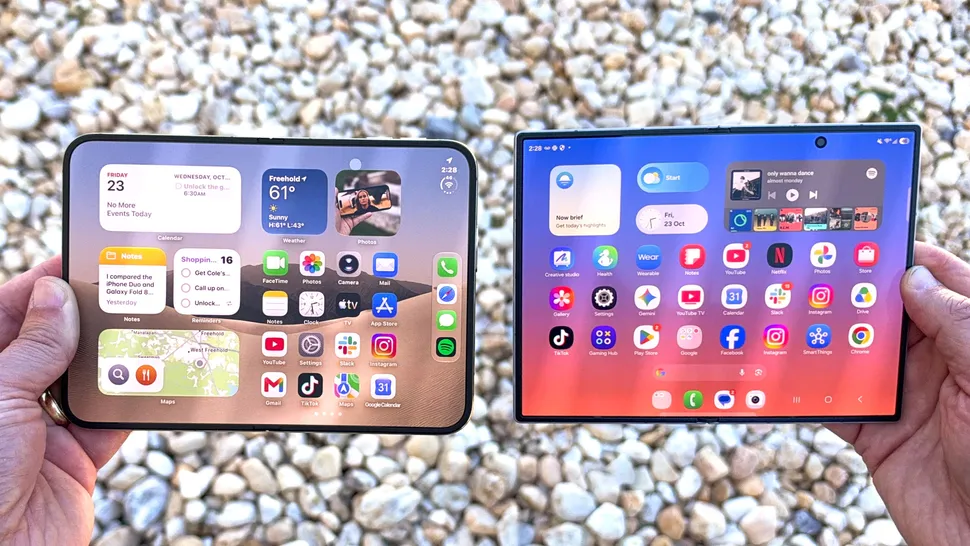
The biggest phone battle in tech history is finally here. For years, people asked when Apple would release a folding smartphone. That wait ended when Apple revealed the iPhone Duo, a device designed to turn heads and challenge Samsung head-on.
Standing in its path is the Samsung Galaxy Z Fold 8. Samsung is no rookie here. The company has spent eight generations tweaking hinges, dropping device weight, and tuning software. Now, the Samsung vs Apple foldable war has pushed mobile engineering into brand-new territory.
Both gadgets cost a serious chunk of money. Spending around two thousand dollars on a piece of pocket tech means you need straight facts before buying. Here is how the iPhone Duo and Galaxy Z Fold 8 compare in everyday life, from screens and hinges to software, cameras, and battery endurance.
Two Very Different Takes on the Passport Form Factor
Both companies have left tall, skinny screens behind in favor of a wider passport-style layout. When folded shut, both devices look and feel like standard smartphones rather than thick remote controls.
When you pick up the iPhone Duo closed, you interact with a 5.4-inch Super Retina XDR outer display. Apple built the frame with Grade 5 titanium, giving it a cool, rigid feel. The body uses an asymmetrical look. The right outer corners are gently rounded, while the hinge edge stays flat. When you unfold the screen, all four corners balance out.
The $0 Secret To Launching Your Entire Online Empire
Why pay hundreds every month for separate software? Build funnels, send emails, and make sales with Systeme.io completely free.
Get Started For $0Free Forever • No Credit Card Needed • Beginner-Friendly
Samsung built the Galaxy Z Fold 8 with its tough Armor Aluminum and gave it a 5.5-inch cover screen. The corners on the Fold 8 are sharper, giving apps slightly more usable display space along the perimeter.
The biggest contrast in everyday hand feel comes down to weight. Samsung engineered the Galaxy Z Fold 8 down to an astonishing 201 grams (7.09 ounces) and just 4.5 millimeters thick when unfolded. It slips into jeans pockets easily and feels barely heavier than a regular flat smartphone.
The iPhone Duo is noticeably heavier. It tips the scales at 254 grams (8.96 ounces) and measures 5.2 millimeters thin when opened. That makes it the heaviest iPhone ever made. You will feel that extra weight pulling on your pocket, and your wrist might feel fatigued during extended reading sessions in bed. If pocket comfort is your priority, Samsung wins this round hands down.
The Battle of the Screens: Nano-Texture Glass vs. Vibrant OLED
Opening either device reveals a spacious 7.6-inch folding screen with an aspect ratio close to 4:3. This gives you roughly the screen area of a mini tablet. However, both brands treat light reflection and color very differently.
Apple made a clever move by adding a nano-texture matte finish to the internal folding glass of the iPhone Duo. Folding phones usually reflect overhead lights like shiny mirrors. That glare makes the center crease catch your eye every time you tilt the device.
The nano-texture coating scatters reflections across the display. Combined with Apple’s redesigned multi-gear hinge, the center crease on the Duo is practically invisible in normal indoor lighting. You can still feel a shallow groove when sliding your finger across the glass, but visually, it is the smoothest folding screen on any phone today. The small compromise is that matte glass slightly softens deep blacks and vivid colors.
Samsung stuck with a glossy Dynamic AMOLED 2X panel on the Galaxy Z Fold 8. Colors are punchy, vibrant, and bursting with contrast. Blacks are pure and inky, which makes watching HDR movies a treat.
Samsung also holds a tiny lead in maximum brightness. According to Tom’s Guide, the Fold 8 reaches a peak brightness of 2,649 nits compared to 2,558 nits on the iPhone Duo. Both are bright enough to read in direct sunlight, but Samsung offers richer colors while Apple eliminates annoying reflections.
Durability, Hinges, and the Dust Protection Problem
Durability remains the top concern for anyone investing in a folding device. Fragile internal components and flexible screens require extra care.
Apple scored a major industry breakthrough with dust protection. The iPhone Duo comes with an official IP68 rating. Dust resistance has been the toughest puzzle for foldable makers because moving hinge gears let in dirt. An IP68 rating certifies that the iPhone Duo is completely sealed against fine sand and dust, while also surviving full submersion in water. You can take it to a sandy park without worrying about grit ruining the hinge.
The Samsung Galaxy Z Fold 8 carries an IP48 rating. While that level 8 water rating provides excellent protection against heavy rain and accidental drops in the sink, the level 4 rating for solids only shields against particles larger than one millimeter. Fine dust and pocket lint can still find their way inside moving parts over time.
Both hinges feel solid and hold open at multiple angles. Apple uses titanium covers that give the hinge a firm, mechanical snap. Samsung’s hinge feels lighter and opens with a silky glide. Still, for real peace of mind in dusty conditions, Apple’s dust protection is a game-changer.
Multitasking and Daily Software: iOS 27 vs. One UI 9
Big folding screens demand software built for multitasking. If software simply blows up phone apps to fill space, the large screen goes to waste.
Apple introduced specialized folding software features in iOS 27 for the Duo. Apple decided to focus on clean simplicity through Split View. You can place two apps side by side, letting you drag images directly into emails or check your calendar while writing a text.
The Duo also takes advantage of flexible poses. In seated mode, the phone sits bent on a table like a laptop, keeping video playback on the top half and controls on the bottom. In StandBy mode, it works as a smart bedside clock and widget hub. However, Apple limits multitasking to two side-by-side apps. You cannot float small pop-up windows over your active tasks.
Send, Spend & Hold Money Worldwide Without Hidden Fees
Transfer money internationally at the real exchange rate and hold 40+ currencies in one account.
Open a Wise AccountMid-market rate • Fast transfers • 40+ currencies
The Samsung Galaxy Z Fold 8 runs One UI 9 on top of Android, and it is a powerhouse for productivity. Samsung allows you to run three apps on the main screen at the same time, plus extra floating windows on top. You can watch a video, scroll through a spreadsheet, chat with a coworker, and pull up a notepad all at once.
Samsung also features Samsung DeX. Connect the Fold 8 to a monitor or TV, and it turns into a desktop computer complete with a taskbar and mouse support. Apple offers nothing similar on the Duo.
If you prefer an uncluttered experience that just works, Apple’s software is wonderful. If you want a pocket computer that can legitimately handle your workday, Samsung is unmatched.
The AI Battle: Siri AI Meets Google Gemini Intelligence
Artificial intelligence is now a central part of flagship phones. Both Apple and Samsung built dedicated smart features right into the core experience.
The iPhone Duo relies on Apple Intelligence and an upgraded Siri AI. Powered by the A20 Pro chip, Siri AI understands your personal schedule, family messages, and daily habits. You can tell Siri to find a document a friend emailed you last month and summarize the details in bullet points. Apple handles most of these tasks directly on the device, keeping your private data secure.
On the other side, Google Gemini Intelligence powers the Galaxy Z Fold 8. Samsung integrated Google’s AI deeply into One UI 9. Circle to Search feels magical on the large 7.6-inch display. You can circle a picture of a landmark, a foreign phrase, or a clothing item, and Gemini pulls up immediate answers without making you leave your current screen.
Gemini also provides real-time voice translation during live phone calls and summarizes messy meeting notes automatically. Siri AI excels at private, on-device personal context, while Gemini feels much more useful for active web searching and research tasks. You can read our detailed breakdown on how Apple Intelligence compares to other AI assistants to see how their approaches differ.
Cameras and Content Creation: Which One Takes Better Photos?
Fitting camera hardware into ultra-thin folding halves requires careful engineering, but both phones produce fantastic photos.
The iPhone Duo comes with a 48MP Dual Fusion camera system on the back, pairing a primary wide lens with an ultra-wide sensor. Apple skipped a dedicated telephoto camera to keep the device profile sleek. Instead, the main sensor crops high-resolution photos to produce sharp 2x zoom images.
Pictures from the iPhone Duo feature natural colors and lifelike skin tones. Video recording on the Duo is the best you will find on any foldable. It captures stable 4K Dolby Vision footage and supports spatial video recording.
The $0 Secret To Launching Your Entire Online Empire
Why pay hundreds every month for separate software? Build funnels, send emails, and make sales with Systeme.io completely free.
Get Started For $0Free Forever • No Credit Card Needed • Beginner-Friendly
Inside the main display, Apple placed a hidden under-display camera for FaceTime calls. It blends into the screen pixels nicely, though it is softer than a standard camera lens. For high-quality selfies, you can fold the phone and use the main rear cameras with the cover screen as a mirror.
The Samsung Galaxy Z Fold 8 carries a triple camera setup: a 50MP main sensor, a 50MP ultra-wide sensor, and a dedicated 10MP telephoto lens. Having that physical zoom camera gives the Fold 8 real 3x optical zoom and up to 30x digital zoom. When capturing photos of wildlife, school stages, or concerts from a distance, Samsung clearly out-zooms Apple.
Samsung processes photos with punchy saturation and sharp contrast. Photos of food, landscapes, and bright skies look vivid immediately without needing filters. While Samsung offers better zoom range, Apple still takes the prize for realistic lighting and cinematic video recording.
Speed, Battery Life, and Charging Speeds
Both devices run on top-tier processors and deliver blazing fast performance.
Apple built the iPhone Duo around the 2-nanometer A20 Pro chip with vapor-chamber cooling. It handles heavy gaming, video editing, and split-screen tasks without getting hot.
Samsung powered the Galaxy Z Fold 8 with the Snapdragon 8 Elite Gen 5 for Galaxy, backed by 12GB of RAM. The Fold 8 flies through heavy multi-app workloads without slowing down. In everyday use, both devices feel instantaneous.
Battery life is where Apple surprises reviewers. Folding phones usually struggle with battery life because two large screens consume lots of power. Apple created a split dual-battery layout and saved internal room by dropping physical SIM cards in favor of eSIM worldwide.
Apple claims up to 31 hours of video playback on the large inner display. In daily testing, the Duo comfortably lasts a full day and a half on a single charge, making it one of the longest-lasting foldables on the market.
The Galaxy Z Fold 8 uses a 4,800mAh battery. It easily delivers a full day of standard use, giving you about six to seven hours of active screen time. However, if you run multiple apps at maximum brightness, its battery runs down faster than Apple’s.
For charging, Samsung charges faster over a cable, reaching 50 percent in about 30 minutes. The iPhone Duo supports standard wired charging alongside magnetic MagSafe charging, which lets you snap wireless chargers and magnetic wallets straight onto the back.
Stylus Support, Biometrics, and Daily Conveniences
Stylus support turns a large folding screen into a digital notebook.
Samsung has led stylus support for years with the Samsung S Pen. On the Fold 8, the S Pen provides pressure sensitivity, quick notes, and screen translation tools. Keep in mind that the stylus does not dock inside the phone frame; you must buy a dedicated case or carry it in your bag.
The iPhone Duo introduces stylus support to the iPhone line for the first time by supporting the Apple Pencil (USB-C). You can sketch diagrams, sign documents, and mark up screenshots. It works well, though Apple offers fewer specialized pen features than Samsung.
Biometrics are nearly identical on both devices. Because folding screens make each side very thin, Apple could not fit Face ID cameras into the frame. Instead, Apple integrated a Touch ID fingerprint sensor into the side power button. Samsung has used a side-mounted fingerprint sensor on Fold devices for years. Both sensors unlock your device in a fraction of a second.
For network connectivity, the iPhone Duo is eSIM-only worldwide. If your cellular carrier does not support digital eSIMs, you will run into setup issues. Samsung continues to offer a physical SIM slot alongside eSIM options in most countries.
Price, Availability, and Long-Term Value
These devices sit at the top of the luxury smartphone market, and their prices reflect that reality.
The iPhone Duo starts at $1,999 for the 256GB base model. If you are preparing to purchase one, check out our guide on how to get ready for the iPhone Duo pre-order to secure your unit before stock sells out. While the price tag is steep, iPhones historically hold higher trade-in value when you decide to upgrade a few years down the line.
The Samsung Galaxy Z Fold 8 starts between $1,799 and $1,899. However, Samsung consistently offers large discounts, trade-in bonuses, and free storage upgrades during launch periods. Checking out how to pre-order the Galaxy Z Fold 8 can save you hundreds of dollars right away.
Both companies promise seven years of full software and security updates, meaning both devices are built to last well into the next decade.
Frequently Asked Questions (FAQ)
Does the iPhone Duo have a visible screen crease?
The iPhone Duo has a crease, but it is the hardest to see of any folding phone on the market. Apple achieved this by combining an advanced titanium hinge with a custom nano-texture matte glass finish. The matte surface scatters room glare, which prevents the crease line from catching light. You can still feel a small dip when you slide your finger across the center, but you will barely notice it while watching videos.
Which phone is better for multitasking and work?
The Samsung Galaxy Z Fold 8 is much better for heavy productivity. Samsung allows you to use three active apps at once, open floating pop-up windows, and connect to a computer screen with Samsung DeX for a full desktop experience. The iPhone Duo uses iOS 27 Split View, which limits you to two apps side by side.
Can you use a stylus on both phones?
Yes. The Galaxy Z Fold 8 supports the Samsung S Pen Fold Edition for drawing, note-taking, and shortcut gestures. The iPhone Duo supports the Apple Pencil (USB-C), making it the first iPhone to work with an Apple Pencil. Neither device stores the stylus inside the phone body, so you will need a special case to hold your pen.
Is the iPhone Duo waterproof and dustproof?
Yes, the iPhone Duo features an official IP68 rating. This means it is completely sealed against sand and dust, and can survive being dropped into fresh water. The Samsung Galaxy Z Fold 8 has an IP48 rating. While it survives water drops just as well, its dust rating only protects against debris larger than one millimeter, leaving it vulnerable to fine sand.
Why does the iPhone Duo use Touch ID instead of Face ID?
Apple used Touch ID on the side power button because the two folding halves of the iPhone Duo are too thin to house the camera sensors required for Face ID. The side fingerprint sensor keeps the bezels thin and unlocks the phone quickly without adding extra thickness.
Which phone has longer battery life?
The iPhone Duo provides better battery endurance. Apple built an internal dual-battery system paired with the power-thrifty A20 Pro chip. In everyday testing, the Duo can stretch into a second day of light use, while the Galaxy Z Fold 8’s 4,800mAh battery requires a nightly charge under regular use.
The Final Verdict: Which Foldable Deserves Your Money?
Picking the winner between the iPhone Duo and the Samsung Galaxy Z Fold 8 comes down to how you plan to use your phone every day.
If you want a lightweight folding device that replaces your laptop on trips, the Samsung Galaxy Z Fold 8 remains the top dog. It weighs significantly less, includes a dedicated 3x telephoto zoom lens, supports rich three-app multitasking, and turns into a computer using Samsung DeX. Samsung’s generous pre-order discounts and trade-in promotions also make it friendlier on your bank account.
Meanwhile, Apple has built a breathtaking piece of hardware with the iPhone Duo. By solving the two biggest gripes in the foldable world—crease visibility and dust resistance—Apple created a device that feels dependable from day one. Its nano-texture matte screen eliminates reflections, the IP68 rating gives you real peace of mind outdoors, and the dual-battery system keeps you going all day.
If you already use an Apple Watch, Mac, or iPad, the iPhone Duo is the foldable upgrade you have been waiting for. If you prefer Android’s open multitasking freedom, Samsung’s eighth-generation Fold remains the champion of productivity.
