
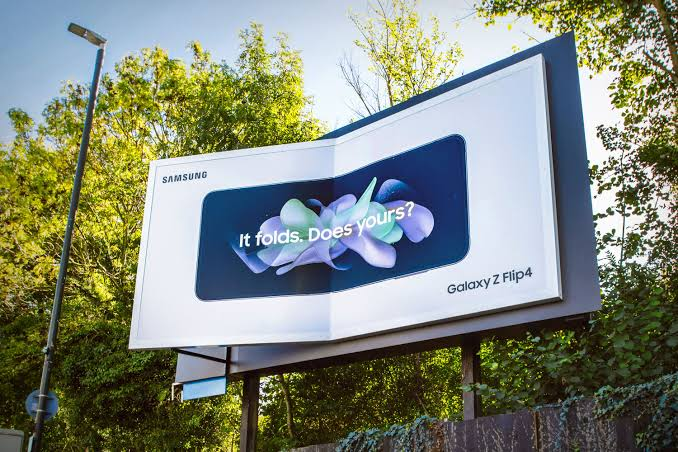
Samsung just launched a massive billboard campaign across Seoul, Tokyo, and London with a simple, provocative message: “Welcome to Foldables.”
The timing was no accident. Hours after Apple unveiled its long-awaited first foldable device, the iPhone Duo, Samsung took to social media with a series of fiery jabs. The South Korean tech giant publicly mocked Apple’s entry into the space, calling the new iPhone “reheated leftovers” and teasing that Apple was late to a party Samsung started seven years ago.
Apple CEO John Ternus fired back during his keynote presentation, describing older foldable designs as looking like “two phones awkwardly stuck together.”
This fiery exchange marks the beginning of the most intense smartphone battle in recent memory. For years, Samsung enjoyed almost total control of the high-end folding market. Now, with Apple stepping onto the stage, the entire industry is bracing for a fundamental shift in how premium mobile devices are built, sold, and used.
The Epic Rivalry Takes a Folding Turn
Samsung launched its first mass-market foldable phone back in 2019. That original launch was far from smooth. Reviewers encountered peeling screen protectors, broken hinges, and fragile displays that forced Samsung to delay the release and redesign the hardware from scratch.
Build Funnels, Email Lists & Sell Online With One Free Tool
Create funnels, send emails, and sell online using Systeme.io without paying for multiple tools.
Create Free AccountFree forever • No credit card • Beginner-friendly
Through eight generations of continuous refinement, Samsung turned a fragile experiment into a durable, mainstream lineup. Devices like the Galaxy Z Fold 8 and Z Flip 8 proved that flexible glass could handle daily wear and tear while offering genuine multitasking benefits.
Apple chose a very different path. True to its historic playbook, the Cupertino company stayed on the sidelines for years, letting competitors pay for the trial and error. Apple waited for display technology, hinge mechanics, and glass durability to mature before revealing its own design.
That patience paid off with the unveiling of the iPhone Duo. As earlier reports on Apple’s foldable iPhone expectations predicted, Apple built a premium wide-format device designed to function as a compact phone when closed and a full-size tablet when opened.
The competition between these two giants is no longer theoretical. It is an active war for market share, mindshare, and the future of mobile hardware.
Unpacking the Hardware: Galaxy Z Fold 8 vs. iPhone Duo
When comparing these two devices side-by-side, the contrast in design philosophies becomes clear immediately.
Form Factor and Aspect Ratios
Samsung’s Galaxy Z Fold 8 adopts a updated wide aspect ratio. Earlier Z Fold generations faced criticism for having cover screens that felt too narrow and cramped for typing. Samsung fixed this by widening the outer screen, making the phone feel natural in your hand even when closed. When opened, the 7.6-inch inner screen displays a squarish layout ideal for split-screen apps, spreadsheets, and reading.
Apple took a broader approach with the iPhone Duo. When opened, it features a 7.7-inch horizontal display with an aspect ratio similar to an iPad Mini. This wide form factor feels tailored for watching widescreen video and reviewing large documents without severe black bars along the top and bottom.
The Display Crease Race
Eliminating the visible center crease on the inner display has been the ultimate engineering goal for foldables.
Samsung introduced its latest creaseless display technology on the Galaxy Z Fold 8. By using an advanced liquid-hinge system and flexible glass layers, Samsung reduced the center dip to a level where it is nearly invisible to the eye and barely noticeable under a finger.
Apple focused heavily on panel flatness during its launch event. The iPhone Duo utilizes specialized structural plates behind the OLED panel to distribute pressure evenly when opening and closing. The result is a smooth inner surface, though field testing will ultimately decide which hinge system stands up better to months of constant opening and closing.
Features, Battery, and Styling
Samsung built the Galaxy Z Fold 8 as a heavy-duty productivity tool. It retains full S Pen stylus support, allowing users to draw, sign contracts, and take notes directly on the large screen. Samsung also enhanced battery performance through efficient display refresh rates and optimized cooling hardware.
Apple added several distinct physical controls to the iPhone Duo. It includes a dedicated capacitive camera control button along the side frame and integrates Touch ID into the power button for seamless biometrics. Furthermore, Apple added 5G satellite connectivity, permitting emergency messaging and basic location tracking even when completely off the cellular grid.
Samsung continues to challenge Apple across multiple hardware categories, similar to how the Galaxy Book 6 launch aimed directly at the MacBook. But the foldable smartphone arena represents the highest-stakes battleground yet.
The Irony of the Supply Chain: Samsung Powers Apple
One of the most fascinating aspects of this conflict lies beneath the surface in the global tech supply chain.
While Samsung Electronics mocks Apple in television ads and social media posts, Samsung Display—its sister company—is earning billions by manufacturing key components for Apple.
Producing flexible OLED panels that can withstand hundreds of thousands of folds without degrading requires immense manufacturing scale. Samsung Display remains the global leader in this technology. As a result, Apple relies heavily on Samsung Display to supply the primary folding panels for the iPhone Duo.
This creates a unique business dynamic:
- Samsung Electronics loses potential phone sales when consumers choose an iPhone Duo over a Galaxy Z Fold 8.
- Samsung Display gains substantial revenue for every iPhone Duo sold worldwide.
- Apple relies on its primary rival’s manufacturing arm to deliver its most important new hardware launch in years.
This co-dependent relationship shows that behind the public banter and marketing jabs, the tech industry relies on deeply interconnected manufacturing networks.
Price Tags and Market Impact: Are $2,000 Phones the New Normal?
Buying into the foldable revolution requires a significant financial commitment. Neither company is offering budget options for their flagships.
Detailed Pricing Breakdown
- Samsung Galaxy Z Fold 8: Starts at $1,899.99 for the 256GB base model. Higher storage tiers climb up toward $2,200.
- Apple iPhone Duo: Starts at $1,999 for the 256GB model. The 512GB version lands at $2,199, the 1TB version costs $2,599, and the maxed-out 2TB configuration reaches $3,199.
While these prices are steep, market research shows growing consumer willingness to invest in ultra-premium mobile devices.
Global Market Predictions
Industry analysts at Counterpoint Research and IDC project that global foldable smartphone shipments will reach 27.5 million units this year, marking a growth rate of roughly 30 percent over previous years.
Before Apple entered the category, Samsung controlled over 40 percent of the global foldable market. With the arrival of the iPhone Duo, projections indicate Apple could capture up to 28 percent of global foldable sales almost immediately, pushing Samsung’s market share down toward 31 percent.
In key regional markets like North America, analysts predict Apple could secure up to 46 percent of all foldable sales within its first full year.
Instead of shrinking the pie for Samsung, Apple’s entrance is expected to expand the total market. Millions of buyers who previously viewed foldables as experimental gadgets now see the form factor as validated and ready for daily use.
Software Wars: iOS Multitasking vs. One UI Maturity
Hardware is only half the equation. The real test for any foldable device is how effectively its software takes advantage of the expanded screen real estate.
Samsung’s One UI Advantage
Samsung spent seven years refining Android for foldable displays. Its One UI software offers a mature desktop-like multitasking environment:
- Taskbar Navigation: A persistent bottom taskbar lets you switch between favorite apps with a single tap.
- Three-App Split: You can run three active applications simultaneously on the main display while keeping a floating pop-up window open.
- Flex Mode: Bending the phone halfway turns the bottom half of the screen into a trackpad or control console while the top half displays media or video calls.
- Samsung DeX: Connecting the device to an external monitor transforms the phone into a full desktop workstation interface.
Apple’s iOS Adaptation for iPhone Duo
Apple redesigned key parts of iOS to accommodate the iPhone Duo’s dual-screen capabilities:
Build Funnels, Email Lists & Sell Online With One Free Tool
Create funnels, send emails, and sell online using Systeme.io without paying for multiple tools.
Create Free AccountFree forever • No credit card • Beginner-friendly
- App Continuity: Opening the device instantly expands single-screen iPhone apps into multi-pane iPad views.
- Drag-and-Drop Workflow: Users can drag images, text, and files between active side-by-side apps smoothly using intuitive gesture controls.
- Smart Docking: When partially folded, the iPhone Duo automatically adjusts media playback controls, keyboard layouts, and camera viewfinders to fit the bottom half of the display.
Samsung holds a clear lead in deep customization and multitasking flexibilities, but Apple’s focus on smooth transitions and app optimization makes the iPhone Duo remarkably easy to pick up and use immediately. You can track ongoing software developments and feature updates in our dedicated Technology & AI section.
Impact on Content Creators and Digital Businesses
The arrival of wide-format foldables changes the landscape for digital entrepreneurs, media producers, and online content creators.
Having a tablet-sized screen that fits in a pocket transforms how creators manage their digital workflows on the go:
- Mobile Video Editing: Editors can run full timeline software on the inner screen while previewing high-resolution clips without plugging into external monitors.
- Live Streaming and Analytics: Creators can stream live content on one side of the screen while keeping real-time chat feeds and performance metrics open on the other.
- Automation and Management: Business owners managing automated channels can monitor content pipelines, schedule uploads, and review analytics without needing a laptop.
If you run digital content workflows or want to build automated online income streams, explore our step-by-step guides in the YouTube Automation category.
Key Comparison Summary
To understand how these two flagship foldables compare across core specifications, here is a breakdown of their primary features:
- Starting Price: Samsung Galaxy Z Fold 8 starts at $1,899.99, while Apple iPhone Duo starts at $1,999.
- Main Inner Display: Samsung offers a 7.6-inch panel, while Apple provides a 7.7-inch panel.
- Display Supplier: Samsung Display supplies OLED panels for both the Galaxy Z Fold 8 and the iPhone Duo.
- Biometric Security: Samsung uses an side-mounted fingerprint scanner and face unlock, while Apple relies on Touch ID built into the power button.
- Stylus Support: Supported on Samsung Galaxy Z Fold 8 with the S Pen; not supported on the iPhone Duo at launch.
- Satellite Features: Apple includes emergency 5G satellite connectivity; Samsung relies on standard cellular and Wi-Fi networks.
- Preorder and Availability: Galaxy Z Fold 8 is available now; iPhone Duo preorders open October 16 with full release on October 23.
Frequently Asked Questions (FAQs)
When is the official release date for the Apple iPhone Duo?
Preorders for the Apple iPhone Duo begin on October 16, with official store availability starting on October 23.
Is the iPhone Duo more expensive than the Samsung Galaxy Z Fold 8?
Yes. The base 256GB model of the iPhone Duo starts at $1,999, which is approximately $100 higher than the starting price of the Galaxy Z Fold 8 at $1,899.99. Higher storage tiers for the iPhone Duo go up to $3,199 for the 2TB model.
Does Samsung manufacture the screen for Apple’s foldable phone?
Yes. Samsung Display supplies the primary flexible OLED display panels used in Apple’s iPhone Duo. This makes Samsung both a key component supplier and the primary hardware rival to Apple.
Does the iPhone Duo support Apple Pencil or stylus input?
At launch, Apple has not added Apple Pencil support to the iPhone Duo. If you need stylus integration for drawing or handwritten note-taking, the Galaxy Z Fold 8 with S Pen support remains the primary choice.
How durable are modern foldable hinges and screens?
Both devices feature advanced hinge mechanisms and ultra-thin flexible glass designed for hundreds of thousands of fold cycles. While early foldables were delicate, modern designs offer strong dust protection, water resistance, and creaseless screen structures built for several years of heavy daily use.
The Verdict: A New Chapter for Mobile Hardware
Samsung’s sarcastic “Welcome to Foldables” campaign makes for fun marketing banter, but behind the taunts lies a clear reality: competition drives innovation.
Samsung spent seven years refining foldable technology, building a solid foundation, and proving that flexible displays are not just a gimmick. Apple’s entrance validates the entire product category, forcing both companies to push screen quality, hinge engineering, and software features to new heights.
Whether you prefer Samsung’s feature-packed Android experience or Apple’s refined iOS ecosystem, mobile users are entering a new era where folding screens are becoming the gold standard for premium smartphones.
Want to learn more about our editorial team and mission? Visit our About Us page or get in touch through our Contact Page. Stay connected with our latest tech updates and news by following us on Instagram, Facebook, and X (Twitter).
