
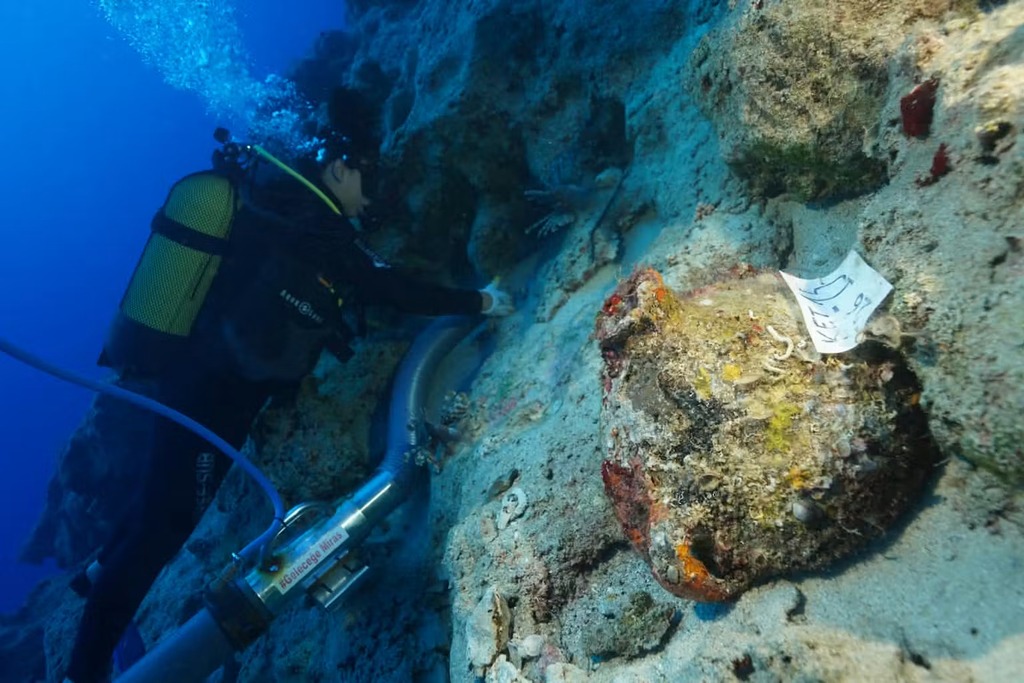
Deep beneath the clear blue waters of the Mediterranean, resting quietly on an underwater slope off the southern coast of Turkey, marine archaeologists have uncovered what is now believed to be the oldest shipwreck in human history.
Lying roughly 30 meters beneath the waves near Kekova Island in Turkey’s Antalya province, the ancient vessel sank between 4,400 and 4,700 years ago. That puts the date of this doomed voyage right into the Early Bronze Age—a period when ancient Egyptians were still laying the foundation stones of the Great Pyramid of Giza.
For nearly five millennia, this ancient merchant vessel sat untouched on the seabed. While its wooden hull vanished long ago, its cargo remained behind like a sealed time vault. More than 30 massive ceramic storage jars, heavy stone anchors, and preserved organic traces survived intact. The discovery rewrites the timeline of human seafaring and sheds brand new light on the brave sailors who crossed dangerous open seas thousands of years before modern navigation.
The Moment Archaeologists Stumbled on the Seafloor Ruins
The groundbreaking discovery was announced by Turkey’s Minister of Culture and Tourism, Mehmet Nuri Ersoy, following detailed underwater excavations conducted by the Mediterranean Archaeology Association in partnership with Akdeniz University.
Leading the underwater expedition was Professor Hakan Öniz, one of Turkey’s leading marine archaeologists. Öniz and his dive team had been surveying the rugged coastal waters of Antalya, a region known for historic maritime routes. When the divers reached a depth of about 30 meters off Kekova Island, they noticed unusual shapes half-buried in the sand and wedged between rocky crevices.
The $0 Secret To Launching Your Entire Online Empire
Why pay hundreds every month for separate software? Build funnels, send emails, and make sales with Systeme.io completely free.
Get Started For $0Free Forever • No Credit Card Needed • Beginner-Friendly
Those shapes were not natural rock formations. They were manufactured ceramic vessels, known as amphorae, along with giant stone anchors that had held the vessel in place before disaster struck.
Speaking about the experience to reporters at the BBC, Professor Öniz described the site as a living time capsule at the bottom of the sea. His team realized quickly that they were the first human beings to lay eyes and hands on these artifacts in nearly 5,000 years.
Dating the Vessel: As Old as the Egyptian Pyramids
Determining the age of something that has spent millennia underwater is no simple task, especially when the ship itself has deteriorated. However, the distinctive shapes, clay styles, and rim designs of the ceramic jars gave the archaeological team clear answers.
To analyze the artifacts with the highest precision, the excavation team brought in Dr. Karin Sowada, a specialist in Bronze Age Mediterranean trade from Macquarie University in Sydney, Australia. Dr. Sowada examined more than 20 recovered vessels and compared them to pottery types cataloged across the ancient world.
The results pointed straight to the Early Bronze Age, placing the wreck somewhere between 2700 BCE and 2400 BCE.
Before this find, the oldest confirmed shipwreck on Earth was the Dokos wreck, found off the coast of Dokos Island in southern Greece, which dates back around 4,200 years. This new Kekova discovery beats that record by several centuries. It also easily predates Turkey’s famous Uluburun shipwreck, a Late Bronze Age vessel discovered in the 1980s that dates back around 3,300 years.
Why Did the Ship Disappear While the Cargo Survived?
People often wonder why divers find pottery and anchors, but not the wooden walls of the ship itself.
Wood is organic material. Over hundreds of years in warm, oxygen-rich sea waters, untreated timber is consumed by wood-boring marine mollusks often referred to as shipworms. Currents, shifting sand, and microscopic bacteria gradually break down the frame of a wooden boat until nothing structural remains.
Stone and baked ceramic clay, on the other hand, do not decay in water. Clay baked in a kiln forms a ceramic mineral bond that can survive indefinitely underwater as long as it is not crushed by heavy falling rocks.
The three stone anchors found at the site were cut directly out of solid rock, featuring drilled holes through which thick ropes once ran. Because the hull broke apart or was eaten away, the heavy anchors and rows of storage jars settled directly into the sea floor, creating a footprint that marks the exact outline of the lost vessel.
Archaeologists estimate the vessel was roughly 10 meters long—a modest, sturdy wooden merchant boat powered by square sails and rowing oars, built to hug coastlines while carrying precious goods between ancient trade ports.
What Was Inside the Jars?
When Dr. Karin Sowada looked inside the recovered ceramic pots in the research laboratory, she found something extraordinary: thick, dark, glossy residue clinging to the inner walls of the containers.
For archaeologists, finding residue inside ancient jars is equivalent to striking gold. In the dry climate of museums, we admire pots as works of art, but in antiquity, these vessels were the cargo containers of their era.
The residue suggests the ship was carrying valuable agricultural goods. The most likely cargo items include:
- Olive Oil: A vital commodity in the Bronze Age used for food, cooking, lighting oil lamps, and making soap and skincare products.
- Wine: Fermented grape wine was traded heavily across the Mediterranean basin and often sealed inside jars with tree sap.
- Tree Resin: Natural resin collected from pine or terebinth trees was widely used as a sealant to waterproof jars, as well as an antiseptic medicine and an incense base.
- Grains and Pulses: Staple crops traded across port cities to feed growing coastal settlements.
The interior residue had been sealed off by ocean sediment, creating an airtight environment that kept the organic chemicals from vanishing completely. Further chemical and botanical testing will soon pinpoint the exact molecular makeup of the ancient liquid.
Send, Spend & Hold Money Worldwide Without Hidden Fees
Transfer money internationally at the real exchange rate and hold 40+ currencies in one account.
Open a Wise AccountMid-market rate • Fast transfers • 40+ currencies
The Mysterious Butter-Making Pot
Among the more than 30 ceramic containers brought to the surface, one particular jar immediately caught the attention of researchers.
Unlike the standard tall shipping jars, this specific vessel featured nine deliberate stamped markings on its outer surface, along with two distinct holes placed along its body.
After careful analysis, the research team believes this jar was not just regular cargo. Instead, it was likely an onboard kitchen tool used for processing milk into cheese or butter.
Long sea voyages required food that would not spoil quickly. In the Early Bronze Age, sailors did not have refrigeration or canned food. Being able to turn fresh milk from goats or sheep into butter or hard curd cheese allowed a small crew to survive weeks at sea. The markings on the exterior may have served as measurement lines or ownership stamps made by the ship’s cook or merchant.
Finding everyday living tools on a shipwreck adds an intimate, deeply human element to the discovery. It proves that the men sailing these waters were practical problem-solvers who prepared their own meals while battling waves and rocky shorelines.
Tracing the Trade Route: Where Did the Ship Come From?
One of the most fascinating aspects of modern marine archaeology is clay sourcing, scientifically known as petrographic analysis. Every region has a distinct mineral fingerprint in its soil. By examining thin slices of pottery under a microscope, scientists can tell where the clay was dug out of the ground.
Early analysis shared by Minister Mehmet Nuri Ersoy indicates that the clay used to make these storage jars originated in workshops located in the Jordan Valley, in the Levant.
Similar pottery styles have been unearthed at several famous land excavations, including:
- The temple and tomb complexes surrounding the Egyptian pyramids at Giza, Saqqara, and Abusir.
- The legendary fortified city of Troy in northwestern Anatolia.
- Minoan settlement layers on the island of Crete.
This tells us that the doomed ship was not an isolated fishing boat. It was part of an international maritime trade network spanning hundreds of miles across modern-day Lebanon, Israel, Jordan, Syria, Turkey, Egypt, and Greece.
Researchers believe the ship took on cargo at an eastern Mediterranean port, made its way along the southern coast of Anatolia, and was likely sailing toward trading hubs in Crete or Troy when rough weather struck. Understanding how different societies shared resources thousands of years ago mirrors our modern efforts to manage global commerce and trade, much like how modern nations navigate unprecedented global trade records.
The $0 Secret To Launching Your Entire Online Empire
Why pay hundreds every month for separate software? Build funnels, send emails, and make sales with Systeme.io completely free.
Get Started For $0Free Forever • No Credit Card Needed • Beginner-Friendly
Kekova: A Beautiful Paradise with a Treacherous Maritime Past
Today, Kekova is famous for its stunning turquoise waters, secluded coves, and popular tourist boat tours. Visitors flock there to view sunken ruins from the ancient Lycian civilization that slipped into the sea after severe earthquakes in the 2nd century CE.
However, beneath its tranquil vacation appearance, Kekova has historically been a graveyard for sailors.
The geography of the area includes steep underwater drop-offs, sharp hidden reefs, and narrow sea channels between the island and the Turkish mainland. During late autumn and winter, sudden squalls can sweep down from the Taurus Mountains, generating fierce localized winds and choppy cross-currents.
For a 10-meter wooden boat weighed down by dozens of heavy stone anchors and clay pots full of oil, a sudden storm near Kekova could prove fatal within minutes. If the steering oar broke or water flooded the low deck, the vessel would have quickly overturned and plummeted to the seafloor slope, scattering its load across the rocks.
From the Seabed to the Museum: How Archaeologists Protect Fragile Finds
Recovering artifacts that have been submerged for nearly five thousand years is a delicate operation. If wet archaeological ceramics dry out too quickly in open air, expanding salt crystals can shatter the clay from the inside out.
Once the team at Akdeniz University mapped the shipwreck site using 3D sonar and underwater video grids, professional dive teams used controlled air-lift vacuums to gently clear away centuries of silt. Each amphora was secured in custom padded lifting nets before being brought to the surface.
The artifacts were immediately transferred into desalinated water treatment tanks to flush out marine minerals slowly.
Minister Ersoy announced that after conservation, desalination, and laboratory study are complete, the entire collection of anchors, jars, and cargo remains will go on permanent public display at the Mediterranean Underwater Archaeology Museum in Antalya.
Much like modern institutions that go to great lengths to preserve rare cultural heritage—from major art galleries safeguarding historic relics to ambitious projects like the billion-dollar Lucas Museum—protecting these ancient artifacts ensures that vital pieces of human history remain safe for future generations. Preserving recovered relics also keeps them out of the hands of illegal artifact looters, a problem that mirrors how law enforcement tracks down stolen treasures in high-profile art recovery operations.
Remembering the Human Story Behind the Wreck
It is easy to look at archaeological discoveries purely as collections of old pots, stone weights, and carbon dates. But Professor Öniz made a point that resonated deeply with the international research community.
Every single jar on that seabed was made by human hands. A potter worked the clay on a manual wheel in the Jordan Valley. A dockworker lifted the heavy jar onto his shoulder and hauled it aboard the ship. And a crew of sailors set out across open waters, braving rough conditions to earn a living and bring goods to distant lands.
Somewhere on shore, families, wives, and children were waiting for those men to return. Because the ship sank quietly off Kekova, that crew never made it home.
Touching these items for the first time in five thousand years is not just a scientific achievement. It is a moment of connection with ordinary people who lived, worked, and faced the perils of the sea at the very dawn of written history. The sea continues to hold many secrets, reminding us of how mysterious and interconnected our planet’s waters have always been, a theme reflected in ongoing studies of how major ocean currents interact.
What Else Lies Hidden Off the Coast of Turkey?
The discovery off Kekova Island is just one chapter in an ongoing underwater survey across southern Turkey.
According to reports from the Turkish Ministry of Culture and Tourism, researchers have documented more than 430 ancient shipwrecks along the Turkish coastline alone. These range from Bronze Age traders and classical Greek warships to Roman grain carriers, Byzantine merchant vessels, and Ottoman galleys.
Turkey’s position at the crossroads of Europe, Asia, and Africa made its coastal waters the busiest maritime highway in the ancient world. With modern diving gear, robotic submersibles, and high-resolution seafloor scanners improving every year, archaeologists believe many more historic vessels are waiting to be found under the sand.
Frequently Asked Questions
Where exactly was the world’s oldest shipwreck found?
The wreck was discovered approximately 30 meters beneath the surface of the Mediterranean Sea, right near Kekova Island in the southern Antalya province of Turkey.
How old is the Kekova shipwreck?
Archaeologists date the wreck to between 4,400 and 4,700 years old (approximately 2700 BCE to 2400 BCE), during the Early Bronze Age.
What ship previously held the record for the oldest shipwreck?
Before this discovery, the Dokos shipwreck found off Dokos Island in southern Greece held the record, dating back around 4,200 years.
Did any human remains or wooden parts of the ship survive?
No wooden structures or human remains survived. Wood and organic tissues decay in warm Mediterranean waters over thousands of years due to marine life and bacteria. However, over 30 ceramic pots and three large stone anchors remained intact.
What was the ship carrying?
The ship was loaded with ceramic amphorae that held agricultural trade products like olive oil, wine, grain, or pine resin. One recovered jar appears to have been an onboard cheese or butter churn used by the crew.
Where can the public see these artifacts?
Following scientific analysis, cleaning, and conservation treatments, the artifacts will be exhibited at the Mediterranean Underwater Archaeology Museum in Antalya, Turkey.
