
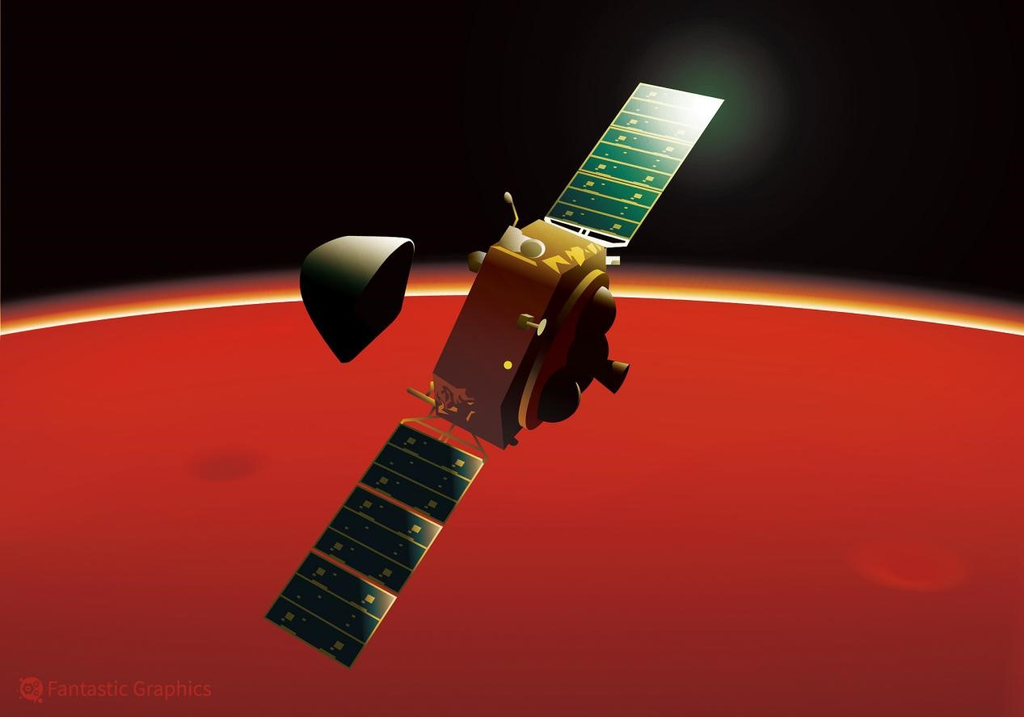
China has set its sights on a historic goal that could completely change how we understand the solar system. Leading space scientists in the country have confirmed that China intends to collect rocks and soil from Mars and bring them back to Earth around 2031. If the plan succeeds, it will mark the first time in human history that material from the Red Planet is delivered directly to our hands.
The ambitious project is named Tianwen-3. It is designed as a direct, streamlined mission to grab Martian samples and bring them home faster than previous space concepts. While other space agencies have spent years working on complex multi-stage concepts, China is moving forward with a focused timeline that could put them first in this new space race.
This effort is about much more than landing on another world. Scientists want to examine real Martian soil up close using advanced equipment on Earth. By doing this, they hope to answer one of the biggest questions humanity has ever asked: did life ever exist on Mars?
What Is the Tianwen-3 Mission All About?
The core of this bold project is the Tianwen-3 mission, which is currently scheduled to launch around 2028. China plans to use two powerful Long March 5 heavy-lift rockets for the operation. These rockets will lift off from the Wenchang Space Launch Site located in Hainan province.
Instead of sending just one spacecraft, the launch will split the duties between two main components. One rocket will carry a stationary lander and ascent vehicle, while the second rocket will carry an orbiter and a return capsule. Both spacecraft will travel through deep space for roughly three years before reaching Mars.
The $0 Secret To Launching Your Entire Online Empire
Why pay hundreds every month for separate software? Build funnels, send emails, and make sales with Systeme.io completely free.
Get Started For $0Free Forever • No Credit Card Needed • Beginner-Friendly
Once the spacecraft arrive at Mars, the lander will descend through the thin Martian atmosphere to touch down on the surface. Unlike long-term rover missions that explore for years, Tianwen-3 is built for speed and efficiency. The lander will stay on the surface for only about two months to do its primary job.
Simple, Direct, and Fast Collection
The operational strategy for Tianwen-3 avoids overly complicated steps on the ground. The lander will stay in one place without needing a rover to drive miles away. It will use a robotic arm and a heavy drill to dig down roughly seven feet into the surface.
The goal is to gather about 500 grams, or roughly 18 ounces, of rock and soil. Once the sample is collected, it will be sealed tight inside a small ascent rocket mounted on top of the lander.
This small rocket will then blast off from the surface of Mars into orbit. Up in orbit, the orbiter will meet the ascent vehicle, grab the precious package, and start the long journey back to Earth. According to reports from the Global Times, this whole sequence is targeted to finish around 2031.
How China Could Beat NASA in the Mars Sample Race
For decades, the United States and NASA have been regarded as the leaders in Mars exploration. NASA landed the Viking landers in the 1970s and has operated successful rovers like Curiosity and Perseverance. However, getting samples back to Earth from Mars requires a completely different level of engineering and funding.
Currently, NASA has its Perseverance rover active on Mars, collecting fascinating rock cores and placing them into small metal tubes on the ground. The original plan was for NASA and the European Space Agency to send a follow-up mission to pick up those tubes.
However, that joint plan has run into serious budget delays and design redesigns. Cost overruns have forced space officials in the U.S. to rethink how and when they can bring those samples back. Some estimates suggest NASA may not be able to return its samples until the mid-to-late 2030s.
Because China chose a simpler, self-contained approach, it has a strong chance to return Mars samples first. Details published by TBS News show that China’s timeline puts them years ahead of current U.S. schedule projections.
Comparing the Two Strategies
The main difference comes down to mission architecture. NASA’s design relies on multiple missions working together over many years: one rover to collect, one lander to retrieve, a tiny rocket to launch into space, and an orbiter to bring it home. If any single piece suffers a delay or budget cut, the whole system stops.
China’s approach puts everything into one single, coordinated mission launch window. The lander collects dirt right beneath its feet, drills down, loads the ascent rocket, and leaves. There is no waiting for a rover to travel miles across dangerous terrain to hand off sample tubes.
This straightforward design reduces the number of things that can go wrong. It also lowers overall mission expenses, making it far easier to stay on schedule.
Why Martian Soil Is the Ultimate Treasure for Science
You might wonder why countries are willing to spend billions of dollars just to bring back a pound of dirt. The answer lies in the limitations of today’s space probes.
Even the most advanced rovers sent to Mars can only carry tiny laboratory instruments. Those instruments are great for general analysis, but they cannot match the massive, highly specialized laboratories we have on Earth.
When dirt from Mars arrives on Earth, scientists can use electron microscopes, particle accelerators, and precise isotopic tools to study every single atom. They can measure the exact age of rocks, search for microscopic fossils, and check for organic molecules that might prove life existed billions of years ago.
Hunting for Signs of Ancient Life
Mars today is a freezing, dry desert with very thin air. But billions of years ago, conditions were very different. Satellite images show dry river valleys, ancient lake beds, and delta formations where liquid water once flowed freely across the surface.
Send, Spend & Hold Money Worldwide Without Hidden Fees
Transfer money internationally at the real exchange rate and hold 40+ currencies in one account.
Open a Wise AccountMid-market rate • Fast transfers • 40+ currencies
If Mars had liquid water, warmth, and a thicker atmosphere in its past, it may have developed simple single-celled life. Finding even tiny molecular evidence of ancient microbes would be one of the greatest scientific discoveries in history.
It would prove that life is not unique to Earth. It would show that whenever a planet has water and the right chemical elements, life can begin.
Unlocking the History of Planets
Besides searching for life, studying Martian soil helps us understand how rocky planets form and evolve. Earth and Mars were created around the same time from the same cloud of gas and dust.
Yet, Earth became a vibrant ocean world full of life, while Mars became a cold, barren desert. By analyzing the chemical structure of Martian rocks, scientists can learn why the two planets took such drastically different paths.
Understanding Mars can also give us clues about Earth’s long-term future. It provides a real-world look at how a planet loses its atmosphere and magnetic field over time.
Preparing the Mission: Advanced Geological Mapping
Before you can land on Mars, you need to know exactly where you are landing. Space agencies cannot risk landing a multi-billion-dollar spacecraft on top of a giant boulder or inside a deep trench.
According to research highlights covered by The Debrief, project chief scientist Hou Zengqian confirmed that Chinese teams are building a high-resolution geological map of Mars. This map will help engineers select the safest and most scientifically valuable landing spot.
The selection process is intense. Scientists are looking for a flat, open plain that has smooth ground for a safe landing, but also possesses rich geological features nearby.
Lessons from Previous Missions
China is not starting from scratch. In 2021, China successfully landed its Tianwen-1 mission on Mars, which deployed the Zhurong rover. That rover spent months traveling across a vast region known as Utopia Planitia.
Data collected by the Zhurong rover and the Tianwen-1 orbiter are directly helping engineers prepare for Tianwen-3. In addition, Chinese researchers are using public datasets from previous NASA and European Space Agency missions to make their maps as accurate as possible.
The $0 Secret To Launching Your Entire Online Empire
Why pay hundreds every month for separate software? Build funnels, send emails, and make sales with Systeme.io completely free.
Get Started For $0Free Forever • No Credit Card Needed • Beginner-Friendly
By combining global data with their own observations, the mission team plans to produce localized maps at an impressive 1:50,000 scale. This level of detail ensures that every rock, hill, and slope in the landing area is well understood.
The Massive Challenges Standing in the Way
Planning a Mars sample return mission is easy on paper, but executing it in real life is incredibly difficult. Space flight to Mars presents extreme engineering hurdles that push human technology to its limits.
Here are some of the biggest obstacles Chinese space engineers must overcome to make the 2031 launch and return a success:
1. Launching a Rocket Off Another Planet
Humanity has launched thousands of rockets from Earth, but we have never launched a rocket from the surface of another planet.
When a rocket launches from Earth, it has a massive team of ground control engineers monitoring every system. On Mars, the launch must happen automatically. Signals take several minutes to travel between Earth and Mars, meaning human operators cannot control the launch in real time.
The small ascent rocket must automatically check its own guidance systems, ignite its engine, adjust its path, and reach the exact orbit required to meet the waiting spacecraft.
2. Autonomous Space Docking
Once the ascent vehicle reaches Martian orbit, it must find and dock with the orbiter. The orbiter is a small spacecraft moving at thousands of miles per hour through space.
The two vehicles must meet, align their docking mechanisms, and safely transfer the sample capsule without damaging anything. This delicate operation must happen millions of miles away from Earth, completely controlled by onboard computers.
3. Surving Harsh Environmental Conditions
Mars is a brutal place for machinery. Temperatures near the equator can drop well below negative 100 degrees Fahrenheit at night. These rapid temperature shifts can crack metal components and drain battery power quickly.
Additionally, dust storms on Mars can last for weeks or months. Fine dust can coat solar panels, block sunlight, and jam mechanical parts. The lander must operate fast enough to gather samples before harsh weather disrupts the mission.
4. Planetary Protection Protocols
When bringing material back from another world, space agencies must follow strict safety rules. These rules are known as planetary protection protocols.
First, engineers must ensure that Earth microbes do not contaminate Mars. If Earth bacteria travel on the lander and end up in the sample, scientists might accidentally “discover” Earth life and think it came from Mars.
Second, the sample container must be completely sealed so that Martian dirt does not leak into Earth’s environment during return. While the chance of finding harmful alien microbes is extremely small, space agencies take zero risks. The returned capsule will be placed in a high-containment facility as soon as it arrives on Earth.
A Stepping Stone for Future Human Exploration
Bringing dirt back to Earth is not just about history books and scientific research. It is also a critical step toward sending human astronauts to Mars in the future.
As Chinese space scientist Zhang points out in reports by the Global Times, Mars offers the best target in our solar system for long-term human exploration. Mercury is too close to the Sun, Venus has a crushing atmosphere, and the outer planets are too far away. Mars has water ice, a manageable day-night cycle, and seasonal weather patterns similar to Earth.
However, keeping humans alive on Mars will require using local resources like water and soil. By studying the soil structure and chemical makeup in ground labs, scientists can learn how to build bases, extract drinking water, and create rocket fuel right on the Red Planet.
Mastering the technology to land, launch, and return from Mars proves that a round-trip journey for human astronauts is truly possible.
The Changing Dynamics of Global Space Exploration
The Tianwen-3 mission highlights how quickly the global space landscape is changing. For many decades, space exploration was dominated by a few agencies. Today, national space programs around the world are competing and pushing each other to achieve greater goals.
This competition speeds up innovation. When one agency sets an ambitious target date, it encourages other nations to streamline their projects and find creative solutions.
At the same time, Chinese space officials have stated that the Tianwen-3 mission will follow principles of open cooperation. According to news coverage on Jalopnik, mission leaders intend to share scientific data with researchers globally. Space exploration works best when scientists across the globe share knowledge and discoveries for the benefit of everyone.
Frequently Asked Questions (FAQs)
When will China launch the Tianwen-3 mission?
China plans to launch the Tianwen-3 mission around 2028 using two Long March 5 rockets. The mission will travel to Mars, collect samples, and return those samples back to Earth around 2031.
How much dirt is China planning to bring back from Mars?
The mission aims to collect roughly 500 grams (about 18 ounces) of Martian soil and rock samples. The lander will drill down about seven feet into the surface to gather pristine material.
Why hasn’t NASA brought back Mars samples yet?
While NASA’s Perseverance rover has already collected sample tubes on Mars, the mission plan to retrieve them has faced high costs and budget delays. NASA is currently redesigning its architecture, which may push its sample return target into the mid-to-late 2030s.
Could Martian soil contain alien bacteria or life?
It is unlikely that the soil contains active, dangerous life, as the surface of Mars is cold and exposed to harsh radiation. However, scientists hope to find microscopic fossils or chemical traces of ancient life from millions or billions of years ago. Strict containment rules will keep the samples isolated once they arrive on Earth.
Where will the lander touch down on Mars?
The final landing site selection is expected to be finalized around late 2026. Scientists are targeting flat, safe areas with interesting geological history, using detailed surface maps built from previous satellite data.
Final Thoughts
The race to bring back the first sample from Mars is officially on. With a projected target date of 2031, China’s Tianwen-3 mission represents a bold step forward in space exploration. If successful, it will unlock secrets about Mars’ past, teach us more about how planets develop, and pave the way for human footprint on the Red Planet.
To stay updated on the latest trending news across science, culture, and global events, check out our About Page to see what we are all about. Have questions or thoughts about space exploration? Head over to our Contact Page and let us know!
You can also join the conversation and follow our social media channels for daily updates:
- Connect with us on Facebook
- Follow our visual updates on Instagram
- Join the discussion on X (formerly Twitter)
