
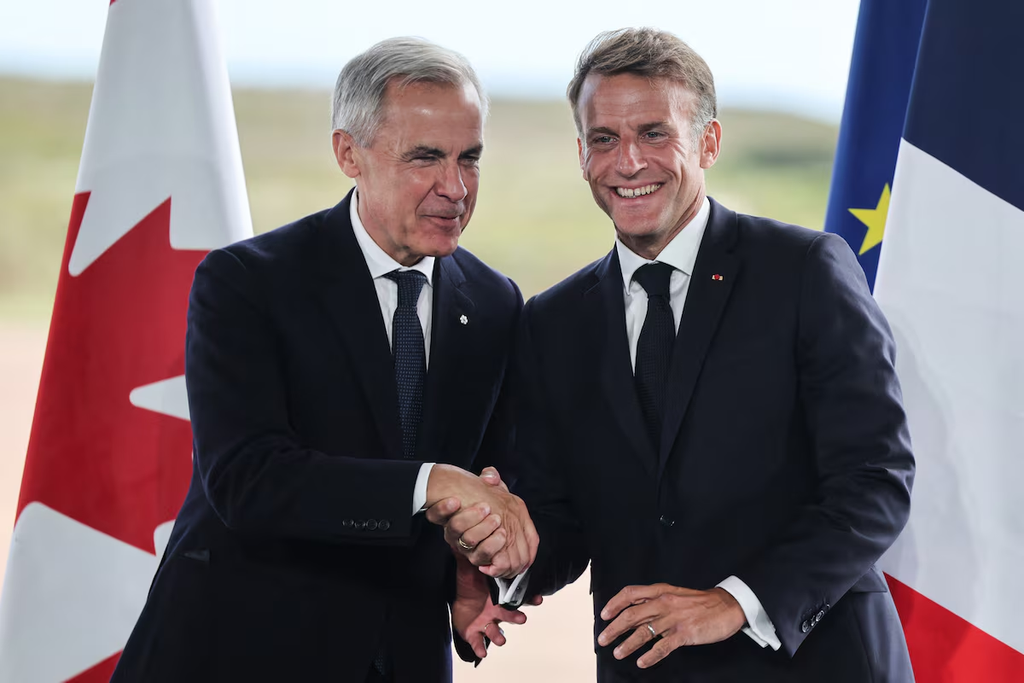
Canadian Prime Minister Mark Carney and French President Emmanuel Macron stood together on the rocky shores of Saint-Pierre and Miquelon to announce a major breakthrough in international space policy. Canada and France are officially joining forces to build space launch infrastructure, share ground stations, and develop advanced satellite technology together.
This announcement represents much more than a routine scientific partnership. It signals a fundamental realignment in global politics. For decades, Canada relied almost exclusively on American infrastructure to get into orbit and protect its airspace. Now, with trade disputes with Washington reaching unprecedented levels, Ottawa is intentionally shifting its vision eastward across the Atlantic.
By partnering with France on rocket launches and military space technology, Mark Carney is demonstrating that Canada’s economic and technological pivot toward Europe is moving at full speed.
The Historic High-Stakes Meeting in Saint-Pierre and Miquelon
The location chosen for this announcement carried deep political significance. Saint-Pierre and Miquelon is a small French territory located just off the coast of Newfoundland, Canada. Standing side by side in this unique spot where North America meets French territory, Carney and Macron instructed their national space agencies and defense departments to start pooling their resources.
Under the new agreement, Canadian and French teams will jointly develop space launch systems and ground reception facilities. While satellite hardware has advanced at a breakneck speed in recent years, getting those satellites into orbit safely and reading their data in real time requires physical launch pads, tracking stations, and secure network infrastructure.
The $0 Secret To Launching Your Entire Online Empire
Why pay hundreds every month for separate software? Build funnels, send emails, and make sales with Systeme.io completely free.
Get Started For $0Free Forever • No Credit Card Needed • Beginner-Friendly
Historically, Canadian companies and researchers looked south to NASA or private American launch providers whenever they needed orbital access. Under this new deal, Canadian defense forces and aerospace firms will gain direct, secure access to European space infrastructure, including French facilities and shared tracking locations across the globe.
Why Mark Carney Is Pivoting Hard Toward the European Union
This space agreement is only one piece of a much larger puzzle. Over the past few weeks, Prime Minister Carney has made it clear that Canada is actively restructuring its entire foreign policy framework. After talks with Washington stalled over new trade barriers, Carney traveled directly to Europe to secure fresh alliances.
During a historic address to the European Parliament in Strasbourg, Carney welcomed a proposal by European Commission President Ursula von der Leyen to give Canada associate member status in the European Union. This status would make Canada the first non-European country to hold such a close relationship with the bloc.
Carney captured the mood of the room in Strasbourg when he explained that single nations can easily be isolated during geopolitical storms, but united alliances can withstand almost anything. Ottawa is actively seeking deeper integration with Europe across critical minerals, clean energy, artificial intelligence, and defense procurement.
Those looking to understand how fast this diplomatic shift occurred can look back at Mark Carney’s speech in Brussels explaining Canada’s pivot to Europe. For a broader breakdown of what this partnership entails, read our guide on inside Canada’s push for EU associate status.
Why Space Access Equals National Sovereignty Today
To understand why two major world leaders are spending precious time talking about rocket platforms, you have to look at how modern security works. Space is no longer just about sending astronauts to the moon or taking photos of distant galaxies. Space is the backbone of the global economy.
Everything from GPS navigation and banking transactions to agricultural tracking, weather forecasting, and military communication depends entirely on satellites orbiting overhead. If a country does not have guaranteed access to satellite communications and launch platforms, its economy and defense systems remain vulnerable to external disruption.
During his press conference with Macron, Carney emphasized that modern national sovereignty rests on secure access to key frontier technologies. That means having reliable supply chains for microchips, quantum systems, clean power, and space operations.
Canada already holds world-class capabilities in satellite robotics, synthetic aperture radar, and space research. France, meanwhile, serves as the heavy-lifting aerospace engine of Western Europe. Combining Canadian tech innovation with French launch capability gives both nations a level of independence that neither could achieve alone.
How Washington and Donald Trump Are Reacting
Unsurprisingly, this blossoming romance between Ottawa and European capitals has drawn a fierce reaction from Washington. U.S. President Donald Trump publicly criticized the idea of Canada securing associate member status in the European Union, labeling the concept unbelievable and warning that closer transatlantic economic ties could trigger heavier American tariffs on European goods.
The trade war between North American neighbors has escalated quickly over recent months. Washington imposed new restrictions on Canadian exports, ranging from timber and dairy to energy products. In response, Ottawa rolled out billions in retaliatory measures and instructed Canadian industries to find new trade partners across the Atlantic and Pacific.
Canadian public opinion has rallied firmly behind this strategic shift. Recent national polling shows that a strong majority of Canadians support Carney’s decision to walk away from unequal trade demands and build lasting partnerships with European allies instead.
To catch up on the economic back-and-forth, check out our coverage on how Canadians back Carney’s decision to reject U.S. trade terms and see the full details on Canada’s retaliatory tariffs taking effect. Political leaders across party lines have echoed this sentiment, with Canadian politicians asserting on international broadcasts that Canada will never become the 51st state.
Expanding the Alliance: Defence, Drones, and Frontier Tech
The space launch initiative with France is building on a momentum that has been gathering pace all year. Canada has taken several concrete steps to integrate its defense and technology sectors with European partners:
Joining European Defence Procurement
Canada became the first non-European nation admitted into the EU’s Security Action for Europe (SAFE) initiative. This opened up billions of dollars in military procurement contracts for Canadian companies. For example, Montreal-based technology firms have already secured major contracts to supply tactical communications gear to European military forces.
Send, Spend & Hold Money Worldwide Without Hidden Fees
Transfer money internationally at the real exchange rate and hold 40+ currencies in one account.
Open a Wise AccountMid-market rate • Fast transfers • 40+ currencies
Joining UK-Led Military Coalitions
Canada formally applied to join the UK-led Joint Expeditionary Force (JEF) to ensure its military forces can seamlessly train and deploy alongside European allies. You can read more about what this military shift means in our feature on why Canada is joining the UK military coalition.
Long-Term Technology Partnerships
Ottawa recently signed a sweeping century-long agreement with Ukraine focused on joint drone development, air defense systems, and intelligence sharing. For a breakdown of this agreement, read our analysis on the Canada-Ukraine 100-year defense deal.
Frontier Technologies and AI Integration
Both France and Canada are investing heavily in artificial intelligence, quantum computing, and secure communications. By linking their domestic tech industries directly with European research hubs, Canadian firms are gaining scale without needing to rely solely on Silicon Valley.
What This Space Deal Means for Businesses and Investors
While political rhetoric can sound grand, investors and business owners want to know how this impacts the economy on the ground. The space sector is no longer limited to government research laboratories; it is a fast-growing commercial industry made up of private satellite operators, software engineers, component manufacturers, and logistics managers.
Closer cooperation between Canadian and European space agencies creates immediate opportunities for commercial aerospace companies. Canadian satellite firms will find it easier to bid on European government contracts, while European launch providers will have smoother regulatory paths to operate within Canadian territory.
Furthermore, building ground tracking facilities requires substantial infrastructure investment. Construction firms, telecommunications providers, and data center operators stand to gain as new facilities are built across Canada and French territories.
To learn more about major infrastructure developments happening across North America and Europe, explore our report on the Canada Investment Summit and major upcoming projects.
The Challenges Facing the Canada-France Space Partnership
Despite the enthusiasm surrounding the announcement in Saint-Pierre and Miquelon, significant hurdles remain before any rockets lift off under this agreement.
Missing Budgets and Timelines
The initial joint statement released by Carney and Macron did not include specific funding figures or a firm implementation timeline. Converting broad political goodwill into operational launch facilities requires billions in capital and years of construction.
Regulatory and Trade History
Navigating export controls for sensitive military space technology is notoriously complex. Canada and Europe have hit snags in the past when trying to align space industry standards under CETA (the Comprehensive Economic and Trade Agreement). Both governments will need to cut through bureaucratic red tape quickly to keep projects moving.
The $0 Secret To Launching Your Entire Online Empire
Why pay hundreds every month for separate software? Build funnels, send emails, and make sales with Systeme.io completely free.
Get Started For $0Free Forever • No Credit Card Needed • Beginner-Friendly
Geopolitical Friction
As Canada moves closer to Europe, economic friction with Washington could persist. Canadian businesses that trade heavily with both the U.S. and Europe will need to manage shifting regulatory standards and potential supply chain adjustments.
Frequently Asked Questions
What did Canada and France actually agree to regarding space?
Canada and France agreed to direct their national space agencies and defense departments to co-develop space launch systems, share ground reception facilities, and collaborate on satellite communications and space defense infrastructure.
Why did Mark Carney and Emmanuel Macron meet in Saint-Pierre and Miquelon?
Saint-Pierre and Miquelon is a French territory located right off the coast of Atlantic Canada. The site was chosen as a symbolic meeting point between Canada and France, highlighting geographic proximity and strong historical ties.
What does “associate member” status in the EU mean for Canada?
EU associate member status is a proposed strategic partnership that would allow Canada to participate deeply in European research programs, defense procurement, energy markets, and digital trade without becoming a full geographical member of the European Union.
How is the U.S. government responding to Canada’s European pivot?
The U.S. administration has expressed strong disapproval of Canada seeking closer ties with Europe, threatening additional tariffs and trade restrictions if Ottawa continues to pivot its economic focus away from North America.
Will this space agreement affect commercial companies?
Yes. The agreement opens new pathways for Canadian and European aerospace, defense, satellite communications, and tech firms to bid on joint contracts, share research, and access infrastructure across both regions.
The agreement between Canada and France marks a clear turning point in transatlantic relations. By choosing to build space launch systems with European partners rather than relying strictly on traditional North American routes, Canada is proving that its commitment to diversifying its trade, tech, and defense networks is real.
As space technology, artificial intelligence, and strategic defense continue to converge, alliances built on shared values and mutual resilience will define the future. Ottawa and Paris have made their choice clear: they are looking up, looking forward, and building a shared future together across the Atlantic.
For more deep-dive coverage on the latest developments in global news, tech innovations, and international affairs, visit our main website at WhatsBuzzn. Have a question, news tip, or feedback for our team? Feel free to reach out directly through our Contact Page.
Interested in how automation and digital platforms are transforming modern businesses? Explore our curated guides on YouTube Automation Strategy and stay ahead of the curve with our latest updates in Technology and AI Innovation.
Don’t forget to follow our official social channels to join the conversation live on Instagram, catch our latest updates on Facebook, and follow our trending discussions on X (formerly Twitter).
