
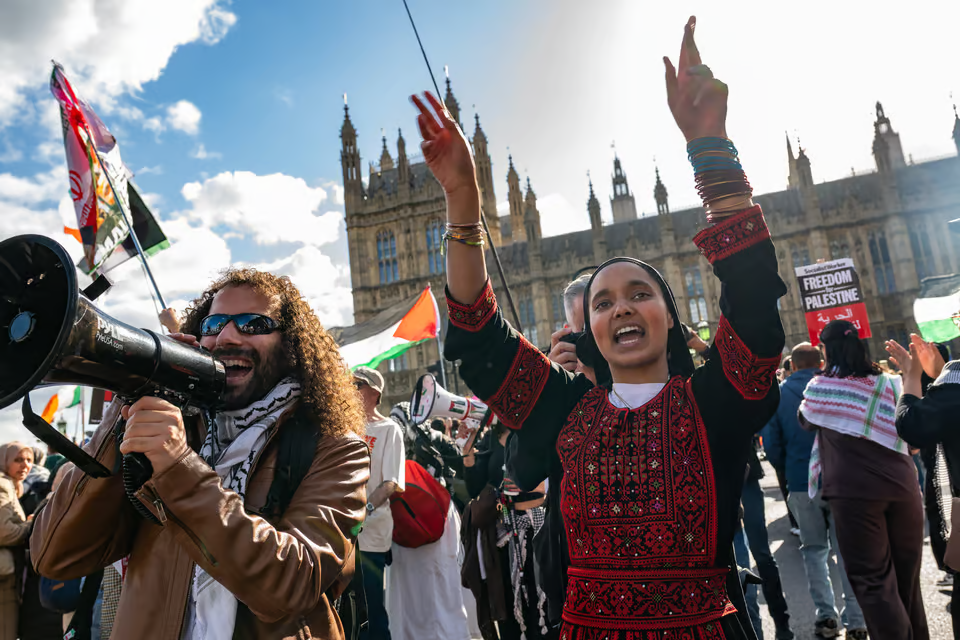
A massive sea of red, green, black, and white stretched as far as the eye could see across central London as hundreds of thousands of people marched through the capital. Organisers from the Palestine Solidarity Campaign announced that over 250,000 protesters filled the streets, making it one of the largest public demonstrations seen in the United Kingdom in recent years.
The march brought traffic to a complete standstill along key corridors of the city. Demonstrators gathered in heavy numbers along Victoria Embankment before advancing toward Downing Street and Parliament Square. Carrying placards, chanting for an end to military action in Gaza, and waving flags, the crowd created a visual spectacle that dominated the capital for hours.
With emotions running high and police monitoring every corner, the sheer scale of the event has reignited intense debate across the country. Here is the full breakdown of how big the demonstration really was, how the city handled the massive turnout, and what this huge show of public support means for the future.
How Big Was London’s Palestine March?
The central question on everyone’s mind following the demonstration is the exact size of the crowd. Organisers and police authorities often view demonstration numbers through very different lenses, and this weekend was no exception.
The Palestine Solidarity Campaign, working alongside coalition partners including Friends of Al-Aqsa, Stop the War Coalition, and the Muslim Association of Britain, officially announced that more than 250,000 people took part. According to event organizers, the turnout reflected widespread public outrage and a growing demand for foreign policy changes.
The $0 Secret To Launching Your Entire Online Empire
Why pay hundreds every month for separate software? Build funnels, send emails, and make sales with Systeme.io completely free.
Get Started For $0Free Forever • No Credit Card Needed • Beginner-Friendly
The Metropolitan Police deployed thousands of officers to monitor the crowds and manage traffic flow across central London. While police forces in the United Kingdom generally refrain from giving official headcounts unless specific safety thresholds are crossed, law enforcement acknowledged that the march was exceptionally large, requiring widespread road closures and rolling police escorts.
Determining crowd sizes during roving street marches is notoriously difficult. Unlike static events in enclosed arenas or fenced parks, street demonstrations stretch over miles of urban roads. Protesters join and leave at various points along the route, making static counts unreliable. However, aerial footage captured by news helicopters and shared on social media showed dense crowds spanning continuously from Victoria Embankment all the way to Parliament.
The March Route: Where the Protesters Gathered
The official route for the march was carefully planned in advance between event organisers and the Metropolitan Police to ensure safety while allowing the demonstration to move through the heart of the capital.
Assembly began early in the day along Victoria Embankment, a major thoroughfare running parallel to the River Thames. By midday, the embankment was completely packed with marchers arriving from across the country via train, coach, and local public transport.
From Victoria Embankment, the march moved systematically toward the political center of the UK government. The massive crowd processed along designated streets toward Whitehall, directly passing Downing Street, the official residence and office of the UK Prime Minister.
The final destination for the rally was Parliament Square, directly opposite the Palace of Westminster. Key figures, activists, and international representatives addressed the crowd from a massive main stage, speaking against a backdrop of historic government buildings.
What Were the Main Demands of the Demonstration?
The crowd was made up of diverse groups, including families, student organizations, trade unions, faith groups, and human rights advocates. Despite coming from different backgrounds, the marchers united around several core political and humanitarian demands.
An Immediate Arms Embargo
One of the primary calls made by speakers and written across thousands of placards was for the UK government to institute an immediate and total arms embargo on Israel. Protesters argued that British-made military components and equipment should not be exported to conflict zones where civilian casualties continue to mount.
An End to Military Operations
Demonstrators called for a permanent and unconditional ceasefire, expressing deep concern over the ongoing humanitarian crisis in Gaza and the West Bank. Speakers at Parliament Square emphasized the urgent need for open humanitarian corridors to allow unhindered aid, medicine, and food into impacted areas.
Government Sanctions and Diplomatic Shifts
Marchers demanded that UK political leaders adopt a firmer diplomatic stance. Protesters urged the government to implement economic and diplomatic sanctions until international law standards are fully upheld.
Key Speeches and High-Profile Figures
Several notable public figures and activists delivered speeches from the stage in Parliament Square, praising the immense turnout and calling on politicians to listen to the public.
Husam Zomlot, the Palestinian Ambassador to the UK, shared messages of appreciation with the crowd, highlighting the sustained level of public solidarity seen across Britain. He noted that even after months of continuous campaigning, the turnout remains exceptionally strong, demonstrating that public concern for the region shows no signs of fading.
Representatives from various UK trade unions and community coalitions also took to the stage. They emphasized that public demonstrations remain a vital tool for citizens to hold elected representatives accountable on foreign policy decisions.
Cultural figures and artists have also continued to amplify these calls outside of street rallies. Across the entertainment world, performers have taken bold stands on global issues, much like how artist activism transformed major music tours into global platforms for awareness.
How the Metropolitan Police Managed the Demonstration
Policing an event with 250,000 people presents massive operational challenges. The Metropolitan Police implemented a high-visibility security operation across central London to ensure the safety of both protesters and the general public.
Send, Spend & Hold Money Worldwide Without Hidden Fees
Transfer money internationally at the real exchange rate and hold 40+ currencies in one account.
Open a Wise AccountMid-market rate • Fast transfers • 40+ currencies
Strict Public Order Conditions
To keep the peace and minimize disruption to London residents, senior police officers placed strict legal conditions on the event under Section 12 and Section 14 of the Public Order Act. These rules specified:
- Strict Start and End Times: Speeches, stage music, and official gathering activities were required to finish strictly by 5:30 PM.
- Mandatory Route Compliance: Marchers were legally required to stick to the pre-agreed route from Victoria Embankment to Parliament Square.
- Dispersal Zones: Police were granted powers to clear designated areas once the official event conclusion time passed.
Managing Arrests and Public Safety
While the vast majority of the 250,000 participants marched peacefully, police officers actively monitored the crowd for any potential public order offenses. Officers were stationed along the route to identify hate speech, banned symbols, or breaches of protest conditions.
A small number of arrests were made throughout the day for minor public order offenses and breach of police conditions. However, law enforcement officials noted that the main body of the rally proceeded without major disorder.
For readers following broader urban safety and law enforcement discussions, understanding how capital cities manage large-scale events connects directly to questions about crime and public safety in London.
Counter-Protests and Surrounding Tensions
Large political demonstrations in major capital cities frequently draw counter-protesters, and London was no exception during this weekend’s events.
A small group of counter-demonstrators gathered near New Scotland Yard and along sections of Whitehall, holding flags and voicing support for Israel’s military actions. Metropolitan Police officers formed thick physical barricades and human chains to keep the two opposing groups entirely separate.
The presence of opposing viewpoints highlighted the deep political divisions surrounding the conflict. Police leadership emphasized that their primary role during such events is to remain neutral, uphold the legal right to peaceful protest, and prevent violence between opposing groups.
Political figures from across the parliamentary spectrum have voiced contrasting views on how public rallies should be policed. These debates over public order laws and expression echo broader political discussions, such as recent policy proposals surrounding bans on full-face coverings in public spaces.
Traffic Disruption and Transport Logistics
Moving a crowd of 250,000 people through the center of a major metropolis requires extraordinary logistical coordination. Transport for London (TfL) issued advance warnings to commuters and tourists to expect severe travel delays throughout the day.
Underground Station Closures
To prevent dangerous overcrowding on train platforms, several London Underground stations near the rally route were subjected to temporary exit-only or entry-only restrictions. Stations such as Embankment, Westminster, and Temple saw massive crowds as marchers arrived in waves.
The $0 Secret To Launching Your Entire Online Empire
Why pay hundreds every month for separate software? Build funnels, send emails, and make sales with Systeme.io completely free.
Get Started For $0Free Forever • No Credit Card Needed • Beginner-Friendly
Road Closures and Bus Rerouting
Major thoroughfares along the River Thames and throughout the Westminster borough were closed to vehicular traffic from early morning until late evening. Dozens of bus routes were diverted or truncated, leading to heavier traffic congestion on surrounding arterial roads across north and south London.
Despite the disruption, many local businesses, including cafes and food vendors along adjacent streets, saw a dramatic increase in foot traffic throughout the day as participants sought refreshments.
Political Impact: What This Means for the UK Government
A crowd of a quarter of a million people marching directly past Downing Street sends a powerful message that political leaders cannot easily ignore.
Members of Parliament from various political parties have expressed differing views on the ongoing demonstrations. Backbench MPs from minority parties and progressive factions have cited the massive crowd size as proof that the government’s current foreign policy is out of touch with public opinion. They continue to press the Prime Minister during parliamentary debates to take a firmer stance on international arms sales.
Conversely, government officials maintain that UK foreign policy must be guided by strategic national interests, intelligence assessments, and diplomatic engagements rather than street demonstrations alone. Ministers have repeatedly stressed that while peaceful protest is a fundamental democratic right, government policy must balance humanitarian concerns with regional stability and security partnerships.
These foreign policy debates occur alongside intense domestic political discussions regarding national budgets and governance, including ongoing debates surrounding economic reforms and UK public spending.
How This March Compares to Historical London Protests
London has a rich history of massive public demonstrations that have shaped the nation’s political landscape. Placing this weekend’s march in historical context helps illustrate its significance.
- 2003 Anti-Iraq War Protest: Widely considered the largest protest in British history, where an estimated 1 million to 2 million people marched against the impending invasion of Iraq.
- 2019 People’s Vote March: An estimated 1 million people marched through central London demanding a second referendum on Brexit.
- 2002 Countryside Alliance March: Around 400,000 people gathered in London to protest proposed bans on hunting and champion rural issues.
- Recent Pro-Palestine Rallies: Over the past year, several demonstrations have consistently drawn between 100,000 and 300,000 participants, marking one of the most sustained protest campaigns in modern UK history.
The consistent ability of organisers to mobilize hundreds of thousands of people month after month underscores the deep commitment of the movement’s core supporters.
Frequently Asked Questions (FAQs)
How many people actually attended the London Palestine march?
Organisers from the Palestine Solidarity Campaign stated that over 250,000 people attended the march. The Metropolitan Police did not provide an official headcount but acknowledged the crowd was exceptionally large and required extensive traffic management and security operations.
What was the route of the London Palestine march?
The march assembled along Victoria Embankment, proceeded along designated streets past Whitehall and Downing Street, and concluded with speeches and a main rally at Parliament Square opposite the Houses of Parliament.
Were there any arrests during the demonstration?
Yes, a small number of arrests were made for minor public order offenses and breaches of police conditions set under the Public Order Act. However, the Metropolitan Police reported that the vast majority of the 250,000 protesters demonstrated peacefully.
Why do crowd numbers differ between police and organisers?
Organisers calculate numbers based on total turnout over the entire duration of the event, including people joining along the route. Police estimates often focus on peak density at specific fixed locations for safety and crowd control purposes.
What were the main demands of the protesters?
Protesters demanded an immediate and permanent ceasefire, a full UK arms embargo on Israel, the unhindered delivery of humanitarian aid into Gaza, and diplomatic sanctions against those responsible for military operations.
The Path Ahead for Public Demonstrations
As the sun set over Parliament Square and the final speeches wrapped up, the massive crowd slowly dispersed into nearby Tube stations and bus stops, leaving central London to return to its usual routine. However, the political impact of the march continues to resonate through the halls of Westminster.
Organisers have already made it clear that public demonstrations will continue as long as military operations persist. With hundreds of thousands willing to take to the streets, the debate over the UK’s role in international affairs will remain at the forefront of national politics.
