
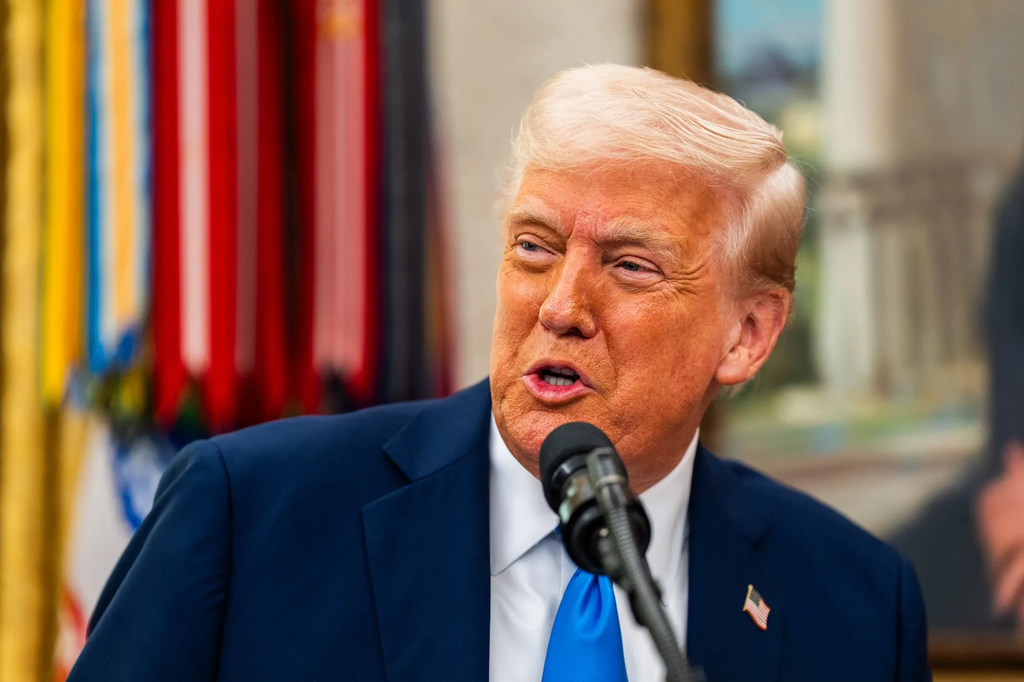
A private visit to the White House has exploded into an unexpected political and spiritual crisis. Twelve American Catholic bishops walked into the West Wing for what they believed was a private, closed-door discussion on human dignity, immigration policies, and religious worker visas. Within hours of their departure, a video and a series of photographs from the meeting surfaced across official social media channels, showing the group of clergymen encircling President Donald Trump, extending their hands over him in prayer right beside the Resolute Desk.
The public reaction was swift, intense, and deeply polarized. Coming less than two weeks before high-stakes midterm elections, the imagery looked to many everyday churchgoers and political observers like an explicit, high-profile endorsement of Donald Trump and his political platform.
Parishioners immediately flooded diocesan phone lines and inboxes with furious complaints. Prominent Catholic figures voiced disbelief, and the fallout forced multiple senior bishops to issue rare, deeply personal public apologies. Leaders who took part in the gathering are now stepping forward to clarify what actually occurred, insisting that a quiet pastoral prayer was hijacked and weaponized as a campaign photo opportunity without their knowledge or consent.
What Really Happened Inside the Oval Office
The gathering took place on a Thursday afternoon at the White House. Twelve Catholic bishops had agreed to travel to Washington, D.C., to hold discussions with the administration. According to multiple bishops who were in the room, the agenda was focused entirely on serious policy issues where the Catholic Church frequently intersects with the federal government.
The prelates arrived hoping to advocate for vulnerable communities. They sought to discuss recent crackdowns on immigration enforcement, protections for migrant families, the logistical backlog facing foreign priests needing religious worker visas, and broader concerns surrounding human dignity.
The $0 Secret To Launching Your Entire Online Empire
Why pay hundreds every month for separate software? Build funnels, send emails, and make sales with Systeme.io completely free.
Get Started For $0Free Forever • No Credit Card Needed • Beginner-Friendly
At the conclusion of the policy talk, as is traditional during pastoral visits with heads of state, the religious leaders offered to pray for the president. In Catholic tradition, praying for civic authorities is a standard scriptural duty based on passages like 1 Timothy 2:1–2, which instructs the faithful to pray for kings and all those in authority so people may lead peaceful and quiet lives.
The bishops stood in a circle around Donald Trump, raised their hands in a blessing of protection and wisdom, and prayed. What they did not expect, however, was that aides and cameras were capturing the scene from multiple angles. White House deputy director of communications Margo Martin and other administration affiliates quickly shared the video and still photos across social media platforms like X.
The clip spread like wildfire, amassing millions of views within hours. It was presented not as a policy dialogue on human suffering or visa regulations, but as an intimate religious blessing bestowed upon Donald Trump by leaders of America’s largest Christian denomination.
Archbishop Jeffrey Grob Breaks His Silence: “A Public Apology”
The most significant break in the silence came directly from the Archdiocese of Milwaukee. Archbishop Jeffrey Grob, who participated in the meeting, released a candid statement titled “A Public Apology.”
Grob made it crystal clear that he never consented to being recorded, nor did the other bishops agree to have their images distributed across public campaign ecosystems. The archbishop stated that the gathering was in no way an endorsement of Donald Trump, his policies, or his political party.
According to Grob, the bishops entered the meeting in good faith to try to work for the betterment of everyday people, to ease suffering, to build up the common good, and to offer a pastoral prayer. They did not travel to the nation’s capital to pose for a campaign advertisement.
“We should never have been put in that position by the White House,” Grob wrote. He acknowledged the deep distress felt by parishioners across the country, especially those from marginalized backgrounds.
The archbishop noted that his office was inundated with messages from people expressing serious worry that the church was taking a partisan stance right before an election. Even more painfully, Grob stated that he heard from individuals who felt deeply wounded because their families had been directly hurt by the administration’s policies.
Admitting that he had personal reservations before attending the meeting, Grob expressed sincere regret for not trusting his instincts. He ended his statement by asking forgiveness from his flock for the pain and confusion his presence in the Oval Office had caused.
Bishop William Joensen: “Exploited for Partisan Political Purposes”
Archbishop Grob was not the only church leader to speak out. Bishop William Joensen of the Diocese of Des Moines, Iowa, echoed the same sentiments and voiced sharp frustration with how the administration handled the encounter.
Joensen publicly stated that the White House exploited the bishops’ pastoral mission for partisan political gain. He expressed sorrow for failing to anticipate how quickly a spiritual gesture could be co-opted for campaign messaging.
In a candid reflection, Joensen admitted that he wished he had been more shrewd and less simple in dealing with high-level political operators. While reaffirming his belief that Christians should pray for their leaders regardless of party affiliation, he acknowledged that walking into the Oval Office so close to an election without strict ground rules regarding media and publicity was a grave miscalculation.
The public reaction from these senior leaders has been documented extensively by established news organizations, including detailed reporting from Associated Press and The Guardian. Both outlets noted that public apologies from Catholic bishops criticizing a sitting president for image manipulation are virtually unprecedented in modern American history.
The U.S. Bishops Conference Distances Itself
As the controversy escalated, the official body representing the American hierarchy—the United States Conference of Catholic Bishops (USCCB)—sought to establish clear boundaries around the event.
Officials confirmed that the meeting was not arranged, sponsored, or coordinated by the USCCB. It was an independently organized private delegation of individual bishops. By making this distinction, the broader conference aimed to protect the institutional neutrality of the church during an already volatile election cycle.
Send, Spend & Hold Money Worldwide Without Hidden Fees
Transfer money internationally at the real exchange rate and hold 40+ currencies in one account.
Open a Wise AccountMid-market rate • Fast transfers • 40+ currencies
The Catholic Church in the United States has historically maintained a strict nonpartisan stance in electoral politics. Federal tax laws governing 501(c)(3) religious organizations prohibit direct endorsements of political candidates, but the church’s own internal guidelines go even further. Catholic social teaching avoids aligning completely with either major American political party, often finding itself agreeing with Republicans on issues like the sanctity of life and religious liberty, while aligning with Democrats on matters like economic justice, social safety nets, environmental stewardship, and immigration reform.
When images emerged of twelve prominent bishops laying hands on Donald Trump, it created the perception that the church was abandoning its traditional independence. The resulting outrage forced bishops across multiple states to reassure their congregations that their pulpits had not been captured by Washington politics.
This dynamic of religious leaders pushing back against political exploitation mirrors broader global discussions about moral independence. From debates over how religious leaders criticize the government to high-profile disputes where government officials push back against Catholic bishops, the line between pastoral presence and political propaganda remains fragile.
Why the Timing of the Video Matters So Much
Timing is everything in politics, and the release of this video could not have come at a more sensitive moment. With midterm elections right around the corner, control of both houses of Congress hangs on razor-thin margins.
Catholic voters represent one of the most critical swing demographics in American politics. Unlike white evangelical Protestants, who consistently vote Republican by wide margins, or Black Protestant voters, who consistently vote Democratic, Catholics are evenly split. In key battleground states like Pennsylvania, Wisconsin, and Michigan, Catholic voters often decide the outcome of national elections.
Donald Trump’s campaign has been actively working to consolidate Catholic support, touting his judicial appointments, executive orders protecting religious exemptions, and traditional cultural values. However, his hardline rhetoric and aggressive policies have simultaneously alienated large segments of Catholic voters.
The White House video was clearly designed to serve as a powerful visual cue to Catholic voters that their spiritual leaders were on board with the administration. Yet, coming at a time when Republicans are panicking about Donald Trump and Senate races are shaken by stacking controversies, the video caused an immediate political firestorm rather than a smooth campaign boost.
While Donald Trump insists Republicans have a winning message, many Catholics felt the administration crossed a sacred line by publishing a private prayer session for purely political leverage.
Gospel Concerns vs. Political Imagery: Religious Sisters Speak Up
The backlash was not limited to bishops and everyday churchgoers. Religious communities, particularly Catholic women religious, quickly entered the conversation to offer a sharp theological critique of the Oval Office photo.
Members of religious orders, such as the Sisters of Charity, pointed out a glaring disconnect between the visual message of the video and the actual demands of Catholic social teaching. In public statements and commentaries, sisters emphasized that the moral authority of the church does not come from standing in proximity to worldly power, but from standing in solidarity with the powerless.
The $0 Secret To Launching Your Entire Online Empire
Why pay hundreds every month for separate software? Build funnels, send emails, and make sales with Systeme.io completely free.
Get Started For $0Free Forever • No Credit Card Needed • Beginner-Friendly
They questioned what message the imagery sent to the most vulnerable members of society. In recent months, federal battles have erupted over immigration policies, including judicial interventions where a federal court blocked attempts to limit birthright citizenship and controversial plans where the administration proposed excluding certain immigrants from the census.
Catholic sisters noted that Catholic teaching places heavy emphasis on welcoming the stranger, protecting the poor, defending human rights, and opposing cruelty. When parishioners saw bishops smiling and praying over a president who champions aggressive deportations and cuts to social safety nets without publicly raising those life-and-death concerns, it caused profound spiritual confusion.
The sisters argued that if church leaders are going to meet with the powerful, their primary duty is to speak truth to power on behalf of the marginalized, rather than providing a photo op that whitewashes contentious policies.
How the White House Responded
Faced with growing criticism and direct accusations of exploitation from the bishops who visited the Oval Office, the White House remained unapologetic.
In statements provided to major media outlets, administration spokespeople brushed aside complaints about the video’s release. The White House defended the encounter by arguing that Donald Trump has consistently championed religious freedom and supported faith communities across the country.
“There has never been a greater president for Catholic Americans than President Trump, and his strong record proves it,” the administration asserted in its official response.
White House officials maintained that the prayer was an uplifting, positive moment of faith that deserved to be shared with the American public. They argued that Americans have a right to see their leader receiving prayer and that praying with clergy is an honored American tradition that should be celebrated rather than hidden away behind closed doors.
Rather than addressing the bishops’ specific complaints regarding lack of consent and the breach of private trust, the administration doubled down on its record, pointing to its defense of Christian institutions, judicial nominations, and cultural policies.
The Deep Divide Inside the American Catholic Church
This clash has laid bare the deep ideological fractures that exist within the American Catholic Church. The Catholic community is not a monolith; it reflects the deep cultural and political divides that characterize the entire nation.
On one side of the spectrum are conservative and traditionalist Catholics who view Donald Trump as a crucial ally against secularism. These believers point to his judicial appointments that led to the overturning of Roe v. Wade, his defense of Catholic adoption agencies that decline to place children with same-sex couples, and his opposition to progressive gender policies in public schools. For many in this camp, seeing bishops pray over the president in the Oval Office was a source of pride, encouragement, and unity.
On the other side are progressive, moderate, and Hispanic Catholics who view Trump’s policies as fundamentally incompatible with Catholic moral teaching. They point to the administration’s aggressive immigration enforcement, the separation of families at the southern border, rollbacks of environmental safeguards, attacks on the poor, and divisive rhetoric as direct violations of Christian love and human dignity.
For these believers, watching bishops lay hands on Trump inside the Oval Office just days before an election felt like a painful betrayal. It signaled that the hierarchy was willing to overlook grave human rights concerns in exchange for access to political power.
The immediate apologies from Archbishop Grob and Bishop Joensen highlight just how precarious this balancing act has become. Catholic leaders are caught in a vise between two polarized factions, and any perceived misstep can instantly alienate thousands of church members.
The Perils of Political Faith and Photo Opportunities
The controversy surrounding the Oval Office prayer video offers a cautionary tale about the intersection of religion and raw political ambition.
Throughout history, political figures have sought the blessing of religious leaders to burnish their public image, soften their flaws, and mobilize devout voting blocs. By standing alongside respected men and women of the cloth, politicians can instantly signal moral legitimacy to millions of voters without having to alter a single policy.
For religious leaders, the temptation to accept invitations into the halls of power is understandable. Bishops, pastors, and imams genuinely believe that by meeting with presidents, governors, and lawmakers, they can advocate for good laws, protect their institutions, and be a positive moral influence.
However, when clergy enter political spaces without clear safeguards, they risk becoming instruments in an election strategy. As Bishop Joensen admitted, political campaigns operate under different rules than pastoral ministries. In Washington, every handshake, smile, and prayer is viewed through the lens of electoral advantage.
When prayer is treated as content to drive social media engagement and rally voters, its sacred character is compromised. Instead of drawing people together in humility before God, it becomes another weapon in the partisan culture wars.
Frequently Asked Questions (FAQs)
Why did the Catholic bishops meet with Donald Trump in the Oval Office?
A group of twelve Catholic bishops met with Donald Trump to hold private discussions on pressing policy matters that affect church operations and vulnerable communities. Key topics included immigration enforcement, protections for migrant families, the availability of religious worker visas for foreign clergy serving in the United States, and human dignity.
Why are the bishops apologizing for the prayer video?
The bishops are apologizing because the White House recorded and published the prayer session without their knowledge or permission. The public release of the footage right before midterm elections gave the strong impression that the bishops were endorsing Donald Trump and his political platform, which caused intense distress and anger among parishioners.
Did the U.S. Conference of Catholic Bishops organize the meeting?
No. The U.S. Conference of Catholic Bishops (USCCB) confirmed that it did not organize, sponsor, or endorse the meeting. It was an independently organized private gathering attended by individual bishops.
Does the Catholic Church officially endorse political candidates?
No. The Catholic Church does not endorse political candidates or align itself with any political party. Catholic doctrine teaches that faithful citizens should form their consciences based on the full scope of Catholic social teaching, which includes defending the sanctity of life, caring for the poor, welcoming immigrants, and promoting peace.
How did the White House respond to the bishops’ complaints?
The White House dismissed the criticism, arguing that Donald Trump has been the greatest president for Catholic Americans in history. Administration officials defended the decision to post the video, claiming that public prayer is an honored American tradition that should be shared openly.
The Road Ahead for Faith Leaders and Washington
The fallout from the Oval Office prayer video will likely influence how religious leaders interact with political figures for years to come. In the short term, the incident has damaged trust between the White House and several prominent dioceses, leaving bishops wary of future engagements.
As the midterm elections approach and the country prepares for the next phase of national politics, Catholic leaders face the difficult task of rebuilding confidence among their flock. They must demonstrate that their primary allegiance belongs to their spiritual principles rather than any political figure or party platform.
Engaging with civic leaders will always remain a core duty for faith communities seeking to protect human dignity. However, this incident serves as a stark reminder that when spiritual moments are staged for political cameras, faith is the first thing that loses its power.
