
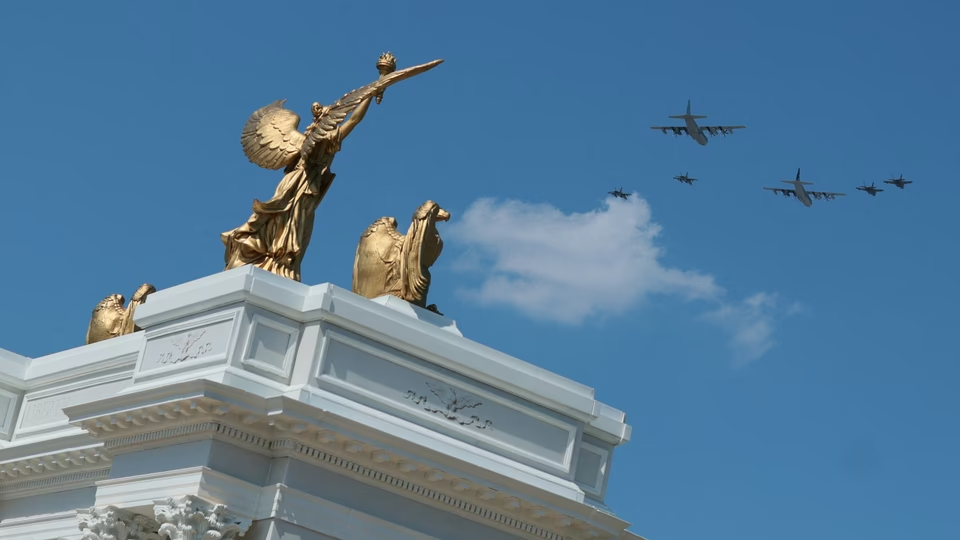
President Donald Trump has announced that his proposed 250-foot-tall Triumphal Arch in Washington, D.C., will be converted into a top-grade military complex equipped to host armed drones, snipers, and ammunition reserves. In a series of statements posted to Truth Social, President Trump stated that the sudden pivot was made at the strong request of the United States military and for national security purposes. The monumental arch, originally pitched as a grand centerpiece to celebrate the upcoming 250th anniversary of American independence, is planned for Memorial Circle along the south bank of the Potomac River, right between the Lincoln Memorial and Arlington National Cemetery.
This unexpected reclassification converts a high-profile civic monument into an active defensive outpost. According to the administration, the updated architectural structure will feature designated rooftop and plaza positions for military sniper teams, alongside dedicated staging bays for rapid drone deployment and storage vaults for military-grade ammunition. The announcement has immediately refocused national attention on the controversial project, sparking widespread debate among lawmakers, aviation authorities, legal scholars, local residents, and military veterans.
Inside the New Military Arch: Drones, Snipers, and Ammunition
The planned structure, often referred to as the United States Triumphal Arch or Independence Arch, was designed to stand at 250 feet tall and roughly 165 feet wide. That height makes it nearly 100 feet taller than the famous Arc de Triomphe in Paris. Initial blueprints presented to federal design commissions depicted a neoclassical stone arch featuring an internal mezzanine level, public exhibit halls, rest areas, a gift shop, and an elevated observation deck for tourists visiting the nation’s capital.
Under the new operational directive, those plans are being adapted to incorporate heavy security infrastructure. President Trump explained that the facility will possess the rapid ability to launch and control large fleets of military drones directly from its upper decks and surrounding plaza spaces. Roof parapets and public plaza areas will also double as fortified firing positions for sniper units overseeing the capital’s strategic approaches.
Interior space originally set aside for public exhibits will now include secure storage vaults capable of holding substantial quantities of sniper ammunition and tactical military equipment. President Trump emphasized that no other capital city in the world possesses a dual-purpose monument of this scale, arguing that combining historical grandeur with military utility creates an unprecedented asset for national defense.
The $0 Secret To Launching Your Entire Online Empire
Why pay hundreds every month for separate software? Build funnels, send emails, and make sales with Systeme.io completely free.
Get Started For $0Free Forever • No Credit Card Needed • Beginner-Friendly
Despite the sweeping operational shift, administration representatives insist that the fundamental visual design of the arch will remain intact. The National Park Service and the Department of the Interior continue to oversee the site plans, asserting that the structural updates will be integrated cleanly without compromising the grand aesthetic of the surrounding parklands.
The National Security Defense: A Familiar Legal Strategy
The decision to label the Triumphal Arch as a military complex is not an isolated event. Observers note that it mirrors the legal and administrative strategy used by the White House to advance other major construction initiatives across D.C. A prime example is the ongoing development of the new presidential facility, where officials successfully argued that specialized underground infrastructure was essential for protecting the commander-in-chief. That argument gained significant traction after the Supreme Court gave the green light to the $400 million White House ballroom construction.
By classifying civic and ornamental structures as critical defense installations, the executive branch aims to strengthen its legal authority to proceed with construction without needing explicit new authorization or dedicated funding from Congress. Administration lawyers argue that national security imperatives fall directly under the president’s constitutional authority as commander-in-chief, overriding routine municipal and statutory hurdles.
Critics, however, view this rationale as a legal maneuver designed to bypass congressional oversight and public accountability. Legal watchdogs contend that inventing defense justifications after projects encounter public friction creates a troubling precedent for federal development. They argue that if any decorative monument can be rebranded as a military complex to evade statutory reviews, the constitutional power of the purse held by Congress could be severely undermined.
Mounting Legal Battles and Veteran Pushback
The proposal has ignited fierce legal challenges from veterans’ organizations and historic preservation advocates. A prominent lawsuit filed by Public Citizen Litigation Group on behalf of three Vietnam War veterans and an architectural historian seeks to halt all progress on the site. The plaintiffs argue that the massive 250-foot structure violates long-established federal planning mandates and destroys the sacred, unimpeded sightline connecting the Lincoln Memorial to Arlington National Cemetery.
In response to emergency filings, U.S. District Judge Tanya Chutkan issued a formal order requiring the federal government to provide the court with at least 48 hours of advance notice before initiating any heavy excavation or physical ground-breaking activities at Memorial Circle. This order gives plaintiffs time to seek immediate emergency injunctions before permanent physical damage occurs to the landscape.
The core of the legal dispute hinges on whether the administration has the statutory authority to build the monument. The Department of the Interior claims authority under a 1924 law that approved a memorial gateway in the general vicinity. However, opponents point out that the century-old legislation authorized a pair of modest 166-foot columns spaced 300 feet apart, rather than a single, massive 250-foot arch that fills the entire interior roundabout.
These court battles reflect a growing trend of contentious litigation surrounding executive actions in Washington. Similar courtroom showdowns have unfolded over executive orders on domestic and immigration policies, including instances where a federal court blocked President Trump’s attempt to limit birthright citizenship. In both cases, federal judges have been asked to determine the exact boundaries of executive power when balanced against statutory laws enacted by Congress.
Flight Paths, Eternal Flames, and FAA Safety Concerns
Beyond legal battles, the proposal to house and launch military drones from the arch has raised severe operational concerns among aviation experts and local lawmakers. Memorial Circle sits directly beneath the primary flight approach corridor for Ronald Reagan Washington National Airport (DCA), one of the busiest and most tightly regulated airspace zones in North America.
Representative Don Beyer, whose congressional district borders the site, publicly criticized the idea of placing an active military drone facility directly inside a commercial landing path. Beyer characterized the concept as unworkable and dangerous, warning that uncoordinated drone launches or signal interference near low-flying commercial airliners pose severe safety risks to thousands of daily passengers.
The Federal Aviation Administration (FAA) recently completed an aeronautical study on the physical height of the 250-foot arch, concluding that the building itself would not constitute a physical hazard to aircraft operations. However, the FAA’s approval was conditional. The agency mandated that the top of the arch must feature a high-intensity “eternal flame” and three powerful floodlight projectors aimed at the structure to ensure maximum visibility for pilots flying at night or during low-visibility weather.
Aviation safety groups argue that while static lighting addresses collision risks with the physical building, it does not resolve the complex air traffic management issues created by operating autonomous or remote-controlled military drones in close proximity to commercial air traffic. They emphasize that any active drone operations will require continuous, real-time coordination with air traffic controllers at Reagan National to prevent catastrophic mid-air incidents.
Overwhelming Local Backlash and the Column Alternative
Public reaction within Washington, D.C., and surrounding communities has been overwhelmingly hostile. During official public comment periods conducted by the National Capital Planning Commission, local agencies received over 11,000 written submissions from citizens, historians, and civic organizations. Approximately 93 percent of comments submitted by District residents expressed strong opposition to the arch.
Local preservation groups, including the Cultural Landscape Foundation and the Committee of 100 on the Federal City, have repeatedly urged the administration to abandon the arch concept entirely. They argue that a structure of such immense scale visually overwhelms the surrounding historic context, dwarfing the nearby Memorial Bridge and disrupting the solemn atmosphere surrounding the entrance to Arlington National Cemetery.
As an alternative compromise, historians and municipal leaders have suggested returning to the original 1924 design by erecting twin, slender classical columns instead of a massive arch. They argue that twin columns would honor historical precedents, preserve the ceremonial gateway, and maintain the open, scenic line of sight between the National Mall and Arlington’s rolling hills.
Send, Spend & Hold Money Worldwide Without Hidden Fees
Transfer money internationally at the real exchange rate and hold 40+ currencies in one account.
Open a Wise AccountMid-market rate • Fast transfers • 40+ currencies
Despite these formal proposals, senior officials from the National Park Service confirmed during public meetings that the administration has not considered switching to columns. Administration spokespersons maintain that the 250-foot arch is intended as a full replacement for the historic concept rather than a literal restoration, insisting that Washington needs a grand triumphal arch comparable to those found in major European capitals.
Broader Changes Across Washington and Defense Leadership
The Triumphal Arch project represents just one component of a broader, multi-billion-dollar effort by President Trump to reshape the physical infrastructure and aesthetic landscape of the capital. Other active initiatives include extensive renovations to the Lincoln Memorial Reflecting Pool, structural overhauls at the John F. Kennedy Center for the Performing Arts, and the complete redesign of public spaces surrounding federal monuments.
This physical transformation of national landmarks is occurring alongside significant structural shifts within the military establishment itself. The Pentagon has experienced major leadership adjustments and policy realignments over the past year. High-level discussions regarding military readiness, defense spending, and administrative priorities have created friction within top defense circles, leading to notable high-profile resignations and policy debates.
For instance, structural changes and cultural debates within the armed forces were highlighted when observers tracked the inside shift at the Pentagon regarding leadership priorities. These internal tensions culminated in high-stakes administrative shakeups, such as when Army Secretary Dan Driscoll resigned following friction with defense leadership.
At the same time, national security agencies have tightened administrative controls and restricted public access to historical military archives, citing heightened global risks and foreign policy tensions. The broader strategic backdrop includes active military operations and diplomatic posture shifts overseas, as seen when the Pentagon cut access to secret military documents amid regional concerns and during periods when the U.S. engaged in escalating military strikes in the Middle East.
These structural realignments extend to symbolic executive actions as well, ranging from presidential visits to military headquarters—such as why Donald Trump visited the Pentagon for national memorials—to official government releases like the special golden coins issued by the U.S. Mint. Seen in this context, converting the Triumphal Arch into a military complex fits into a broader strategy of merging presidential legacy projects with national security functions.
Technology, AI, and Modern Drone Staging
Integrating automated drone facilities into civic architecture highlights how rapidly modern defense technology is reshaping traditional infrastructure. Unmanned aerial vehicles (UAVs), tactical automated surveillance systems, and algorithmic defense tools are no longer confined to remote military bases; they are increasingly being integrated into urban security models.
To explore how advanced automated systems, artificial intelligence, and emerging tech tools are impacting global industries, explore our detailed analysis in the Technology and AI news hub. From autonomous hardware to machine learning frameworks, modern technology is redefining both public safety and commercial automation.
Furthermore, as digital technology advances, creators and media strategists are leveraging automated tools to cover breaking news and analyze complex military developments in real time. If you want to learn how digital media channels leverage automation platforms to produce high-impact video content and reach global audiences efficiently, check out our step-by-step guide on YouTube automation strategies and tools.
Frequently Asked Questions (FAQs)
What is the proposed Triumphal Arch in Washington, D.C.?
The proposed Triumphal Arch, also known as the United States Triumphal Arch, is a planned 250-foot-tall neoclassical monument located at Memorial Circle near Arlington National Cemetery. It was originally announced by President Donald Trump to commemorate the 250th anniversary of American independence.
The $0 Secret To Launching Your Entire Online Empire
Why pay hundreds every month for separate software? Build funnels, send emails, and make sales with Systeme.io completely free.
Get Started For $0Free Forever • No Credit Card Needed • Beginner-Friendly
Why is the arch being converted into a military complex?
President Donald Trump announced that the arch is being converted into a military complex at the request of the U.S. military for national security purposes. Under the revised plan, the structure will store military ammunition, host rooftop and plaza sniper positions, and feature rapid-deployment staging bays for armed drones.
Where is the arch going to be built?
The designated site is Memorial Circle, a traffic roundabout situated on Columbia Island along the south bank of the Potomac River. It sits between the western end of the Arlington Memorial Bridge and the main entrance to Arlington National Cemetery, directly across the river from the Lincoln Memorial.
Does the project have final approval to begin construction?
While the project received preliminary site approvals from the Commission of Fine Arts and the National Capital Planning Commission, it still faces significant legal and regulatory challenges. A federal judge has ordered the administration to provide 48 hours of advance notice before starting excavation work due to ongoing lawsuits filed by military veterans and preservation groups.
How are aviation authorities reacting to the drone plans?
Aviation experts and lawmakers have expressed concern because the site lies directly within the flight path of Ronald Reagan Washington National Airport (DCA). While the FAA stated the 250-foot structure itself would not hazard flights if equipped with an eternal flame and floodlights, critics warn that operating active military drones near commercial flight lanes poses serious safety risks.
What Happens Next for Washington’s Most Controversial Monument?
The upcoming months will determine whether construction on the Triumphal Arch moves forward or remains stalled in federal court. The National Capital Planning Commission is scheduled to convene this fall to review updated structural specifications, environmental impact assessments, and security plans submitted by the Department of the Interior.
Simultaneously, U.S. District Judge Tanya Chutkan will hear arguments regarding the injunction filed by Public Citizen Litigation Group. The court’s decision on whether the administration can use century-old statutory authorizations to build a dual-purpose military arch will set a major legal precedent for executive authority and historical land preservation in Washington.
If approved, the Department of the Interior plans to execute an intensive 20-hour-a-day construction schedule spanning two to three years. As the debate between national security, historic preservation, and presidential legacy continues, the Triumphal Arch remains one of the most controversial development projects in modern American history.
To stay updated on breaking political stories, tech developments, and world news, visit our main About WhatsBuzzn overview page or get in touch directly via our official Contact Us portal. You can also follow real-time updates and join the global conversation across our social media channels on Instagram, Facebook, and X (formerly Twitter).
