
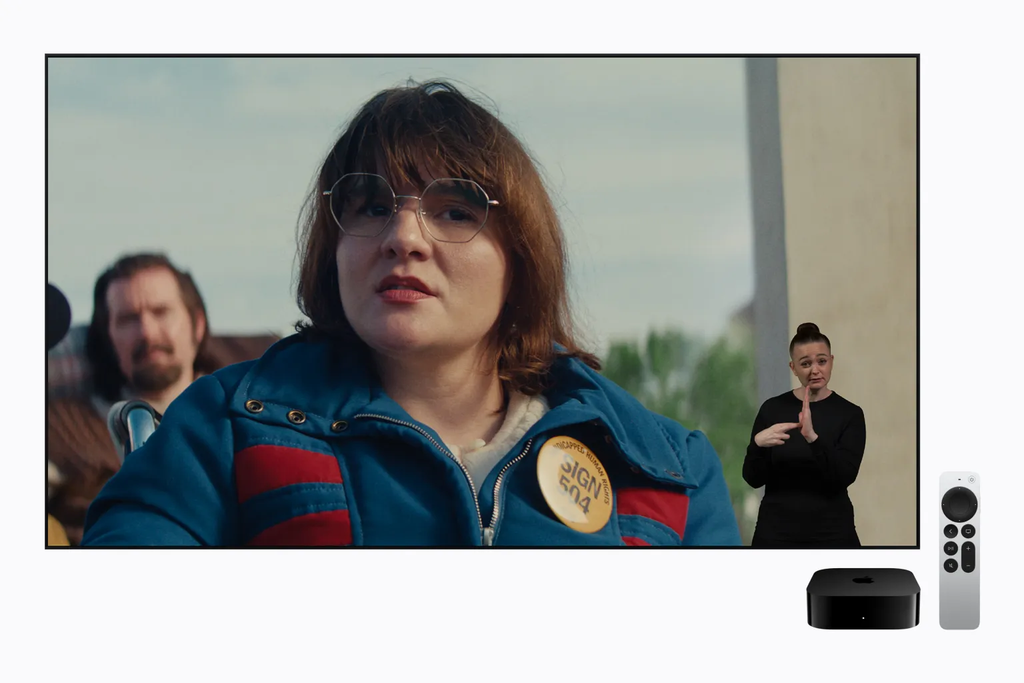
Apple has officially rolled out a dedicated sign language interpretation feature on the Apple TV app. Starting this week, Deaf and hard of hearing audiences can watch movies and television series accompanied by a real human signer directly on the screen.
Instead of forcing viewers to rely solely on scrolling subtitles, Apple is putting native signers directly into the frame. The feature launches globally on Friday, November 13, 2026, premiering alongside the Apple Original biographical film Being Heumann.
This update represents one of the largest leaps in digital entertainment accessibility in years. It changes how streaming platforms think about storytelling, language, and everyday inclusion.
What Is the New Apple TV Sign Language Feature?
The new Apple TV feature provides on-screen sign language interpretation for supported movies and television shows. When activated, an on-screen window appears alongside the main video playback, showing a fluent interpreter translating spoken dialogue, emotional tone, background noises, and music into visual sign language.
At launch, the service supports two major sign languages:
The $0 Secret To Launching Your Entire Online Empire
Why pay hundreds every month for separate software? Build funnels, send emails, and make sales with Systeme.io completely free.
Get Started For $0Free Forever • No Credit Card Needed • Beginner-Friendly
- American Sign Language (ASL), which is used primarily across the United States and parts of Canada.
- British Sign Language (BSL), widely used throughout the United Kingdom.
Viewers can turn the feature on or off directly through their playback controls. It operates smoothly across the Apple TV app ecosystem, covering Apple TV 4K boxes, iPhones, iPads, and Mac computers.
Why Closed Captions Are Not Always Enough
For decades, the streaming industry treated closed captions as the only solution for Deaf viewers. If you could not hear the dialogue, platforms expected you to read text flashing across the bottom of your television screen.
Captions are useful, but text cannot always capture the full emotional weight of a scene. Written English and sign language are two completely different languages with entirely separate grammatical structures.
The Linguistic Difference Between Text and Sign
American Sign Language is not just English spelled out with hands. ASL has its own distinct syntax, facial grammar, idioms, and physical rhythm. For millions of native signers, ASL or BSL is their primary language, while written text is essentially a second language.
When an actor whispers in terror, laughs sarcastically, or screams in fury, regular subtitles simply display flat words on a screen. A skilled human signer communicates the exact urgency, tone, volume, and humor through facial expressions, body movement, and hand speed.
Overcoming Subtitle Fatigue
Reading fast-moving subtitles during an intense action scene or an emotional family drama can be exhausting. Viewers often spend the entire movie staring at the lower third of the screen, completely missing the cinematography, character expressions, and visual effects.
By offering high-quality video interpretation, Apple allows Deaf audiences to experience cinematic storytelling in a natural, native format without feeling disconnected from the visual art on screen.
The Launch Lineup: Starting With “Being Heumann”
Apple chose a deeply symbolic title to debut its new accessibility tool: the original feature film Being Heumann.
The film chronicles the life and activism of Judy Heumann, widely recognized as the mother of the disability rights movement. Directed by Academy Award winner Siân Heder—the filmmaker behind Apple’s Oscar-winning film CODA—the biographical drama stars Ruth Madeley as Heumann.
To ensure the interpretation matched the film’s artistic integrity, the sign language tracks were directed by actor Daniel Durant, who also starred in CODA. Durant worked directly with native Deaf signers to capture the humor, tension, and political urgency of the story.
Additional Titles Coming Soon
Apple confirmed that Being Heumann is only the starting point. The company has already lined up several major Apple Original releases to receive sign language interpretation over the coming weeks:
- F1 The Movie: The high-octane racing blockbuster starring Brad Pitt, bringing fast-paced track commentary and engine roar energy into visual sign.
- Greyhound: The gripping World War II naval battle drama starring Tom Hanks, featuring military commands and high-tension naval tactics.
- Way of the Warrior Kid: The highly anticipated family adventure movie, set to premiere on November 25, 2026.
Over time, Apple plans to expand sign language options across its broader library of original films, documentaries, and hit drama series. As Apple continues to expand its broader entertainment footprint, detailed in our breakdown of Apple’s bigger Hollywood plan and why it matters for movies and TV, accessible viewing is becoming a pillar of their platform strategy.
Built With Native Signers, Not Quick Tech Fixes
In a market dominated by rapid automation and cost-cutting, many tech companies look for shortcuts. Automated machine learning models and artificial avatars have been tested across several industries, but they often fail to capture the human soul of sign language.
Apple took an intentional, human-centered approach. Every sign language track on the Apple TV app is performed and reviewed by real native signers from the Deaf community.
Sarah Herrlinger, Apple’s Senior Director of Global Accessibility Policy and Initiatives, noted that the company wanted to ensure every performance felt natural to the viewer. When an interpreter signs a character’s dialogue, they are not acting like a mechanical dictionary. They match the pacing of the scene, reflect the character’s personality, and translate musical rhythms through physical tempo.
Send, Spend & Hold Money Worldwide Without Hidden Fees
Transfer money internationally at the real exchange rate and hold 40+ currencies in one account.
Open a Wise AccountMid-market rate • Fast transfers • 40+ currencies
This dedication to authentic representation prevents the awkward, disjointed translations that frequently ruin automated captioning experiments.
How to Enable and Use Sign Language on the Apple TV App
Apple designed the user interface so anyone can activate the interpretation track in a couple of clicks. You do not need to hunt through dozens of hidden developer menus.
Follow these simple steps to turn on the feature:
Step 1: Check Content Compatibility
Browse your Apple TV app for titles carrying the new Sign Language badge. Supported titles display this badge directly on their movie details page, sitting right next to the 4K, Dolby Vision, and Audio Description indicators.
Step 2: Open Playback Settings
Start playing your movie or show. Bring up the playback controls by swiping on your remote or clicking your screen.
Step 3: Select the Sign Language Button
Look for the dedicated Sign Language icon (an outline of two signing hands) on your playback menu.
Step 4: Pick Your Preferred Language
Choose between American Sign Language (ASL) or British Sign Language (BSL), depending on your region and preference. The interpreter video will appear smoothly on your screen, perfectly synced with the video timeline.
If you are running the app on hardware like the new Apple TV 4K box with Siri smart features, you can also use your voice remote to switch tracks without lifting a finger.
Finding Sign Language Content with the New App Hub
To make sure these features do not get lost in the catalog, Apple is launching a brand-new curation hub titled “Movies & Shows with American Sign Language.”
This hub collects every piece of content that supports Deaf culture, native signers, or dedicated sign interpretation into one convenient space. You will find:
The $0 Secret To Launching Your Entire Online Empire
Why pay hundreds every month for separate software? Build funnels, send emails, and make sales with Systeme.io completely free.
Get Started For $0Free Forever • No Credit Card Needed • Beginner-Friendly
- Newly interpreted Apple Original blockbusters.
- Award-winning classics where sign language is woven into the narrative, such as CODA.
- Documentaries and community-focused projects celebrating accessibility pioneers.
You can also use Siri voice search or type simple search phrases into the search bar. Typing phrases like “movies with ASL” or “shows with sign language” will immediately take you to supported titles.
How Apple Compares to Other Streaming Giants
Apple is not the first streaming platform to experiment with sign language, but its integration is easily the most polished and deeply integrated into a mainstream operating system.
Here is how the landscape currently looks across the major players:
Netflix
Netflix has offered individual titles featuring Deaf actors and occasional specialized tracks, but it has not built a system-wide, dedicated sign language toggle into its standard video player. Most accessibility on Netflix remains focused on closed captions and multi-language audio descriptions.
Prime Video and Max
Platforms like Max and Amazon Prime Video have experimented with ASL overlays on select major releases. Max, for example, gained praise for offering an ASL version of select tentpole films like Godzilla vs. Kong. However, these were often hosted as separate video files that users had to search for manually, rather than an integrated toggle on the main film.
Apple TV App
Apple’s approach integrates the signer directly as an auxiliary video layer within the standard player. This means you do not have to leave the movie page, hunt for an alternate version, or lose your watch history. It lives right beside the audio track and subtitle menus.
Even as streaming services face economic pressures—as covered in our report on the Apple TV subscription price increase—delivering industry-leading accessibility helps justify premium platform positioning.
The Broader Impact on Streaming Accessibility Standards
When a tech giant like Apple introduces a polished accessibility feature, the rest of the media industry takes notice. Federal regulators and consumer advocacy organizations have long called for better accessibility across on-demand digital entertainment.
Historically, the Americans with Disabilities Act (ADA) and Federal Communications Commission (FCC) guidelines focused primarily on broadcast television. As audiences shifted to streaming, digital accessibility rules lagged behind.
By demonstrating that native sign language interpretation can be incorporated directly into the video player without degrading video quality or distracting general viewers, Apple has set a fresh benchmark. Viewers who enjoy quirky indie programs and massive dramas alike—from prestige cinema to viral sensations like Apple TV’s Small Prophets—can now experience stories with fewer barriers.
Industry analysts expect other major studios, including Disney+ and Paramount, to face growing pressure from subscriber communities to match these accessibility standards over the next two years.
What Deaf Creators and Audiences Are Saying
The reaction across online accessibility communities and creator circles has been overwhelmingly positive.
For years, Deaf content creators on social media pointed out the emotional disconnect caused by poor automated captions. Viewers frequently complained about laggy text, misheard dialogue during pivotal plot twists, and zero indication of background music mood.
Early reactions highlight three major wins:
- Accurate Emotional Translation: Hearing people experience movies through dramatic sound design, soaring musical scores, and subtle whispers. Interpreters bring those exact soundscapes to life through physical expression.
- True Shared Family Viewing: Families with both Deaf and hearing members can watch the exact same screen together in comfort, without sacrificing anyone’s viewing preferences.
- Professional Opportunities for Deaf Performers: Rather than outsourcing translation to computer algorithms, Apple is hiring Deaf directors, consultants, and native signers, creating valuable jobs in Hollywood.
Generative AI vs. Human Interpretation in Entertainment
As artificial intelligence dominates tech headlines, many companies are rushing to automate sign language with digital avatars. While 3D avatars might serve basic announcements in airports or train stations, narrative cinema demands nuanced human expression.
Sign language relies heavily on:
- Micro-expressions on the face to indicate doubt, sarcasm, or fear.
- Shifting shoulder positions to represent dialogue between two different characters.
- Varying signing speed to mirror the intensity of an argument or the slowness of grief.
Computer models still struggle with these organic social cues. Apple’s decision to employ human interpreters directed by Deaf industry leaders proves that storytelling remains an inherently human craft.
Frequently Asked Questions (FAQs)
What is the new Apple TV sign language interpretation feature?
It is a built-in accessibility setting that plays a high-definition video of a fluent human interpreter signing dialogue and sound cues alongside supported movies and series.
When will the sign language feature be available?
The feature officially launches worldwide on Friday, November 13, 2026, alongside the premiere of the Apple Original film Being Heumann.
Which sign languages are supported at launch?
Apple TV supports American Sign Language (ASL) and British Sign Language (BSL) during its initial rollout, with plans to explore additional regional sign languages in future updates.
Does it cost extra to watch movies with sign language?
No. The sign language feature is included at no additional cost for all active Apple TV subscribers and supported movie rentals or purchases.
What devices can I use to watch sign language tracks?
You can access the feature on any modern device running the Apple TV app, including Apple TV 4K, iPhone, iPad, and Mac computers.
What was the first movie to get the feature?
The biographical drama Being Heumann, directed by Siân Heder and starring Ruth Madeley, is the debut title to feature full sign language interpretation tracks.
Will all Apple TV movies have sign language immediately?
Not all titles will have it immediately. Apple is rolling out the feature in phases, beginning with major originals such as Being Heumann, F1 The Movie, Greyhound, and Way of the Warrior Kid, before expanding to a broader catalog.
What This Means for the Future of Entertainment
Apple’s rollout of native sign language interpretation proves that true accessibility is not an afterthought or a compliance checkbox. It is an essential component of modern digital entertainment.
By trusting native signers, hiring Deaf creative directors, and designing a smooth playback toggle, Apple has shown how technology can bring audiences together. As this feature expands to more movies and series throughout 2026 and 2027, the barrier between great art and global audiences continues to shrink.
