
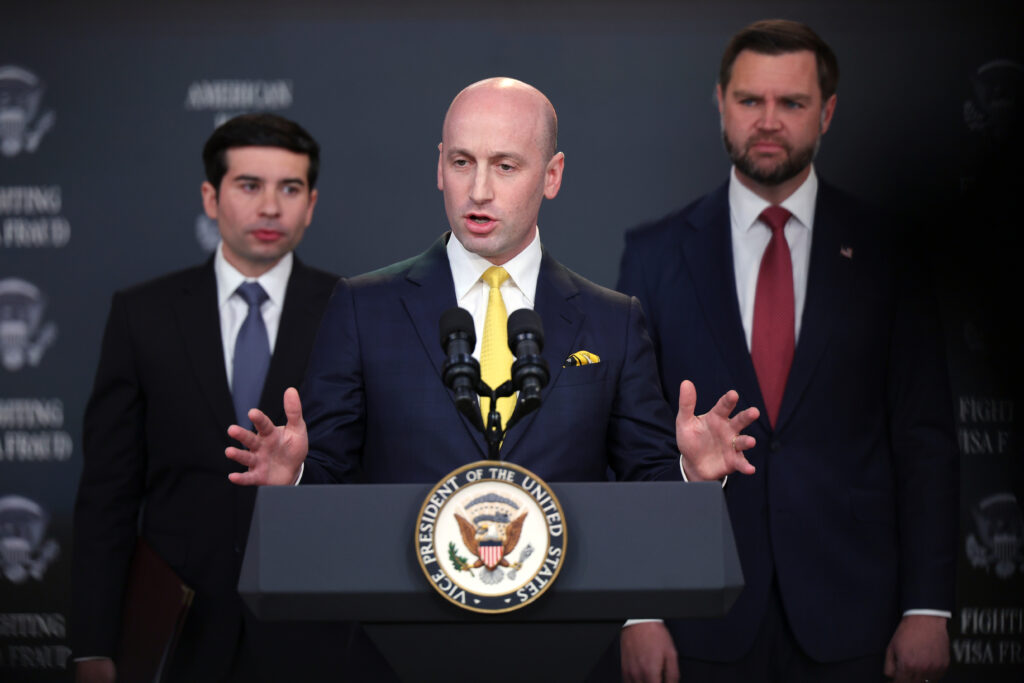
President Donald Trump has officially named longtime policy adviser Stephen Miller as the 33rd White House Chief of Staff, placing one of his closest and most outspoken allies in charge of West Wing operations. According to an official White House announcement, the president revealed the decision on Friday, November 6, 2026, and Miller officially stepped into the role on Monday, November 9, 2026.
The promotion comes right after a turbulent week in American politics. Just days earlier, voters delivered major victories to the Democratic Party in the November 2026 midterm elections, flipping control of both the House of Representatives and the Senate. Instead of pivoting toward the political center after those losses, the administration chose to elevate a loyal insider who has helped shape its toughest policies since 2016.
Miller replaces Susie Wiles, the seasoned campaign strategist who had served as chief of staff since the start of the president’s second term in January 2025. As TIME reported, Trump praised Miller to reporters as “a great manager” who “gets it” and has been by his side from the very beginning. For everyday Americans, business owners, and lawmakers on Capitol Hill, this leadership change sets a very different tone for the final two years of the presidency.
Key Facts About Stephen Miller’s White House Promotion
For readers looking for the essential details at a glance, here is what you need to know about the West Wing leadership transition:
- New Role: Stephen Miller is the 33rd White House Chief of Staff, the highest-ranking unelected official inside the Executive Office of the President.
- Start Date: President Trump announced the move on November 6, 2026, and Miller officially assumed office on November 9, 2026.
- Predecessor: He succeeded Susie Wiles, who resigned on November 5, 2026, and transitioned to work with the president’s outside political organization.
- Previous Posts: Prior to this promotion, Miller served simultaneously as White House Deputy Chief of Staff for Policy and United States Homeland Security Advisor.
- First Major Action: Within days of taking the helm, Miller issued a strict directive requiring White House staff to get clearance from government lawyers before meeting with registered lobbyists.
Who Is Stephen Miller and How Did He Rise to the Top?
At 41 years old, Stephen Miller has spent nearly two decades working inside conservative politics, steadily moving from behind-the-scenes congressional offices to the center of executive power. Born in Santa Monica, California, in August 1985, Miller graduated from Duke University before heading to Washington, D.C., where he worked as a press secretary and communications aide for Republican lawmakers.
The $0 Secret To Launching Your Entire Online Empire
Why pay hundreds every month for separate software? Build funnels, send emails, and make sales with Systeme.io completely free.
Get Started For $0Free Forever • No Credit Card Needed • Beginner-Friendly
From Capitol Hill Speechwriter to Senior White House Adviser
Miller first caught national attention when he worked for former Senator Jeff Sessions, helping craft legislative strategies and messaging around border enforcement and trade. In early 2016, he joined Donald Trump’s presidential campaign as a senior policy adviser and speechwriter. His sharp, populist writing style quickly matched the candidate’s voice on the campaign trail.
When Trump took office in January 2017, Miller became Senior Advisor to the President and White House Director of Speechwriting. Throughout that first four-year term, he helped draft major addresses, including the 2017 inaugural speech, and played a central role in shaping executive orders on travel restrictions, refugee caps, and asylum rules. Unlike many staffers who cycled in and out of the administration during those years, Miller remained in the West Wing from the first day until the last.
His Second-Term Role Before the Promotion
After leaving government in 2021, Miller founded America First Legal, a conservative legal group that filed dozens of lawsuits challenging federal regulations and corporate diversity programs. When Trump returned to the White House in January 2025, Miller came back with far broader authority as Deputy Chief of Staff for Policy and Homeland Security Advisor.
In those roles, Miller worked closely alongside border czar Tom Homan to oversee the administration’s sweeping border crackdown and deportation initiatives. According to statements from the White House, officials credit him with spearheading federal crime initiatives in cities such as Washington, D.C., and Memphis, pushing through broad deregulation, and expanding domestic energy production. That deep familiarity with how federal agencies operate is a big reason the president trusted him to step up to the top staff job.
Why Did Susie Wiles Step Down After the 2026 Midterm Elections?
To understand why Miller’s promotion is sending shockwaves through Washington, it helps to look at the person he replaced. Susie Wiles made history in January 2025 as the first woman to serve as White House Chief of Staff, earning wide respect across Republican circles for bringing structure and discipline to Trump’s 2024 presidential campaign.
The Timing Behind the West Wing Shake-Up
According to reporting from the Associated Press, Wiles handed in her resignation on Thursday night, November 5, 2026, just two days after Republicans suffered steep losses in the midterm elections. Earlier in 2026, Wiles had also been open about undergoing treatment for breast cancer before announcing she showed no remaining evidence of the disease.
When reporters asked President Trump on November 6 if he replaced Wiles because he was unhappy with the election results, he pushed back on that idea. He explained that the midterm races were not his own name on the ballot and told journalists, “Not because of the election. It’s just time. Sometimes you change”. In his public announcement, Trump praised Wiles for an outstanding tenure and confirmed she would continue working within his broader political operation.
Two Very Different Management Styles
Even if the transition was amicable on paper, political observers see a dramatic shift in how the West Wing will run day to day. As NPR noted in its analysis, Wiles operated largely behind the scenes. She rarely gave television interviews and viewed her role as a steady gatekeeper who organized schedules, managed cabinet personalities, and offered candid advice without trying to dominate the spotlight.
Miller represents almost the exact opposite style. He is a frequent, combative presence on cable news broadcasts and social media, fiercely defending every administration move and challenging journalists directly. While Wiles focused on process and political coordination, Miller is driven primarily by ideological goals and aggressive executive action.
What Stephen Miller Has Already Changed in the West Wing
Miller did not waste any time putting his stamp on the office once he took over on November 9, 2026. Within four days on the job, he introduced a significant new rule aimed at tightening control over outside influence inside the White House.
Strict New Rules on Lobbyist Meetings
On November 13, 2026, Law Commentary reported that Miller issued an internal directive prohibiting White House staff from holding unauthorized policy meetings with registered lobbyists anywhere on the White House grounds. Under the new policy, employees must obtain advance approval from the Office of White House Counsel before sitting down with lobbyists to discuss government decisions.
The order followed recent public complaints from former Health and Human Services senior adviser Calley Means, who had accused corporate lobbying interests of trying to steer administration health policies. By placing White House lawyers directly between lobbyists and policy aides, Miller signaled that he intends to keep a tight grip on who gets access to decision-makers.
Pledging Full Devotion at Mar-a-Lago
Shortly after his appointment was announced, Miller spoke at Mar-a-Lago and framed his new job around total loyalty to the president. According to coverage from The Jerusalem Post, Miller told the crowd that Trump had saved the country’s military, economy, and border, adding, “It is the greatest honor of my life to be your chief of staff. I pledge to you, Mr. President, my absolute loyalty, my unwavering commitment, and my complete dedication to your success”.
On social media, Miller echoed that message, describing his mission as fighting with full energy to support the president’s agenda. That rhetoric shows he views the chief of staff role not as a neutral referee, but as a frontline commander carrying out the president’s vision.
How Republicans, Democrats, and Legal Experts Are Reacting
Because Stephen Miller is one of the most polarizing figures in modern American politics, news of his promotion immediately drew strong reactions from every corner of Washington.
Send, Spend & Hold Money Worldwide Without Hidden Fees
Transfer money internationally at the real exchange rate and hold 40+ currencies in one account.
Open a Wise AccountMid-market rate • Fast transfers • 40+ currencies
Praise From Administration Officials and Conservative Allies
Inside the administration and among loyal conservative allies, the move was celebrated as a bold step to keep the America First agenda moving forward. Vice President JD Vance called Miller an “amazing patriot” and congratulated him on what he termed a “well deserved promotion”. Environmental Protection Agency Administrator Lee Zeldin described Miller as a sharp, relentless fighter who has stood beside the president since day one.
Several Republican lawmakers also voiced strong backing. Senator Eric Schmitt of Missouri stated that Miller understands what is at stake at a pivotal moment for the country, while Representative Paul Gosar of Arizona praised Miller’s work on border security. Conservative commentators and media editors similarly welcomed the choice, calling Miller a “wartime chief of staff” who knows how to use the machinery of the federal government to get things done without backing down.
Pushback From Some House Republicans
At the same time, the promotion exposed real divisions within the Republican Party following Tuesday’s election defeats. As FOX 5 DC reported, several House Republicans had privately and publicly argued just hours before the announcement that Miller should actually be dismissed rather than promoted.
Representative Marlin Stutzman of Indiana called the promotion a “horrible decision,” arguing that Miller’s hardline approach to immigration damaged the party’s standing with Hispanic and Latino voters in key states like Texas. Retiring Representative Don Bacon of Nebraska shared a similar view, telling reporters that Miller’s policies had hurt the administration and cost Republicans seats in Congress. When asked for a reaction after the promotion became official, one House Republican simply responded with a skeptical gesture.
Sharp Criticism From Democratic Leaders
Democrats, preparing to take over majorities in both the House and the Senate in January 2027, condemned the appointment in stark terms. Senate Minority Leader Chuck Schumer stated that the choice proved the White House had learned nothing from its midterm defeat, calling Miller the architect of harsh policies and promising that Democratic majorities would oppose him at every turn.
In the House, Representative Robert Garcia of California—who is set to chair the powerful House Oversight Committee in the new Congress—singled out Miller by name as a primary target for upcoming congressional investigations. According to CBS News, Garcia warned that Miller should “lawyer up” as lawmakers prepare to examine Department of Homeland Security operations, immigration enforcement actions, and White House decision-making.
What This Appointment Means for Immigration, Congress, and Everyday Americans
Beyond the political headlines, changing the White House Chief of Staff affects real policies that touch businesses, families, and government agencies across the country. Because the chief of staff controls the flow of information to the Oval Office and decides which policy proposals reach the president’s desk, Miller now holds sway over far more than border rules.
Immigration Policy and Legal Visa Processing
Immigration remains the issue most closely tied to Miller’s career, and legal experts expect enforcement to grow even stricter under his leadership. Earlier in 2026, the State Department suspended immigrant visa issuance for nationals from 75 countries. According to analysis from immigration law firm Reddy Neumann Brown PC, Miller’s elevation means tighter oversight will likely reach every corner of the legal immigration system as well.
Employers and foreign workers could soon see several practical shifts:
- Closer Scrutiny of Work Visas: Companies sponsoring H-1B skilled workers may face higher rates of Requests for Evidence, stricter reviews of wage levels and job descriptions, and more frequent workplace compliance inspections.
- Slower Green Card Processing: Applicants waiting to adjust their legal status could experience longer processing timelines and tougher background checks.
- Expanded Border and Interior Enforcement: With Miller coordinating directly with Homeland Security officials from the top West Wing office, deportation operations and border restrictions will remain a top daily priority.
A Tougher Standoff With Capitol Hill
In a divided Washington where Democrats control Congress and a Republican sits in the White House, the chief of staff normally spends months negotiating budget deals, judicial confirmations, and legislative compromises with lawmakers from both parties. Political analysts say Miller’s appointment suggests the White House is preparing for confrontation rather than compromise.
The $0 Secret To Launching Your Entire Online Empire
Why pay hundreds every month for separate software? Build funnels, send emails, and make sales with Systeme.io completely free.
Get Started For $0Free Forever • No Credit Card Needed • Beginner-Friendly
Fox News chief political anchor Bret Baier noted that elevating Miller signals the president is gearing up for a fight rather than reaching across the aisle. Similarly, DCReport observed that with Congress likely to block major conservative bills, the administration is expected to rely heavily on executive orders, regulatory changes, and agency directives—areas where Miller has spent years mastering the fine print of federal law.
Frequently Asked Questions About Stephen Miller’s Appointment
When did Stephen Miller officially become White House Chief of Staff?
President Donald Trump announced Stephen Miller’s appointment on Friday, November 6, 2026, and Miller officially took over the position on Monday, November 9, 2026.
Who did Stephen Miller replace as White House Chief of Staff?
Miller replaced Susie Wiles, who had served as White House Chief of Staff since January 2025. Wiles stepped down on November 5, 2026, and moved to a role within President Trump’s political organization.
What does the White House Chief of Staff actually do?
The White House Chief of Staff manages the entire White House staff, controls access to the Oval Office, oversees the president’s daily schedule, coordinates policy across federal cabinet departments, and leads negotiations with Congress and outside leaders.
What was Stephen Miller’s job before becoming Chief of Staff?
Before his promotion in November 2026, Miller served as White House Deputy Chief of Staff for Policy and United States Homeland Security Advisor during Trump’s second term. During Trump’s first term from 2017 to 2021, he served as Senior Advisor to the President and Director of Speechwriting.
What was Stephen Miller’s first major policy rule in his new role?
On November 13, 2026—just four days after starting the job—Miller issued a new rule barring White House staff from holding unauthorized policy meetings with registered lobbyists anywhere on the White House complex without prior approval from the Office of White House Counsel.
How will Stephen Miller’s promotion affect U.S. immigration rules?
Because Miller now oversees the entire White House policy process, legal experts anticipate stricter enforcement across both border operations and legal employment visas, including heightened reviews of H-1B petitions, more workplace audits, and longer waits for green card applicants.
Looking Ahead at the Next Two Years in Washington
Putting Stephen Miller in the chief of staff’s office marks one of the clearest turning points of President Trump’s second term. By replacing a traditional political manager like Susie Wiles with a committed policy hardliner right after a tough midterm election, the White House has shown that it plans to double down on its core agenda rather than soften its approach.
As the new Democratic Congress prepares to take office in January 2027, Washington is heading into a period of intense political friction, high-stakes oversight battles, and sweeping executive actions. How well Miller balances his ideological drive with the day-to-day demands of managing a massive federal government will shape the remainder of this presidency.
What do you think about Stephen Miller taking over as White House Chief of Staff?
