
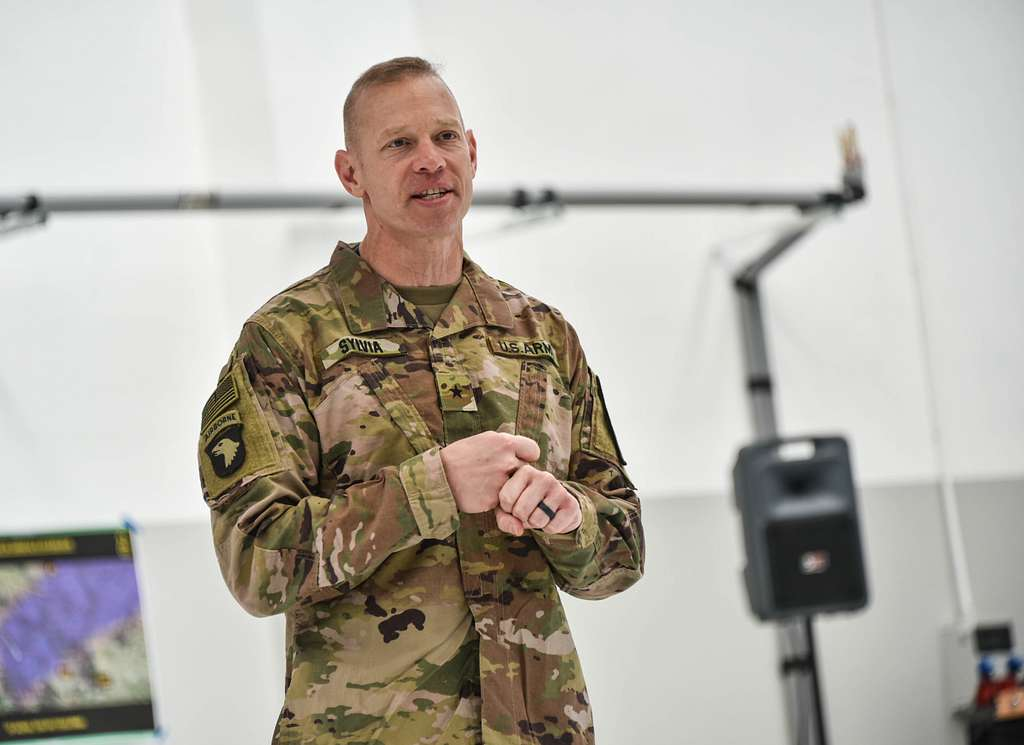
The halls of the Pentagon just witnessed another massive earthquake. Defense Secretary Pete Hegseth has abruptly removed Lieutenant General Brett Sylvia, the military’s director for strategy, plans, and policy. General Sylvia served as the chief strategic brain for the Joint Chiefs of Staff, holding the crucial post known across Washington as the J5.
His sudden exit comes at what might be the most dangerous moment of the year. President Donald Trump and his national security cabinet are actively weighing fresh military strikes against Iran. When you remove the primary architect responsible for drawing up global war plans right as combat operations are on the table, alarms start ringing from the E-Ring of the Pentagon all the way to Capitol Hill.
This shake-up is not an isolated incident. It marks the latest chapter in an aggressive remaking of America’s military high command, where career officers find themselves walking on razor-thin ice. If you want to understand why this sudden firing matters, how it connects to the standoff across the Middle East, and what it could mean for everyday fuel prices and global stability, here is the full breakdown of the situation.
Who Is Lieutenant General Brett Sylvia, and Why Was He Ousted?
Lieutenant General Brett Sylvia is not a political appointee. He is a seasoned three-star Army general with more than thirty-two years of active-duty military service. Before taking over the J5 directorship, Sylvia commanded major combat formations, led soldiers during multiple overseas deployments, and earned a reputation as a methodical, detail-oriented strategic thinker.
In military circles, the J5 directorship is widely viewed as one of the most demanding posts in the entire armed forces. The officer in this seat does not drive tanks or fly fighter jets. Instead, the J5 coordinates directly with the Chairman of the Joint Chiefs of Staff, General Dan Caine, to transform White House political directives into actionable, realistic military strategies. If the President asks what happens if American forces bomb specific targets overseas, the J5 team provides the operational blueprints, logistical timelines, and worst-case retaliation assessments.
The $0 Secret To Launching Your Entire Online Empire
Why pay hundreds every month for separate software? Build funnels, send emails, and make sales with Systeme.io completely free.
Get Started For $0Free Forever • No Credit Card Needed • Beginner-Friendly
Sylvia’s sudden removal without an immediate permanent successor left defense analysts stunned. A spokesperson for the Joint Staff publicly thanked Sylvia for his decades of service, wishing him well in his post-military transition. Yet behind the polite public statements, leaks and finger-pointing quickly filled the void.
Reports circulating across defense channels, including reporting highlighted by the Daily Mail, suggest that Sylvia’s removal was tied to internal accusations that he met with reporters outside Pentagon grounds to bypass strict media escort rules. Anonymous defense sources also claimed he clashed over unauthorized leaks of sensitive operational plans.
At the same time, veteran defense observers note that Sylvia is the second top planner pushed aside in rapid succession. Sylvia’s predecessor, Joseph McGee, was also nudged into early retirement under similar high-pressure circumstances. To many inside the building, Sylvia’s departure looks less like a single personnel dispute and more like a systematic effort by defense leadership to sweep out traditional military planners who push back against aggressive White House options.
The Broader Shake-Up Under Defense Secretary Pete Hegseth
To understand how Sylvia lost his post, you have to look at how Pete Hegseth has run the Department of Defense since taking the oath of office. From his first week at the helm, Hegseth made it obvious that business as usual at the Pentagon was over.
Hegseth has openly championed a sweeping overhaul of military leadership, previously announcing plans to enforce a massive 20 percent cut to top military brass. He has regularly argued that the military became bloated with too many desk-bound generals and distracted by corporate culture. His critics, however, argue that his laser focus on ideological disputes and culture wars has thrown standard operational continuity into disarray, a dynamic explored in our look at how Pete Hegseth’s culture war focus disrupted military progress.
This aggressive leadership style has repeatedly triggered severe friction inside the Pentagon’s civilian and military ranks. Not long ago, the defense community was rocked when Army Secretary Dan Driscoll resigned following high-stakes friction with Pete Hegseth.
When political appointees repeatedly purge senior flag officers during active regional crises, it creates immense institutional hesitation. Subordinate planners can become hesitant to deliver blunt military advice if telling the defense secretary that an attack plan carries serious flaws might abruptly end their careers.
The Looming Standoff: Why New Iran Strikes Are on the Table
The most urgent backdrop to General Sylvia’s departure is the deteriorating security environment in the Middle East. Over recent months, the conflict involving the United States, its regional allies, and Tehran has moved through dangerous peaks and uneasy lulls.
Diplomatic overtures have repeatedly stalled. Earlier this year, Washington flatly dismissed diplomatic off-ramps, as covered when Trump rejected Iran’s seven-day peace deal. Instead of moving toward long-term stabilization, American defense officials have maintained that Iran’s leadership must make sweeping concessions regarding its missile program and regional proxy networks before any lasting agreement can be reached.
That diplomatic deadlock has repeatedly manifested in dangerous direct skirmishes. American forces have previously launched targeted strikes against shipping assets, as seen when the US struck three Iranian oil tankers following attacks on Navy warships. In response, regional skies and sea lanes have witnessed back-and-forth drone and missile duels, highlighted by episodes where the US and Iran traded air attacks in the Strait of Hormuz.
Publicly, the administration has insisted that Tehran is running out of options. The White House has reiterated that Trump claims Iran is in deep trouble as the conflict drags on.
Despite those public declarations, intelligence estimates tell a far more complicated story. Iranian forces and affiliated regional militias continue to deploy long-range loitering munitions, ballistic missiles, and naval swarm boats. With diplomatic negotiations currently on life support, officials speaking with CNN report that the White House is once again evaluating options for a renewed wave of precision air and missile strikes designed to degrade Iran’s defensive installations and command nodes.
Carrying out an offensive of that scale requires immense planning. Target folders must be updated daily, allied defensive batteries across the Persian Gulf must be positioned to intercept retaliation, and air wings must be rotated safely. Losing the chief planner responsible for overseeing those exact logistics right as orders are being drawn up is why this personnel move has shocked Washington.
Capitol Hill Pushes Back Against the Pentagon
General Sylvia’s sudden dismissal is landing in the middle of a political firestorm on Capitol Hill. Lawmakers from both sides of the aisle are watching the Pentagon’s personnel shake-ups with rising skepticism.
On the legislative front, Congress has repeatedly attempted to reassert its constitutional war powers authority. Lawmakers have brought forward multiple measures to constrain executive authority in the Middle East, as demonstrated when the US House voted for a third time to force an end to the Iran war. While hawkish leaders have so far managed to preserve executive flexibility—seen when the Senate blocked a War Powers Resolution to back the administration’s Iran strategy—the political margin is thinning rapidly.
Send, Spend & Hold Money Worldwide Without Hidden Fees
Transfer money internationally at the real exchange rate and hold 40+ currencies in one account.
Open a Wise AccountMid-market rate • Fast transfers • 40+ currencies
Pete Hegseth himself has become a lightning rod for congressional frustration. Discontent is not limited to opposition Democrats; several conservative lawmakers have expressed public unease over how military operations and personnel decisions are being handled.
In an extraordinary move, conservative firebrand Thomas Massie moved to impeach Defense Secretary Pete Hegseth over the unlawful Iran war. Simultaneously, reports of quiet resistance have emerged in the upper chamber, where several Republican leaders have voiced concerns over defense policies, culminating in a noticeable GOP Senate revolt against Defense Secretary Pete Hegseth.
Lawmakers are now asking whether General Sylvia was ousted because he raised realistic objections about the military’s ammunition stockpiles, regional base vulnerabilities, or the risk of regional spillover. When congressional committees convene their next oversight hearings, expect Sylvia’s dismissal to take center stage.
The Midterm Election Factor and Public Opinion
Timing is everything in politics, and General Sylvia’s exit cannot be separated from the domestic political calendar. The United States is heading straight into high-stakes midterm elections, and voters are paying close attention to national security decisions.
Military interventions rarely occur in a political vacuum. Administration officials know that a decisive military action can project strength, but an unexpected foreign policy catastrophe can sink vulnerable candidates at the ballot box. Across critical swing states, voters have expressed deepening fatigue with open-ended Middle Eastern entanglements, especially when military actions coincide with domestic economic pressure.
Polls have shown that foreign conflict directly affects political standing at home. For instance, recent surveys revealed that Arizona voters gave record-low approval marks over the economy and the Iran conflict.
When voters see billions of dollars flowing toward overseas military engagements while grocery bills and borrowing costs remain elevated, political patience wears thin. If the administration launches fresh strikes on Iran, it risks alienating independent voters who want Washington focused strictly on domestic priorities. By ousting Sylvia now, the Pentagon may be attempting to ensure that any military moves executed around election season are carried out by leadership that moves in lockstep with the White House.
What This Means for Everyday People: Gas Prices and Global Shipping
It is easy to look at military personnel changes inside the Pentagon and think they have nothing to do with your everyday life. In reality, strategic decisions made by the J5 planner influence global markets faster than almost anything else.
The Persian Gulf and the Strait of Hormuz represent the primary transit corridor for roughly twenty percent of the world’s petroleum. Whenever military strikes occur, maritime insurers dramatically increase the premiums they charge cargo ships and oil tankers operating in the region. Many commercial transport companies choose to reroute their vessels entirely around the southern tip of Africa, adding weeks to transit times and millions of dollars in operational fuel costs.
We have already seen what happens when tensions spill over into vital shipping corridors. Regional attacks have previously caused massive market turmoil, notably when US-Iran escalations and Houthi strikes in Saudi Arabia pushed oil prices past one hundred dollars per barrel.
The $0 Secret To Launching Your Entire Online Empire
Why pay hundreds every month for separate software? Build funnels, send emails, and make sales with Systeme.io completely free.
Get Started For $0Free Forever • No Credit Card Needed • Beginner-Friendly
Higher crude prices do not stay confined to Wall Street trading floors. Within days, elevated oil prices translate into higher prices at local gas pumps. From there, shipping and logistics companies pass those higher transportation expenses on to retailers, raising the price of produce, household goods, and everyday consumer items on supermarket shelves worldwide.
The reverberations stretch into global refining networks as well. As international markets scramble to secure stable oil supplies, independent refiners have had to adjust purchasing plans, as seen when Dangote Refinery bought sixteen million barrels of crude as Middle East tension squeezed fuel markets. When the Pentagon changes its top war planner while gearing up for new strikes, global energy traders notice immediately.
Frequently Asked Questions (FAQs)
Who is Lieutenant General Brett Sylvia?
Lieutenant General Brett Sylvia is a veteran United States Army general with over thirty-two years of service. He served as the Director for Strategy, Plans, and Policy (J5) on the Joint Staff, where he was responsible for leading strategic planning and military policy advice for the Chairman of the Joint Chiefs of Staff and the Secretary of Defense.
Why did Defense Secretary Pete Hegseth remove General Sylvia?
While the Pentagon’s official statement only thanked Sylvia for his decades of service, reporting from defense sources indicates friction over strategic planning and unauthorized media interactions. Reports allege that Sylvia met with reporters outside the Pentagon building to avoid escort requirements and faced questions concerning leaks of sensitive war planning documents.
What does the Pentagon’s J5 Director actually do?
The J5 Director leads the strategy, plans, and policy division of the Joint Staff. In simple terms, this officer is the chief architect of America’s military playbooks. When civilian leaders consider launching military action abroad, the J5 office develops the operational plans, evaluates logistics and resource constraints, and assesses how adversary nations are likely to respond.
Is the United States about to launch new strikes on Iran?
Defense officials report that President Donald Trump and his national security team are actively evaluating plans for renewed strikes against Iranian targets. While a final operational green light depends on diplomatic developments and regional developments, planning at the highest levels of the Pentagon is actively underway.
How could new military action against Iran affect everyday consumers?
Any major escalation in the Middle East threatens energy transit through the Strait of Hormuz. Disruptions to oil shipping quickly lead to sharp spikes in global crude prices, which directly drives up the cost of gasoline at local pumps and increases shipping fees for everyday groceries and consumer goods.
High Stakes and Uncertainty Ahead
The dismissal of Lieutenant General Brett Sylvia removes an experienced, methodical voice from the Pentagon’s war room at the exact moment calm, steady planning is needed most. As Secretary Pete Hegseth continues his drive to reshape military leadership, the margin for operational error grows vanishingly thin.
Planning a potential military confrontation against a heavily armed regional power like Iran is not an academic exercise. It requires meticulous coordination, realistic pushback against overly optimistic assumptions, and a clear understanding of downstream consequences. With the J5 director’s desk suddenly vacant and tensions simmering across the Persian Gulf, the coming weeks will reveal who takes over America’s strategic planning—and whether the nation is stepping into a new military escalation.
