
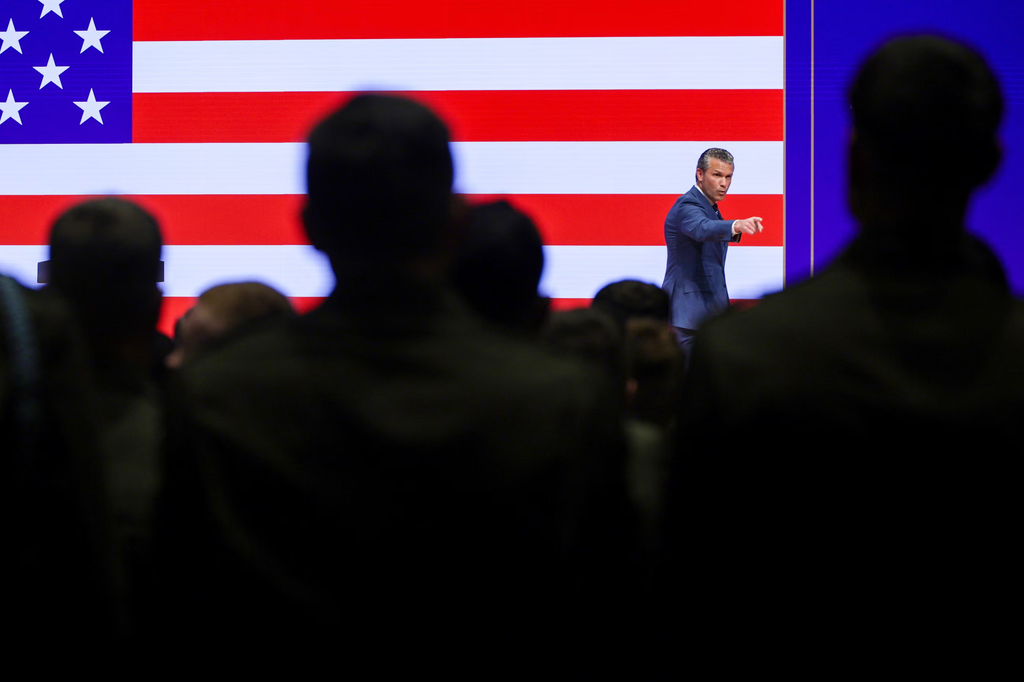
Defense Secretary Pete Hegseth delivered a direct and unfiltered message to the American military during his annual State of the Force address at Marine Corps Base Quantico in Virginia. Speaking directly to lower-ranking service members, Hegseth announced a sweeping plan to slash 20% of all general and admiral positions across the United States Armed Forces.
Hegseth made it clear that the Pentagon is shifting its entire focus away from diversity programs and back toward strict combat readiness. He told the crowd that the Department of Defense is no longer the woke department or the weak department. He explained the decision in plain language, stating that the new rule means no fatties, no trannies, no beardos, no weirdos, no wimps, and no radicals, leaving only warriors in the ranks.
The announcement marks one of the most drastic leadership restructurings at the Pentagon in modern history. While supporters view the move as a long-overdue cleanup of top-heavy military bureaucracy, critics argue it represents a political purge that could remove experienced military leaders.
Breakdown of the 20% Cut: What Is Changing in Top Leadership?
The plan to reduce top military brass target positions across every branch of the military, including the Army, Navy, Air Force, Marine Corps, and Space Force. Under the current structure, the U.S. military maintains approximately 851 active-duty generals and admirals, which sits just under the federal limit of 857 set by Congress.
The 20% reduction target is split into two distinct parts:
The $0 Secret To Launching Your Entire Online Empire
Why pay hundreds every month for separate software? Build funnels, send emails, and make sales with Systeme.io completely free.
Get Started For $0Free Forever • No Credit Card Needed • Beginner-Friendly
- Direct Removals: The Pentagon plans to remove roughly 10% of currently serving generals and admirals from their positions.
- Billet Elimination: The department will eliminate another 10% of general officer slots entirely, ensuring those leadership positions are not refilled in the future.
By taking these steps, the Pentagon will eliminate more than 170 top-level officer roles. Hegseth noted that while major media outlets are calling the move a purge, the administration views it purely as accountability. He argued that the military has become too top-heavy over the past few decades, creating excessive bureaucracy at the expense of front-line combat units.
This structural shift aligns with broader administrative changes across the military establishment, similar to earlier operational updates highlighted in our coverage on inside the Pentagon shift.
“Just Warriors”: The Core Philosophy Behind the Pentagon Shift
At the heart of Hegseth’s speech is a complete rejection of social programs, diversity mandates, and non-combat administrative initiatives within the military. Hegseth emphasized that every military formation must center its entire operational schedule around five specific goals: training, readiness, accountability, discipline, and lethality.
During his speech, Hegseth told the assembled troops that when leaders focus strictly on combat readiness, commanders no longer have to walk on eggshells. He noted that complainers, ideologues, and poor performers are being pushed out of leadership roles so that true warriors can take charge.
The defense chief stated that military culture had drifted away from its core mission over previous administrations. Under the new directive, promotions and leadership assignments will focus strictly on tactical competence, physical fitness, and adherence to traditional military standards rather than administrative background or diversity metrics.
What “No Beardos” Means for Daily Military Operations
One of the most talked-about phrases from Hegseth’s speech was his prohibition of beardos and relaxed standards. To understand why this phrase raised eyebrows, it helps to look at how military grooming rules actually operate on the ground.
Standard military regulations generally prohibit active-duty service members from growing facial hair, primarily to ensure that gas masks and protective breathing equipment form a tight seal against the face. However, over the years, the military has granted medical waivers, known as shaving waivers, for service members suffering from skin conditions like pseudofolliculitis barbae, which causes severe irritation from daily shaving. Religious accommodations have also allowed certain personnel to maintain beards.
Hegseth’s comments signal a strict crackdown on these exceptions:
- Stricter Waiver Reviews: Commands will apply much tighter scrutiny to medical and personal grooming waivers.
- Return to Uniform Standards: Personnel who do not meet strict grooming standards may face administrative discharge or limited deployment options.
- Re-enforced Fitness Benchmarks: Physical fitness tests and body composition limits will be strictly enforced, with fewer allowances for non-deployable status.
Critics point out that tightening grooming and medical waivers could unintentionally penalize service members who rely on legitimate medical waivers. However, defense officials maintain that uniform standards are essential for maintaining discipline and unit cohesion across the force.
How Capitol Hill and Military Experts Are Reacting
The decision to cut 20% of senior military officers has sparked intense debate among lawmakers on Capitol Hill and defense policy analysts.
Senator Mike Rounds, a member of the Senate Armed Services Committee, acknowledged that trimming a top-heavy command structure might have valid points. However, he emphasized that Congress needs a full accounting of Hegseth’s reasoning and a clear blueprint showing how the cuts will affect operational readiness before fully endorsing the plan.
Other lawmakers have expressed deeper concerns, questioning whether the reductions are intended to eliminate independent military voices. Political friction over defense leadership is not new in Washington, as seen in ongoing congressional debates like GOP Representative Thomas Massie’s effort regarding defense leadership.
Key arguments from both sides of the debate include:
- Supporters’ Perspective: Slashing general positions removes unnecessary administrative management, reduces budget overhead, speeds up decision-making, and refocuses military resources on actual combat capabilities.
- Critics’ Perspective: Removing one in five generals risks stripping away decades of institutional knowledge, diplomatic skill, and complex logistics experience needed during global crises.
Friction and Turnover at the Top of the Defense Department
The announcement of these leadership cuts comes during a period of significant turnover within the leadership ranks of the Department of Defense. Over recent months, multiple high-ranking civilian and military officials have departed following disagreements over policy and organizational direction.
A prime example was the high-profile exit of former Army Secretary Dan Driscoll, who stepped down after public friction over command decisions and administrative authority. Details on that transition were explored in our report on Army Secretary Dan Driscoll resigning following high-stakes friction.
Send, Spend & Hold Money Worldwide Without Hidden Fees
Transfer money internationally at the real exchange rate and hold 40+ currencies in one account.
Open a Wise AccountMid-market rate • Fast transfers • 40+ currencies
This high rate of turnover raises practical questions about how major military modernization programs will be managed. The Pentagon is currently overseeing massive long-term investments, ranging from spending $2 billion on nuclear microreactors for military bases to advanced technological developments like military drone and sniper complex projects. Carrying out these complex initiatives requires steady management, making the retention of qualified personnel a central concern.
Retention Rates and Force Morale: What the Numbers Show
Despite concerns regarding morale and turnover, Hegseth insisted during his address that the military is currently retaining service personnel at record rates. He told the audience at Quantico that about 80% of the force onboard was retained, claiming that everyday service members appreciate clear, firm rules and strong leadership.
Military recruitment has also shown signs of rebound after years of missing target quotas across several branches. Defense officials attribute this shift to clear messaging, updated enlistment incentives, and a simplified focus on core military service rather than social programs.
At the same time, policy changes regarding operational security have accelerated. The Department of Defense has recently adjusted access to internal files and historical records, a topic discussed in our overview on why the Pentagon cut access to secret military documents. Together, these moves represent a broader campaign to tighten internal security and streamline operational command.
How the Cuts Will Roll Out Across Military Branches
Eliminating 20% of general and admiral slots is a massive logistical task that cannot happen overnight. The Department of Defense plans to execute the reduction in phases over the coming fiscal year to prevent sudden command gaps in active theater operations.
The rollout is expected to follow several key steps:
- Retirement Audits: Reviewing flag officers who are currently eligible for voluntary retirement or whose terms of service are coming to an end.
- Billet Consolidation: Merging overlapping command structures, particularly within administrative headquarters, regional staff offices, and joint task forces.
- Promotion Board Re-alignment: Reducing the number of annual promotions from Colonel (O-6) to Brigadier General (O-7), ensuring that fewer candidates enter the flag officer pipeline.
- Performance Reviews: Evaluating sitting generals on unit readiness metrics, physical fitness standards, and combat leadership experience.
By focusing the cuts on administrative staff functions rather than operational field commands, the Pentagon hopes to keep frontline combat units fully staffed while scaling down high-level office personnel.
Frequently Asked Questions (FAQs)
Why is the US military cutting 20% of its generals and admirals?
Defense Secretary Pete Hegseth announced the cuts to reduce military bureaucracy, trim top-heavy leadership staff, and refocus Pentagon resources directly on combat readiness and lethality rather than administrative oversight.
What did Pete Hegseth mean by “no beardos, weirdos and wimps”?
The phrase was used during Hegseth’s State of the Force speech to emphasize a strict return to traditional military standards. It signals a crackdown on relaxed grooming waivers, non-essential medical exemptions, diversity programs, and lower physical fitness standards.
Does Congress need to approve cuts to general officer positions?
While the Defense Department has administrative authority to manage officer assignments and retirements, Congress sets the overall statutory limits on the maximum number of general and admiral positions. Major structural changes to command billets typically require consultation with congressional armed services committees.
The $0 Secret To Launching Your Entire Online Empire
Why pay hundreds every month for separate software? Build funnels, send emails, and make sales with Systeme.io completely free.
Get Started For $0Free Forever • No Credit Card Needed • Beginner-Friendly
How many generals and admirals will be affected by this decision?
With approximately 851 active-duty flag officers currently serving across all branches, a 20% reduction will eliminate or remove more than 170 general and admiral slots.
Will these cuts affect frontline military recruitment or enlisted personnel?
The 20% cut specifically targets high-ranking flag officers (generals and admirals) and their headquarters staff. Enlisted personnel and junior officers are not targeted by these reductions, and defense officials report that overall force retention remains stable.
The sudden shake-up at the top of the Pentagon marks a dramatic turning point for American defense policy. By combining deep leadership cuts with an explicit push for traditional discipline, Defense Secretary Pete Hegseth is reshaping how the U.S. military operates from the top down. Whether this approach builds a leaner, more effective fighting force or creates long-term operational challenges remains one of the most critical questions facing national defense leadership today.
To stay updated on breaking news, viral stories, and deep-dive analyses on global events, learn more about our mission or reach out directly through our contact page.
Join the conversation and follow our latest updates across social media on Instagram, Facebook, and X (formerly Twitter).
