
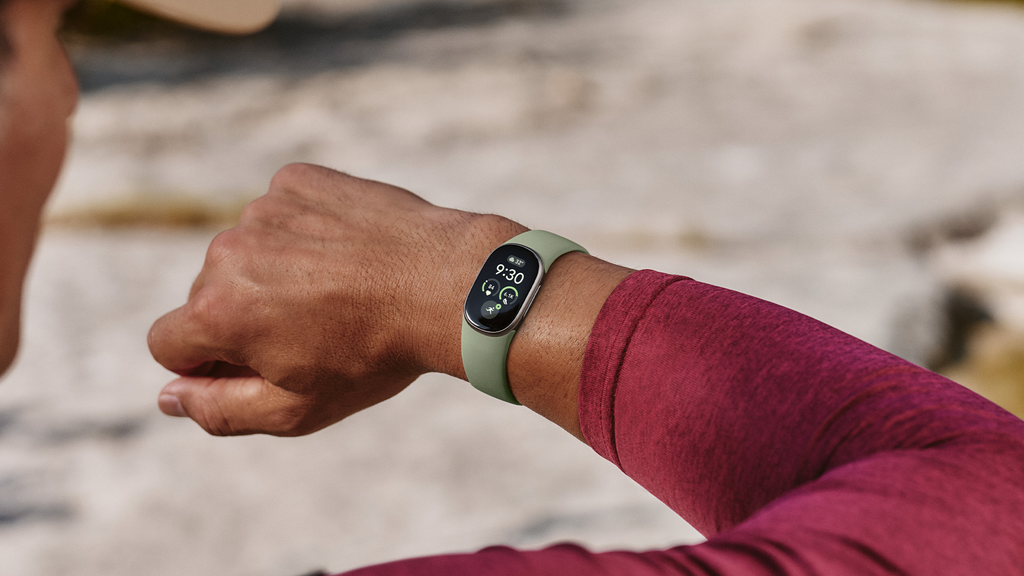
Google has officially pulled back the curtain on its newest wearable hardware, introducing the Fitbit Edge to the world. The sleek wristband sits directly at the center of Google’s long-term health monitoring ambitions, blending dedicated wellness sensors with intelligent software powered by Gemini.
Following months of speculation about how Google would evolve the Fitbit lineup, the Google Fitbit Edge announcement makes the company’s direction clear. Instead of forcing everyone into an oversized, battery-hungry smartwatch, Google is doubling down on dedicated fitness bands that disappear on your wrist, last for days on a single charge, and quietly track your vital statistics around the clock.
If you have felt torn between a bulky smartwatch and a basic step counter, this new release might just be the exact sweet spot you have been waiting for.
Price, Release Date, and What Comes in the Box
The Fitbit Edge is officially priced at $179.99 in the United States, positioning it as an accessible alternative to $400 flagship smartwatches. Pre-orders are open right now through the Google Store and major retail partners, with units officially shipping and landing on retail shelves on October 27.
Every order comes with a free three-month trial of Google Health Premium, giving buyers access to personalized coaching algorithms and in-depth fitness metrics right out of the box.
The $0 Secret To Launching Your Entire Online Empire
Why pay hundreds every month for separate software? Build funnels, send emails, and make sales with Systeme.io completely free.
Get Started For $0Free Forever • No Credit Card Needed • Beginner-Friendly
For shoppers who want something unique, Google also teamed up with four-time NBA champion Stephen Curry to unveil the Stephen Curry Special Edition Fitbit Edge. Priced at $219.99, this upgraded edition includes a custom water-repellent performance band dressed in signature rye and game-day orange accents, alongside exclusive digital watch faces.
Google is launching the standard tracker in four clean case finishes, each molded from recycled aluminum:
- Obsidian, featuring a matte black aluminum case paired with a matching dark active band.
- Fog, pairing a polished silver casing with an off-white wristband.
- Olive, giving the tracker an earthy satin pyrite finish.
- Canyon, offering a warm gold aluminum case with a soft terracotta tone.
You can also swap bands easily with quick-release clips. Google is launching active sport bands with extra ventilation, performance loop straps, magnetic bands, and premium metal link bracelets for formal wear. If you have ever shopped around for watch accessories, you know that finding the right comfortable watch band makes an enormous difference in how consistently you wear your device day and night.
A Massive Screen That Finally Beats Direct Sunlight
One of the biggest complaints about slim fitness bands has always been their tiny, cramped screens. Trying to glance down at your running pace while sprinting outdoors under strong sunlight often means squinting at tiny numbers.
Google tackled that problem head-on with the Fitbit Edge. The tracker features a newly engineered Hybrid OLED display that offers 46 percent more active viewing area than earlier generations.
The bezels have been trimmed down to create an edge-to-edge look, allowing room for much larger fonts, detailed workout metrics, and interactive glance cards. Despite the increased display area, the tracker maintains an ultra-slim profile that curves naturally along the contour of your wrist bone.
Outdoor visibility gets a noticeable boost as well. The screen is engineered to stay legible under blistering mid-day glare, so you do not have to cup your hand over the screen just to check your heart rate zone. The user interface has also been rebuilt around fluid tiles, letting you swipe through daily step tallies, quick weather checks, and workout triggers without any hesitation or stutter.
The Return of the Physical Button
If you have ever tried using a capacitive touch sensor on a fitness band with sweaty hands or during a heavy rainstorm, you know how frustrating missed taps can be. Google heard those complaints loud and clear and brought back a true physical side button on the Fitbit Edge.
The new button sits along the aluminum chassis and features tuned haptic feedback. When you press it, you get a solid, mechanical vibration that confirms your input immediately.
This simple design choice makes a world of difference during active workouts. You can pause a timer, start an interval, or scroll through menus mid-stride without needing to tap a slippery glass display. It is an intentional, practical design choice built for people who actually exercise.
A Giant Step for Repairability: A Replaceable Battery
Perhaps the biggest surprise of the entire launch is how Google designed the inside of the tracker. The Fitbit Edge is Google’s first repairable fitness tracker, built with a modular internal architecture and a replaceable battery.
For over a decade, fitness bands have been treated as disposable gadgets. When a tracker’s battery degraded after two or three years of daily charging cycles, owners had no choice but to throw the entire gadget in the trash. That waste has pushed thousands of users to research the steep battery replacement costs on smartwatches or give up on wrist trackers altogether.
With the Fitbit Edge, technicians can actually open the casing and swap the power cell without destroying the outer shell or ruining the internal sensors. The device still retains full 50-meter water resistance, meaning you can swim in pools, surf in open water, or jump in the shower without worrying about water leaking into the frame.
Making a waterproof, modular device that can actually be serviced down the road is a massive win for sustainability and gives customers real long-term value for their money.
7-Day Battery Life with Emergency Fast Charging
Even with a brighter screen, full satellite positioning, and round-the-clock sensors, Google claims the Fitbit Edge delivers up to seven full days of battery life on a single charge.
Send, Spend & Hold Money Worldwide Without Hidden Fees
Transfer money internationally at the real exchange rate and hold 40+ currencies in one account.
Open a Wise AccountMid-market rate • Fast transfers • 40+ currencies
Google calls this “weekend-to-weekend” battery endurance. You can charge the tracker up on Sunday night, wear it all week to track meetings, runs, gym sessions, and nightly sleep cycles, and you will not have to search for the charging cable until the following Sunday.
When you do run low on juice, you will not have to leave the tracker on your nightstand for hours. The Fitbit Edge features magnetic fast charging that delivers a full 24 hours of power in just five minutes of plug-in time. If you wake up, realize your tracker is down to 3 percent, and want to log a morning run, plugging it in while you lace up your running shoes gives you enough battery to power through the entire workout and the rest of your workday.
While some ultra-simple smart bands like long-lasting budget smartwatches hit double-digit battery life by omitting advanced biometric sensors, getting a full week out of a medical-grade sensor array is impressive.
Precision GPS and Over 50 Workout Modes
When it comes to tracking workouts, the Fitbit Edge leaves behind the clunky limitations of older fitness trackers.
Inside the nano-molded aluminum housing, Google added a redesigned satellite chipset. The built-in GPS on the Edge is up to 40 percent more accurate than the Charge 6, meaning you can leave your smartphone on the kitchen counter and still get pinpoint running routes, accurate mile splits, and realistic pace metrics.
An onboard altimeter tracks elevation changes during your outdoor hikes, stair workouts, and hill sprints, so you get credit for every bit of vertical climbing you finish.
The onboard Exercise app comes loaded with over 50 specific workout profiles, covering everything from outdoor cycling and track running to HIIT routines, weightlifting, and Pilates. If you use high-tech stationary gym equipment, the Fitbit Edge can also broadcast your live heart rate metrics directly over Bluetooth to compatible treadmills, rowers, and exercise bikes.
For times when you forget to start a workout manually, Google built in upgraded automatic activity detection. Using contextual AI algorithms, the tracker watches your movement patterns and automatically logs over 100 distinct physical activities. Whether you are running to catch a bus, mowing the lawn, or joining a casual evening basketball game, your effort is automatically recognized and credited toward your daily activity goals. This aligns directly with recent moves where Google transformed daily workout tracking across popular wearable platforms.
Health Guardian: Proactive Warnings, Blood Pressure, and Insulin Trends
The biggest headline of this launch is Google’s new “Health Guardian” suite. Google is shifting wearable technology away from passive counters that merely display past data, turning the Fitbit Edge into a proactive wellness monitor that identifies early physiological changes.
Instead of waiting for you to feel sick or fatigued, Health Guardian quietly runs complex background analyses on your baseline biological signals. Over weeks and months, the software watches for subtle drifts in your health baseline.
The $0 Secret To Launching Your Entire Online Empire
Why pay hundreds every month for separate software? Build funnels, send emails, and make sales with Systeme.io completely free.
Get Started For $0Free Forever • No Credit Card Needed • Beginner-Friendly
Among its standout features:
- Blood pressure trend indicators: While consumer wrist trackers cannot provide diagnostic medical cuff readings, the Edge monitors pulse transit characteristics to map monthly blood pressure trend directions. If you want to understand how wrist devices evaluate cardiovascular strain, our guide on measuring blood pressure on smartwatches breaks down the realistic abilities and limits of modern sensors.
- Insulin resistance patterns: By pairing continuous heart rate metrics, sleep consistency, skin temperature fluctuations, and metabolic load markers, the Google Health platform flags potential signs of declining metabolic efficiency or early insulin resistance trends.
- Cardiac safety alarms: The optical photoplethysmography sensor checks resting heart rate metrics every two seconds, sounding loud alerts if your pulse shoots abnormally high or drops dangerously low while you are at rest.
Google stresses that these readings are not meant to substitute for a hospital diagnosis, but they give users crucial clues about their internal wellness. When combined with Google Health Premium, the platform generates comprehensive summaries that users can easily export and share directly with their doctors during regular checkups.
ECG Rhythm Checks, Skin Temperature, and Morning Recovery Scores
Beyond the proactive Health Guardian system, the Fitbit Edge retains the gold standard biometric sensors that fitness enthusiasts rely on every day.
The device features an on-wrist electrocardiogram app. By placing your thumb and index finger on the metal bezel sensors, you can take a 30-second heart rhythm reading right on your wrist to check for signs of atrial fibrillation, also known as AFib. Irregular heart rhythm notifications also run quietly in the background to catch unexpected flutter events while you go about your day.
When you go to bed, a dedicated skin temperature sensor measures your skin temperature variations against your baseline. Nighttime temperature data is paired with blood oxygen saturation levels, sleep phase detection (Light, Deep, and REM sleep), and heart rate variability to calculate a single Morning Recovery Score.
If your recovery score is high, the tracker encourages you to push hard during your morning workout. If your recovery score drops because of high stress, late meals, or poor sleep quality, the tracker gently advises you to focus on active recovery, light stretching, or getting to bed earlier. Similar to the health metrics tracked on modern Galaxy smartwatches, this daily context keeps you from overtraining and helps prevent burnout.
Gemini Meets Google Health Coach: An AI Trainer on Your Wrist
Raw numbers alone rarely help people make better lifestyle choices. Seeing that you took 7,200 steps or slept for six hours does not tell you what you need to adjust to feel better tomorrow.
Google is addressing this gap by deeply integrating its Gemini artificial intelligence directly into the Google Health companion platform.
The new Google Health Coach acts like an attentive personal wellness partner. Instead of serving up generic advice, the AI analyzes your specific exercise history, sleep stages, stress levels, and daily schedule. It then gives you plain-English suggestions:
- It can suggest ideal bedtime windows based on when you fall into deep sleep fastest.
- It can modify your afternoon workout if your morning recovery score reveals that your body is fighting off fatigue.
- It can answer direct wellness questions without confusing medical jargon, explaining what a drop in heart rate variability actually means for your physical training.
This follows an industry-wide rush toward personalized artificial intelligence, much like when OpenAI rolled out dedicated health tools to guide users through personal wellness routines. Having an AI that understands your actual physical readings gives the Fitbit Edge a massive advantage over standard trackers that just dump spreadsheets of data onto your phone.
Daily Smarts: Google Maps, Wallet, and Seamless Multi-Device Sync
The Fitbit Edge is built first and foremost as a dedicated health device, but it does not ignore the everyday features that make smart wearables convenient.
You get turn-by-turn navigation alerts right on your wrist courtesy of Google Maps, allowing you to walk or cycle around town without keeping your phone glued to your hand. Google Wallet is built in, meaning you can tap your wrist against payment terminals at grocery stores, transit gates, or coffee shops to pay securely.
You also get full call notifications, text previews, calendar reminders, and music playback controls for whatever audio is playing on your phone.
Even better, Google has redesigned its account backend to support seamless device switching. If you own a premium smartwatch like the Apple Watch Ultra line or a Pixel Watch for formal days, you can pair the Fitbit Edge and your smartwatch to the very same Google account.
You can strap on the lightweight Fitbit Edge for workouts and sleep, switch over to a dressier watch for evening dinner plans, and your step totals, heart rate logs, and recovery metrics will merge together without duplicate counts or missing data.
Fitbit Edge vs. The Competition: How Does It Stack Up?
When shopping for a new fitness wearable, the market is crowded with excellent options. Here is how the Fitbit Edge stacks up against the most popular alternatives on shelves today:
Against Flagship Smartwatches
Smartwatches like the Apple Watch Series 10 or the Samsung Galaxy Watch 7 are basically miniature smartphones on your wrist. They run thousands of third-party apps, support cellular calling, and feature huge displays.
However, they suffer from two major flaws: they are bulky, and they almost always require charging every 24 to 36 hours. The Fitbit Edge strips away the distracting app clutter, weighs a fraction as much, and gives you a full week of battery life, making it a far better tool for sleep tracking and pure fitness focus.
Against Screenless Bands
Screenless trackers like Whoop or the Fitbit Air offer ultimate minimalism, but they force you to unlock your smartphone every single time you want to see the time, check your current heart rate, or look at your workout duration.
The Fitbit Edge gives you the best of both worlds. You get the slim, featherweight comfort of a fitness band, but you still have a bright screen for real-time workout stats, turn-by-turn maps, and payment taps.
Against Older Fitbit Trackers
Compared to the Charge 6, the Fitbit Edge is a massive step forward. You get a screen that is 46 percent larger, GPS tracking that locks on faster and stays 40 percent more accurate, a true physical button that works when soaked in sweat, a replaceable battery that extends the device’s lifespan, and proactive Health Guardian tools. For anyone still rocking a Charge 4 or Charge 5, the Edge represents a massive generational leap.
Who Should Buy the Fitbit Edge?
The Fitbit Edge hits an appealing balance, but it is not meant for every single consumer.
You should pick up the Fitbit Edge if:
- You want deep, medical-grade health monitoring without strapping a bulky mini-computer to your arm.
- You hate charging your watch every single day and want a device that reliably lasts for a full week.
- You care about sleep tracking and need a slim tracker that feels weightless and comfortable in bed.
- You run, walk, or cycle outdoors and want accurate built-in GPS without dragging your phone along.
- You value repairable electronics and want a gadget with a replaceable battery that will last for years.
You might want to skip the Fitbit Edge if:
- You want to answer phone calls directly on your wrist with a built-in microphone and speaker.
- You want a massive app store with third-party social apps, messaging platforms, and heavy interactive games.
- You are looking for a dirt-cheap $30 band that only counts steps and does not offer GPS or advanced cardiac sensors.
Frequently Asked Questions (FAQs)
Does the Fitbit Edge work with both Android and iPhone?
Yes. The Fitbit Edge works smoothly with both Android and iOS devices. You need an Android phone running Android 11 or higher, or an iPhone running iOS 16.4 or higher, along with the free Google Health app.
Do I have to pay a monthly subscription to use the Fitbit Edge?
No. All core features on the device—including step counting, heart rate tracking, ECG scans, sleep stage logs, built-in GPS workouts, Google Wallet, and Google Maps—work completely free without any monthly fee.
The Google Health Premium subscription is optional and adds advanced long-term trend analysis and personalized Gemini-powered coaching advice. Your purchase includes a three-month trial so you can test those features before deciding.
Can I swim and shower with the Fitbit Edge?
Yes. The tracker features 50-meter water resistance (5 ATM). You can wear it while swimming in pools or the ocean, taking showers, or working out in the rain without risking water damage.
Can the battery really be replaced?
Yes. Unlike older sealed trackers, Google built the Fitbit Edge with a modular internal structure. Certified repair centers and service providers can open the unit and replace an aging battery cell down the road, preventing you from having to replace the entire unit when the battery wears out.
Can I take phone calls on the Fitbit Edge?
No. The Fitbit Edge does not have an onboard speaker or microphone for wrist conversations. It will notify you of incoming calls with haptic vibrations and show you caller IDs, allowing you to answer or decline the call on your smartphone.
Google’s launch of the Fitbit Edge proves that the fitness tracker category is far from dead. By skipping unnecessary smartwatch gimmicks and focusing heavily on what matters—week-long battery life, an easy-to-read outdoor screen, physical button controls, proactive health detection, and true repairability—Google has delivered one of the most compelling wellness gadgets of 2026.
If you have questions about upcoming tech launches or want to share your thoughts on the new Fitbit tracker, feel free to reach out to our team via our Contact Page. You can also join our growing community and stay updated on the latest news by following us on Instagram, checking out our updates on Facebook, and jumping into the discussion over on X (formerly Twitter).
