
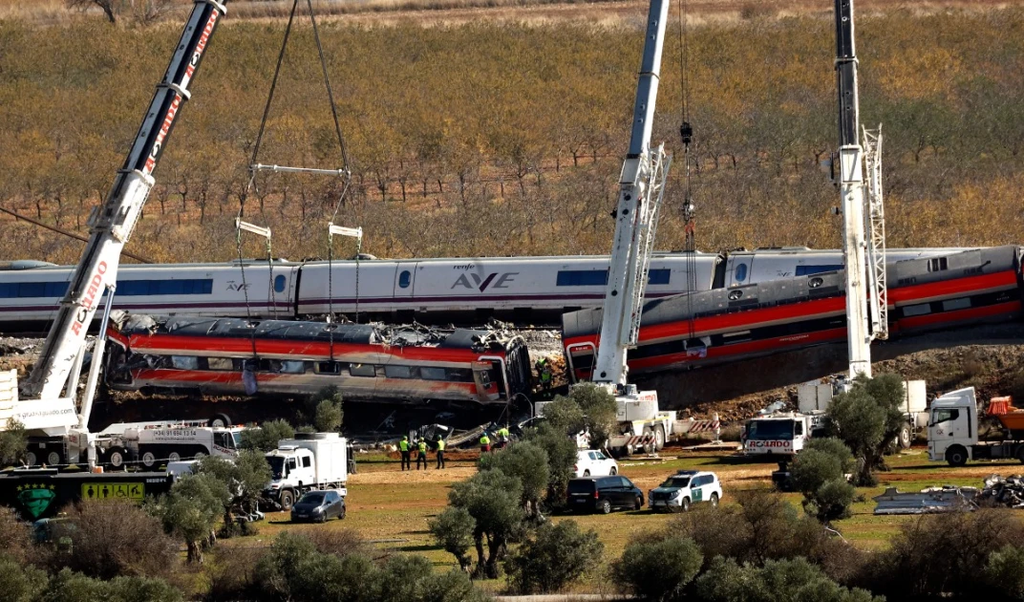
Spanish emergency authorities have officially confirmed that four American citizens are among the 69 people killed in the catastrophic high-speed train collision outside the central Spanish town of Urda.
The tragedy, which struck the busy Madrid to Seville corridor, has sent shockwaves through international travelers and shattered the sterling safety reputation of Europe’s largest high-speed rail network.
What began as a routine morning commute on October 28, 2026, turned into a scene of absolute devastation when a packed Spanish state train collided with a stationary passenger train at nearly 120 miles per hour. Forensics teams working day and night in the province of Toledo completed the identification of dozens of victims, turning what was already a national mourning period into a cross-continental heartbreak.
Here is the full breakdown of how this disaster unfolded, why four Americans lost their lives, what went terribly wrong inside the rail control center, and what international travelers need to know right now.
The Breaking Confirmation: Four Americans Identified Among 69 Casualties
Late Sunday, Spanish forensic and judicial authorities released an updated casualty report confirming that four United States citizens died in the collision. The tragedy claimed at least 69 lives and left more than 100 passengers injured, with 58 requiring emergency hospital care and 15 fighting for their lives in intensive care.
The $0 Secret To Launching Your Entire Online Empire
Why pay hundreds every month for separate software? Build funnels, send emails, and make sales with Systeme.io completely free.
Get Started For $0Free Forever • No Credit Card Needed • Beginner-Friendly
The U.S. Embassy in Madrid has been working closely with Spanish regional officials and the Guardia Civil to support grieving families. Consular officers are helping coordinate the painful process of formal identification, personal property retrieval, and the repatriation of remains back to the United States according to updates shared by international media outlets like CBS News.
Spain’s foreign ministry confirmed that the victims represent an unusually international passenger list. Alongside the four American citizens, officials confirmed the deaths of passengers from Canada, Japan, France, Portugal, Argentina, Mexico, Tunisia, and the Czech Republic, as well as 54 Spanish nationals. Search and rescue operations have also been tracking missing persons cases involving two Australian travelers and an additional Japanese national.
For thousands of tourists who consider high-speed rail the gold standard of European transit, this news hits hard. If you are currently planning a journey across the continent, our guide on how to travel from the United States to Europe on a budget highlights key safety steps and planning advice you should review before booking long-distance trips.
What Happened on the Tracks Near Urda?
To understand how two ultra-modern, bullet-style trains collided on a straight section of track in broad daylight, you have to look at the exact timeline of events that morning.
The incident unfolded on Wednesday morning, October 28, 2026, just before 9:00 AM local time, roughly 80 miles (130 kilometers) south of Madrid.
The Departing Trains from Madrid Atocha
The two trains involved left Madrid’s primary railway station, Atocha, only six minutes apart, both traveling south toward the Santa Justa station in Seville:
- The first train was Train 6076, operated by private rail operator Iryo. It utilized a modern Frecciarossa 1000 train carrying 147 passengers and crew members, departing at 7:54 AM.
- The second train was AVE Train 2080, operated by Spain’s state rail carrier Renfe. It was a high-capacity Class 103 bullet train carrying 397 passengers, leaving Madrid at 8:00 AM.
Both trains were running on the Madrid–Seville line, the historic backbone of Spain’s high-speed rail infrastructure that first launched back in 1992.
The System Blackout and the Fatal Command
Around 8:30 AM, an automated safety and signalling system known as LZB experienced a sudden computer malfunction along a 39-mile (63-kilometer) stretch of the line. Under standard railway safety rules, when an automatic signalling system goes offline, the network automatically defaults into a failsafe mode. All trains along that sector receive an immediate stop signal to protect passenger safety.
The leading Iryo train followed protocol. It halted on the track near the village of Urda, surrounded by flat farmland and olive groves, waiting for dispatch instructions.
What happened next has left railway experts, government ministers, and surviving passengers completely stunned.
Instead of maintaining the stop order while technicians cleared the line, rail traffic controllers at Spain’s railway infrastructure agency, ADIF, made a manual override. Command personnel instructed the trailing Renfe AVE train to resume moving down the tracks. Even worse, the train was reportedly cleared to accelerate without strict emergency speed caps, despite the fact that a stationary train was resting directly ahead on the exact same line.
The Moment of Impact
Traveling at an estimated speed between 100 and 124 miles per hour (160 to 200 km/h), the Renfe bullet train emerged along the track and slammed into the rear carriages of the stationary Iryo train at 8:54 AM.
The force of the collision was catastrophic:
- The impact obliterated the rear two carriages of the Iryo train and pulverized the front engine and leading passenger car of the Renfe AVE.
- Several rail cars derailed and tumbled down a steep gravel embankment.
- Metal was shredded so violently that a steel rail from the track bed lifted straight into the air and pierced an entire passenger compartment.
- Shockwaves inside the carriages hurled luggage, laptops, and passengers through the air.
Local agricultural workers and construction teams working in nearby fields heard an explosion-like roar and rushed toward the smoking wreckage. Within minutes, the sports pavilion in the quiet town of Urda was converted into a makeshift medical triage center as local residents handed out bottles of water, blankets, and first aid supplies to dazed survivors.
The Human Cost: Stories of Survival and Loss
Behind the horrific statistics are real people whose lives were cut short while traveling for work, study, and family vacations.
Send, Spend & Hold Money Worldwide Without Hidden Fees
Transfer money internationally at the real exchange rate and hold 40+ currencies in one account.
Open a Wise AccountMid-market rate • Fast transfers • 40+ currencies
Among the dead was former Spanish Minister of Employment Fátima Báñez, who was seated in the rear car of the Iryo train. Renowned Cambridge University developmental biologist Dr. Marta Shahbazi, widely celebrated for her pioneering medical research, also perished in the crash. Other victims included Spanish classical composer Marisa Manchado, prominent sports figures, journalists, and everyday commuters.
For the four American families who received the devastating call from consular officials, the shock is unbearable. Two of the American victims were university students studying abroad in Spain for the autumn semester, while the other two were tourists exploring the historic sights of Andalusia.
Survivors described chaotic, terrifying moments inside the carriages immediately after the crash. British traveler Samy Paul told reporters that everything collapsed in a single instant: “Suddenly, everything started falling apart. Bang! We realized carriage two, carriage one, all gone, all smashed. There was blood all over.”
Another passenger, Ignacio Relaño, explained how the train had briefly stopped, started moving again, and then struck the wall of metal ahead: “We all felt the train abruptly slowing down and then the impact. The car leaned to one side like it was about to tip over. Luggage and cell phones went flying. Everything shook.”
Remarkably, one survivor on the Renfe train had previously survived Spain’s Adamuz rail crash in Andalusia in January 2026, escaping physical injury in both disasters.
Why Spain’s Renowned Rail System Is Under Scrutiny
For more than three decades, Spain has been considered a world leader in high-speed passenger rail. Its network spans over 2,500 miles, making it the second-largest high-speed rail grid on earth, behind only China. Tens of millions of domestic commuters and international travelers use these trains every single year without incident.
Until 2026, the high-speed AVE network had recorded zero fatal crashes since its grand opening for the 1992 Seville World Expo.
Now, Spain is dealing with its second fatal high-speed collision in ten months. In January 2026, a tragic collision near Adamuz in the Andalusia region killed 46 people. With 69 more lives lost in Urda, serious questions are being raised about whether the system is under too much pressure.
Industry analysts point to three major factors that regulators and accident investigators from Spain’s Rail Accident Investigation Board are examining:
1. Massive Expansion and Rail Liberalization
Over the past few years, Spain opened its rail lines to private competition, bringing in operators like Iryo and Ouigo alongside state-owned Renfe. While this reduced ticket prices and made rail travel more affordable for everyday people, unions have repeatedly warned that track frequency doubled without a matching increase in maintenance funding and staff training.
The $0 Secret To Launching Your Entire Online Empire
Why pay hundreds every month for separate software? Build funnels, send emails, and make sales with Systeme.io completely free.
Get Started For $0Free Forever • No Credit Card Needed • Beginner-Friendly
2. Manual Signalling vs. Automatic Safeguards
Automated protection systems like LZB and ERTMS are designed specifically to eliminate human error. When a train gets too close to another vehicle or runs a red signal, onboard computers automatically slam on the emergency brakes.
In this disaster, the automatic system experienced a glitch, forcing traffic managers to revert to manual dispatching. Investigators are trying to determine why a human dispatcher cleared a high-speed train to run at full throttle into an occupied block of track without visual confirmation or digital confirmation that the line was clear.
3. Transportation Disruptions Across Europe
This disaster highlights growing concerns about critical infrastructure resilience across Europe. Travel systems are operating at peak capacity while dealing with aging components and software glitches. A similar vulnerability was exposed during the UK air traffic control system failure, which grounded flights and left hundreds of thousands of passengers stranded across major hubs.
What Government Officials Are Saying
Spain’s Minister of Transport and Sustainable Mobility, Óscar Puente, visited the ADIF control center in Madrid following the crash. He stated publicly that the disaster was caused by an “inexplicable” decision by the command center to authorise the Renfe train to move.
Puente made it clear that the train engineers were not at fault. The driver was simply following direct dispatch clearance from central traffic control.
“The train should never have been told to start moving again since there was still a stop signal active on that line,” Puente stated. “And if it had been instructed to move, it should have been told to proceed at cautious, restricted speed so the operator could stop if an obstacle appeared.”
Spain’s King Felipe VI and Queen Letizia traveled to the area to meet with local emergency workers, doctors, and victims’ families. European Commission President Ursula von der Leyen also extended condolences, stating that Europe shares the deep grief of all the nations mourning their citizens.
The tragedy comes at an intense political moment in Spain, occurring just weeks ahead of a nationwide general election where infrastructure safety, public transit budgets, and government accountability are taking center stage.
Practical Safety Tips for Americans and Foreign Tourists Traveling Abroad
Train travel remains statistically one of the safest ways to travel the world. Even with recent tragedies, your chances of being involved in a fatal railway accident are far lower than in a car or bus. However, when things go wrong thousands of miles away from home, being prepared can save your life.
Here are practical, common-sense steps every traveler should take when venturing overseas:
1. Register with the STEP Program
If you are an American citizen traveling abroad, always enroll your trip in the U.S. State Department’s Smart Traveler Enrollment Program (STEP). It is completely free and allows the nearest U.S. Embassy or Consulate to contact you or your family in the event of a natural disaster, train derailment, or civil emergency.
2. Keep Digital Copies of Your Passport and Travel Documents
Never rely solely on the paper passport in your bag. In a severe crash or evacuation, passengers often have to leave luggage and personal belongings behind. Store encrypted copies of your passport, travel insurance, and medical records on secure cloud storage and email them to a trusted family member back home.
3. Download the Right Offline Tools and Apps
When traveling across foreign rail networks, cell towers can drop out or get jammed by emergency services during a crisis. Keeping trusted offline navigation and safety tools installed on your phone is critical. Check out our detailed guide on the 14 essential travel apps you need to install in 2026 to ensure you have the best translation, navigation, and emergency alert tools ready on your home screen.
4. Know How to Report and Seek Help
If you or someone you are traveling with is involved in an incident in Europe, remember:
- The universal emergency telephone number across Spain and all European Union countries is 112. Operators speak multiple languages, including English.
- The emergency contact number for the U.S. Embassy in Madrid is (+34) 91-587-2200.
- You can reach the State Department’s Overseas Citizens Services line from abroad at +1 202-501-4444.
Frequently Asked Questions (FAQs)
How many Americans died in the Spain train crash?
Spanish forensic authorities have officially confirmed that four U.S. citizens died in the high-speed train collision outside Urda in Toledo province.
When and where did the train collision take place?
The collision occurred on Wednesday morning, October 28, 2026, at approximately 8:54 AM CET. It happened near the rural municipality of Urda in the province of Toledo, approximately 80 miles south of Madrid on the Madrid–Seville high-speed rail line.
Which train companies were involved?
The crash involved two separate train operators: an Iryo Frecciarossa 1000 train (Train 6076) that had stopped on the tracks, and a Renfe AVE Class 103 train (Train 2080) that rear-ended it from behind.
What caused the high-speed train crash in Spain?
Initial government findings and transport ministry reports indicate that an automated signalling system malfunctioned. Rail command controllers at ADIF made a manual decision to clear the trailing Renfe train to resume normal speeds, failing to account for the stationary Iryo train stopped directly ahead on the track.
Is high-speed train travel in Spain still safe?
Statistically, high-speed rail remains one of the safest transit systems in the world. However, this collision marks the second fatal high-speed crash in Spain during 2026, leading to urgent nationwide reviews of dispatch procedures, traffic management software, and track capacity.
What should families of missing or affected foreign passengers do?
Families should immediately contact their country’s embassy in Madrid or local emergency hotlines. U.S. citizens seeking information regarding loved ones can contact the U.S. Department of State’s Office of Overseas Citizens Services at 1-888-407-4747 (from the U.S. and Canada) or +1 202-501-4444 (from overseas).
The tragic confirmation of four American deaths brings an agonizing personal reality to an international disaster that has forever altered the debate over European railway safety. As forensic teams complete the remaining identifications and rail regulators inspect dispatch logs, the priority shifts toward accountability, supporting the victims’ families, and repairing the structural oversights that allowed two high-speed trains to share the same stretch of track.
