
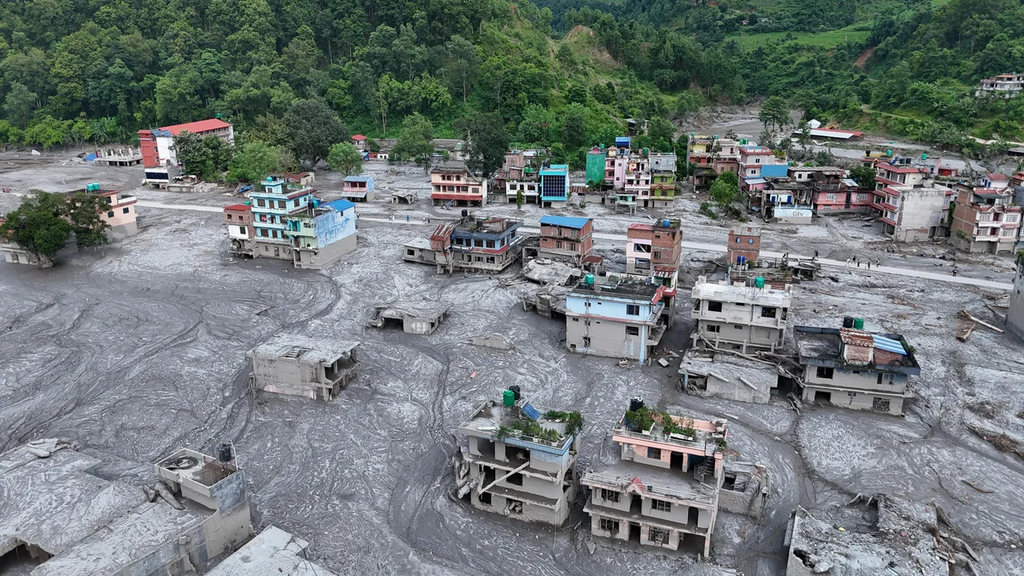
Catastrophic flash floods and massive landslides along the border of Nepal and China have killed more than 1,000 people, marking one of the worst natural disasters to strike the Himalayan region in recent years.
Disaster management authorities confirmed that at least 987 fatalities have been recorded on the Nepalese side, while Chinese state media reported 16 deaths in the Tibet region, bringing the combined official death toll to 1,003. Search and rescue operations are entering a critical phase as more than 4,400 individuals remain unaccounted for across both nations.
The sudden deluge destroyed entire villages, washed away critical bridges, and severely damaged major road networks that link mountain communities. Emergency response teams are working under extremely dangerous conditions to locate survivors buried under thick mud, rock debris, and collapsed concrete structures.
With thousands of residents displaced and essential power networks disrupted, emergency crews are racing against time to reach isolated mountain settlements before bad weather worsens conditions on the ground.
The Scope of the Crisis Along the Border
The catastrophe struck without warning when a massive wall of water and thick mud rushed through mountain valleys, destroying everything in its path. The disaster affected several districts in central Nepal, including Rasuwa, Nuwakot, Dhading, Kavre, and parts of the Kathmandu Valley. On the Chinese side of the border, the surge swept through Gyirong County in southwestern Tibet, burying key border crossings and cutting off vital transport routes.
The $0 Secret To Launching Your Entire Online Empire
Why pay hundreds every month for separate software? Build funnels, send emails, and make sales with Systeme.io completely free.
Get Started For $0Free Forever • No Credit Card Needed • Beginner-Friendly
The physical destruction left behind by the water is immense. Dozens of residential communities have been reduced to mudfields, while concrete bridges were snapped in two by the sheer force of moving boulders. Local infrastructure has suffered severe damage, leaving thousands of residents without access to electricity, clean drinking water, or reliable phone connections.
According to official updates from disaster response agencies reported by major international news outlets like CNN and AP News, search teams are still finding bodies in mud slides and along swollen riverbanks downstream. Authorities in neighboring Indian states have also recovered several bodies floating down rivers that originate high in the Nepalese mountains.
The combined number of missing people stands at 4,462, with 3,916 missing in Nepal and 546 missing in Tibet. Because many remote areas remain completely cut off from ground transport, officials fear that the final loss of life could rise significantly as search parties gain access to isolated valleys.
What Caused the Massive Flash Floods?
Geologists and climate scientists report that the flash floods were triggered by a massive glacial event high up in the mountains. A large section of a glacier located near Mount Langtang Lirung fractured at an elevation of roughly 5,200 meters. This collapse sent millions of tons of ice and rock tumbling down steep slopes, creating a powerful avalanche that rapidly transformed into a violent flow of mud and water.
When the mixture of melting ice, loose soil, and giant boulders hit local river systems, it created natural dams that briefly held back the water before collapsing under immense pressure. This burst sent a catastrophic wave of water rushing down the Trishuli River basin and neighboring valleys.
High mountain regions in the Himalayas have experienced unusual temperature shifts in recent years, making glaciers less stable. When high-altitude ice blocks crack, they do not just melt slowly; they can snap and slide down entire valleys in minutes.
The timing of the disaster made it even more dangerous. Heavy seasonal rainfall had already saturated the soil across the region, making the mountain slopes soft and prone to sliding. When the glacial collapse added millions of gallons of water into swollen river channels, the riverbanks gave way instantly, catching thousands of people completely off guard.
The Race to Save Workers Trapped in Hydropower Tunnels
Trapped Underground in Pitch Darkness
One of the most urgent and harrowing rescue efforts is taking place deep beneath the ground at several hydropower construction sites along the Trishuli River. Approximately 900 workers are missing across 12 damaged hydroelectric facilities in Nepal’s Rasuwa and Nuwakot districts.
At the Upper Trishuli-1 Hydropower Project, more than 500 workers were on shift when the torrent hit. Officials believe hundreds of these workers ran deep into reinforced underground tunnels to escape the initial wave of mud and debris outside. While these thick underground structures protected them from being swept away, heavy mud quickly sealed off the tunnel entrances, trapping the crews inside in total darkness.
Pumping Oxygen and Clearing Debris
Rescue crews including specialized military units are working long hours to reach the trapped workers. Using heavy machinery, industrial pumps, and manual shovels, workers are attempting to dig through more than 15 meters of tightly packed mud and rock to clear the main tunnel openings.
At the same time, technical teams are attempting to pump oxygen and clean water through narrow ventilation pipes that remain open to the surface. Time is critical, as oxygen supplies inside sealed underground spaces decrease rapidly over time.
Helicopter pilots carrying supplies and medical personnel have reported that the surrounding terrain has been altered so dramatically that recognizable landmarks have completely disappeared. Search teams are moving slowly through muddy tunnels, climbing over fallen boulders and wading through waist-deep water to check for any signs of life.
Global Impact: Hundreds of Foreign Visitors Unaccounted For
Families Around the World Await News
The disaster has sent shockwaves across the globe because the border region between Nepal and Tibet is a major destination for international trekkers, mountain climbers, border traders, and spiritual pilgrims. Authorities confirm that hundreds of foreign nationals from more than 30 countries are among those listed as missing.
According to reports released by disaster agencies:
- Over 270 citizens from India and 100 Chinese nationals are currently unaccounted for along the border zones.
- Dozens of visitors from the United States, the United Kingdom, Australia, Malaysia, Ukraine, and Japan were trekking in the affected valleys when the water hit.
- Embassy representatives from multiple nations have set up emergency helplines in Kathmandu to coordinate rescue information for worried families back home.
The loss of cellular coverage across mountain valleys has made it extremely difficult for stranded tourists to contact their families, causing widespread anxiety for thousands of people worldwide.
Send, Spend & Hold Money Worldwide Without Hidden Fees
Transfer money internationally at the real exchange rate and hold 40+ currencies in one account.
Open a Wise AccountMid-market rate • Fast transfers • 40+ currencies
International Search and Rescue Operations
In response to the growing humanitarian crisis, neighboring countries have dispatched emergency teams, medical experts, and specialized disaster dogs to assist local search crews. Disaster relief personnel from India, China, and South Korea have joined local military forces on the ground.
The government of Nepal has issued an urgent international appeal for essential technical supplies, including mobile cold-storage freezers, high-precision DNA testing kits, remote sensing devices, and satellite communication equipment. These tools are necessary to help identify victims, locate buried structures, and restore basic communication in areas where cell towers were destroyed.
Modern Technology and AI in Emergency Disaster Relief
High-Tech Tools Saving Lives on the Ground
Modern technology is playing an essential role in how emergency crews respond to massive natural disasters like this Himalayan flood. Because many mountain roads are covered under several feet of mud or completely washed away, sending human search teams blindly into damaged valleys can be extremely dangerous.
Search parties are relying heavily on advanced equipment to speed up their work:
- Unmanned aerial drones are flying over dangerous ravines to capture high-definition photos and thermal images, helping teams locate trapped survivors without risking rescuers’ lives.
- Satellite imaging systems are analyzing real-time ground changes, helping geologists spot unstable slopes before new landslides occur.
- Automated early-warning messages are sent directly to mobile phones in downstream towns, giving residents crucial extra minutes to seek higher ground before water levels rise.
To read more about how artificial intelligence and modern digital tools are transforming emergency services and everyday life, check out our latest articles in technology and AI.
The Power of Fast Digital Information
When emergencies happen in remote regions, getting accurate information to the public as quickly as possible is vital. Modern news gathering relies on digital workflows and automated systems to compile verified updates from field reporters, government reports, and weather satellites.
Automated video channels and fast media tools allow news organizations to broadcast verified safety warnings and missing person notices to millions of viewers globally within minutes. If you want to understand how modern creators and news teams use smart digital production methods to cover big stories, explore our deep dive into YouTube automation.
Staying Safe During Extreme Weather Events
Living in or traveling through mountain environments requires extra preparation, especially during seasons with high rainfall or rapid temperature changes. If you ever find yourself in an area prone to flash floods or landslides, keeping a few basic safety rules in mind can make a huge difference:
- Watch the rivers closely. If you notice river water turning dark and muddy very quickly, or if the water level drops suddenly without warning, move to higher ground immediately. A sudden drop often means an upstream landslide has temporarily blocked the river, which can lead to a violent flash flood when the block breaks.
- Never try to cross rushing water. It takes only six inches of fast-moving water to knock a grown person off their feet, and less than two feet of water can carry away heavy vehicles.
- Keep an emergency grab-bag ready. Always carry a small waterproof bag containing basic first-aid items, a flashlight, extra phone batteries, official identification, and a few bottles of clean drinking water.
- Follow official instructions without delay. If local authorities send emergency alerts or issue evacuation orders, pack essential items quickly and move along recommended safety routes right away.
Frequently Asked Questions (FAQs)
What caused the recent Nepal-China flood disaster?
The disaster was caused by a sudden glacial collapse near Mount Langtang Lirung at an altitude of about 5,200 meters. Millions of tons of ice and rock slid down mountain valleys, triggering massive mudslides and swelling rivers along the Trishuli River basin.
How many people have been affected by the disaster?
Official estimates confirm over 1,000 fatalities, with 987 deaths in Nepal and 16 in Tibet, China. More than 4,400 people remain missing across both countries, and thousands more have been displaced due to destroyed homes and infrastructure.
The $0 Secret To Launching Your Entire Online Empire
Why pay hundreds every month for separate software? Build funnels, send emails, and make sales with Systeme.io completely free.
Get Started For $0Free Forever • No Credit Card Needed • Beginner-Friendly
What is being done to rescue workers trapped in hydropower tunnels?
Emergency crews are using heavy machinery and shovels to clear thick mud blocking tunnel entrances at facilities like Upper Trishuli-1. Rescue teams are also pumping fresh air and clean water into underground chambers through narrow ventilation pipes while digging to reach trapped workers.
Are foreign nationals involved in the disaster?
Yes, hundreds of foreign nationals from countries including India, China, the US, the UK, Australia, Malaysia, Ukraine, and Japan are currently listed as missing. Many were trekking or working near border crossings when the flash floods occurred.
How can I stay updated on rescue efforts?
You can follow major news outlets like Reuters, CNN, and AP News, as well as official updates from regional disaster management agencies. We also post regular updates on trending global news and major events across our official channels.
Final Thoughts and Staying Connected
The tragic flooding along the Nepal-China border serves as a stark reminder of the incredible power of nature and the vulnerability of mountain communities. As rescue workers continue their tireless efforts underground and across remote mountain valleys, international aid and technological support will remain critical in helping affected communities rebuild their lives.
Our thoughts are with all the families affected by this heartbreaking event, as well as the brave rescue crews working around the clock under dangerous conditions.
To learn more about our team and what drives our story coverage, feel free to visit our About Us page. If you have questions, feedback, or news tips you would like to share with us, you can easily get in touch with our team through our official Contact Page.
Do not forget to join our growing community online! Follow our social channels to get real-time updates, breaking stories, and engaging discussion every day:
- Connect with us on Instagram for daily visual updates and highlights.
- Follow our official page on Facebook to join discussions with readers around the world.
- Follow our real-time updates on X (formerly Twitter) to stay informed on breaking news as it happens.
