
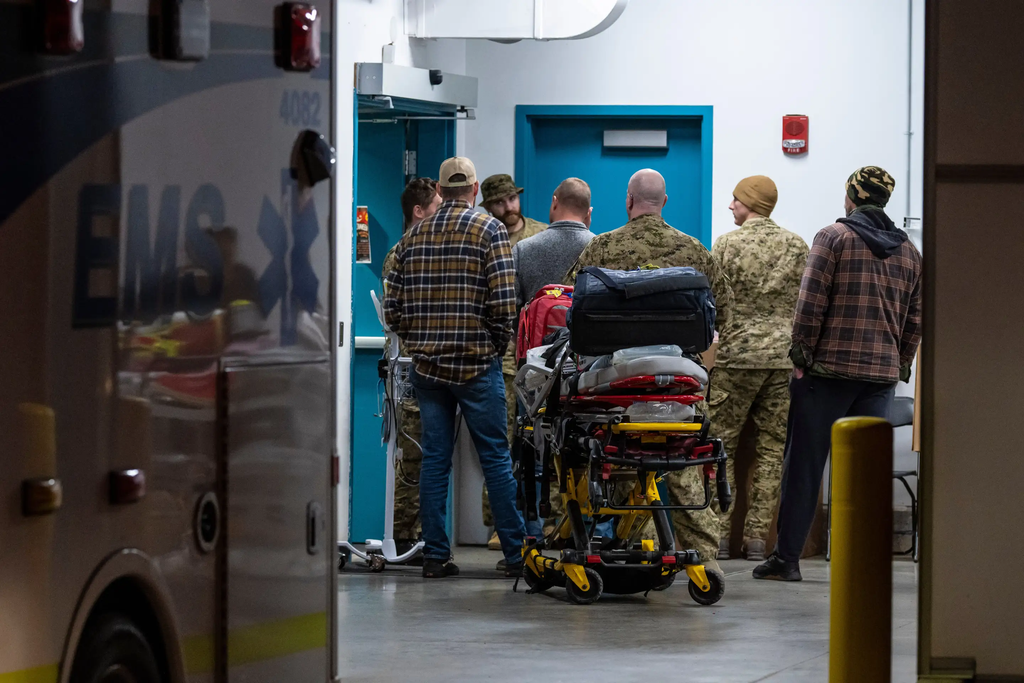
A devastating turn of events unfolded in east-central Alberta on Saturday afternoon when a deadly incident at Canadian Forces Base Wainwright sparked a massive, fast-moving wildfire. The crisis left several people dead, injured many others, and sent thick plumes of smoke across surrounding prairie communities.
The disaster began shortly after 4:00 p.m. inside a designated military training zone. Powerful wind gusts blowing at speeds up to 100 kilometers per hour quickly fanned the initial flames. Within minutes, the blaze jumped past the base fences and swept into open brush and rural farmland across the Municipal District of Wainwright.
The scale of the emergency put immediate pressure on local health networks. Regional medical centers quickly filled up, forcing paramedics to rush critically injured victims to major trauma centers in Edmonton, nearly 200 kilometers away.
Here is a full breakdown of what happened, how first responders are tackling the blaze, what leaders are saying, and what this means for residents living across the region.
What Happened at CFB Wainwright?
CFB Wainwright is one of the primary army training facilities in North America. On Saturday afternoon, military personnel were carrying out exercises when a serious mishap took place in an active field zone. While military investigators have not yet confirmed the exact mechanical or explosive trigger, the initial event caused immediate fatalities and severe injuries on site.
The $0 Secret To Launching Your Entire Online Empire
Why pay hundreds every month for separate software? Build funnels, send emails, and make sales with Systeme.io completely free.
Get Started For $0Free Forever • No Credit Card Needed • Beginner-Friendly
The event quickly ignited dry grass and surrounding brush. Under normal conditions, military and base fire crews maintain firebreaks and dedicated containment equipment to put out localized flares. But Saturday was anything but normal.
Dry ground conditions combined with dangerous windstorms turned what might have been a contained fire into a fast-moving wall of flames. The fire moved rapidly across the training grounds and crossed the military installation perimeter, threatening rural fields, pastureland, and transportation corridors.
The Royal Canadian Mounted Police (RCMP) confirmed that officers rushed to the site around 4:15 p.m. after reports of an out-of-control fire and multiple casualties. By nightfall, regional fire crews from neighboring towns joined military firefighters in a desperate push to stop the fire from reaching civilian homesteads and critical infrastructure.
Extreme 100 km/h Winds Create a Firestorm
Weather played a massive role in how fast this situation deteriorated. Meteorologists had already flagged wind warnings across wide sections of central and eastern Alberta for Saturday, warning of gusts capable of toppling trees and damaging loose structures.
When the fire ignited, these winds acted like a giant bellows:
- Wind gusts reached up to 100 kilometers per hour, blowing sparks and burning embers hundreds of meters ahead of the main fire line.
- Spot fires erupted rapidly across dry brush and tall prairie grass outside base boundaries.
- Thick, dark smoke cut visibility to near zero on regional secondary highways, complicating movement for fire engines and ambulances.
- Shifting wind directions forced fire commanders to constantly reposition crews to avoid getting trapped.
By 11:00 p.m. on Saturday, the Municipal District of Wainwright announced that emergency crews had made progress containing key sectors of the blaze. Officials confirmed that critical town infrastructure and main residential sectors had been defended successfully, and no mandatory evacuation order was required for the central townsite. However, crews remained on high alert overnight to stomp out spot fires and protect livestock and outlying properties.
Hospitals Overwhelmed: Emergency Trauma Protocols Triggered
One of the most alarming aspects of this crisis was the swift pressure placed on regional healthcare infrastructure. The town of Wainwright has a dedicated local health center, but it was never designed to absorb a sudden mass-casualty incident involving severe burns and trauma.
Within hours of the explosion and fire, the local Wainwright medical facility became overwhelmed. Doctors and nurses worked tirelessly to triage patients, administer life-saving stabilization, and coordinate urgent air and road evacuations.
Ambulances and emergency response teams began routing patients to specialized hospital centers in Edmonton, located roughly 180 to 200 kilometers to the northwest.
Dr. Warren Thirsk, an emergency physician practicing at Edmonton’s Royal Alexandra Hospital, spoke with CBC News to explain the scale of the crisis. He noted that healthcare networks across Edmonton were placed on high alert as casualties arrived.
Dr. Thirsk pointed out that receiving this volume of acute trauma and burn victims strains an entire metropolitan healthcare system. Medical teams across multiple departments were mobilized, calling in off-duty surgeons, burn specialists, and intensive care nurses to handle the surge.
Casualties and the Human Toll
The human cost of the incident has sent shockwaves through the military community and the wider province.
Federal Defence Minister David McGuinty confirmed that people were killed and multiple others suffered serious injuries. Minister McGuinty called the situation active and delicate as military teams worked alongside civilian emergency crews.
Chief of the Defence Staff General Jennie Carignan issued a heartfelt statement acknowledging the profound grief felt across the armed forces. She confirmed that formal casualty identification and next-of-kin notifications were underway, expressing deep sympathy for the families who lost loved ones.
Lieutenant-General Michael Wright, Commander of the Canadian Army, also addressed the tragedy. He reaffirmed that the military’s absolute priority is supporting the injured, assisting affected families, and helping the surrounding Wainwright community recover from the trauma.
Send, Spend & Hold Money Worldwide Without Hidden Fees
Transfer money internationally at the real exchange rate and hold 40+ currencies in one account.
Open a Wise AccountMid-market rate • Fast transfers • 40+ currencies
Because military operations require careful confirmation before names are released publicly, authorities have withheld the specific identities and total casualty count until all families have been properly informed in person.
Local Disruptions: Advance Voting and Road Closures
The reach of the fire extended beyond the base and the emergency rooms. The incident coincided with an important political moment in Alberta, disrupting advance voting stations ahead of a high-profile provincial referendum.
Elections Alberta confirmed that two separate advance voting locations had to shut their doors early on Saturday evening due to fire danger, road blockages, and severe smoke:
- The advance voting location in Lloydminster closed its doors ahead of schedule.
- The advance polling station in Vermilion also suspended operations early.
Officials with Elections Alberta stated that all ballot boxes and voting materials were secured immediately and transported safely away from the danger zone.
In addition to voting delays, several local gravel roads and rural connectors near the base perimeter were closed to regular traffic. Law enforcement kept routes open exclusively for fire tenders, military transports, and emergency ambulances heading toward Highway 14 and Edmonton.
National and Provincial Leaders React
The catastrophe brought swift reactions from top leaders across the country.
Prime Minister Mark Carney stated that a serious incident had sparked a major fire at the base, emphasizing that the federal government was collaborating with provincial authorities to supply all necessary resources.
Alberta Premier Danielle Smith referred to the blaze as a significant and tragic event that directly impacted brave military personnel. She confirmed that the province was maintaining direct lines of communication with local mayors, base commanders, and emergency management directors to ensure nothing stood in the way of safety.
Support also crossed provincial borders:
- Saskatchewan Premier Scott Moe reached out immediately, sending emergency aid and stating that his province stood ready to provide further firefighting equipment or medical backup if called upon.
- British Columbia Premier David Eby contacted the Alberta government to offer mutual aid personnel and specialized wildfire support.
- Federal Opposition Leader Pierre Poilievre publicly urged Albertans in the area to heed emergency instructions, stay off the roads, and keep priority lanes open for first responders.
Understanding CFB Wainwright: Why This Base Matters
To understand how an incident here can carry such widespread consequences, it helps to look at the history and purpose of Canadian Forces Base Wainwright.
The $0 Secret To Launching Your Entire Online Empire
Why pay hundreds every month for separate software? Build funnels, send emails, and make sales with Systeme.io completely free.
Get Started For $0Free Forever • No Credit Card Needed • Beginner-Friendly
Located in east-central Alberta, roughly 200 kilometers east-southeast of Edmonton, the base covers more than 600 square kilometers. That makes it one of the largest and busiest live-fire military training grounds anywhere in Canada.
The base was first established as a military training center back in the early 1950s during the Korean War. Since then, it has evolved into a premier training hub for soldiers preparing for domestic operations and foreign deployments.
Key Base Facilities and Operations
- Canadian Manoeuvre Training Centre (CMTC): This unit runs full-scale, complex force-on-force training. Units simulate realistic battlefield scenarios using live equipment, vehicles, and blank-firing weapon simulations.
- 3rd Canadian Division Training Centre: This school trains regular force soldiers and reservists across Western Canada in specialized tactics, marksmanship, leadership, and survival.
- Workforce Scale: On a typical working day, the base is home to approximately 690 active-duty military personnel and around 300 civilian workers. That number jumps dramatically to thousands of personnel during major joint exercises like Exercise Maple Resolve.
- Terrain: The base features rolling prairie, dense brush, and scrub timber. While this terrain provides ideal cover for tactical maneuvers, it also creates heavy fuel loads when weather conditions turn hot, dry, or windy.
Because training exercises frequently involve vehicles, pyrotechnics, and live-fire drills, the environment carries inherent operational hazards that require strict safety protocols. When an unexpected malfunction or fire takes place amid fierce winds, the danger multiplies exponentially.
The Investigation: What Happens Next?
In the coming days, multiple regulatory and investigative bodies will examine how this catastrophe happened.
According to the Department of National Defence, standard military protocol calls for an immediate and thorough inquiry:
- Securing the Scene: The specific training area where the incident originated must be fully extinguished, cooled down, and cordoned off as an official investigation zone.
- Military Police and National Investigation Service (CFNIS): Military detectives will lead the inquiry into the operational events, equipment usage, and safety measures in place when the fire ignited.
- RCMP Collaboration: Because the fire spread into civilian jurisdictions and impacted public roads and property, the RCMP will assist with evidence gathering and perimeter management.
- Summary or Board of Inquiry: The Canadian Armed Forces typically convenes an independent Board of Inquiry for fatal domestic incidents to review operational practices, command decisions, and equipment maintenance, ensuring reforms are made to prevent future tragedies.
- Wildfire Origin and Cause Examination: Provincial wildfire specialists from Alberta Wildfire will analyze the burn patterns, weather factors, and perimeter breach points to assess how the fire spread so quickly across rural lines.
Officials have asked for patience while these teams conduct their work. Establishing technical facts around military hardware or sudden training accidents requires meticulous forensic analysis.
Prairie Wildfire Safety: How to Stay Protected
Incidents like this remind everyone just how quickly prairie fires can threaten homes and lives when high winds hit. If you live in an area prone to grassland or brush fires, taking practical steps early can make all the difference.
Prepare Your Property in Advance
- Clear tall, dead grass and dry weeds within 10 meters of your house and outbuildings.
- Keep firewood, propane tanks, and fuel cans stored at least 10 meters away from exterior walls.
- Clean leaves, pine needles, and dried debris from your gutters and roof valleys.
- Make sure garden hoses are connected and long enough to reach all corners of your home.
- Keep basic hand tools like shovels, rakes, and buckets easily accessible near sheds or barns.
Build a Quick Evacuation Plan
- Pack an emergency grab bag containing essentials: prescription medicines, phone chargers, personal identification, first aid supplies, and important financial papers.
- Keep a supply of clean drinking water and non-perishable food for every family member, including pets.
- Maintain at least half a tank of gas in your vehicle at all times during dry or windy seasons.
- Plan two separate driving routes out of your neighborhood or rural section in case primary roads get cut off by smoke or emergency vehicles.
What to Do If a Fire Is Approaching
- Tune into local emergency broadcasts and keep your phone notifications on for emergency alerts.
- Close all windows, doors, vents, and fireplace dampers to prevent burning sparks and smoke from entering your home.
- Move flammable outdoor patio furniture, door mats, and children’s toys inside your garage or home.
- Back your car into your garage or driveway facing the street, with keys in the ignition, so you can depart without delay.
- Turn on outside lights so your home remains visible through heavy smoke if emergency crews pass by.
- Never hesitate or wait until the last second to leave when emergency services advise you to evacuate.
Community Resilience in Rural Alberta
Even during terrifying moments, the spirit of rural communities shines through. The town of Wainwright and surrounding rural settlements have a long-standing bond with the military base and the personnel stationed there.
When news of the fire broke, local volunteer fire departments immediately mobilized their equipment to assist. Farmers and acreage owners used tractors, water tanks, and disc plows along rural road boundaries to create emergency dirt breaks, helping stop the flames from jumping into standing crops and grazing pastures.
Local businesses and community halls quickly prepared to offer coffee, food, and warm spaces for first responders who worked on the frontlines for hours in blinding smoke and punishing winds. That neighbor-helping-neighbor attitude remains one of the strongest defenses rural areas have during unexpected disasters.
Frequently Asked Questions (FAQs)
What caused the fire at CFB Wainwright?
Authorities have confirmed that the fire was sparked by a serious training incident within an active exercise zone on the base. While early reports point to an explosion or heavy training equipment mishap, military investigators are actively working to determine the precise technical cause.
How many people were killed or injured?
Officials confirmed that multiple people lost their lives and others suffered serious injuries. Exact numbers have been withheld by the Department of National Defence until casualty identification is complete and all families have been formally notified.
Did the town of Wainwright have to evacuate?
No mandatory evacuation order was issued for the central town of Wainwright. By late Saturday night, municipal officials confirmed that the fire was being contained and key infrastructure had been protected.
Why were patients sent all the way to Edmonton?
The local health center in Wainwright was quickly overwhelmed by the number and severity of burn and trauma casualties. Specialized trauma centers in Edmonton, including the Royal Alexandra Hospital, possess the advanced burn units and intensive care capacity required for critical care.
Did the fire disrupt anything else in Alberta?
Yes, high winds, heavy smoke, and emergency operations forced two advance voting stations for the provincial referendum to close early in Lloydminster and Vermilion. Several local rural roads were also restricted to emergency traffic only.
The tragedy at CFB Wainwright serves as a sober reminder of the risks military personnel face during rigorous operational training, as well as the rapid danger posed when strong prairie winds turn a spark into an explosive wildfire. As first responders continue damping down remaining hot spots and medical teams work around the clock in Edmonton hospitals, the entire country is standing behind the families and workers affected by this heartbreaking event.
