
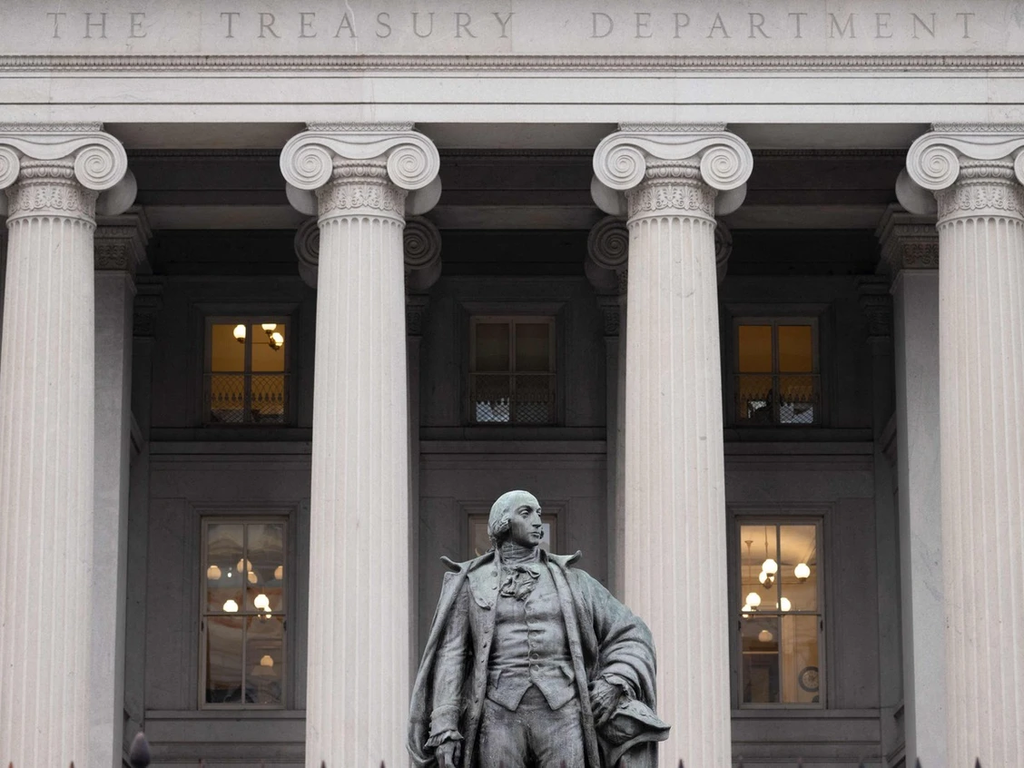
The United States government just crossed a line that once felt impossible. For the first time in history, net annual interest payments on the national debt officially breached the $1 trillion mark, climbing to $1.05 trillion.
When you factor in gross interest payments, which include money owed to government trust funds like Social Security, the bill reached an unprecedented $1.36 trillion.
To put that into perspective, the federal government is now spending roughly $3 billion every single day simply paying the finance charges on money it previously borrowed. That money does not build new bridges. It does not fund scientific breakthroughs, improve schools, or buy medical equipment for veterans. It is strictly the cost of servicing past bills.
According to official figures from the U.S. Department of the Treasury, overall federal spending reached $7.40 trillion while revenues brought in $5.40 trillion. That gap produced a budget deficit of nearly $2 trillion in a single year.
Even more startling is how fast this expense has grown. Net interest payments jumped more than 8% in the past year alone, rocketing past the entire annual budget for national defense.
The $0 Secret To Launching Your Entire Online Empire
Why pay hundreds every month for separate software? Build funnels, send emails, and make sales with Systeme.io completely free.
Get Started For $0Free Forever • No Credit Card Needed • Beginner-Friendly
Economists and budget watchdogs are now warning of a dangerous financial trap known as a debt snowball. When borrowing costs rise this quickly, a government must take out new loans simply to pay the interest on older loans. This cycle can quietly drain the strength of the economy, push interest rates higher for consumers, and change the financial reality of ordinary families.
Here is an honest, plain-English breakdown of how America reached this $1 trillion milestone, what a debt snowball actually does, and what steps you can take to protect your own money.
What Does a $1 Trillion Interest Bill Actually Look Like?
One trillion dollars is an abstract number. Most people never interact with numbers larger than a few hundred thousand dollars when buying a home or planning retirement.
When you break down $1.05 trillion into daily and per-person numbers, the scale becomes clearer:
- The government spends roughly $2.88 billion every 24 hours just on interest.
- Every single hour of the day, approximately $120 million leaves the Treasury to pay bondholders.
- With roughly 340 million people living in the country, that equates to more than $3,000 per person, per year, just for interest on past debt.
- For a family of four, the federal government spends about $12,350 each year solely paying down finance charges on their behalf.
The Peter G. Peterson Foundation, a non-partisan organization that tracks federal fiscal policy, reported that net interest payments have climbed to 3.4% of the nation’s total economic output (Gross Domestic Product, or GDP). That ties the highest level ever recorded in post-World War II American history.
Net interest has officially become the third-largest expense in the entire federal budget. Social Security ranks first at $1.67 trillion, followed by Medicare at $1.07 trillion. Net interest comes in third at $1.05 trillion, pushing national defense down to fourth place at $965 billion.
The United States now spends more on interest than it spends defending its borders, maintaining its military fleets, and paying its service members. It also spends more on interest than on Medicaid, federal education programs, and veterans’ healthcare combined.
How Did Borrowing Costs Climb So High, So Fast?
To understand how interest payments doubled in just a handful of years, you have to look at two powerful forces that collided at the exact same time: a rapidly growing pile of total debt and a steep rise in interest rates.
A Mountain of Principal
Over the last fifteen years, total federal debt expanded from around $10 trillion to nearly $38 trillion. During the 2010s, running large annual deficits did not feel painful because interest rates were sitting near zero percent.
When interest rates are close to zero, borrowing an extra trillion dollars adds very little to your annual monthly payment. The federal government was able to issue short-term and medium-term bonds at rates between 0.5% and 2%. The cost to service that debt stayed low, creating a false sense that huge amounts of borrowing were essentially free.
The Return of Normal Interest Rates
When inflation flared up, the Federal Reserve stepped in to cool off the economy by hiking its benchmark rate to between 3.75% and 5.5% over a multi-year campaign.
While higher rates helped moderate inflation, they transformed the cost of government borrowing. As older Treasury bonds paying 1.5% matured, the Treasury had to replace them by issuing new bonds paying 4% or 4.5%.
Think of it like an adjustable-rate mortgage on a house. If you owe $300,000 and your rate jumps from 2% to 5%, your payment increases noticeably. If you owe $38 trillion, that same rate jump adds hundreds of billions of dollars to your bill every single year.
According to estimates from financial institutions like TD Securities, if average yields across Treasury bonds increase by just one additional percentage point (100 basis points), it would add another $310 billion to annual interest costs almost immediately.
Understanding the “Debt Snowball”: Why Compounding Interest Is Dangerous
In personal finance, the “debt snowball” usually describes paying off your smallest balance first to build positive psychological momentum. In government finance, the term has a much darker meaning.
Send, Spend & Hold Money Worldwide Without Hidden Fees
Transfer money internationally at the real exchange rate and hold 40+ currencies in one account.
Open a Wise AccountMid-market rate • Fast transfers • 40+ currencies
A fiscal debt snowball happens when interest costs grow faster than the economy itself.
When a nation runs an operational deficit—meaning it spends more on everyday programs than it collects in taxes—it must borrow money to cover the shortfall. But when interest payments reach $1 trillion, a huge portion of that new borrowing does not fund services; it goes directly to pay the interest on money borrowed years ago.
Here is how the cycle feeds on itself:
- The government spends $7.4 trillion but collects only $5.4 trillion in revenue, leaving a $2.0 trillion deficit.
- Out of that $2.0 trillion deficit, more than half ($1.05 trillion) is purely the interest payment on existing debt.
- To pay that interest, the government must sell new Treasury securities to global investors.
- Those newly issued securities add directly to the total national debt.
- Next year, the government must pay interest on that even larger total, forcing it to borrow even more money.
The Committee for a Responsible Federal Budget warns that if policy choices do not change, annual deficits could easily swell past $3.1 trillion by 2036, driven primarily by compounding interest charges.
The Congressional Budget Office projects that over the next 10 years, net interest payments alone will consume $16.2 trillion. By 2036, interest expenses are projected to swallow over 25% of all federal tax revenue.
When a quarter of every tax dollar collected goes straight to paying finance fees, the government has far less flexibility to handle unexpected shocks, economic downturns, or natural disasters.
How Does a $1 Trillion Government Interest Bill Impact Your Wallet?
It is easy to assume that a trillion-dollar federal interest payment is strictly a problem for politicians in Washington. The reality is that federal debt dynamics ripple through the everyday economy and land right on your kitchen table.
Mortgage and Auto Loan Rates Stay Elevated
The interest rates on 30-year home mortgages and auto loans are closely linked to yields on U.S. 10-year Treasury bonds.
When the federal government needs to borrow $2 trillion a year, it floods the financial markets with new bonds. To convince investors around the world to buy that massive supply of debt, the Treasury must offer attractive yields.
When Treasury yields stay high, mortgage lenders have to charge higher rates too. That is why 30-year fixed mortgage rates have remained stubborn, hovering well above where they sat for the prior decade. A family looking to buy a median-priced home faces a monthly mortgage payment that can be hundreds of dollars higher simply because borrowing costs across the economy remain elevated.
The $0 Secret To Launching Your Entire Online Empire
Why pay hundreds every month for separate software? Build funnels, send emails, and make sales with Systeme.io completely free.
Get Started For $0Free Forever • No Credit Card Needed • Beginner-Friendly
Pressure on Public Services and Social Programs
Every dollar allocated to bond interest is a dollar that cannot be used anywhere else. As interest payments take up 15% to 18% of all tax revenues, Congress faces painful choices:
- Funding for road repairs, bridge maintenance, and public transit gets squeezed.
- Grant money for local schools and scientific research dries up.
- Programs like Medicare and Social Security face earlier trust fund exhaustion dates, making benefit cuts or tax hikes more likely in the future.
Potential Inflationary Pressures
When debt expands continuously and the government struggles to find enough buyers for its bonds, central banks may eventually feel pressured to keep interest rates artificially low or buy up government paper directly. Historically, expanding the money supply to finance national debt has eroded the purchasing power of the currency, pushing up the price of food, fuel, and everyday goods.
4 Smart Personal Finance Moves to Protect Your Money
While you cannot control the federal budget, you have complete control over how you position your own household balance sheet.
Taking a defensive approach toward personal debt and cash management can insulate your savings from broad economic volatility.
1. Eliminate High-Interest Consumer Debt First
The math is simple: if the biggest borrower in the world is feeling the heat of high interest, carrying variable-rate consumer debt is a guaranteed drain on your wealth.
Credit card interest rates in the United States currently average above 21%. If you carry a $10,000 balance on a credit card at 21.5% APR and pay only a 3% minimum payment (around $300 a month), it will take you over 15 years to pay off the debt, costing you more than $11,000 in interest alone.
Commit an extra $250 per month toward that balance ($550 total monthly payment). That simple adjustment pays the balance in full in 24 months, cutting your total interest paid to roughly $2,350. You save more than $8,650 in cash that stays in your pocket instead of going to a bank.
2. Move Idle Cash to High-Yield Savings Accounts
One silver lining of higher benchmark interest rates is that savers can finally earn meaningful yield on their cash reserves.
Leaving your emergency reserve in a traditional checking account or a standard brick-and-mortar savings account earning 0.01% means your purchasing power is actively eroding. Many federally insured high-yield savings accounts (HYSAs) and money market funds offer annual percentage yields (APYs) between 4.0% and 4.75%.
A $15,000 emergency fund in an account earning 0.01% produces $1.50 in interest over an entire year.
That same $15,000 placed in an account earning 4.5% APY generates approximately $675 in safe, passive interest each year. That is real money you can reinvest or use to buffer against unexpected expenses.
3. Favor Fixed-Rate Borrowing Over Variable-Rate Debt
With long-term interest rates remaining unpredictable, carrying variable-rate personal loans or home equity lines of credit (HELOCs) exposes your monthly budget to surprise increases.
If you plan to finance a car, a home renovation, or a major purchase, prioritize fixed-rate loan terms over adjustable rates. If you currently hold an adjustable-rate product that allows refinancing into a stable, predictable fixed rate, crunch the numbers with your lender to secure fixed payments that do not climb if yields spike again.
4. Build a Diversified, Long-Term Investment Strategy
Inflation and changing fiscal conditions remind us why holding pure cash for long-term goals rarely works.
Over decades, broad-market index funds, real assets, and diverse equities have historically outpaced inflation and compensated investors for currency depreciation. While bond yields now offer decent fixed income for conservative portions of your portfolio, continuing to make regular, automated contributions to diversified low-cost index funds gives your capital the best chance to grow ahead of rising living costs.
Frequently Asked Questions
Why did the US interest bill cross $1 trillion so quickly?
The surge was driven by two key factors: a national debt that reached roughly $38 trillion, and a sharp increase in interest rates by the Federal Reserve. As older bonds issued during periods of low interest rates reached maturity, the government had to refinance them at substantially higher current market rates.
Who gets all of this interest money?
The interest goes to anyone who owns U.S. Treasury bills, notes, and bonds. This includes everyday American citizens who hold savings bonds or Treasury funds in their retirement accounts, domestic banks, pension funds, state and local governments, and foreign entities like Japan, the United Kingdom, and Canada. A significant portion is also paid to federal trust funds, such as Social Security.
Does this mean the US government is going to default?
No. An outright default by the United States is considered extremely unlikely because the U.S. borrows in its own currency and remains the world’s primary reserve currency. The real danger is not a sudden bankruptcy, but a gradual “debt drag.” High interest costs crowd out productive public investments, create upward pressure on mortgage and business loan rates, and force future cuts to popular government programs.
What is the difference between gross interest and net interest?
Gross interest reflects the total interest paid on all outstanding government securities, including debt held by government accounts like the Social Security Trust Fund. That figure reached $1.36 trillion. Net interest measures only what the government pays to outside bondholders, including individuals, banks, pension funds, and foreign nations. Net interest reached $1.05 trillion.
What can Congress do to fix the debt snowball?
Slowing down the debt snowball requires reducing the annual budget deficit. Lawmakers can accomplish this by cutting federal spending, increasing tax revenue, reforming large mandatory entitlement programs, or encouraging stronger economic growth. In practice, lasting fiscal reform usually requires a combination of spending discipline and revenue adjustments.
The record $1 trillion interest milestone is a reminder of how quickly borrowing costs can shift the balance of an entire economy. While Washington wrestles with multi-trillion-dollar budgets, the best move you can make today is to run your personal finances with discipline. Keeping your debt low, maintaining an emergency fund in high-yielding cash, and investing consistently for the long haul will give your household stability no matter what happens to federal debt numbers.
