
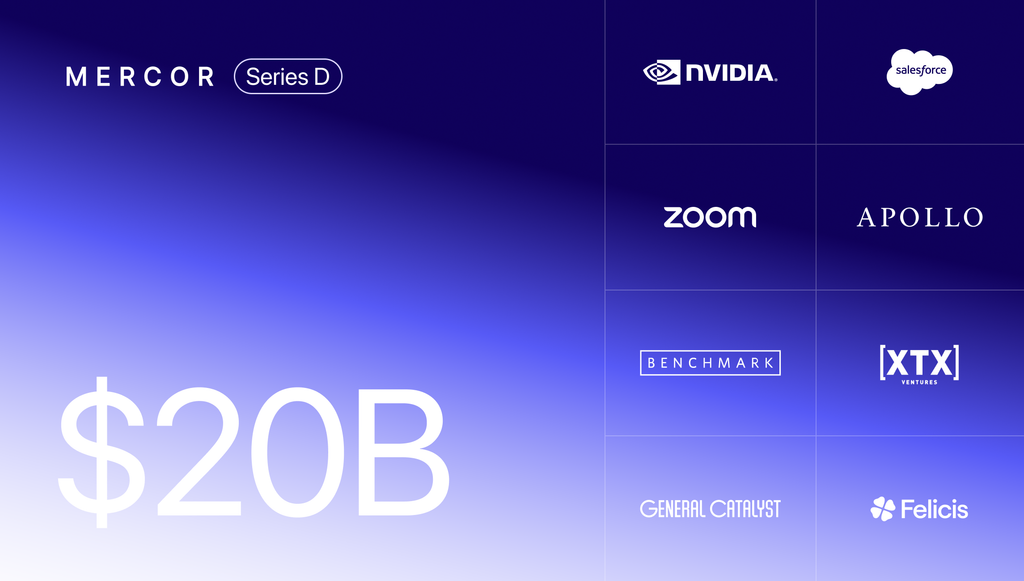
AI training powerhouse Mercor just shocked Silicon Valley by locking down $750 million in fresh capital at a mind-boggling $20 billion valuation.
The deal officially doubles the startup’s valuation in roughly a year, cementing its place among the most valuable private artificial intelligence companies in the world. Led by high-profile investors alongside tech heavyweights like Benchmark, Felicis, Fundomo, and Nvidia, the round proves that the race for machine intelligence is no longer just about computer chips—it is about human brains.
Started in a dorm room by three high school friends who dropped out of Georgetown and Thiel Fellowship programs, Mercor has evolved from a scrappy recruitment platform into the backbone of generative AI. By hiring tens of thousands of top-tier doctors, corporate lawyers, financial analysts, and software engineers to teach AI how to complete real-world office tasks, Mercor is quietly building an engine to automate white-collar labor.
The massive funding round lands at a moment when investors are pouring unprecedented cash into specialized tech. Crunchbase tracking reveals that AI companies secured an astonishing $102 billion in global venture capital in the third quarter of 2026 alone. As tech giants like OpenAI and Anthropic race toward agentic workflows, the infrastructure behind model training has become the hottest real estate in tech.
What Is Mercor and How Did It Reach a $20 Billion Valuation?
Mercor is an artificial intelligence data and training platform that connects frontier tech labs with highly skilled domain specialists. Unlike traditional crowdsourced data labeling platforms that focus on basic image tags, Mercor recruits verified subject-matter experts—such as certified accountants, medical clinicians, senior software architects, and corporate attorneys—to benchmark, critique, and guide artificial intelligence systems.
The $0 Secret To Launching Your Entire Online Empire
Why pay hundreds every month for separate software? Build funnels, send emails, and make sales with Systeme.io completely free.
Get Started For $0Free Forever • No Credit Card Needed • Beginner-Friendly
Founded in 2023 by Brendan Foody, Adarsh Hiremath, and Surya Midha, the San Francisco-based company began as an automated hiring engine that matched global tech talent with remote jobs. As leading AI research labs realized that generic internet text was running dry, they ran into a brick wall: large language models needed deep domain expertise to handle complex reasoning.
Mercor quickly pivoted to fill this gap. By turning its hiring engine into an expert training pipeline, the company assembled a vetted army of more than 30,000 elite contractors. These specialists complete mock work, evaluate AI agent behavior, write complex reasoning chains, and grade model accuracy.
The strategy paid off faster than anyone anticipated. After raising $350 million at a $10 billion valuation in late 2025, Mercor’s rapid revenue climb attracted top institutional backers. Its new $750 million Series D financing round, announced in November 2026, officially elevated its valuation to $20 billion, making its young founders some of the wealthiest entrepreneurs on the planet.
Who Backed the $750 Million Series D Round?
The latest cash injection drew support from an elite roster of venture capital firms, sovereign-backed vehicles, and corporate tech giants. Benchmark and Felicis led the round, accompanied by major institutional players including:
- Nvidia
- Salesforce Ventures
- Zoom Video Communications
- General Catalyst
- Sapphire Ventures
- Funds managed by affiliates of Apollo
- G Squared
- Glade Brook Capital
- StepStone Group
- XTX Ventures
The participation of chipmaker Nvidia and enterprise software players like Salesforce and Zoom underscores how critical human data pipelines have become. As Nvidia continues to roll out faster hardware, enterprise platforms need verified real-world training environments to deploy AI agents directly into corporate workflows.
The investment round also included a substantial employee tender offer, allowing early staff and engineers to cash out significant equity while keeping the company privately owned.
The Big Shift: Why AI Labs Are Desperate for Human Experts
For years, artificial intelligence advanced by scraping billions of public web pages, digital books, and code repositories. That strategy hit a ceiling when leading research labs recognized that public web data could only take reasoning so far. Teaching an AI model to summarize an email is easy; teaching an autonomous agent to draft an air-tight commercial merger agreement or diagnose a rare heart condition requires human mastery.
To build models capable of handling high-stakes corporate tasks, frontier labs rely on reinforcement learning from human feedback (RLHF) and post-training evaluations. This process requires continuous human correction:
- Task Execution: An AI agent is tasked with building an financial balance sheet or auditing an accounting ledger.
- Expert Grading: A licensed accountant grades the model’s work, pinpoints logical flaws, and demonstrates the correct procedure.
- Model Refinement: The model uses this specialized human feedback to adjust its weights, learning professional nuance that text scrapers cannot provide.
As competition intensifies among global tech leaders, access to verified human intellect has become the scarcest commodity in Silicon Valley. By controlling a curated network of professionals across 50 countries, Mercor has become an indispensable utility for foundation model builders.
The explosion of interest in AI training mirrors what is happening across the entire tech ecosystem. Startups and enterprise giants are shifting away from general chat interfaces and directing billions into specialized tools. Just look at how the maker of Claude recently prepared its massive market roadmap, or how enterprise tech titans are dropping billions on custom AI chips to ensure their networks can handle agent workloads without crashing.
Inside the Vision: Every Job Will Need Its Own AI Agent
According to Mercor co-founder and Chief Executive Brendan Foody, the ultimate goal goes far beyond helping frontier labs benchmark chatbots. The company believes that over the next five years, every distinct professional role will be augmented or matched by an intelligent digital counterpart.
Foody noted that the global economy is entering an era where businesses will spend far more capital adapting existing models to specific enterprise jobs than building baseline foundational models. To operate safely inside regulated industries, these AI workers cannot learn on public data alone. They must be evaluated inside closed corporate environments that mirror daily enterprise routines.
In July 2026, Mercor accelerated this mission by acquiring Deeptune, an advanced startup specializing in synthetic simulation environments and reinforcement learning. The acquisition enables Mercor to test autonomous AI agents inside virtual enterprise software suites—letting digital workers practice navigating CRMs, ERPs, and internal codebases before going live.
This transition comes as corporations seek total workflow automation. For instance, platforms are rapidly deploying tools that convert internal chatter into live software, visible in recent rollouts like GitHub Copilot in Microsoft Teams. Similarly, major search engines are building autonomous systems to handle full job tasks, as seen when Google unveiled universal Gemini AI agents designed to take over repetitive digital workloads.
Security Scrutiny and the Fast-Moving Post-Training Market
Mercor’s rapid ascent has not been without growing pains. Rapid scaling in the high-stakes AI sector brings intense regulatory and operational scrutiny. Earlier in 2026, the startup faced scrutiny following a cybersecurity breach that targeted contractor data and identity verification documents, briefly pausing testing pipelines for selected clients.
Send, Spend & Hold Money Worldwide Without Hidden Fees
Transfer money internationally at the real exchange rate and hold 40+ currencies in one account.
Open a Wise AccountMid-market rate • Fast transfers • 40+ currencies
The company responded by overhauling its data governance protocols and expanding physical footprints into major corporate capitals. Alongside its San Francisco headquarters, Mercor established offices in New York City and London to work directly with institutional banking institutions, medical groups, and government contractors.
Despite pushback from labor groups concerned about white-collar job displacement, venture capital continues to flood the space. Scale AI, Mercor’s primary competitor in data infrastructure, has pursued similar enterprise expansion, and earlier this year an AI platform built specifically for corporate lawyers raised $550 million to automate legal research and contract drafting.
Rather than slowing down, capital allocators view human data curation as the ultimate bottleneck preventing artificial general intelligence from entering the economy.
What Mercor’s Valuation Means for the Global Job Market
The fact that an AI training company is worth $20 billion tells a fascinating story about where work is headed. In the short term, the demand for human expertise has created a lucrative new economy for moonlighting professionals. Doctors, software developers, and translators are making premium hourly rates evaluating synthetic conversations from home.
The freelance world is already reshaping itself around this shift. Millions of skilled professionals who previously focused on basic gigs are discovering that training models pays substantially better than traditional freelancing. For professionals looking to build remote incomes, mastering high-value workflows has become crucial, whether you are studying the best entry-level online jobs or seeking high-paying freelance skills you can learn online for free.
For those wanting to build independent businesses around digital expertise, platforms like Systeme.io provide all-in-one marketing tools to launch courses, communities, and digital services without coding.
Yet the long-term irony remains inescapable: highly educated professionals are being paid generous wages to train the very autonomous systems designed to automate their careers. Whether Mercor’s network of human teachers will eventually teach AI enough to make their own coaching redundant is the multi-billion-dollar question hanging over the global workforce.
Frequently Asked Questions
What is Mercor?
Mercor is an AI training and evaluation platform headquartered in San Francisco. It connects major artificial intelligence developers and enterprise clients with a global network of subject-matter experts—including doctors, lawyers, coders, and financial analysts—to train, evaluate, and test autonomous AI models on complex tasks.
What is Mercor’s current valuation?
As of November 2026, Mercor is valued at $20 billion following a $750 million Series D funding round.
Who founded Mercor?
Mercor was founded in 2023 by Brendan Foody, Adarsh Hiremath, and Surya Midha. The trio met in high school in the San Francisco Bay Area and later dropped out of top universities to build the startup with early backing from Peter Thiel.
The $0 Secret To Launching Your Entire Online Empire
Why pay hundreds every month for separate software? Build funnels, send emails, and make sales with Systeme.io completely free.
Get Started For $0Free Forever • No Credit Card Needed • Beginner-Friendly
Who are the main investors in Mercor?
Mercor is backed by premier venture capital firms and major technology leaders, including Benchmark, Felicis, General Catalyst, Nvidia, Salesforce Ventures, Zoom Video Communications, and Apollo-managed funds.
How does Mercor make money?
Mercor generates revenue by providing high-quality training data, model evaluation benchmarks, and domain-specific reinforcement learning environments to frontier AI labs like OpenAI, Anthropic, and large enterprise corporations.
The explosive rise of Mercor proves that the artificial intelligence gold rush has entered an entirely new chapter. Hardware and raw compute power laid the foundation, but human intelligence is what turns raw algorithms into reliable corporate workers. As billions continue to pour into training autonomous agents, the boundary between human skill and software performance is disappearing faster than ever.
