
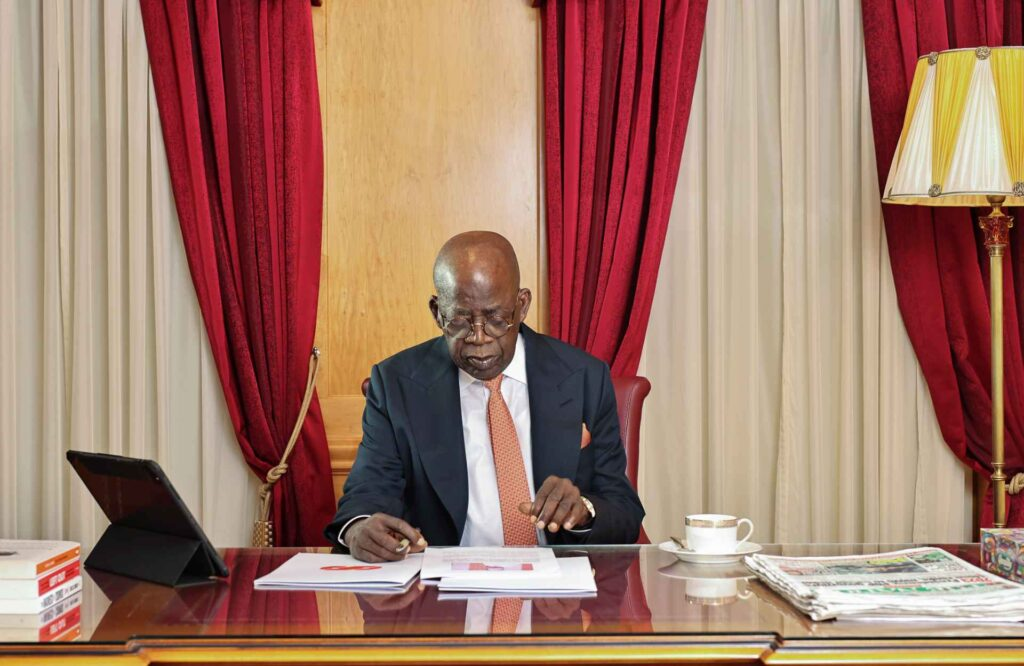
President Bola Ahmed Tinubu has landed back in Nigeria following a four-week working vacation across Europe. His presidential aircraft, Nigerian Air Force One, touched down at the Presidential Wing of the Murtala Muhammed International Airport in Lagos at approximately 6:22 p.m. on Tuesday evening. After spending weeks away in London and Paris, the president stepped off the plane into a busy Lagos environment, greeting officials and declaring that he was refreshed and ready to get back to work.
His return comes at a critical moment for the nation. With Nigeria’s 66th Independence Anniversary just around the corner, citizens across the country are eager to hear what the administration plans to do about rising living costs, soaring fuel prices, and general economic pressure. Rather than flying straight to the Federal Capital Territory in Abuja, President Tinubu opted to stop in Lagos first. Government officials confirmed that his stay in the nation’s commercial nerve center includes attending key cultural events, holding high-level political consultations, and preparing for his scheduled national broadcast to the nation.
Inside President Tinubu’s Four-Week European Trip
The president departed Abuja in late August for what the Villa described as a working vacation. The trip took him to the United Kingdom and France, marking his latest stay abroad since taking office. While many citizens questioned the timing of an extended stay out of the country, presidential aides maintained that modern technology allows the head of state to run government affairs seamlessly from anywhere in the world.
Special Adviser to the President on Information and Strategy, Bayo Onanuga, issued several updates during the month to reassure the public. Onanuga stated that President Tinubu remained in daily contact with cabinet ministers, security chiefs, and key government advisors throughout his stay in London and Paris. The administration stressed that a working vacation is standard practice for world leaders and that state business did not grind to a halt while the president was away.
Despite these assurances, the four-week duration of the trip drew widespread public attention. Critics argued that physical presidential presence in the country provides important symbolic leadership during periods of economic tension. Defenders of the trip pointed out that the president had been working at an intense pace since taking office in May 2023 and required time to recharge while managing executive duties remotely.
The $0 Secret To Launching Your Entire Online Empire
Why pay hundreds every month for separate software? Build funnels, send emails, and make sales with Systeme.io completely free.
Get Started For $0Free Forever • No Credit Card Needed • Beginner-Friendly
Upon arriving at the Lagos airport, President Tinubu appeared in good spirits as he greeted welcoming officials, including Lagos State Governor Babajide Sanwo-Olu and senior members of the ruling All Progressives Congress. When briefly speaking about his time abroad, the president indicated that he enjoyed his rest and felt completely ready to tackle the major governance challenges ahead.
The Opposition Backlash: Political Leaders React to the President’s Absence
While the Villa insisted that government operations remained smooth, opposition figures used the president’s absence to mount sharp political attacks. Key political leaders argued that taking an extended European vacation while everyday Nigerians struggled with high inflation and fuel price hikes sent the wrong message to the public.
Former Vice President Atiku Abubakar was among the most vocal critics during the four-week period. Atiku raised strong concerns about the direction of the country, arguing that the leadership was disconnected from the daily realities of citizens. In a widely discussed statement, Atiku slammed President Tinubu’s Europe vacation, describing the country’s economic state as urgent and calling for immediate hands-on governance to address mounting difficulties.
Labour Party presidential candidate Peter Obi also weighed in heavily on the situation. Obi expressed deep concern over the impact of ongoing economic reforms on household budgets. In various public comments, Peter Obi highlighted daily hardship faced by families across the country, questioning whether current policy choices were taking the right toll on citizens. The former Anambra State governor went as far as suggesting political alternatives, leading to sharp exchanges between opposition spokespersons and the presidency.
In response to these comments, presidential aides dismissed the criticism as standard partisan politics. The Villa released counter-statements maintaining that structural reforms take time to yield full benefits. They argued that previous administrations had avoided making tough economic decisions for decades, leaving current leadership to implement long-overdue fixes.
The back-and-forth between the ruling party and opposition leaders highlights the growing political tension across Nigeria. With public debate intensifying over every major policy move, the president’s return sets the stage for a fiery quarter of political debate and policymaking.
The Economic Challenges Waiting on the President’s Desk
President Tinubu returns to a desk piled high with pressing economic issues that directly impact everyday life for millions of Nigerians. At the top of that list is the price of fuel, which has continued to fluctuate and climb across filling stations nationwide.
In recent weeks, commuters and business owners have watched transport fares and operating costs jump dramatically. As price tags at petrol pumps reached unprecedented levels, Nigerians groaned under petrol price hikes that touched every sector of the economy. From small business operators relying on generators to commercial drivers trying to turn a profit, high energy costs remain the single biggest daily complaint across the country.
Food inflation continues to put severe pressure on family budgets as well. Agriculture supply chains face multiple hurdles, including transportation expenses, localized security concerns, and seasonal shifts. Governors and regional leaders have voiced concerns over the situation, with figures like Oyo State Governor Seyi Makinde speaking out on fuel prices and border security challenges that affect goods movement.
At the macro level, official data shows a complex picture of Nigeria’s economy. While national output figures show modest gains, industrial production and manufacturing continue to face headwinds. Reports show that while Nigeria’s GDP grows in key sectors, factory output has slowed down due to foreign exchange pressures, high interest rates, and elevated energy bills.
On the corporate front, business confidence remains a major topic of debate. Recent exits and downsizing by international companies have sparked discussions about the business climate. Critics point to company departures as evidence of economic stress, with opposition figures claiming that corporate departures signal trouble. On the other hand, government officials point to new investment interest, capital market records, and structural deals as proof that long-term recovery is underway.
Energy Sector Developments and Market Expectations
One of the most watched areas during the president’s absence has been the domestic oil and gas sector. The shift toward local refining and market deregulation is moving into a new phase, with massive implications for energy security and government revenue.
The Dangote Petroleum Refinery has remained at the center of national economic discussions. As the mega-refinery scales up production and prepares for broader market involvement, retail investors and market analysts are paying close attention. Interest peaked following announcements surrounding the company’s financial strategies, including the highly anticipated Dangote Refinery stock sale. Many believe that local refining efficiency could eventually stabilize domestic pump prices and reduce the immense foreign exchange demand needed for imported fuel.
Questions surrounding subsidy savings also continue to generate significant discussion among financial analysts and political leaders. Opposition leaders like Atiku Abubakar have called for total transparency regarding money saved from subsidy removal. In public statements, Atiku demanded full subsidy accounting, asking the government to clearly demonstrate how saved funds are being allocated to infrastructure, healthcare, and education.
The administration maintains that foreign exchange reform and subsidy removal are necessary pills to cure decades of fiscal distortion. Officials emphasize that initial savings are being funneled into state government allocations, social welfare programs, and student loan schemes. However, citizens are looking for tangible results that lower the cost of living in their daily routines.
Send, Spend & Hold Money Worldwide Without Hidden Fees
Transfer money internationally at the real exchange rate and hold 40+ currencies in one account.
Open a Wise AccountMid-market rate • Fast transfers • 40+ currencies
With the president back on home soil, energy experts expect fresh policy directives aimed at streamlining fuel distribution, supporting local refiners, and expanding compressed natural gas initiatives as a cheaper alternative for transportation.
Why President Tinubu Stopped in Lagos First
Many political observers expected President Tinubu to fly straight to Abuja upon returning to Nigeria. However, his decision to land in Lagos first reflects a strategic blend of official duties and political engagement.
Lagos serves as the historic home base for the president and remains the center of gravity for his political movement. During his stay in the state, President Tinubu is scheduled to attend several major cultural and official events. High on the agenda is the national premiere of MKO, an ambitious documentary celebrating the life and democratic legacy of Chief Moshood Kashimawo Olawale Abiola. Held at the Wole Soyinka National Theatre, the event gathers political leaders, civil rights veterans, and cultural icons to reflect on Nigeria’s democratic journey.
Beyond cultural events, the Lagos stopover provides an ideal opportunity for closed-door political meetings. The president is expected to consult with key stakeholders, regional leaders, and ruling party strategists. These meetings come as discussions around political alliances and governance strategies build up across the country.
Lagos also offers a grand stage for the president as he prepares to deliver his annual speech for Nigeria’s 66th Independence Anniversary on October 1st. Broadcast addresses delivered from or prepared in the nation’s commercial capital carry a distinct significance, serving as a platform to speak directly to both the business community and the broader public.
Following the completion of his engagements in Lagos, the president will return to the Presidential Villa in Abuja to preside over Federal Executive Council meetings and resume full administrative duties in the nation’s capital.
Political Positioning and the Long Road to 2027
Even though the next general elections are still years away, political maneuvering in Nigeria never truly stops. The president’s return will inevitably accelerate political discussions within both the ruling party and opposition camps.
In recent months, political figures from across the political spectrum have started laying early groundwork. Some religious and political groups have offered candid assessments of the administration’s performance. For example, reports surfaced regarding discussions where Christian elders voiced opinions on 2027, reflecting public debate over political succession and economic performance.
Meanwhile, opposition parties are actively exploring coalition strategies. Discussions about unifying various political platforms to create a stronger front against the ruling party have been ongoing. Major opposition figures have held consultations, debated leadership structures, and evaluated past election performances to determine the best path forward.
Despite these opposition moves, the presidency and ruling party leaders express confidence in their political standing. The administration argues that once key economic policies mature and deliver visible relief to households, public support will consolidate behind the government. Official spokespersons repeatedly urge patience, asserting that structural reforms are essential foundation blocks for sustainable national prosperity.
The $0 Secret To Launching Your Entire Online Empire
Why pay hundreds every month for separate software? Build funnels, send emails, and make sales with Systeme.io completely free.
Get Started For $0Free Forever • No Credit Card Needed • Beginner-Friendly
As both sides refine their messaging, everyday citizens remain focused on immediate realities: stable food prices, reliable electricity, secure communities, and job opportunities for the youth.
What Nigerians Expect from the October 1st Independence Speech
Every year, the October 1st Independence Anniversary speech gives the sitting president a major platform to address the entire nation. Coming just days after his return from Europe, President Tinubu’s upcoming address will be scrutinized with extra attention.
Nigerians across all walks of life are hoping for clear, practical solutions rather than high-level policy promises. Here are the key areas citizens will be watching closely during the broadcast:
Fuel and Transportation Relief
Citizens want to hear concrete steps on how the government plans to reduce transportation costs. Updates on local refining capacity, compressed natural gas bus rollouts, and fuel price stabilization will be major highlights.
Food Security and Living Costs
With food taking up the largest share of household budgets, listeners expect actionable measures to boost agricultural output, lower market prices, and protect farmland from security threats.
Security and National Safety
Addressing insecurity remains a top priority for families in every region. The public expects updates on military operations, intelligence strengthening, and community policing efforts to protect lives and property.
Youth Employment and Social Programs
Young Nigerians are looking for clear details on job creation programs, digital skill initiatives, and the rollout of student loans and business support funds.
The tone of the speech will be just as important as the policy announcements. A message that acknowledges real daily challenges while offering transparent, realistic solutions could help build public confidence as the administration moves into its next phase.
Frequently Asked Questions (FAQs)
When did President Bola Tinubu return to Nigeria?
President Bola Ahmed Tinubu returned to Nigeria on Tuesday evening, September 29, 2026. His plane landed at the Presidential Wing of the Murtala Muhammed International Airport in Lagos at approximately 6:22 p.m. local time.
How long was President Tinubu away on vacation?
The president was away for four weeks on a working vacation. He departed Abuja in late August and spent his time in Europe, specifically visiting London and France during the trip.
Why did President Tinubu land in Lagos instead of Abuja?
President Tinubu landed in Lagos to attend official and cultural events, including the national premiere of a documentary on Chief MKO Abiola at the Wole Soyinka National Theatre. He is also conducting key political meetings in Lagos before returning to Abuja.
What is a working vacation for a president?
A working vacation means that while the president is away from the physical capital, he continues to handle executive duties, stay in contact with cabinet members, review government briefs, and issue directives remotely using modern communication tools.
What are the main issues facing the president upon his return?
The president faces several major issues, including high fuel prices, rising food inflation, general cost-of-living concerns, security challenges, and ongoing public debate regarding economic policy reforms.
Looking Ahead: A Pivotal Moment for the Administration
President Bola Ahmed Tinubu’s return from his four-week European stay marks the beginning of an important stretch for the administration. With the rest period officially over, the focus shifts squarely back to governance, policy execution, and delivering measurable results to the Nigerian public.
The coming weeks will test the government’s ability to balance tough macroeconomic reforms with immediate relief measures for citizens. As the nation prepares to celebrate its 66th Independence Anniversary, all eyes remain on leadership to navigate current economic hurdles and set a clear course toward lasting stability.
To stay updated on breaking news, political analysis, and trending stories from across the globe, visit our homepage at WhatsBuzzn. Have a question or feedback for our editorial team? Feel free to reach out directly through our Contact Page.
Join our growing community on social media to share your thoughts on President Tinubu’s return and the upcoming Independence Day address:
- Follow us on Instagram
- Connect with us on Facebook
- Join the conversation on X (formerly Twitter)
