
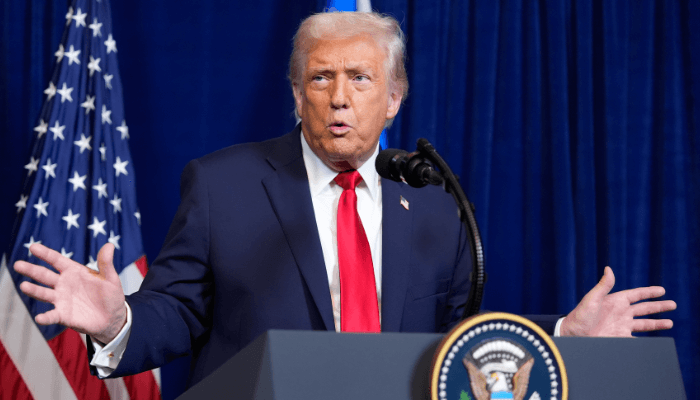
A brand-new commercial recently hit television screens across the United States, leaving millions of viewers rubbing their eyes in disbelief. The high-energy video looks and sounds just like a fiery political campaign spot. It showcases dramatic clips of Donald Trump, flashes bold slogans on screen, features ringing endorsements, and plays music with a chorus singing “I’ll make them love me.”
What surprised viewers was not the content itself, but the notice at the bottom of the screen. Right at the end of the broadcast, a clear text disclosure appears stating: “Paid for by the U.S. Government.”
American taxpayers suddenly realized they were funding a television spot that plays like a promotional video for the sitting president. Within hours of its national debut on major cable networks, the commercial sparked an intense political and legal battle in Washington.
Critics are calling the project an illegal use of government funds and a blatant political advertisement. On the other side, the White House insists that the commercial is simply a patriotic public service announcement meant to inspire unity across the nation.
Understanding how this situation unfolded requires looking closely at what appears in the video, what federal law says about government publicity, and why this story is causing such a massive stir across the country.
The $0 Secret To Launching Your Entire Online Empire
Why pay hundreds every month for separate software? Build funnels, send emails, and make sales with Systeme.io completely free.
Get Started For $0Free Forever • No Credit Card Needed • Beginner-Friendly
What Is Inside the Infamous “Love Me” Commercial?
The commercial made its debut on national television networks like Fox News, Newsmax, and CBS. From the very first second, it grabs the viewer’s attention with dramatic visuals and intense audio.
The spot opens with Donald Trump delivering a passionate speech, declaring that America will defeat communism, socialism, and Marxism. Fast-paced video edits then cycle through various moments from his presidency. Viewers see scenes of domestic manufacturing plants, law enforcement officers, military flyovers, and footage from a high-profile Ultimate Fighting Championship match hosted on the White House lawn.
Bold text flashes across the screen carrying slogans such as “America will never be a communist country.” The ad highlights economic policies, tax cuts, and domestic security efforts. Toward the end of the spot, audio plays from UFC CEO Dana White praising Trump, describing him as the toughest and most resilient man he has ever met.
What makes the commercial stand out is its soundtrack. The video is set to the song “Love Me” by R&B artist JMSN. As Trump appears on screen in various hero-style shots, a chorus of voices sings the line “I’ll make them love me” over and over in the background.
The soundtrack choice quickly created its own separate drama. Shortly after the ad started airing on national cable networks, JMSN posted on social media stating that he never granted a license or gave permission for his song to be used in a government-funded ad campaign.
Multiple versions of the spot exist, ranging from 30-second clips to full 60-second edits. Federal ad-tracking data showed that the U.S. government paid an ad agency to produce the content and buy commercial airtime during prime-time television broadcasts.
The Official White House Defense: “It Is Just a Public Service Announcement”
As soon as news spread that public money was used to create and air the commercial, reporters began asking the White House for answers. Government officials quickly moved to defend the campaign, rejecting claims that it serves as a personal endorsement or political campaign ad.
An official White House statement explained that the television spots are public service announcements. According to administration spokespeople, the campaign is designed to remind citizens to love their country and understand what makes the nation worth defending both at home and abroad.
The White House described the advertisement as educational, unapologetically patriotic, and something every American should feel proud to watch. Officials emphasized that there is nothing wrong with a government encouraging national pride and highlighting American strengths.
To counter allegations of illegal campaigning, administration representatives pointed to a key factual detail: Donald Trump is not personally on the ballot for the upcoming midterm elections. Because the ad does not contain an explicit call to action, such as telling people to vote for a specific candidate or political party, the administration maintains that it remains strictly non-partisan.
Supporters of the move also note that previous presidents have used public funds for public service communications. Past administrations run government-funded campaigns for various causes, ranging from health initiatives and environmental awareness to military recruitment and economic updates.
White House representatives argue that showing the sitting president in a positive light while promoting national pride falls comfortably within the traditional duties of government messaging.
Why Critics and Legal Experts Are Calling Out the Ad
Despite the official defense, opposition leaders, legal scholars, and government oversight groups are deeply unconvinced. They argue that there is a massive difference between traditional public health announcements and a video hyper-focused on glorifying an individual leader.
Since the 1950s, federal law passed by Congress strictly forbids executive agencies from using taxpayer dollars for publicity or propaganda purposes. Annual federal funding legislation—including the official budget laws governing current spending—explicitly bans using appropriated public funds for purely partisan self-promotion.
Reporting from major outlets like CBS News, The Washington Post, and Axios highlights how fast opposition to the ad campaign grew on Capitol Hill. Top lawmakers immediately launched formal inquiries into how the spot was produced and financed.
Send, Spend & Hold Money Worldwide Without Hidden Fees
Transfer money internationally at the real exchange rate and hold 40+ currencies in one account.
Open a Wise AccountMid-market rate • Fast transfers • 40+ currencies
Prominent members of Congress sent urgent letters to White House Chief of Staff Susie Wiles demanding an immediate halt to the broadcast. Lawmakers argued that using public money for a slick commercial that resembles a campaign spot is an unacceptable misuse of hard-earned taxpayer dollars.
Representative Jamie Raskin voiced strong concern, pointing out that converting federal property and taxpayer dollars for political self-promotion could violate the Hatch Act, a federal law that restricts government employees from engaging in political activity while on duty. Raskin suggested that using public funds in this manner could even constitute illegal conversion of government property.
Senator Jacky Rosen went a step further by proposing legislative amendments to expand existing rules against self-promoting government commercials. Her proposal aims to explicitly ban both the president and vice president from using federal dollars on media campaigns centered on themselves.
Legal experts note that while campaign finance law usually focuses on whether a candidate is actively running in an election, government ethics rules focus on the source of the money. When public money is spent on media campaigns, federal oversight bodies like the Government Accountability Office carefully check whether the message serves a genuine government function or acts as hidden propaganda.
The Broader Pattern of High-Stakes Midterm Campaigning
This commercial controversy does not exist in a vacuum. It comes at a time when political tension across the United States is at an all-time high as parties prepare for upcoming elections.
In recent months, political watchers have noted an aggressive strategy aimed at capturing public attention. Donald Trump previously promised a full campaign blitz for the midterms, emphasizing that his team intends to keep his message front and center across key swing states.
At the same time, commentators have pointed out that some party strategists express worry about election dynamics, with Republicans panicking over midterm strategies as economic pressures and policy disputes continue to shape voter opinions.
Media relation strategies during this administration have also drawn intense public debate. The White House recently faced criticism over White House news outlet blacklists, which led to major legal challenges and eventual federal court orders to reinstate press access.
Beyond television ads, other unusual government and promotional initiatives have caught public attention. The administration celebrated a special $1 golden coin release through the U.S. Mint, while discussions around proposed $5,000 midterm dividend checks generated endless debate on social media.
Meanwhile, local officials across the country are responding to federal moves with their own legislative actions, such as state-level election law blockades enacted by state leaders seeking to limit executive influence over voting procedures.
The $0 Secret To Launching Your Entire Online Empire
Why pay hundreds every month for separate software? Build funnels, send emails, and make sales with Systeme.io completely free.
Get Started For $0Free Forever • No Credit Card Needed • Beginner-Friendly
When viewed alongside these events, critics view the “Love Me” advertisement as part of a larger trend of pushing traditional boundaries between official state business and political branding.
What This Means for Everyday Taxpayers and Voters
For the average citizen sitting at home watching television, the debate over this advertisement brings up real questions about how government dollars are spent.
Many everyday citizens are currently dealing with rising living costs, high grocery bills, and economic uncertainty. When people see tax money going toward high-production television commercials praising a political leader, it naturally triggers strong reactions.
Public opinion on the issue is sharply divided:
- Supporters see the ad as an uplifting, patriotic message that reminds people to take pride in American values, domestic achievements, and national strength.
- Critics see it as an improper use of federal money that functions as a political commercial disguised as a public service announcement.
- Ethics watchers express concern that allowing government funds to pay for leader-focused media campaigns sets a risky precedent for future administrations of any political party.
When government messaging starts to look identical to campaign advertising, the line between public service and personal branding becomes blurred. Taxpayers are left wondering who decides what counts as patriotic education versus partisan propaganda.
Frequently Asked Questions (FAQs)
Did the U.S. government really pay for a Donald Trump TV commercial?
Yes. The television advertisement features a tag stating “Paid for by the U.S. Government.” Federal ad-tracking data confirms that the government hired an advertising agency to produce the content and purchase broadcast airtime on national television networks.
Is it illegal for the president to use public funds for television ads?
Federal law passed by Congress strictly prohibits executive agencies from using taxpayer funds for “publicity or propaganda” purposes. While presidents can run public service announcements for official government business, lawmakers and legal experts argue that running ads focused on self-promotion violates federal appropriations laws and ethics rules.
Did artist JMSN give permission to use his song “Love Me” in the ad?
No. Following the national broadcast of the commercial, R&B singer JMSN posted publicly on social media stating that he never granted a license or gave permission for his song “Love Me” to be used in the government-funded ad campaign.
Why does the White House claim the ad is not a political campaign spot?
The White House states that the ad is an educational public service announcement designed to promote national pride. Administration officials argue that because Donald Trump is not personally on the ballot for the upcoming midterm elections and the ad contains no explicit call to vote, it does not count as a campaign ad.
What are lawmakers doing in response to the commercial?
Democratic lawmakers have sent formal letters demanding an immediate stop to the ad broadcasts and a full accounting of all federal funds spent. Additionally, members of Congress have proposed legislation to ban presidents and vice presidents from using public funds for self-promoting media campaigns.
The debate over the “Love Me” commercial touches on foundational questions about transparency, ethics, and the proper use of public funds. As lawmakers continue their inquiries and broadcast networks decide whether to keep running the spots, citizens on all sides of the political spectrum are keeping a close watch on how Washington handles executive spending.
To explore more stories on political events, media trends, and global news, check out our About Us page or get in touch with our editorial team through our Contact Us page.
Stay connected and join the conversation with us on social media:
- Follow us on Instagram
- Connect with us on Facebook
- Catch our latest updates on X (formerly Twitter)
What are your thoughts on using taxpayer dollars for public service commercials featuring sitting leaders? Let us know your perspective as this story continues to unfold!
