
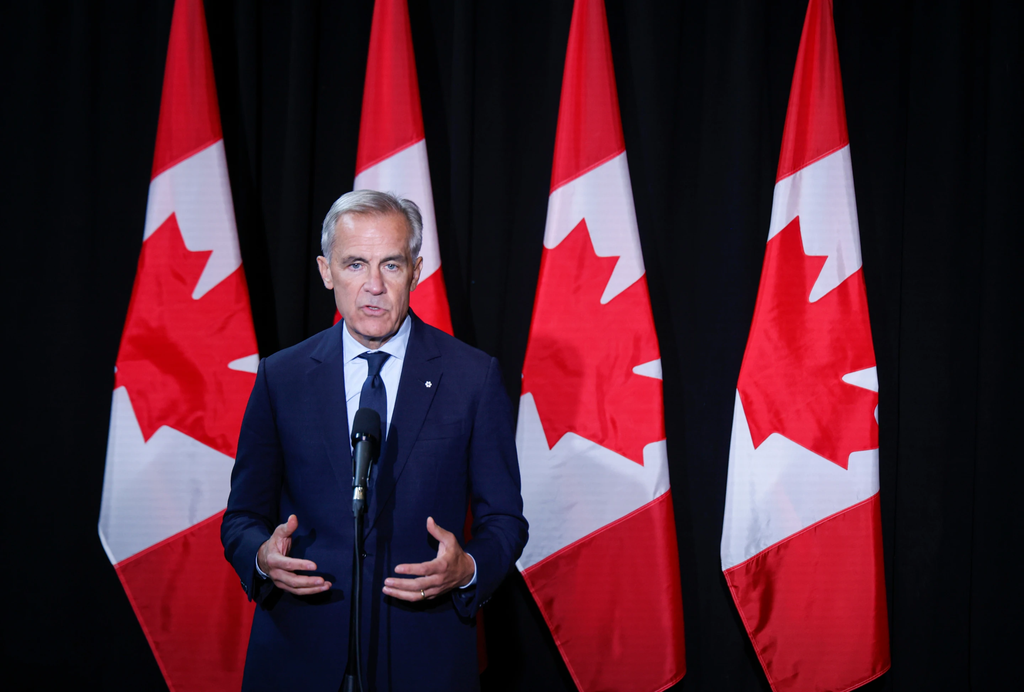
Canadian Prime Minister Mark Carney has signaled that Canada may hold off on launching a new round of retaliatory tariffs against the United States. Speaking at a cabinet retreat in Banff, Alberta, Carney described President Donald Trump’s latest trade restrictions as “relatively modest” when compared to previous economic measures taken by Washington.
The statement comes shortly after the United States escalated the ongoing dispute by placing new restrictions on Canadian imports. Washington recently banned certain Canadian dairy products, motorcycles, and most alcoholic beverages. In addition, the Trump administration moved to block Canadian suppliers from competing for large, long-term U.S. government contracts.
Carney noted that while his team is still reviewing the full impact of these steps, Canada does not need to react impulsively to every new announcement coming out of Washington. Instead, he emphasized that Canada’s primary focus should remain on building economic strength at home and expanding trade relationships with other global partners.
Understanding Washington’s Latest Trade Restrictions
The latest restrictions from the White House mark another chapter in the ongoing economic friction between the two neighboring nations. The decision targeting Canadian dairy, alcohol, and motorcycles followed earlier retaliatory measures enacted by Ottawa.
The move to exclude Canadian firms from U.S. government procurement contracts is designed to limit Canadian access to public funding projects across the border. This step targets key sectors that rely heavily on cross-border procurement agreements.
Build Funnels, Email Lists & Sell Online With One Free Tool
Create funnels, send emails, and sell online using Systeme.io without paying for multiple tools.
Create Free AccountFree forever • No credit card • Beginner-friendly
Many trade experts were expecting a swift tit-for-tat reaction from Canada. However, Carney explained that a careful analysis reveals these latest steps are not as devastating as earlier trade barriers. You can read more about how the dispute reached this point in our breakdown of how the North America trade war escalates with bans on dairy and motorcycles.
In many cases, the newly announced tariffs replace existing restrictions that Washington had previously rolled back. Because of this swap, the net increase in overall economic burden on Canadian industry is smaller than it appears at first glance.
Why Carney Described the Tariff Changes as ‘Relatively Modest’
During his address in Banff, Carney was transparent about the math behind Canada’s calm assessment. He acknowledged that specific companies in the dairy or beverage industries will certainly feel the pinch from these measures. However, when looking at the entire national economy, the overall impact remains limited.
Carney explained that the Canadian government looks at the broader context of U.S. actions. When viewed against the backdrop of earlier sweeping tariff threats, these recent bans represent a much smaller percentage of total bilateral trade.
Independent financial analysts share a similar view. Economist Derek Holt from Scotiabank pointed out that the White House’s latest move looks more like a political tactic to save face than an effort to launch a massive new trade offensive. The financial hit to Canada’s top industries appears manageable under current market conditions.
Canada’s underlying economic indicators have shown resilience in recent quarters. You can explore more background on Canada’s economic foundation in our coverage of how the Canada GDP bounced back with strong growth.
Separation of International Diplomacy and Trade Conflict
One notable aspect of Carney’s remarks was his emphasis on keeping diplomatic channels open. Even while navigating economic disagreements, Carney confirmed that he maintains regular communication with President Trump on major international developments.
Carney revealed that he had spoken with Trump multiple times in recent days. Their conversations focused on critical global issues, including security matters in Ukraine and diplomatic tensions in Iran.
According to Carney, international leaders must learn to separate trade disputes from broader national security matters. Disagreeing on tariffs does not mean two allied nations cannot cooperate on global stability and defense challenges.
However, Carney clarified that these recent phone calls were focused on geopolitical security rather than active trade negotiations. Formal trade talks between Washington and Ottawa remain paused, but communication lines between the leaders remain clear.
Strengthening the Domestic Economy First
Rather than spending energy matching every tariff coming out of Washington, Carney made it clear that Canada’s top priority is national self-reliance. He argued that the most effective response to trade uncertainty is building a stronger domestic market.
Carney highlighted three core pillars for Canada’s forward strategy:
- Building infrastructure and domestic production capacity at home.
- Diversifying commercial relationships with international partners outside North America.
- Delivering direct economic support and stability for Canadian workers and businesses.
By focusing on internal growth, Canada aims to reduce its economic vulnerability to political decisions made in Washington. This long-term approach aims to turn temporary trade disruption into an opportunity for structural improvement.
To protect workers affected by trade shifts, Ottawa continues to roll out strategic programs. Check out our detailed report on how Mark Carney promised government support for Canadians as trade shifts deepen.
Doug Ford Takes a Different Approach
While Prime Minister Carney projected calm and strategic restraint, Ontario Premier Doug Ford offered a much more direct response. Ford expressed sharp criticism of Washington’s trade policy and voiced strong opinions regarding upcoming U.S. political elections.
Ford publicly stated that he hopes American voters hold the current administration accountable during the upcoming midterm elections. He expressed a desire to see a change in Congressional leadership to help restore predictable trade policy between the two countries.
Ford has been one of the most outspoken critics of U.S. trade pressure on Canadian manufacturers. He has repeatedly warned that aggressive tariffs hurt workers on both sides of the border by disrupting established manufacturing supply chains.
Despite his harsh words, Ford agreed with Carney on one key point: finding a fair, negotiated deal is ultimately the best outcome for everyone. Ford noted that he believes Washington will eventually want to settle the trade conflict before voters head to the polls.
Canadian Public Opinion Stands Firm Behind Government Strategy
The government’s calm response aligns closely with public sentiment across Canada. Recent nationwide polls indicate that a vast majority of Canadians support taking a firm, principled stand during international trade discussions.
Public support for rejecting unfair trade demands has remained high, even as tariff threats made headlines. Canadians have shown a willingness to endure short-term market adjustments if it means protecting national sovereignty and key industries over the long run.
This unity across provinces has given federal leadership greater flexibility in how they handle trade talks. Carney does not face heavy internal pressure to rush into a disadvantageous deal simply to clear the headlines.
For a deeper look into public reactions, read our article showing how Canadians stand behind PM Mark Carney’s decision to reject unfair trade deals.
Expanding Beyond North America: Looking Toward Europe and Asia
A primary component of Canada’s economic strategy involves looking beyond traditional borders. As trade friction with Washington continues, Canadian officials are actively building stronger commercial ties across Europe and Asia.
Carney has engaged in high-level discussions with European Union leaders to expand bilateral trade agreements. These efforts focus on opening new market opportunities for Canadian agricultural goods, raw materials, energy products, and advanced technology.
By opening new export pathways, Canadian companies can offset reduced demand from U.S. buyers. Diversification ensures that local businesses are not overly dependent on a single export market.
You can learn more about these international diplomatic efforts in our article on why Mark Carney traveled to Brussels to expand European trade partnerships.
Previous Retaliations and the Logic Behind Restraint
To understand why Canada is holding back on new counter-tariffs today, it helps to look at past actions. In previous rounds of the trade conflict, Canada reacted quickly by imposing targeted counter-tariffs on key American goods.
Build Funnels, Email Lists & Sell Online With One Free Tool
Create funnels, send emails, and sell online using Systeme.io without paying for multiple tools.
Create Free AccountFree forever • No credit card • Beginner-friendly
Earlier Canadian tariffs targeted items like U.S. steel, aluminum, copper wire, and specialized manufactured goods. Those measures were designed to send a clear signal and protect vital local industries from unfair competition.
However, continuous tit-for-tat tariff increases can quickly spiral, raising costs for domestic consumers and disrupting local business supply chains. Carney’s decision to pause new counter-tariffs reflects a deliberate choice to prevent unnecessary inflation at home.
You can review previous tariff steps in our comprehensive guide on how Canada added targeted tariffs on U.S. goods as well as our complete breakdown of Canada’s earlier counter-tariff package on U.S. products.
How Trade Disputes Impact Businesses and Everyday Consumers
Trade disputes between major economies rarely stay confined to high-level policy meetings. Eventually, the financial impact filters down to everyday consumers, small business owners, and local workers.
When tariffs are placed on imported goods, the importing business usually faces higher costs. To maintain profit margins, companies often pass those expenses on to shoppers through higher retail prices.
For small businesses, trade friction creates uncertainty around inventory pricing and shipping timelines. Many business owners respond by streamlining operations and exploring digital tools to optimize performance.
Many entrepreneurs are adopting modern digital solutions to lower overhead costs during volatile economic periods. You can discover innovative tech insights in our guides covering emerging technology and AI tools for business and strategies for building modern automated channels for growth.
Understanding the broader economic picture helps individuals make smarter spending and investment decisions. For a practical breakdown of how trade tariffs affect your household budget, read our feature on what the U.S.-Canada tariff war really costs you.
What Lies Ahead for U.S.-Canada Economic Relations?
Looking ahead, trade relations between Ottawa and Washington will likely remain dynamic as political events unfold over the coming months. With U.S. midterm elections approaching, political considerations will continue to influence policy decisions on both sides of the border.
Carney reiterated that Canada remains open to resuming formal trade negotiations whenever Washington is ready. However, he emphasized that future talks must be conducted professionally and must respect Canadian sovereignty.
If new U.S. measures begin to harm core Canadian industrial sectors like steel or auto manufacturing, Ottawa retains the right to launch targeted retaliatory measures. Restraint today does not mean Canada has ruled out future action if conditions change.
Both nations share deep historic, economic, and cultural ties that extend far beyond current trade policy friction. Many analysts expect both sides to eventually find common ground once political pressures cool down.
To understand the long-term outlook, check out our analysis on how Canada is preparing for a long trade dispute that could extend past the midterms.
Frequently Asked Questions (FAQs)
Why did Mark Carney call Donald Trump’s latest trade measures ‘relatively modest’?
Mark Carney explained that when evaluated against the entire volume of U.S.-Canada trade, the newest restrictions represent a small overall percentage. Additionally, several of the new restrictions simply replace older tariffs that Washington had previously removed, resulting in a limited net impact on Canada’s broader economy.
Which products were targeted in the latest U.S. trade announcement?
The latest restrictions announced by Washington target Canadian dairy products, motorcycles, and most alcoholic beverages. The U.S. administration also moved to restrict Canadian businesses from competing for long-term U.S. government procurement contracts.
Is Canada planning to launch immediate retaliatory tariffs?
No. Mark Carney indicated that Canada will hold off on immediate counter-measures. The government is choosing to study the impact of the U.S. policy while focusing on domestic economic growth and expanding trade partnerships elsewhere.
Are trade negotiations between the U.S. and Canada ongoing?
Formal trade negotiations between the two countries remain paused. However, Prime Minister Carney confirmed that he remains in regular contact with President Trump regarding international security, defense, and global foreign policy issues.
How do these trade measures affect regular shoppers?
Tariffs and import bans can lead to higher prices for consumer goods, reduced product variety on store shelves, and potential supply chain delays. However, because Canada is focusing on market diversification and domestic growth, officials aim to minimize direct consumer impact.
The ongoing trade dialogue between Canada and the United States shows how fast economic policy can shift. While temporary restrictions present challenges for specific sectors, Canada’s strategic focus on internal growth, diplomatic restraint, and international market diversification offers a clear path forward.
To learn more about our mission and stay updated on breaking news, visit our About Us page. If you have questions, feedback, or story ideas, feel free to reach out directly through our Contact page.
Stay connected with us across social media for daily updates and trending coverage:
- Follow us on Instagram
- Join our community on Facebook
- Get real-time alerts on X (formerly Twitter)
