
A one-year-old artificial intelligence research lab that does not sell a single product, earns zero customer revenue, and has never released a public app just landed a $6 billion valuation.
The San Francisco startup is called Flapping Airplanes. On Wednesday, the young firm announced a massive $1 billion Series A funding round co-led by top venture capital heavyweights Index Ventures and Lux Capital. Legendary investment giants including Sequoia Capital, Alphabet venture arm GV, Kleiner Perkins, and microchip titan Nvidia also joined the funding round.
The new cash injection brings total funding for the lab to $1.18 billion. Just nine months ago, in January, the company raised a $180 million seed round at a $1.5 billion valuation. In less than a year, the value of the business has quadrupled, catching the eye of tech insiders and financial watchers across the globe.
To the casual observer, handing billions of dollars to an experimental laboratory with no commercial software sounds completely wild. When you look at how much money big companies are burning on computer power, however, the logic behind the deal starts to make a lot of sense.
Modern tech giants are caught in an aggressive race. Heavyweights like Microsoft, Google, and Meta are pouring hundreds of billions of dollars into data centers, power grids, and silicon processors to train ever-larger artificial intelligence models. As Wall Street watches historic sums flood into the AI sector, many experts worry that current training methods are hitting a hard wall. Flapping Airplanes claims it has found a smarter path forward, and the biggest investors in Silicon Valley are betting serious money that they are right.
The $0 Secret To Launching Your Entire Online Empire
Why pay hundreds every month for separate software? Build funnels, send emails, and make sales with Systeme.io completely free.
Get Started For $0Free Forever • No Credit Card Needed • Beginner-Friendly
Who Cut the Billion-Dollar Check for Flapping Airplanes?
Securing $1 billion in a Series A round is virtually unheard of in startup history. Rounds of this scale were once reserved for late-stage companies on the verge of going public on the stock exchange.
This funding round was co-led by Index Ventures and Lux Capital, two firms known for making aggressive, high-conviction bets on emerging technologies. As part of the agreement, Index Ventures partner Mark Xu is taking a seat on the Flapping Airplanes board of directors.
The list of other backers reads like a hall of fame for venture capital:
- Alphabet venture arm GV
- Sequoia Capital
- Kleiner Perkins
- Nvidia
- Valor Equity Partners
- A* Capital
- Atreides Management
The participation of Nvidia is particularly interesting. Nvidia manufactures the advanced graphics processing units, or GPUs, that power almost every top AI system on Earth. Tech moguls like Elon Musk spend tens of billions buying Nvidia hardware to keep up with industry demands. Seeing Nvidia invest directly into a company whose entire mission is to do more work with fewer chips shows how urgently the industry needs software breakthroughs.
Meet the Twenty-Something Founders Behind the Company
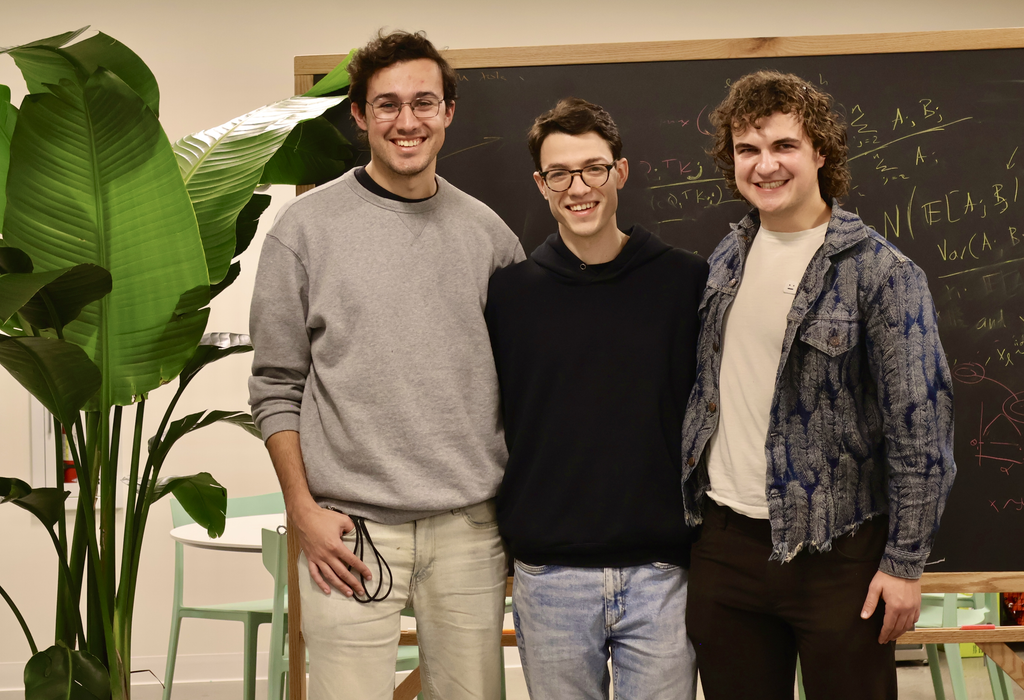
The brains behind Flapping Airplanes are three young builders who come from deep technical and academic backgrounds: Aidan Smith, Asher Spector, and Ben Spector.
Aidan Smith previously dropped out of university after earning a prestigious Thiel Fellowship, a program funded by billionaire Peter Thiel that pays ambitious young builders to skip college and create companies. Before teaming up to launch Flapping Airplanes, Smith spent three years working at Elon Musk’s brain-computer interface firm, Neuralink, while studying at the Georgia Institute of Technology.
Brothers Asher and Ben Spector bring deep analytical firepower from Stanford University. Asher Spector was working toward his Ph.D. in statistics at Stanford and was a former national debate champion. Ben Spector was completing graduate work in computer science at Stanford after creating Prod, a talent incubator built to help top college engineers break into tech careers.
Instead of building another standard software app or a simple chatbot wrapper, the trio decided to set up what insiders call a “neolab.” A neolab is an independent research lab that operates more like an elite university science department than a corporate business. Their goal is not to sell small software subscriptions today, but to solve fundamental math and engineering puzzles that could change computing for the next twenty years.
Why Is the Company Named Flapping Airplanes?
The name Flapping Airplanes sounds playful, but it carries a very specific historical lesson about human engineering.
Centuries ago, early flight pioneers were obsessed with birds. Inventors designed strange contraptions called ornithopters, which were flying machines built with mechanical flapping wings. The inventors assumed that because birds flap their wings to fly, human aircraft had to flap their wings too.
Those flapping machines mostly failed. Humans did not conquer the skies until the Wright brothers and early aeronautical engineers abandoned flapping wings altogether. Instead, they studied the physics of airflow, designed fixed wings, and built dedicated combustion engines.
The founders of Flapping Airplanes believe the current AI boom is stuck in its own “flapping wing” stage. Today’s artificial intelligence systems attempt to produce smart answers by swallowing almost every piece of written text on the internet and running it through tens of thousands of power-hungry computer chips.
The founders argue that simply making models bigger and feeding them more data is clumsy and unnatural. It is the digital equivalent of flapping harder to stay airborne. True intelligence, they argue, needs a totally different design.
The Brute Force Crisis: Why AI Needs to Stop Eating the Internet
To understand why investors valued this company at $6 billion, you have to look at how current artificial intelligence actually works.
Most modern frontier tools, including systems like ChatGPT, Claude, and Gemini, are trained on massive datasets. They ingest trillions of words from books, news articles, blog posts, Wikipedia pages, forums, and social media posts. The industry calls this brute-force scaling: if you want a smarter model, you feed it ten times more data and rent ten times more computer chips.
Send, Spend & Hold Money Worldwide Without Hidden Fees
Transfer money internationally at the real exchange rate and hold 40+ currencies in one account.
Open a Wise AccountMid-market rate • Fast transfers • 40+ currencies
That approach is running into severe limitations:
- The internet is running out of new human text. Researchers estimate that top tech firms have already vacuumed up almost all the high-quality public reading material that humans have ever published online.
- Data centers are straining physical energy systems. Massive server farms require unbelievable amounts of electricity and cooling water. Across North America, big investors worry about growing public pushback against data centers because power grids cannot handle the load.
- Current models sound identical. When every model eats the exact same data from the open internet, they all develop the same tone, make the same mistakes, and repeat the same biases.
Now compare that brute-force method to how a human child learns. A three-year-old child does not need to look at five hundred thousand pictures of a dog to recognize a puppy on the street. A parent points to a dog once or twice, and the child’s brain understands the concept immediately. By the time an adult finishes school, they have read only a tiny fraction of the data an AI system consumes in an hour, yet human beings can write poetry, fix cars, solve equations, and invent new tools.
Flapping Airplanes is working on algorithms that learn like humans do. If an AI model can pick up skills from small, carefully chosen pieces of data rather than the whole internet, training costs could plummet by 90 percent or more. As co-founder Asher Spector pointed out in tech discussions, a model that uses data one million times more efficiently would be dramatically easier and cheaper to plug into the real economy.
The Secret Software: What Is a Megakernel?
Solving the learning algorithm is only half of what Flapping Airplanes is doing. The other half is raw computer engineering designed to fix a major bottleneck in computer chips.
Modern AI training runs on specialized computer chips known as graphics processing units. While these chips are fast, they are often held back by how memory moves inside them. Training a model involves two main steps: crunching the numbers (compute) and moving data in and out of the chip memory storage (memory transfer).
When a chip is busy transferring data from memory, the math processors sit idle, waiting for the information to arrive. When the math processors are running heavy calculations, the memory pipeline waits. That dead time wastes incredible amounts of money.
To fix this, the engineering team at Flapping Airplanes built a software system they call a “megakernel.”
Instead of treating memory loading, model training, and question-answering as separate, clunky steps, the megakernel organizes all these tasks to run inside a single, unified execution cycle. It mixes memory-heavy tasks with calculation-heavy tasks at the exact same moment.
By overlapping these operations, the graphics chip rarely sits empty. In testing, the startup reported that their megakernel can handle deep model training, run real-time answers, and even power a 3D video game simultaneously on the same graphics processor without slowing down.
When companies are spending billions on silicon hardware, squeezing even 10 or 15 percent more usable output from existing processors saves hundreds of millions of dollars. As major tech leaders look for ways to trim expenses, such as how Microsoft developed specialized internal chips to trim its hardware bills, software that wrings extra power out of standard chips becomes extremely valuable.
The $0 Secret To Launching Your Entire Online Empire
Why pay hundreds every month for separate software? Build funnels, send emails, and make sales with Systeme.io completely free.
Get Started For $0Free Forever • No Credit Card Needed • Beginner-Friendly
The Rise of the AI Neolab: Why Pure Research Is Back in Style
For the past decade, most Silicon Valley venture capital went into consumer mobile apps, delivery platforms, and business management dashboards. Investors wanted to see quick sign-ups, recurring credit card payments, and fast sales numbers.
The artificial intelligence boom has completely changed that rulebook. We are now seeing the return of the pure research laboratory, reminiscent of historic innovation centers like Bell Labs or Xerox PARC.
Venture capitalists are realizing that the standard software playbook does not work for foundational breakthroughs. You cannot build a generational leap in computer intelligence just by hiring a sales team and tweaking user interfaces. You have to solve deep mathematical equations, design novel neural network architectures, and rewrite how operating systems communicate with silicon.
Investors are willing to value Flapping Airplanes at $6 billion without a product because foundational intellectual property is rare. If their mathematical theories on data efficiency pan out, the startup will not need to sell small monthly apps. They could license their architecture to global tech giants, power industrial robotics, or provide the foundational engine for entire national economies.
Other major players are noticing the shift. From announcements showing OpenAI rolling out new budget-friendly model tiers to major hardware deals where Samsung committed $1 billion to back specialized AI operations, the market is hungry for fundamental research that lowers computing costs.
Huge Opportunity or Silicon Valley Hype?
Despite the enthusiasm, a $6 billion valuation for a company without a single paying customer raises eyebrows.
Skeptics point out that venture capital has a history of falling in love with ambitious ideas before the technology is proven. Training models with tiny amounts of data is notoriously difficult. Computer scientists have tried to mimic human learning for decades, yet brute-force pattern matching on massive datasets remains the only method that has consistently produced capable modern systems.
There is also the financial risk. Artificial intelligence research requires massive compute budgets. A $1 billion funding round sounds like an infinite mountain of cash, but renting top-tier computing clusters can burn through tens of millions of dollars every single month. If the team runs into dead ends or if competing labs discover a different shortcut first, that capital can evaporate quickly.
Financial commentators frequently debate whether the technology world is overheating. Discussions about whether current market enthusiasm represents an unsustainable bubble are becoming common among Wall Street analysts.
Even so, backers like Index Ventures and Lux Capital believe the reward far outweighs the danger. If Flapping Airplanes succeeds, they will hold equity in the company that solved the biggest bottleneck in computer history. If they fail, they took a calculated swing on top-tier engineering talent during an era defining the future of technology.
What This Breakthrough Could Mean for Everyday People
While high-level venture deals sound distant from daily life, breakthroughs in data efficiency and chip management directly affect ordinary technology users in three major ways:
1. Smarter AI on Personal Phones and Laptops
Today’s top artificial intelligence models are too large to fit on a smartphone. Every time you ask a complex question, your request travels over the internet to a massive data center filled with humming servers. If models become smaller and require far less data to understand ideas, powerful intelligence could run directly on your smartphone, tablet, or home computer without needing an internet connection.
2. Radical Reductions in Computing Costs
When software is cheap to run, consumer products become cheaper. Businesses currently spend huge portions of their budgets paying cloud service providers for computing power. If data-efficient models slash operational expenses, the cost of smart automated tools, personal digital tutors, and medical diagnostic assistants will drop dramatically for everyday people.
3. Lower Environmental and Energy Demands
Data centers use massive quantities of electricity, putting pressure on local power plants and water supplies. If models can learn from modest datasets using optimized megakernels that keep chips from running unnecessarily hot, the carbon footprint of future technology will shrink significantly.
Frequently Asked Questions (FAQs)
What is Flapping Airplanes?
Flapping Airplanes is an artificial intelligence research startup based in San Francisco, California. Founded in late 2025, the company focuses on foundational AI research, specifically building models that learn from much smaller amounts of data and developing specialized software to make computer chips run faster.
Why is Flapping Airplanes valued at $6 billion with no products?
Investors are paying for breakthrough technical research rather than existing sales. The startup is tackling the data efficiency problem and GPU chip bottlenecks. If their research succeeds, their intellectual property and software could become essential across the entire tech industry, making early ownership highly valuable.
Who are the founders of Flapping Airplanes?
The company was founded by Aidan Smith, Asher Spector, and Ben Spector. Aidan Smith is a former Thiel Fellow who spent three years working at Neuralink. Asher Spector was a Stanford statistics Ph.D. researcher, and Ben Spector was a Stanford computer science graduate researcher and entrepreneur.
Who invested in the $1 billion Series A round?
The Series A funding round was co-led by Index Ventures and Lux Capital. Major participating investors include Sequoia Capital, Alphabet venture arm GV, Kleiner Perkins, and Nvidia, alongside firms like Valor Equity Partners, A* Capital, and Atreides Management.
What is the “data efficiency problem” in AI?
Today’s artificial intelligence systems require trillions of words scraped from the internet to learn basic tasks. By contrast, humans learn language and concepts with only a tiny fraction of that information. The data efficiency problem is the challenge of teaching AI systems to understand the world using small, high-quality datasets rather than brute-forcing the entire internet.
What is a megakernel?
A megakernel is custom low-level software developed by Flapping Airplanes for Nvidia graphics chips. It blends memory-loading tasks and math computations inside a single execution loop. This prevents computer chips from sitting idle, allowing hardware to train models and run operations much more efficiently.
The funding of Flapping Airplanes proves that the artificial intelligence landscape is changing gears. The first phase of the AI revolution was defined by raw power, giant datasets, and massive spending sprees. This next chapter may belong to the thinkers who figure out how to do more with less. By stepping back from brute force and rethinking the basic math of machine learning, a small team of twenty-something researchers in San Francisco just convinced the world’s most powerful investors that real intelligence does not need to swallow the entire internet to take flight.
