
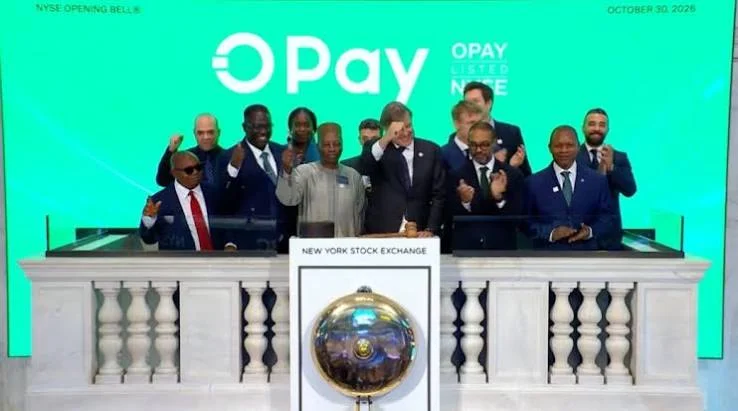
OPay was just hours away from making history on the New York Stock Exchange. Executives had gathered, the opening bell had been rung, and shares were already priced at $19 each. Investors across the globe were getting ready to trade what would have been one of the biggest African fintech stock market debuts ever.
Then, everything ground to a halt.
In an unexpected announcement that sent shockwaves through Wall Street and the African tech ecosystem, OPay canceled its planned $304 million initial public offering (IPO). The listing, which would have valued the financial services giant at an eye-watering $4 billion, was abruptly withdrawn right before the stock could trade under the ticker OPAY.
If you use OPay to send cash, receive payments, or save money every day, you are probably asking yourself some very urgent questions. Why did they pull out at the very last second? Is your money safe? What does this mean for the future of digital banking across emerging markets?
Here is a clear, simple breakdown of what happened behind closed doors, why regulators stepped in, and what this dramatic decision means for you.
The $0 Secret To Launching Your Entire Online Empire
Why pay hundreds every month for separate software? Build funnels, send emails, and make sales with Systeme.io completely free.
Get Started For $0Free Forever • No Credit Card Needed • Beginner-Friendly
The $4 Billion Plan That Vanished Overnight
To understand why this withdrawal caused such a massive buzz, you have to look at how close OPay actually came to crossing the finish line.
OPay had already completed almost every single step required by international financial regulators. On Thursday, October 29, 2026, the United States Securities and Exchange Commission (SEC) officially approved the listing documents. Global financial heavyweights like Citigroup, Deutsche Bank, Standard Bank, and CICC had signed on as underwriters to sell the shares.
The company had set up a deal to sell 16 million American Depositary Shares (ADSs). By Friday morning, the pricing was finalized at $19 per share. At that price point, the entire business was valued at roughly $4 billion.
Trading was scheduled to kick off immediately on the New York Stock Exchange. The media was ready, investors had set their orders, and celebratory posts were already circulating on social media.
Instead of seeing the ticker go live, the trading screens stayed completely blank. Hours later, reports confirmed that OPay had instructed its underwriters to terminate the agreement and pull the offering off the table.
Why Did OPay Cancel the Listing?
The official reason given by the company centers around an unexpected regulatory inquiry from an unnamed foreign jurisdiction.
According to formal statements reported by Reuters and international business outlets, OPay received questions from a government regulator outside of its primary operating bases. While OPay did not name the specific country or government agency, it emphasized that the jurisdiction involved is completely immaterial to its day-to-day business.
In legal and corporate finance, going public on the New York Stock Exchange requires absolute transparency. When an unexpected inquiry lands on an executive’s desk hours before an IPO, moving forward without resolving it creates massive legal exposure. If an untested regulatory issue comes up after shares begin trading, shareholders can file massive class-action lawsuits accusing the company of withholding material facts.
OPay chose to slam the brakes rather than launch with a lingering question mark hanging over its head. The company stated clearly that this inquiry does not reflect its operational health, its financial results, or its compliance record in core markets like Nigeria. The management team maintains that the issue is minor and will be resolved satisfactorily soon.
The Massive Scale of OPay: How Big Is the Company Today?
For millions of people, OPay is simply the super-fast app on their phone that makes transfers go through when traditional banking networks fail. But the filings submitted to the U.S. Securities and Exchange Commission reveal just how gigantic the fintech has become behind the scenes.
The numbers filed during the IPO process tell an incredible story of growth:
- Over 50 million registered users: Spread across emerging markets, with the overwhelming bulk of activity concentrated in Nigeria.
- Massive financial surge: OPay pulled in $536.3 million in revenue in 2025, representing a jump of more than 160% compared to 2024.
- Real bottom-line profitability: Unlike many tech startups that burn venture capital without making a profit, OPay recorded an operating income of $107.1 million in 2025 and $131.2 million in just the first six months of 2026. Net income reached $90.9 million for the first half of 2026 alone.
- Debit cards in every wallet: The platform had issued 38.7 million debit cards by mid-2026.
- Powering everyday retail: Over 800,000 active Point of Sale (POS) merchant terminals across neighborhoods, corner stores, and markets.
- Savings and lending: More than 42 million savings subscribers, alongside 6.7 million quarterly borrowers accounting for over $1.5 billion in loan originations.
These figures show that OPay is no longer an underdog startup trying to prove itself. It is a full-scale financial backbone for consumer commerce and local businesses alike.
This level of expansion mirrors the wider transformation of modern finance across the continent, where mobile-first platforms have completely changed how everyday transactions work. For instance, you can see how rapid digital adoption has transformed retail finance in our deep dive on how FairMoney hit 30 million users in Nigeria.
What Does This Mean for Your Money and Your App?
Whenever big corporate headlines mention regulators or canceled deals, everyday users naturally start to worry. You might wonder if your deposits are safe, if your card will decline at the store, or if transfers will start failing.
The short answer is no, your funds are not in danger.
Send, Spend & Hold Money Worldwide Without Hidden Fees
Transfer money internationally at the real exchange rate and hold 40+ currencies in one account.
Open a Wise AccountMid-market rate • Fast transfers • 40+ currencies
An IPO withdrawal is purely an investment and stock market decision. It does not affect day-to-day consumer banking or payment operations.
OPay reiterated that its operations in Nigeria remain fully licensed, properly capitalized, and regulated by the Central Bank of Nigeria (CBN), with customer deposits insured by the Nigeria Deposit Insurance Corporation (NDIC). Local bank transfers, POS agent cash-outs, automated bill payments, and merchant settlement services continue to run without interruption.
The regulatory inquiry did not originate from Nigerian regulators, nor does it affect local licensing. The company operates normally, and all user funds remain intact.
The Broader Impact on African Tech and Public Listings
The sudden cancellation of the OPay IPO is a sobering moment for the entire African tech landscape.
For years, founders, venture capital funds, and everyday observers have waited for the big moment when African tech giants would list on the world’s most prestigious stock exchanges. A successful $4 billion listing on Wall Street was expected to open the floodgates for other emerging market giants to follow suit.
When high-profile listings pause, it prompts companies to rethink international expansion and risk. We saw a similar trend when fintech leaders paused certain cross-border initiatives to double down on home territory, as explored in our coverage on why Moniepoint refocused on its core African market.
At the same time, major funding and strategic partnerships continue to move forward across the sector. International institutions have poured record amounts into African payment infrastructure, such as when Circle Ventures backed Flutterwave at a $3.25 billion valuation to speed up cross-border settlements.
Going public in the United States brings incredible prestige and access to deep capital pools, but it also comes with ruthless regulatory scrutiny. Even minor cross-border paperwork inconsistencies or questions from foreign jurisdictions can cause immense legal complications.
This reality has caused many African companies to reconsider local capital markets. Rather than taking on the complex compliance headaches of American exchanges, several high-value enterprises are turning to domestic exchanges like the Nigerian Exchange (NGX) to raise equity directly from local retail and institutional investors. A prominent example of this shift is the massive domestic enthusiasm surrounding public stock offerings, which you can read about in our complete guide to the Dangote Refinery stock sale and IPO.
How Fintech Transformed Daily Spending Habits
The reason OPay’s story matters so much to the public is that digital financial platforms have fundamentally altered daily life.
The $0 Secret To Launching Your Entire Online Empire
Why pay hundreds every month for separate software? Build funnels, send emails, and make sales with Systeme.io completely free.
Get Started For $0Free Forever • No Credit Card Needed • Beginner-Friendly
A few years ago, buying groceries, paying for a taxi, or buying street food meant having physical cash in your pocket. Whenever cash shortages or banking network downtime hit, normal commerce would grind to a halt. Fintech apps stepped into that gap by providing lightning-fast peer-to-peer transfers that work on basic smartphones with minimal connectivity.
This massive shift away from physical paper money has even drawn the attention of central bankers. Regulators have actively highlighted how the meteoric rise of agency banking and mobile apps has dramatically reduced our reliance on small currency notes. For an in-depth look at this behavioral change, check out our breakdown on how fintech reduced the use of small naira notes.
As digital payments take over, tech companies are also looking into strategic acquisitions to strengthen their payment rails and move into international remittances. A good example of this deal-making wave is discussed in our piece on how Zedcrest acquired Leatherback to expand money transfers.
Because these apps are now woven into the fabric of everyday commerce, any headline about their corporate maneuvers quickly catches everyone’s attention.
What Comes Next for OPay?
Pulling an IPO is a setback, but it is rarely the end of the road.
Many global tech corporations have withdrawn planned offerings when market conditions turned volatile or when unexpected paperwork questions emerged, only to return to the market once everything was straightened out.
Here are the most likely paths forward for OPay:
1. Resolving the Foreign Inquiry
The immediate priority for OPay’s executive team and legal counsel is providing whatever clarification or documentation the foreign regulator requested. Once the regulatory authority issues a clean clearance or resolves the inquiry, OPay can formally update its regulatory disclosures.
2. Refiling With the SEC
If OPay chooses to return to the New York Stock Exchange, it will need to submit amended registration forms that clearly explain the inquiry and show that the matter is settled. Because the underlying business generated over $90 million in net profit in the first half of 2026 alone, investor interest in the stock will likely remain strong once the uncertainty clears.
3. Exploring a Dual Listing
Another route being discussed by financial analysts is a potential dual listing. OPay could choose to list shares both on an international exchange like the NYSE and on the Nigerian Exchange (NGX). This strategy would allow millions of everyday users who rely on the platform to own a direct piece of the company while still unlocking global investment capital.
The fintech industry remains one of the fastest-growing sectors powering overall gross domestic product, even during challenging economic cycles. To understand how non-oil sectors and digital platforms drive modern economic numbers, explore our analysis on how Nigeria’s economy expanded through commercial diversification.
Frequently Asked Questions (FAQs)
Why did OPay cancel its $304 million US IPO at the last minute?
OPay withdrew its New York Stock Exchange listing after receiving an unexpected regulatory inquiry from an unidentified foreign jurisdiction. Because listing on Wall Street requires total disclosure, the company decided to halt trading until the inquiry is cleared up.
Is my money on the OPay app safe?
Yes, your money is completely safe. The canceled listing is an investment transaction that has no impact on consumer accounts, transfers, card payments, or merchant settlements. OPay operations in Nigeria remain fully active, licensed by the Central Bank of Nigeria, and protected by deposit insurance.
What was the expected valuation of OPay on the NYSE?
OPay was expected to trade at $19 per American Depositary Share, giving the company a total market valuation of approximately $4 billion.
Can OPay still go public in the future?
Yes. Companies frequently pause IPOs when regulatory or market conditions require clarification. Once the foreign inquiry is resolved, OPay can refile its paperwork with the US SEC or pursue an alternative listing strategy.
Did the Nigerian government or CBN stop the IPO?
No. OPay confirmed that the regulatory question came from a foreign country outside of its main operating markets. The company’s standing with regulators in Nigeria remains untouched.
The sudden pause of OPay’s New York Stock Exchange debut shows just how demanding the world of global public markets can be. While the withdrawal delayed what would have been a historic day for African fintech, the company’s underlying fundamentals—surging revenues, tens of millions of active users, and real profitability—show that the digital banking revolution is here to stay.
Have thoughts or tips on this story? Reach out directly through the WhatsBuzzn Contact Page and let us know what you think.
