
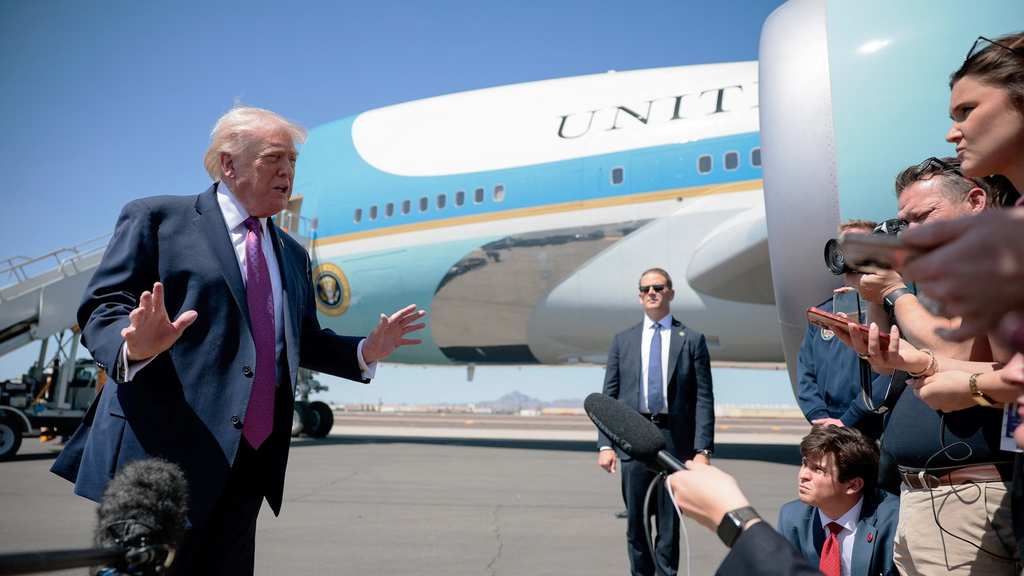
Donald Trump took the stage in front of thousands of supporters and dropped a statement that left diplomats, military strategists, and everyday observers scratching their heads. Speaking openly about the raging conflict across the Middle East, the former president and Republican nominee admitted that Washington might have created an unexpected diplomatic nightmare by hitting Iran too hard.
“They don’t have a navy. They don’t have an air force. Their army is decimated. Their leaders are gone,” Trump told a roaring crowd during a campaign swing through Montana, repeating similar remarks in Ohio and Arizona. Then came the line that immediately caught fire across news networks and social media platforms: “I should have probably left their leaders because I don’t know who the hell we’re negotiating with.”
It was a classic, raw Trump observation—part brag about American firepower, part blunt confession about a bizarre diplomatic dead end. After months of devastating strikes that dismantled command centers and wiped out top Iranian military and political officials, the United States wants to bring the conflict to a close. But there is a massive problem: when you eliminate every senior figure in an enemy government, who is left to sign a peace treaty?
The remarks pull back the curtain on a messy reality that world leaders rarely admit out loud. Winning on the battlefield is one thing, but sitting down across a table to hammer out a lasting peace deal requires an actual human being on the other side who has the authority to make decisions and keep their word.
What Trump Actually Said on the Campaign Trail
Trump did not hold back when describing the damage inflicted on Iranian military infrastructure. According to his account, previous waves of precision strikes did not just slow Tehran down—they wiped out their primary fighting assets on land, sea, and air.
The $0 Secret To Launching Your Entire Online Empire
Why pay hundreds every month for separate software? Build funnels, send emails, and make sales with Systeme.io completely free.
Get Started For $0Free Forever • No Credit Card Needed • Beginner-Friendly
He told his audience that Iran’s naval capability had been crushed, claiming that all 159 of its naval vessels were sitting at the bottom of the ocean. He pointed out that over 270 jet fighters were blown to tiny pieces before they could even get off the runways. For years, Iran had built a reputation as the heavyweight bully of the Persian Gulf, funding proxy militias and threatening critical trade lanes. Trump insisted those days are officially history.
Yet, despite describing Iran’s armed forces as completely broken, Trump acknowledged that total military victory brings its own set of headaches. In his own words, taking out the entire senior tier of Iranian leadership created a power vacuum so deep that American envoys cannot figure out who is calling the shots.
Addressing a crowd in Ohio, he even joked that “nobody wants to be the president of Iran” right now because anyone who steps into the spotlight fears becoming the next target. It drew laughs from the crowd, but foreign policy veterans saw it as a startling admission. When you want to end a war, you need a counterpart. Without one, negotiations turn into conversations with shadows.
The Decapitation Trap: When Victory Destroys Diplomacy
Military strategists call it a “decapitation strike”—taking out the head of the snake so the body cannot fight back. The strategy sounds great in war movies and tactical briefings. You take down the decision-makers, scramble the communications network, and stop enemy forces from launching coordinated attacks.
In real life, decapitating a government often leads straight into what historians call a diplomatic trap. When the people at the top disappear overnight, the entire chain of command falls apart. Local commanders, splinter militias, and rogue intelligence units start acting on their own survival instincts rather than following national orders.
That seems to be exactly what is happening right now. While Donald Trump insists that the end of the conflict is near, military commanders on the ground are dealing with erratic rocket barrages and unpredictable skirmishes.
Instead of dealing with a single, unified government in Tehran, international negotiators are suddenly forced to guess who holds actual power. Is it a surviving general from the Islamic Revolutionary Guard Corps? Is it a mid-level diplomat stationed in Geneva? Or is it an unelected council trying to stay alive in an underground bunker?
When American negotiators try to pass messages through neutral third parties, the answers coming back are fragmented and contradictory. One faction wants an immediate ceasefire, while another launches drones at commercial shipping routes. By wiping out the recognized faces of the regime, the US military may have solved an immediate threat while making long-term peace ten times harder to achieve.
Who Is Actually Running Iran Right Now?
To understand why Trump is throwing his hands up in confusion, you have to look at how Iran has organized its defenses over the last three decades. Tehran never built its military to operate like a traditional Western army where orders travel smoothly from the top general down to the private.
Decades ago, Iranian military planners created what they call the “Mosaic Doctrine.” They realized that if a superpower like the United States or a regional powerhouse like Israel attacked, top command centers would be targeted immediately. To survive, they designed their armed forces to break into dozens of independent cells that can operate without direct orders from the capital.
Here is how the leadership breakdown looks on the ground:
- The Supreme Leader’s Inner Circle: With top clerics and key advisers either killed, in hiding, or unable to communicate securely, the central authority that once held the country together is fractured.
- The Revolutionary Guard Factions: Surviving regional commanders of the Islamic Revolutionary Guard Corps (IRGC) hold local weapon stockpiles. Many of these commanders answer to no one and believe that signing a peace deal is treason.
- The Civilian Bureaucracy: Government ministers and career diplomats still sit in half-empty offices in Tehran, but they hold virtually no control over the armed forces. An agreement signed by a civilian minister might be completely ignored by fighters on the ground.
- Regional Proxy Forces: Groups spread across Yemen, Iraq, and Syria are increasingly operating as independent units, making decisions based on local survival rather than instructions from Tehran.
This fractured setup explains why messages from Tehran keep conflicting. An envoy might promise peace talks in the morning, only for an IRGC cell to fire drones across the Persian Gulf in the evening. As Iranian officials recently signaled, bullets and bombs will not solve the deadlock, but finding someone with the authority to stop those bullets is proving nearly impossible.
Oil, Gas, and Your Wallet: The Real-World Impact
While politicians trade insults and rally speeches, the real cost of this diplomatic stalemate shows up at the gas pump and in grocery store aisles. The Middle East remains the energy engine of the planet, and whenever uncertainty clouds the region, global markets react violently.
Trump promised his supporters that once this conflict wraps up, global crude oil prices will plunge and everyday consumers will see immediate relief. He argued that taking out Iran’s naval capabilities removes the threat of naval blockades in the vital Strait of Hormuz, the narrow water passageway through which one-fifth of the world’s petroleum travels every single day.
Global energy analysts and major oil producers are not quite as optimistic. The head of Saudi Aramco recently warned that the global oil supply cushion is dangerously thin. When oil traders do not know who is running the second-largest crude producer in OPEC, they price in worst-case scenarios.
Send, Spend & Hold Money Worldwide Without Hidden Fees
Transfer money internationally at the real exchange rate and hold 40+ currencies in one account.
Open a Wise AccountMid-market rate • Fast transfers • 40+ currencies
If talks drag on because nobody can verify who represents Tehran, shipping insurance rates stay sky-high. Tankers have to take longer routes around the southern tip of Africa, burning extra fuel and adding weeks to delivery times. That extra cost gets passed directly down the line to diesel fuel, jet fuel, trucking companies, and ultimately the food sitting on supermarket shelves.
Trump has floated ideas like tapping into emergency domestic energy mechanisms to cushion American drivers from price spikes. But as long as the status of the Iranian regime remains up in the air, the global energy market will stay on a hair-trigger alert.
The Fight in Washington: Strategy or Recklessness?
Back in Washington, Trump’s off-the-cuff remarks sparked immediate partisan battles. Capitol Hill lawmakers have spent weeks arguing over war powers, foreign aid, and the overall trajectory of US involvement in the Middle East.
Supporters of Trump’s stance argue that his comments reflect harsh honesty. They believe that crushing Iran’s military infrastructure was the right call regardless of who holds office in Tehran. In their view, a weakened enemy with no navy and no air force cannot project power, even if finding someone to negotiate with takes time. They point out that keeping the pressure on through heavy economic sanctions and air superiority will eventually force someone inside Tehran to step forward and concede.
Critics, however, see the remarks as evidence of a reckless approach to international conflict. Lawmakers on the foreign affairs committees argue that going to war without a clear plan for the morning after is the classic American mistake in the Middle East. They compare the current confusion to the aftermath of the 2003 invasion of Iraq, where dismantling the government created chaotic power vacuums that gave rise to insurgent groups and years of instability.
Independent reporting from outlets like Reuters and the Associated Press highlights growing frustration among allied nations in Europe and the Gulf. Regional partners like Saudi Arabia, the United Arab Emirates, and Qatar want stability above all else. They worry that a leaderless, chaotic Iran right on their doorstep is far more dangerous than a hostile but predictable regime that could at least be kept in check through formal diplomatic agreements.
The Role of Middle East Mediators
Because direct phone lines between Washington and Tehran are non-existent, international diplomats from neutral countries are working overtime behind the scenes. Nations like Oman, Switzerland, and Qatar have long served as the diplomatic post office between the US and Iran.
These mediators are currently facing an unprecedented challenge. In normal diplomatic crises, Swiss or Omani ambassadors carry sealed letters back and forth between the US State Department and the Iranian Foreign Ministry. Both sides know the letters are read by people who have the power to make binding decisions.
Today, those mediators are running into stone walls. Swiss diplomats in Tehran have reported difficulty verifying whether official communiqués are reaching individuals who still possess operational command over military forces. When messages do get through, the responses are often delayed by days or weeks as remaining officials debate among themselves who has the constitutional authority to respond.
International negotiators have tried offering temporary pauses and short-term truces to allow both sides to talk. However, hardline factions within Washington and Tehran have repeatedly shot down these proposals. Envoys recently saw a proposed week-long peace framework fall apart because neither side trusted the other to honor the conditions.
The $0 Secret To Launching Your Entire Online Empire
Why pay hundreds every month for separate software? Build funnels, send emails, and make sales with Systeme.io completely free.
Get Started For $0Free Forever • No Credit Card Needed • Beginner-Friendly
Mediators are now working under extreme pressure. They know that if backchannel talks fail completely, the only alternative is prolonged military occupation or perpetual air patrols, neither of which anyone wants.
Lessons from Past Conflicts: Can You Make Peace with Chaos?
History is full of warnings about what happens when an invading or attacking power wipes out an enemy government without knowing who will take the reins.
Consider what happened in Libya in 2011. Western airstrikes helped topple Muammar Gaddafi, but there was no organized leadership ready to take control. The country dissolved into rival warlords, competing parliaments, and open-air weapons markets that destabilized the entire North African region for more than a decade.
A similar story played out in Iraq after the fall of Baghdad. The decision to completely purge the military and government leadership left hundreds of thousands of trained soldiers without pay, purpose, or leadership. Many of those individuals went on to form insurgent groups that fought coalition forces for years.
The United States finds itself facing a similar dilemma with Iran:
- If the US halts strikes now: An unpredictable collection of military commanders and proxy militias could rebuild stockpiles in secret without answering to any central oversight.
- If the US keeps bombing: The remaining moderate or diplomatic voices inside Iran are silenced, leaving only hardline survivalists who refuse to talk.
- If the US pushes for a quick deal: Any document signed might be completely disowned by whichever faction eventually emerges on top once the dust settles.
This dynamic explains why Trump’s rally comment resonated so strongly with foreign policy analysts. It may have been delivered as a punchline, but it points to a serious strategic trap. Destroying an enemy’s weapons is relatively straightforward; rebuilding a functional political partner to sign a surrender is an entirely different task.
What Needs to Happen Before Talks Can Work
For any real negotiations to take place between Washington and Tehran, several basic conditions must be met. Right now, almost none of them exist on the ground.
First, Iran’s remaining political and military leaders must establish a clear, single voice to represent the nation. Whether that takes the form of an interim governing council, a military junta, or a transitional committee, international law requires a recognized authority with the power to issue binding orders to armed forces.
Second, the United States must define what an acceptable endgame looks like. Is Washington seeking the complete surrender and dismantling of Iran’s political system, or is it willing to accept a reformed government that agrees to strict nuclear inspections and stops funding regional militias? Without clear demands, the people on the other end of the line have no idea what they are negotiating for.
Third, reliable backchannels must be protected. When top envoys fear being targeted by drone strikes, they will stay in deep hiding rather than risk meeting in neutral cities like Muscat or Geneva. Establishing safe zones for diplomatic representatives is always the first quiet step before public peace talks can begin.
Until those pieces fall into place, rallies and political speeches will continue to dominate the news cycle while the conflict itself remains unresolved.
Frequently Asked Questions (FAQs)
Why did Donald Trump say he doesn’t know who the US is negotiating with?
Trump explained that heavy military strikes targeted and removed top Iranian political leaders and military commanders. Because so many high-ranking officials were eliminated or forced into hiding, American officials are struggling to identify who currently has the legal authority and military command to negotiate a peace deal.
Did the US military really destroy Iran’s entire navy and air force?
Trump claimed during his campaign rallies that all 159 Iranian naval vessels were sunk and that more than 270 jet fighters were destroyed on runways. While US and allied operations have severely degraded Iranian conventional naval and air capabilities, independent military assessments suggest small fast-attack boats, mobile missile launchers, and drone units still remain operational across dispersed locations.
Who represents Iran in international peace talks right now?
Diplomats from Iran’s foreign ministry still communicate through neutral third-party nations like Switzerland, Oman, and Qatar. However, it remains unclear how much influence these diplomats hold over the Islamic Revolutionary Guard Corps (IRGC) and other military factions operating independently inside Iran.
What is the “Mosaic Doctrine” and why does it matter?
The Mosaic Doctrine is Iran’s decentralized defense strategy. It allows individual military units and regional commanders to make operational decisions and launch attacks on their own if central communications in Tehran are cut off. This doctrine makes negotiating a unified ceasefire extremely difficult because local commanders do not always obey orders from the capital.
How does this diplomatic standoff affect everyday gas prices?
Uncertainty in the Persian Gulf keeps oil shipping costs and insurance premiums elevated. Even if direct fighting slows down, the risk of surprise drone or missile attacks on oil tankers in the Strait of Hormuz causes global crude prices to stay volatile, which directly affects the cost of fuel at local gas stations.
Can a peace agreement be legally binding if a country’s leadership is gone?
Under international law, an agreement is only valid if it is signed by authorized representatives of a recognized state who have the power to enforce its terms. If an agreement is signed by an official who is later overthrown or ignored by the military, the deal becomes worthless in practice.
Finding a path out of war is never clean, and the latest developments around Iran prove that military dominance does not automatically create political peace. When command structures collapse, silence and confusion rush in to take their place. As long as American negotiators are left guessing who holds the keys in Tehran, the region will remain suspended between quiet pauses and sudden escalations.
