
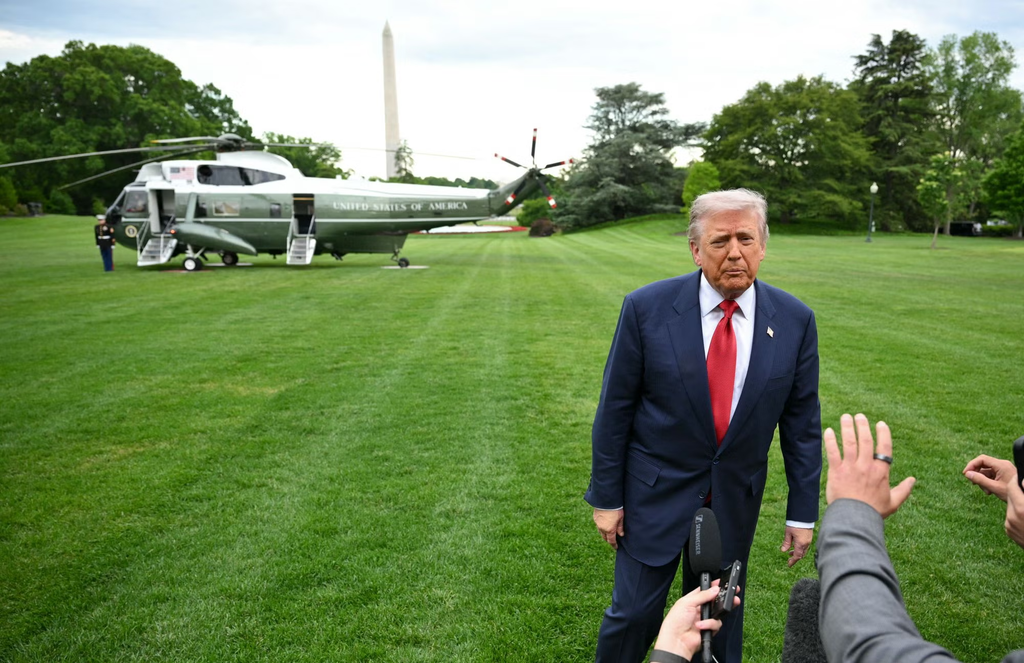
President Donald Trump stepped out onto the South Lawn of the White House to show off his brand-new, multi-million-dollar granite helicopter landing pad. It was supposed to be a grand celebration of presidential infrastructure. Instead, major television networks made a decision that shocked Washington: they turned their cameras away and refused to broadcast the ceremony.
The sudden TV blackout came after a massive argument over freedom of the press. Just days before the helipad ribbon-cutting, the White House banned journalists from CNN, MS NOW, and Politico from entering the grounds. In response, every major television news network decided to stand together in solidarity. They refused to provide shared video footage of the event, leaving viewers with dark feeds and no official pool video of the president speaking.
This showdown on the White House lawn has created one of the biggest media battles in recent political history. On one side is a president who wants to remodel historic grounds and control how news gets reported. On the other side are competing news organizations uniting to protect constitutional rights.
What Happened on the White House South Lawn?
Workers finished putting the final touches on a massive circular landing zone right in the middle of the White House South Lawn. President Trump walked out to celebrate the opening of the new helipad before boarding Marine One to travel to New York for the United Nations General Assembly.
The president spoke to the crowd and walked around the newly paved area. However, anybody watching live feeds provided by the traditional television news pool could not hear what he was saying. Because network cameras were turned off in protest, the available video feed showed President Trump moving his lips while standing next to a loud helicopter engine, with no official audio recorded by pool reporters.
The $0 Secret To Launching Your Entire Online Empire
Why pay hundreds every month for separate software? Build funnels, send emails, and make sales with Systeme.io completely free.
Get Started For $0Free Forever • No Credit Card Needed • Beginner-Friendly
After taking off from the new landing pad, President Trump posted on Truth Social. He wrote that he was leaving the White House Lawn on the maiden voyage from the newly built heliport. He also thanked defense contractor Lockheed Martin for their involvement in the project. Later in the day, after meeting with New York City Mayor Zohran Mamdani, President Trump tried to brush off the news blackout, saying it was interesting that the networks chose to boycott him.
The lack of broadcast footage meant that major news outlets like Axios and the Associated Press had to rely on written pool notes and radio reports to describe what took place during the event.
Why Did the Major TV Networks Boycott the Event?
To understand why the television cameras were turned off, you have to look at what happened over the weekend. President Trump announced that he was banning reporters from CNN, MS NOW, and Politico from covering White House events. He claimed these outlets were producing fake news that damaged the country. By Saturday morning, security officers at the White House gates denied entry to journalists and crew members from those three organizations.
This decision caused an immediate crisis for the White House press pool. The press pool is a cooperative system where news outlets take turns covering events and sharing their footage with everyone else. On Monday, it was CNN’s turn to act as the primary TV pool broadcaster for the day. That meant CNN was supposed to operate the main camera and share the live feed with ABC, CBS, NBC, and Fox News.
Because the White House blocked CNN from entering the grounds, CNN could not fulfill its assignment. Rather than letting another network take CNN’s place, the four other major networks took an extraordinary step. They decided that if one network was unfairly banned, none of them would broadcast the pooled coverage of the president.
Bryan Boughton, the Washington bureau chief for Fox News who also serves as the chairman of the TV pool, sent an email to all pool members announcing the decision. He explained that effective immediately, the TV pool would not cover pool-designated events for the president while CNN was prevented from doing its job.
Shortly after, all five news networks issued a joint statement. They declared that the public has a fundamental right to receive independent, accurate information about government leaders. They added that no presidential administration should ever block a news organization simply because it dislikes the reporting coming from that outlet. Reports from The Guardian confirmed that this boycott marked one of the most unified press protests seen in Washington in decades.
How the White House Press Pool Works in Plain English
Many people wonder why a press pool exists in the first place. The White House is a secure building with limited physical space. In tight locations like the Oval Office, the Roosevelt Room, or inside Air Force One, there is simply not enough room for hundreds of journalists from around the world to squeeze inside with heavy camera equipment.
To solve this space problem, news outlets created the press pool system decades ago. A small group of about twenty journalists—including camera operators, sound engineers, print reporters, and still photographers—is chosen each day to represent the entire media corps. They travel closely with the president, record everything that happens, and immediately share their notes, audio, photos, and video with every other news station in the country.
When the TV pool decides to turn off its shared cameras, it creates a huge blackout in independent news recording. Without the TV pool, news shows cannot show live, high-quality video of the president moving around or speaking at official events. While government-operated cameras or private spectators might still take clips, the public loses access to unbiased, professional media coverage.
This system relies on fairness and equal access. If a president can choose which reporters are allowed into the pool and which ones are kicked out, the independence of the entire media system breaks down. That is why networks that are normally fierce rivals—like Fox News and CNN—decided to set aside their competition and stand together against the ban.
The First Amendment Lawsuit and the Legal Battle
The conflict did not stay on the White House lawn for long. CNN, MS NOW, and Politico filed a joint federal lawsuit against the Trump administration. The lawsuit asks a federal judge to step in immediately and restore the news organizations’ press passes so their journalists can return to work.
The legal team representing the media companies argues that banning specific news outlets violates the First Amendment of the United States Constitution, which protects freedom of speech and freedom of the press. They also argue that it violates Fifth Amendment rights to due process, because the White House revoked credentials without giving the outlets a fair hearing or process to defend themselves.
In response to the legal challenge, President Trump defended his actions online. He insisted that his administration is not launching an assault on the free press. Instead, he claimed he is protecting national security and stopping inaccurate reporting. White House spokespersons also released statements saying that news outlets spreading false stories do not have an automatic right to sit inside the Oval Office.
Legal experts point out that past court cases have generally protected journalists’ rights to White House press credentials. In previous administration disputes, federal courts ruled that the government cannot strip away a reporter’s pass simply because officials dislike the news coverage. Courts are expected to hear arguments on this lawsuit very soon to decide whether the White House must allow the banned reporters back onto the grounds.
Send, Spend & Hold Money Worldwide Without Hidden Fees
Transfer money internationally at the real exchange rate and hold 40+ currencies in one account.
Open a Wise AccountMid-market rate • Fast transfers • 40+ currencies
Grass, Granite, and Grand Renovations: Inside Trump’s $6 Million Helipad
While the media argument dominated headlines, the new helipad itself is a major project that has changed the look of the White House South Lawn. For decades, presidential helicopters landed directly on the green grass of the lawn. However, the White House recently started using newer, larger presidential helicopters known as the VH-92A Patriot.
These modern helicopters are bigger and much more powerful than the older models used since the Vietnam War era. During test flights earlier in the year, hot exhaust fumes from the powerful engines scorched and destroyed large patches of lawn grass. To fix this problem, President Trump decided to build a permanent, heavy-duty landing pad right on the grounds.
Construction began in June and quickly turned the historic South Lawn into a busy building site. The landing pad spans roughly 100 feet across and is made from heavy granite slabs. President Trump boasted that the granite used for construction has a million-year lifespan and will stand the test of time for future presidents. Workers also carved the official Seal of the President of the United States directly into the landing pad area.
Estimating the exact cost of the project has been tricky. President Trump stated that the project cost between $5 million and $6 million, and that defense contractor Lockheed Martin—the parent company of helicopter manufacturer Sikorsky Aircraft—agreed to cover the expenses. However, extensive ground-leveling work, extra security features, and late adjustments to the design have made calculating the final price tag complicated.
Interestingly, construction teams were seen making last-minute changes just days before the official opening. Workers briefly installed large letters spelling out the presidential seal around the landing pad, only to disassemble and remove them shortly after. White House officials described these changes as routine adjustments to match the operational needs of the grounds.
A Pattern of Changing Historic Grounds
The new granite helipad is just one part of a broader series of physical changes made to the White House complex. Donald Trump has always taken a personal, hands-on interest in construction and design projects. People who have worked with him note that he often gets involved in minor details like stone selection, walkway layouts, and landscaping choices.
Over the past several months, multiple projects have altered historic areas around the executive mansion:
- Workers removed original Tennessee flagstones along the West Wing colonnade and replaced them with dark black granite.
- The traditional walkway leading from the diplomatic entrance was remodeled using white granite.
- Sections of the asphalt driveway around the South Lawn were repaved and restructured.
- A temporary fighting arena and cage were built on the South Lawn to host a special UFC event.
President Trump rushed workers to finish the helipad project in time for an upcoming state visit by Chinese President Xi Jinping. White House officials noted that the president wanted the historic grounds to look spotless and impressive for visiting foreign dignitaries. Yet, despite all the effort put into building a world-class landing pad, Marine One remains the only aircraft allowed to land on the White House lawn.
Media Outlets Fight Back Across Print, Digital, and Broadcast Platforms
The TV network blackout was not the only way news organizations showed their frustration with White House restrictions. Major newspaper outlets and digital publishers also joined in to show support for their banned colleagues.
The Washington Post announced that it would withhold its official photographs of presidential events, refusing to publish them until after midnight Eastern Time as a sign of solidarity with banned outlets. Other print reporters and wire services continued sending written reports, but overall coverage was noticeably scaled back compared to typical presidential events.
The $0 Secret To Launching Your Entire Online Empire
Why pay hundreds every month for separate software? Build funnels, send emails, and make sales with Systeme.io completely free.
Get Started For $0Free Forever • No Credit Card Needed • Beginner-Friendly
This boycott highlights how digital media and news production are shifting. In an age where digital publishing and content creation rely heavily on continuous video feeds, cutting off live TV pool footage creates massive disruptions across the entire media ecosystem. Modern digital platforms depend on clear, high-definition video streams to inform the public in real time. Creators interested in exploring digital production trends can explore our insights on YouTube automation to see how video delivery systems operate behind the scenes.
Furthermore, rapid developments in technology and AI mean that audiences consume news across dozens of new channels every day. However, even with advanced media tools, basic access to primary sources remains essential. Without reporters on the ground to record real audio and video, automated media systems and traditional broadcasts alike are left without reliable information.
To learn more about how independent reporting works and read about our mission to bring you real news, check out our about page. If you have questions, feedback, or want to submit news tips, you can always reach out through our contact page.
What Happens Next in Washington?
The battle between the White House and the press corps is far from over. In the coming days, several major events will test how both sides manage media coverage moving forward.
First, President Trump is attending the United Nations General Assembly in New York. While the White House press pool will not be providing its usual camera setup for that event, the United Nations operates its own internal broadcast system, which will provide public video feeds of speeches and meetings.
Second, the arrival of Chinese President Xi Jinping will bring international attention to the White House. It remains unclear whether the White House will attempt to resolve the media dispute before hosting foreign leaders, or if the network blackout will continue during high-profile diplomatic ceremonies.
Finally, all eyes are on the federal court system. Rulings on the First Amendment lawsuit filed by CNN, MS NOW, and Politico could come at any moment. A temporary restraining order from a judge could force the White House to restore reporter access immediately, while a ruling in favor of the administration could permanently alter how presidential media pools operate in the future.
Frequently Asked Questions (FAQs)
What is the White House press pool?
The White House press pool is a small group of journalists, camera operators, and photographers selected to cover presidential events where space is limited. They share their news notes, photos, and video feeds with all major media outlets so the public stays informed.
Why did President Trump build a new helipad?
The new helipad was built because the White House began using newer, heavier VH-92A Patriot helicopters. Powerful hot exhaust fumes from these modern helicopters were burning and scorching the grass on the South Lawn during routine landings.
How much did the new helipad cost and who paid for it?
President Trump estimated the project cost between $5 million and $6 million. He stated that defense contractor Lockheed Martin, which owns helicopter manufacturer Sikorsky Aircraft, agreed to cover the expenses.
Why did television networks turn off their cameras during the ceremony?
The networks stopped coverage because the White House banned CNN, MS NOW, and Politico from entering the grounds. Monday was CNN’s scheduled turn to operate the shared TV pool camera. Since CNN was blocked, ABC, CBS, NBC, and Fox News refused to cover the event in solidarity.
Did the White House ban apply to all news outlets?
No, the ban specifically targeted CNN, MS NOW, and Politico. Other reporters, print journalists, and radio hosts were still allowed on the grounds, but many major outlets adjusted their reporting to support the banned organizations.
Is there a legal case against the White House ban?
Yes, CNN, MS NOW, and Politico filed a joint lawsuit in federal court. They argue that revoking press credentials based on news reporting violates First Amendment rights to a free press and Fifth Amendment rights to due process.
The opening of the new White House helipad was meant to showcase a sleek upgrade to the historic South Lawn. Instead, it exposed a deep rift between the presidential administration and the journalists who cover it every day. As both sides prepare for a showdown in federal court, the fundamental question remains: how much access should the public have to the inner workings of the presidency?
When news organizations stand together to protect media access, it shows how important independent reporting is to a functioning democracy. As the legal battle unfolds, readers and viewers will be watching closely to see if cameras return to the White House lawn or if this media blackout becomes the new normal in Washington.
Stay connected with the latest news, updates, and discussions by following us on Instagram, joining our community on Facebook, and getting real-time updates on X.
