
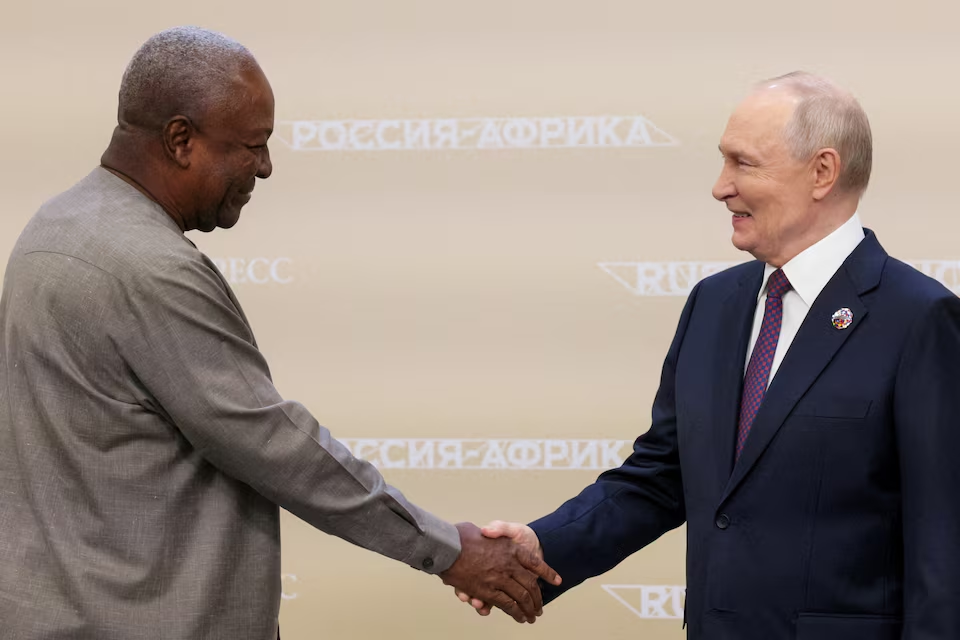
Russia’s largest aluminium maker, Rusal, has officially signed a landmark partnership with Ghana to unlock one of the biggest untapped mineral treasures in West Africa.
The agreement, struck between the Russian metals giant and the state-owned Ghana Integrated Aluminium Development Corporation (GIADEC), hands Rusal majority control over two massive joint ventures. Together, they plan to dig up millions of tons of raw bauxite every single year and construct a modern alumina refinery directly inside Ghana.
Announced during high-level meetings at the Russia-Africa summit in Moscow, this move signals a dramatic shift in how West Africa manages its natural resources. It also highlights how global powers are rushing to secure the building blocks of everyday modern life, from soda cans and smartphones to high-speed trains and electric vehicles.
Here is the full breakdown of what this partnership means, why Ghana switched partners at the eleventh hour, and how the entire project could reshape the economic landscape of the region.
The Massive Deal at a Glance
The agreement centers on the Nyinahin bauxite deposit, nestled inside Ghana’s Ashanti Region. For decades, experts knew that Nyinahin held immense wealth beneath the ground, but turning that underground rock into hard cash proved difficult.
The $0 Secret To Launching Your Entire Online Empire
Why pay hundreds every month for separate software? Build funnels, send emails, and make sales with Systeme.io completely free.
Get Started For $0Free Forever • No Credit Card Needed • Beginner-Friendly
Under the new arrangement announced by Rusal, the project breaks down into two core industrial engines:
First, a joint mining operation will be built to dig out up to five million tonnes of bauxite every year.
Second, the partnership will build an alumina refinery with the capacity to process 1.2 million tonnes of alumina annually on Ghanaian soil.
Rusal will hold majority ownership in both joint ventures, while GIADEC will hold the remaining stake on behalf of the government and people of Ghana. While the exact total financial figure and final construction timelines have not yet been made public, industry insiders know that an alumina refinery of this scale easily costs billions of dollars to construct and run.
Reports confirmed by CNBC Africa note that the Nyinahin area earmarked for Rusal contains more than 100 million tonnes of proven bauxite deposits. That volume guarantees decades of non-stop industrial activity.
What Exactly Is Bauxite and Why Does It Matter So Much?
To understand why a Russian industrial heavyweight flew halfway across the world to sign this agreement, you have to understand the metal chain.
Bauxite is a reddish-brown, clay-like rock. It is the primary raw ore used across the entire planet to make aluminium. You cannot simply dig up bauxite and start building an airplane wing. The process requires three distinct stages:
- Mining the Bauxite: Digging the raw red rock out of the earth.
- Refining into Alumina: Crushing the bauxite, heating it with chemicals, and turning it into a fine, snow-white powder called alumina (aluminium oxide).
- Smelting into Aluminium: Melting that white alumina powder using massive electric currents to produce pure, shiny aluminium metal.
For generations, many developing nations suffered from a common economic trap. Foreign firms would dig up raw bauxite for cheap, pack it onto cargo ships, and take it abroad. Foreign factories would refine it, smelt it, make finished products, and sell those expensive goods right back to Africa.
By insisting on an alumina refinery in this deal, Ghana wants to end that cycle. Refining bauxite into alumina inside the country instantly multiplies the value of every single tonne pulled from the soil. As countries rethink their industrial plans—much like how this firm recovers over 99 percent of critical metals—local processing is becoming the gold standard for resource security.
Why Ghana Walked Away from a Previous 1.2 Billion Dollar Deal
This new partnership did not happen out of nowhere. It actually came on the heels of a sudden, bold policy change by Ghana’s mining authorities.
Last year, the Ghanaian government cancelled a 1.2 billion dollar lease agreement with a local mining firm called Rocksure International. Rocksure had originally been selected as the lead strategic partner to exploit the Nyinahin hills.
So why did Ghana pull the plug on a homegrown business?
The answer comes down to sheer financial muscle and technical scale. Digging dirt out of a hill is relatively straightforward, but constructing an alumina refinery is one of the most capital-heavy and technically complex engineering tasks on earth. It requires massive water systems, reliable energy grids, specialized chemical handling, and access to international sales channels.
GIADEC realized that while local empowerment is vital, building an entire integrated aluminium industry from scratch required a partner with deep pockets, proven global experience, and immediate access to global trade.
As reported by Mining.com.au, Ghana made the strategic choice to cancel the local lease and look outward for an established international producer that already knew how to build and operate giant alumina plants. Rusal checked every single one of those operational boxes.
Send, Spend & Hold Money Worldwide Without Hidden Fees
Transfer money internationally at the real exchange rate and hold 40+ currencies in one account.
Open a Wise AccountMid-market rate • Fast transfers • 40+ currencies
This strategy mirrors broader shifts happening across the continent, where governments balance domestic ambitions with foreign capital, similar to how Nigeria plans to build a 1 trillion dollar economy by partnering with foreign investors.
Why Russia and Rusal Needed This Win Badly
While Ghana wanted heavy capital and industrial know-how, Rusal had urgent motivations of its own.
Rusal is the biggest aluminium company in the world outside of China. It runs massive smelters across Siberia that churn out millions of tonnes of metal for global manufacturing. But those smelters run on alumina. If you run out of alumina, your smelters go cold, and you lose billions.
Back in 2022, global supply chains shattered. War, geopolitical rifts, and trade restrictions cut off Rusal from roughly 40 percent of its traditional alumina supply lines, notably from Australia and facilities in Ukraine.
To survive and keep its smelters humming, Rusal had to find secure, long-term supplies of raw materials that could not be shut down by Western trade actions.
Africa became the obvious answer.
Rusal already manages extensive bauxite mines and an alumina refinery in neighboring Guinea. Expanding into Ghana gives Rusal a secondary West African anchor. In 2025 alone, Rusal produced nearly 6.9 million tonnes of alumina globally, covering about 85 percent of its internal requirements. Securing Nyinahin’s 100 million-tonne deposit helps close the remaining gap and guarantees stability for decades ahead.
At the same time, this deal fits neatly into Moscow’s broader foreign policy goal of strengthening commercial ties with non-aligned nations across the Global South. As traditional Western banking and trade channels face friction—a trend also visible in why Ghana International Bank looked toward non-Western vaults—African capitals are open to working with any reliable partner ready to deploy real capital on the ground.
The Vision for Jobs, Rail, and Deepwater Ports
For people living in Ghana, especially around the Ashanti Region, the primary question is straightforward: what does this deal actually do for regular citizens?
GIADEC Chief Executive Officer Reindorf Twumasi Ankrah emphasized that the partnership aligns directly with Ghana’s national master plan. The ultimate goal is not just to sell rocks, but to build an interconnected industrial web that touches several sectors:
The $0 Secret To Launching Your Entire Online Empire
Why pay hundreds every month for separate software? Build funnels, send emails, and make sales with Systeme.io completely free.
Get Started For $0Free Forever • No Credit Card Needed • Beginner-Friendly
Thousands of Direct and Indirect Jobs
A mine that produces five million tonnes of ore alongside a 1.2-million-tonne refinery requires thousands of workers. It demands heavy machinery operators, chemical technicians, electrical engineers, environmental monitors, safety supervisors, caterers, truck drivers, and administrative staff. GIADEC expects the venture to spark an employment boom across nearby towns.
Upgrading the Railway Network
Moving five million tonnes of heavy rock each year by highway trucks would completely destroy local asphalt roads within months. Because of this reality, the Nyinahin project depends on modern rail infrastructure. The venture will inject new momentum into developing the Western Railway line, linking interior mining sites straight down to the coast.
Expanding Port Facilities
Once bauxite is refined into alumina, that cargo needs deepwater sea docks capable of handling massive bulk cargo ships. The ports of Takoradi and Tema will see expanded cargo handling, modern storage warehouses, and faster port operations, providing long-term economic dividends long after the construction dust settles.
Environmental Concerns and Community Voices
Big mining projects always spark big debates, and the Nyinahin hills are no exception.
The bauxite deposits in the Ashanti Region sit near sensitive forest reserves and vital watersheds that feed rivers supplying drinking water to millions of people. For years, local environmental organizations, non-governmental groups, and community chiefs have expressed worry about open-pit mining in these pristine hills.
Bauxite mining is surface mining. You have to remove topsoil and vegetation to reach the red rock beneath. Critics point out that without strict environmental controls, runoff from the mines can silt up clean rivers, destroy cocoa farms, and harm rare wildlife habitats.
Furthermore, refining bauxite into alumina produces an industrial byproduct known as “red mud” (bauxite residue). Managing red mud requires specialized containment ponds and rigorous engineering to ensure alkaline materials never leak into groundwater.
Ghanaian authorities maintain that this project will use modern, eco-responsible mining methods. GIADEC has repeatedly stated that land restoration will happen concurrently with excavation, meaning that mined-out sections will be replanted with native trees and commercial timber crops as work progresses.
Still, local communities will be watching closely to ensure that the promises of clean water, school construction, road paving, and local hiring are written into enforceable community development agreements rather than left as vague press releases.
What This Means for West Africa’s Geopolitical Future
This transaction offers a clear snapshot of how geopolitical realities are changing across West Africa.
For decades, European and North American companies held a near-monopoly on major natural resource deals in the region. Today, governments from Accra to Abuja are deliberately diversifying their international partners. Whether negotiating with Beijing, Moscow, New Delhi, or Washington, African leaders are demanding tangible value addition inside their borders rather than simple extraction leases.
Even as regional organizations navigate internal strain—such as the recent political disruptions across the ECOWAS community—individual states are moving forward with aggressive resource development strategies.
Ghana’s arrangement with Rusal proves that international capital is still eager to invest in African industry, provided the reserves are proven and the host nation offers a stable operating framework. If the Nyinahin joint ventures deliver on their promises, Ghana could easily emerge as the preeminent aluminium hub of the Gulf of Guinea.
Frequently Asked Questions
What did Rusal and Ghana agree to?
Russian aluminium giant Rusal signed an agreement with Ghana’s state-owned GIADEC to create two joint ventures. Rusal will hold majority ownership. The projects aim to mine up to 5 million tonnes of bauxite per year at the Nyinahin deposit and construct an alumina refinery inside Ghana capable of producing 1.2 million tonnes of alumina annually.
Where is the Nyinahin bauxite deposit located?
The Nyinahin deposit is located in the Ashanti Region in southwestern Ghana. It is one of the richest unexploited mineral reserves in West Africa, containing an estimated volume of over 100 million tonnes of high-grade bauxite ore.
Why is building an alumina refinery in Ghana such a big deal?
Most bauxite-rich developing countries simply export the raw, unrefined rock at low prices. Refining bauxite into alumina within Ghana creates far more economic value, creates thousands of specialized industrial jobs, and helps Ghana realize its dream of an integrated domestic aluminium industry.
Why did Ghana cancel its earlier deal with Rocksure International?
Ghana previously signed a 1.2 billion dollar lease agreement with local firm Rocksure International. However, building and operating a world-class alumina refinery requires massive capital, deep global supply connections, and specialized technical expertise. Ghana decided to seek an established global operator, opening the door for Rusal.
Is Rusal permitted to operate under international sanctions?
Unlike several other Russian state-linked enterprises, Rusal as an operating company was not directly placed under Western sanctions related to the conflict in Ukraine, largely because the world market depends heavily on its aluminium output to prevent global industrial shortages.
How will this project affect local Ghanaian communities?
The project is expected to create thousands of jobs, improve local road and rail infrastructure, and boost port activity. At the same time, local civil society groups are urging strict environmental standards to protect local river systems, cocoa farms, and nearby forest reserves.
The Road Ahead
The joint venture between Rusal and GIADEC marks a bold new chapter for Ghana’s industrial ambitions. Moving from simply digging up raw earth to refining alumina domestically represents the kind of value addition African economies have pursued for decades.
Success will ultimately depend on transparent execution, respecting environmental boundaries, and ensuring that local communities directly enjoy the jobs, roads, and prosperity this massive deposit can deliver.
