
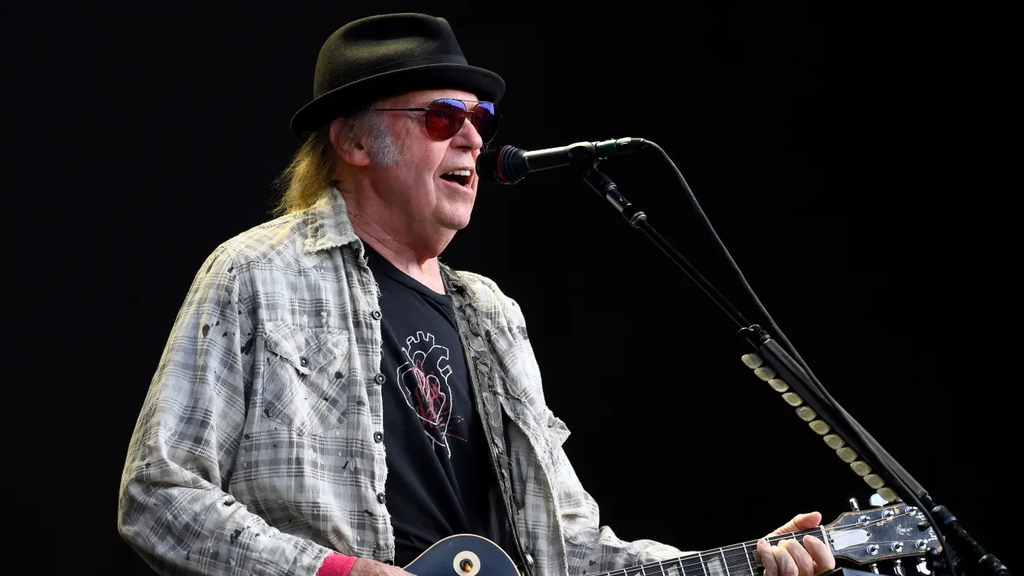
Neil Young has officially had enough. The legendary folk-rock icon has filed a massive $10 million copyright infringement lawsuit against Donald Trump’s primary fundraising committee, Trump 47 Committee, Inc., after the group blasted his 1989 hit song “Rockin’ in the Free World” at a high-profile political rally in Youngstown, Ohio.
The legal action landed in the United States District Court for the Eastern District of Virginia. The five-page complaint accuses the political committee of playing the track without a valid license, directly violating federal copyright laws and breaking the terms of a prior legal dispute that was supposed to settle this argument years ago.
This is not a casual disagreement over political tastes. It is a full-scale legal battle over ownership, artist rights, and the unauthorized use of creative work to fuel political campaigns.
The Ohio Rally That Sparked the $10 Million Fight
The breaking point happened on the evening of October 12. Thousands of supporters gathered inside an arena in Youngstown, Ohio, waiting for Donald Trump to walk out on stage. Trump has been traveling across the country as part of an aggressive push leading up to critical elections, often promising a full campaign blitz for midterms.
As the crowd cheered in anticipation, the opening guitar chords of “Rockin’ in the Free World” thundered through the stadium loudspeakers. The song played loudly to energize the room just moments before the former president took the podium.
The $0 Secret To Launching Your Entire Online Empire
Why pay hundreds every month for separate software? Build funnels, send emails, and make sales with Systeme.io completely free.
Get Started For $0Free Forever • No Credit Card Needed • Beginner-Friendly
The moment the audio made rounds across social media and television feeds, Neil Young and his legal team took immediate action.
Young did not just release an angry statement or tweet his frustration. He sent his attorneys straight to court.
According to the federal filing, the Trump 47 Committee had no legal right, contract, or license to use the recording or the underlying musical composition. Young’s team argues that playing the song was a willful act of copyright infringement carried out by seasoned political operatives who knew very well that the musician had barred them from ever touching his catalog.
What the Lawsuit Actually Alleges
The lawsuit filed in Virginia federal court targets Trump 47 Committee, Inc., a registered political fundraising entity. While Donald Trump is not personally named as a sole defendant in the paperwork, his central fundraising machine bears the brunt of the legal claim.
In the complaint, Young’s legal counsel outlines three primary claims:
- Direct Copyright Infringement: The committee publicly performed a protected musical work without obtaining a public performance license from the copyright owner or an authorized licensing agency.
- Willful Disregard of Intellectual Property: The committee and its organizers knew that Young objected to the use of his music, making the unauthorized broadcast intentional rather than accidental.
- Severe Brand and Reputational Damage: The public performance creates a false impression that Neil Young endorses Donald Trump, damaging the musician’s hard-earned public image, personal credibility, and commercial value.
Young is demanding $10 million in statutory and actual damages, alongside an immediate federal injunction that permanently bars Trump-affiliated committees from ever playing his music at future rallies or events.
As reported by Music Business Worldwide, the legal team made sure to point out that this is not an innocent mistake by junior campaign volunteers. It is an intentional repeat violation by an operation that has repeatedly pushed boundaries with copyright holders.
Why Neil Young Says the Song Is the Opposite of Trump
Many politicians love using rock anthems because the choruses sound loud, patriotic, and triumphant. But if anyone listens to the verses of “Rockin’ in the Free World,” they quickly realize it is not a cheerleading song for American politics.
Neil Young wrote the track in 1989 during the presidency of George H.W. Bush. The song is a sharp, biting critique of social neglect, economic inequality, homelessness, and political hypocrisy.
In the new lawsuit, Young broke down the meaning of his own song to explain why hearing it at a Trump rally is so deeply offensive to him:
“‘Rockin’ in the Free World’ is a blistering anthem that contrasts the hollow promises of American political rhetoric with the harsh realities faced by the poor, homeless and forgotten,” the complaint states. “The lyrics paint vivid street-level portraits—a mother discarding her baby, addicts lost in despair, garbage piling in the shadows of prosperity—while the repeated chorus delivers a savage irony, celebrating freedom that clearly isn’t shared by all.”
The legal document pulls no punches, adding a blunt conclusion:
“In short, the song is the opposite of everything that Donald J. Trump stands for.”
Young feels that blasting his song as a victory march completely strips it of its intended social message. More importantly, it tricks ordinary listeners into thinking that the Canadian-American songwriter supports policies he has spent decades speaking out against.
A Decade-Long Music Feud: How We Got Here
To understand why Neil Young is demanding $10 million today, you have to rewind the clock to June 2015.
Send, Spend & Hold Money Worldwide Without Hidden Fees
Transfer money internationally at the real exchange rate and hold 40+ currencies in one account.
Open a Wise AccountMid-market rate • Fast transfers • 40+ currencies
When Donald Trump first announced his run for president by riding down the golden escalator at Trump Tower in New York City, “Rockin’ in the Free World” was the exact song playing in the background.
Young reacted almost immediately. He issued a public statement clarifying that he never gave permission for his work to be used. He pointed out that he supported Bernie Sanders and did not align with Trump’s political platform.
Yet the song kept showing up at rallies in 2016, 2018, and 2020.
Young wrote open letters pleading with the campaign to stop. In 2018, after the song was played at a rally in Montana, Young published a message on his website expressing frustration that his polite requests were ignored. He accused Trump of deliberately disregarding the rights of artists and the voices of everyday citizens.
When the Trump campaign played the anthem again in the summer of 2020 during events at Mount Rushmore and in Tulsa, Oklahoma, Young took off the gloves.
The 2020 Settlement That Was Supposed to Fix This
In August 2020, Young filed his first federal copyright lawsuit against Donald J. Trump for President, Inc. in the Southern District of New York. In that lawsuit, Young argued that he could not allow his music to be used as a theme song for a divisive political campaign.
A few months later, in December 2020, the case suddenly ended. Young agreed to dismiss the lawsuit with prejudice.
Why did he dismiss it? According to coverage from Rolling Stone, the two sides reached an out-of-court agreement. As part of that confidential settlement, representatives for the Trump campaign promised that they would never use Neil Young’s catalog again without express written consent.
For nearly six years, that agreement held. The Trump team avoided playing the song.
Then came October 12 in Youngstown.
The $0 Secret To Launching Your Entire Online Empire
Why pay hundreds every month for separate software? Build funnels, send emails, and make sales with Systeme.io completely free.
Get Started For $0Free Forever • No Credit Card Needed • Beginner-Friendly
Young’s legal team argues that by bringing the song back into rotation for a 2026 rally, the political operation violated the trust and terms established during their earlier legal battle. Because the campaign was already on clear, written notice about Young’s objections, this new violation cannot be dismissed as an honest misunderstanding.
How Political Campaign Music Licensing Actually Works
You might wonder how political rallies can play popular music in the first place. Why do campaigns often play hit tracks even when the artists hate it?
Here is how music licensing works in plain English:
1. Blanket Venue Licenses
Most arenas, stadiums, and convention centers pay annual fees to Performance Rights Organizations (PROs) like ASCAP and BMI. These agreements are called blanket licenses. They allow the venue to play millions of songs during sporting events, trade shows, and public gatherings.
In the past, political campaigns argued that if the venue had a blanket license, the campaign could play whatever was in that catalog.
2. Specialized Political Campaign Licenses
To prevent campaigns from hiding behind general venue permits, ASCAP and BMI created separate political campaign licenses. These licenses require political committees to register directly and pay fees for the music they play at their own rallies.
3. The Artist Exclusion Clause
Crucially, these political campaign licenses contain a specific opt-out provision. If a songwriter writes to the licensing organization and objects to a specific political candidate or party using their music, the PRO can remove that artist’s catalog from the campaign’s license.
Once a song is excluded, playing it at a campaign stop is no longer covered. The performance becomes unlicensed, exposing the organizers to direct copyright infringement lawsuits.
Neil Young had already exercised this right years ago. By pulling his songs from political performance packages and putting the Trump team on direct legal notice, any public playback became an immediate violation of federal law.
Other Major Artists Who Clashed with Trump over Music
Neil Young is far from the only musician who has fought back against political campaigns using their work without permission. Over the years, dozens of top artists and estates have issued cease-and-desist letters, filed complaints, or publicly condemned the use of their songs at political rallies.
- The White Stripes: Jack White threatened immediate legal action after a campaign video featured the famous guitar riff from “Seven Nation Army.”
- Rihanna: The pop star sent a formal cease-and-desist letter after her hit single “Don’t Stop the Music” was played at a rally in Tennessee.
- Foo Fighters: Dave Grohl and his bandmates publicly objected when “My Hero” was used to introduce political figures, promising that any royalties from the unauthorized spin would be donated to opposing causes.
- The Estate of Tom Petty: Following the use of “I Won’t Back Down” at a 2020 event, Petty’s family issued a firm statement declaring that the late singer would never want his work used to support hatred or division.
- The Estate of Sinéad O’Connor: The late Irish singer’s estate demanded that the campaign stop using her iconic ballad “Nothing Compares 2 U,” stating she lived by a moral code that clashed with the campaign’s public rhetoric.
- The Rolling Stones, Aerosmith, and Linkin Park: All issued warnings or took steps through BMI to block their biggest hits from rally playlists.
Clashes between celebrities and political figures are nothing new. From entertainment legends like Sylvester Stallone pushing back on unauthorized political use to rock stars protecting their publishing rights, artists are increasingly willing to use the legal system to protect their identities.
Can Neil Young Actually Win $10 Million?
Demanding $10 million grabs headlines, but how realistic is that payout in a federal courtroom?
Under the United States Copyright Act, an owner can seek either actual damages (the actual money lost plus the profits made by the infringer) or statutory damages.
For ordinary copyright infringement, statutory damages generally range from $750 to $30,000 per infringed work. However, when an infringement is proven to be willful, the law allows judges to award up to $150,000 per infringed work.
So where does the $10 million figure come from?
Young’s legal team is not just looking at minimum statutory penalties. They are arguing that the unauthorized use caused massive reputational harm, diluted the commercial licensing value of the song, and breached prior legal agreements. In high-stakes disputes involving political figures, public brand association can significantly alter an artist’s catalog valuation.
Legal analysts point out that many copyright lawsuits against political campaigns end in private settlements. However, because Neil Young already settled once and saw his agreement broken six years later, his legal team may push harder for a formal court ruling or a permanent federal injunction that carries strict financial penalties if violated again.
With political organizers working under intense pressure during critical midterm election cycles and navigating complex federal voting laws, adding an active $10 million federal lawsuit to the docket creates an unwanted legal headache.
Frequently Asked Questions (FAQs)
Why did Neil Young sue Trump’s committee for $10 million?
Neil Young filed the lawsuit because the Trump 47 Committee played his 1989 song “Rockin’ in the Free World” at an October 12 rally in Youngstown, Ohio, without his permission or a valid music license. Young argues that the unauthorized playback infringed his copyright and harmed his reputation by falsely suggesting he endorses Donald Trump.
Is Donald Trump personally being sued?
No. The lawsuit names Trump 47 Committee, Inc., which is the registered fundraising entity responsible for running and financing the campaign rallies. Donald Trump as an individual is not listed as a defendant in the court paperwork.
Didn’t Neil Young already sue Trump over this song?
Yes. Young previously sued the Trump 2020 campaign committee in federal court over the use of “Rockin’ in the Free World” and another song. That lawsuit was dismissed with prejudice in December 2020 after an out-of-court settlement where campaign representatives agreed not to play his music again. The new 2026 lawsuit accuses the committee of breaking that agreement.
Can political campaigns legally play any music they want at rallies?
No. While arenas often have broad blanket licenses, both ASCAP and BMI provide political campaign licenses that allow artists to formally exclude their songs from political rallies. Once an artist opts out, a campaign cannot legally perform the music without direct permission from the copyright holder.
What is the true meaning behind “Rockin’ in the Free World”?
Although often mistaken for a simple patriotic party track due to its upbeat chorus, the song is a direct critique of American social inequality, poverty, drug addiction, and government neglect written during the late 1980s.
Protecting the Music
At its heart, this battle is about creative control. For musicians like Neil Young, songs are not just catchy background sounds to warm up a crowd. They represent decades of personal beliefs, artistic integrity, and political expression.
When a political committee takes an artist’s signature work and plays it to thousands of cheering voters, it risks rewriting what that music stands for in the minds of the public. By drawing a hard line in a Virginia courtroom, Neil Young is sending an unmistakable message to every campaign across the country: if you want to use an artist’s voice to build your political brand, you must respect the law and get permission first.
