
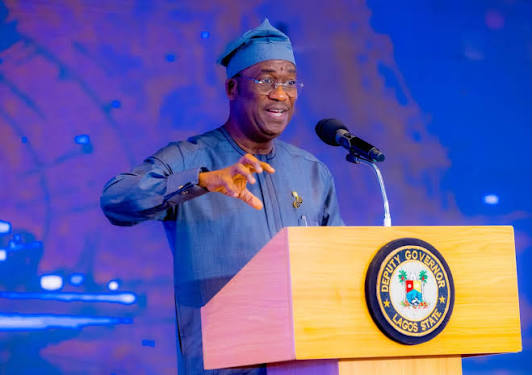
The discussion around giving Lagos State a special status within Nigeria is not new, but it has recently taken on a much stronger economic focus. The Deputy Governor of Lagos State, Dr. Obafemi Hamzat, made it clear that granting Lagos special status is no longer a political political request or a luxury. Instead, it is an urgent economic necessity that will benefit the entire nation.
At WhatsBuzzn, we keep track of the big conversations that shape our economy, our communities, and our daily lives. When top leaders speak about national development, we look beyond the political headlines to explain what it really means for regular citizens.
Dr. Hamzat pointed out that Lagos is carrying responsibilities that no other city or state in Nigeria carries. From building huge light rail networks entirely on its own balance sheet to managing massive daily population growth, the state is under intense financial pressure. Understanding why this issue matters requires taking a close look at the numbers, the infrastructure gap, and how a stronger Lagos helps every state across Nigeria.
The Core Argument Behind Hamzat’s Statement
When leaders talk about granting Lagos special status, some people assume it means asking for unfair favors. However, as Dr. Hamzat explained in recent interviews, including details highlighted by The Guardian Nigeria, the request is grounded in pure facts and hard economic data.
Lagos generates a massive portion of Nigeria’s non-oil gross domestic product (GDP). It hosts the country’s busiest seaports, the busiest international airport, and the head offices of major banks, telecommunication giants, and manufacturing companies. Hundreds of thousands of people travel into Lagos every single day from neighboring states to trade, work, and conduct business.
Build Funnels, Email Lists & Sell Online With One Free Tool
Create funnels, send emails, and sell online using Systeme.io without paying for multiple tools.
Create Free AccountFree forever • No credit card • Beginner-friendly
Because of this constant commercial activity, the infrastructure in Lagos suffers heavy wear and tear. Roads that are meant to last for years get damaged quickly by thousands of heavy cargo trucks moving goods from the ports to northern, eastern, and southern Nigeria. Lagos bears the cost of repairing these roads, managing the waste, and maintaining public order, even though the whole country profits from the trade.
Dr. Hamzat stressed that treating Lagos like any other state in terms of federal revenue allocation ignores the massive burden the state carries on behalf of the whole country.
The Mind-Blowing Budget Gap: Lagos vs. Other Mega-Cities
To really understand why Lagos needs extra support, it helps to compare its budget with other major economic hubs around the world. Dr. Hamzat shared striking figures that highlight this contrast.
Lagos operates on an annual budget of roughly N4.4 trillion, which equals about $3.2 billion. While that sounds like a huge number in Naira, compare it to New York City, which runs on an annual budget close to $600 billion. In fact, the New York City Police Department alone has a larger budget than the entire state of Lagos!
Yet, Lagos caters to an estimated population of over 22 million people. That is more than the population of several African nations combined. The state must build hospitals, construct roads, dig drainage channels, clear millions of tons of waste, and keep the streets safe on a fraction of what global cities spend.
Despite this limited budget, Lagos remains the only sub-national government in the entire world carrying light rail infrastructure on its own balance sheet without primary funding from its central government. The state built the Blue Line and the Red Line rail projects using state resources and private partnerships. While this is a massive achievement, it absorbs huge amounts of money that could otherwise go toward local healthcare, primary education, and housing.
Why Lagos Is Everyone’s Business
One common misunderstanding is that special status only helps people who were born in Lagos. The reality is quite the opposite. Lagos is a true representation of Nigeria as a whole.
People move to Lagos daily from all 36 states of Nigeria. Some arrive to pursue higher education, others to start small businesses, and many to find entry-level jobs in corporate offices or industrial zones. Lagos does not turn anyone away at its borders. Anyone who steps into the state gets to use the public roads, public transport, health centers, and emergency services.
This continuous influx creates intense pressure on basic public services:
- Healthcare: State hospitals treat millions of non-resident patients every year.
- Sanitation: Tons of waste are generated daily across markets, residential areas, and industrial centers.
- Water and Power: Water distribution systems must constantly expand to reach new neighborhoods.
- Security: Police and local security teams must patrol heavily populated areas to protect lives and properties.
When Lagos receives targeted support, it directly improves the lives of millions of Nigerians from every tribe and background who call the city home.
The Historical Legacy of Being the Former Federal Capital
Until late 1991, Lagos was the official capital of Nigeria. When the capital officially moved to Abuja, the federal government shifted its primary administrative attention to building up the new territory.
However, moving the political capital did not change the physical realities on the ground in Lagos. The federal assets remained, including the national ports, federal highways, national stadiums, and historic public buildings.
In many countries, when a political capital moves, the national government establishes a special funding formula for the former capital city. Cities like Rio de Janeiro in Brazil or Abidjan in Ivory Coast receive sustained national financial backing because their infrastructure continues to drive national revenue.
In Nigeria, Lagos inherited the responsibilities of a national capital without receiving a corresponding long-term financial package. For example, a 20-kilometer radius around major ports like Apapa and Tin Can would ideally be federally maintained with world-class standards. In reality, the Lagos State Government frequently steps in to fix damaged port access roads, direct heavy traffic, and manage environmental pollution caused by thousands of trucks.
Building Modern Infrastructure in a Tough Economic Climate
Building durable roads, bridges, and rail lines requires massive financial investments, especially as inflation drives up the price of materials. Dr. Hamzat noted that there is no low-cost cement, steel, or sand. Construction costs are high everywhere, and state revenues must stretch to cover these rising bills.
Lagos has committed over N1.1 trillion to major infrastructure projects in recent years. Yet, experts estimate that the state still faces an infrastructure gap of over N20 trillion across key sectors like housing, public transport, flood management, and healthcare.
Consider the ongoing challenge of flooding and drainage. Because Lagos is a coastal state with many low-lying areas, keeping the water flowing smoothly away from streets requires building massive drainage channels and continually clearing blocked waterways. When heavy rain falls, those drainage systems protect billions of Naira worth of private homes, shops, and vehicles from destruction.
Maintaining these systems is an ongoing expense. Without federal assistance or a special status allocation, the state must constantly choose between fixing critical bridges or building new schools.
Tech, Innovation, and the Future of Work in Lagos
Lagos is not just a place of heavy physical trade; it is also the undisputed tech engine of Africa. Neighborhoods like Yaba and Lekki are filled with young coders, creative designers, and digital entrepreneurs who are building companies that attract international investment.
The state government is working to position Lagos as a global leader in human capital. From coding schools to innovation hubs, young people are learning high-value skills to work with global companies. To explore how artificial intelligence and smart technologies are transforming local industries, check out our updates on Technology and AI.
In addition to traditional tech startups, thousands of young Nigerians in Lagos are earning independent income through content creation, digital marketing, and remote work. Many are utilizing innovative strategies like YouTube Automation to build profitable online channels, reaching global audiences directly from their apartments in Ikeja or Surulere.
However, for this digital economy to reach its full potential, the city needs reliable infrastructure:
- Uninterrupted Power: Tech hubs and remote workers require stable electricity grids.
- Fast Digital Infrastructure: High-speed fiber optic cables must be laid across the city safely.
- Safe, Well-Lit Streets: Young professionals moving around at night need street lights and effective policing.
- Predictable Mass Transit: Developers and creators should not have to waste four hours every day stuck in standstill traffic.
Granting Lagos special status ensures that public investments keep pace with the needs of young entrepreneurs and tech workers who bring valuable foreign exchange into Nigeria.
Solving the Housing and Security Challenges
Housing is another area where Dr. Hamzat offered realistic, practical thoughts. Right now, the Lagos State Government subsidizes housing projects by roughly 35 percent to make homes more affordable for residents.
However, sustaining this subsidization model is difficult when building materials remain expensive. Most working-class Africans spend up to two decades building a house gradually—one block at a time—which takes money away from their children’s education and healthcare.
Dr. Hamzat argued that the real long-term solution is establishing a large, revolving housing fund and expanding access to affordable mortgages. Instead of spending twenty years building a single house, workers should be able to get a home loan and pay it back conveniently over 15 to 25 years.
On security, safety is the foundation of any thriving market. Businesses cannot flourish if people are afraid to walk at night or open their shops early. Dr. Hamzat reaffirmed that Lagos is ready to spend whatever is necessary to keep the state safe, including deploying modern surveillance technology and supporting community-based state policing. Special status funding would provide dedicated financial backing to install smart CCTV cameras, maintain street lights, and equip response teams across every neighborhood.
Build Funnels, Email Lists & Sell Online With One Free Tool
Create funnels, send emails, and sell online using Systeme.io without paying for multiple tools.
Create Free AccountFree forever • No credit card • Beginner-friendly
What Special Status Would Actually Look Like
When people hear “special status,” they sometimes wonder what it means in practical legislative terms. It does not mean taking away money from other Nigerian states. Instead, it involves structured legal and fiscal mechanisms designed to match Lagos State’s unique responsibilities:
- A Dedicated Revenue Share: Allocating a specific percentage (such as 1 percent) of total federal revenues directly to Lagos to maintain national infrastructure.
- Stabilization Fund Support: Accessing federal funding mechanisms to help bridge the massive N20 trillion infrastructure gap.
- Joint Port Corridor Maintenance: Direct federal co-funding for roads, rail connections, and bridges within a 20-kilometer radius of national ports and border corridors.
- Legislative Backing for State Police: Giving legal and financial recognition to state-level policing architectures to secure high-density commercial zones.
When these mechanisms are put in place, the entire country reaps the rewards. Ports clear goods faster, reducing the prices of imported food and machinery in markets nationwide. Businesses operate with lower costs, creating more jobs for young graduates.
Frequently Asked Questions (FAQs)
What does “special status” for Lagos mean?
Special status means giving Lagos State special financial and legal recognition in Nigeria’s revenue allocation framework. This recognition provides extra federal funding to help the state maintain national infrastructure, such as major ports, highways, and high-capacity public transit systems that serve citizens from all over the country.
Why should Lagos get special funding when other states are also struggling?
Lagos hosts over 22 million people and contributes up to one-third of Nigeria’s total GDP. Millions of citizens from every state move to Lagos to work, trade, and live. Because the state maintains federal roads, port access routes, and public services that benefit the whole national economy, supporting Lagos directly boosts trade and food supply chains for every other state.
Did the agitation for special status stop when President Tinubu took office?
No. As Dr. Hamzat clarified, the advocacy for special status has not slowed down. The state continues to push for national consensus and legislative support because the financial demands of running Africa’s largest commercial hub grow every year.
How would granting special status help regular residents in Lagos?
Extra funding would allow the state to complete major transportation projects faster, reduce traffic congestion, fix inner-city roads, expand clean water access, and build more affordable housing. It would also mean safer streets through better security technology and lighting.
How does Lagos compare to other major cities financially?
Lagos operates on an annual budget of roughly $3.2 billion (N4.4 trillion) to serve over 22 million people. In contrast, global mega-cities like New York run on budgets near $600 billion. This vast gap shows why Lagos needs additional financial support to meet its public service demands.
Dr. Obafemi Hamzat’s point is clear: granting Lagos special status is not about politics or state rivalry. It is about simple economic logic. As the commercial heart of Nigeria, Lagos powers the rest of the nation through trade, taxation, innovation, and job creation. When Lagos has the financial backing to fix its roads, build modern rail lines, secure its neighborhoods, and expand housing, every Nigerian benefits. Supporting Lagos is simply investing in the prosperity of the entire country.
We want to hear your thoughts on this conversation! Do you think the National Assembly should pass a law granting Lagos special status? Connect with us and share your perspective on our social pages on Instagram, Facebook, and X / Twitter. If you have feedback, news tips, or ideas you would like us to cover, feel free to reach out directly through our Contact Page.
