
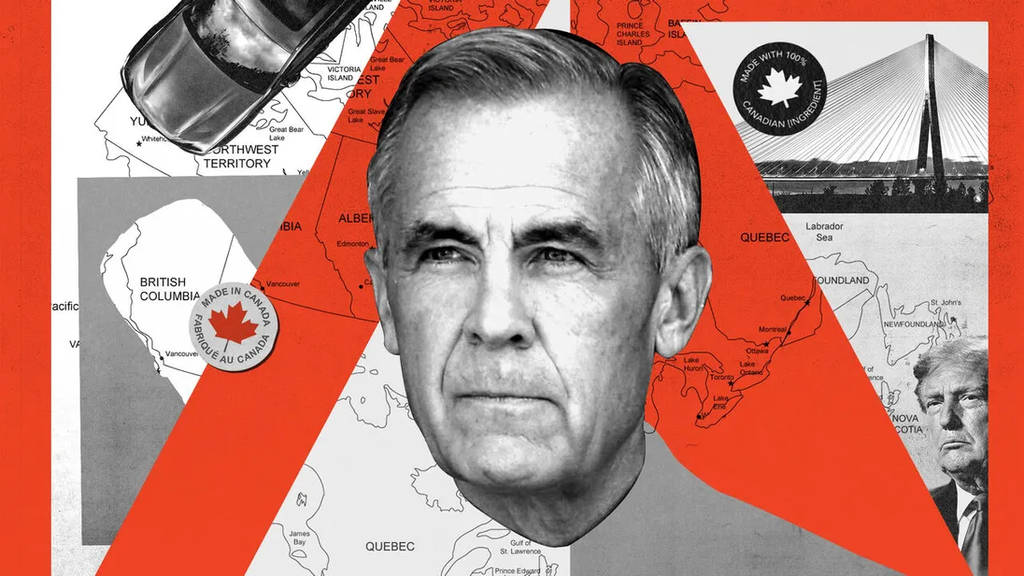
Donald Trump took the stage at an Arizona campaign rally and dropped a bombshell that sent shockwaves from Washington all the way to Ottawa. He declared that Canada treats the United States unfairly on trade, warned about crushing new tariffs, and boldly claimed that Canada will eventually end up as America’s 51st state. The political reaction across Canada was swift and furious. Provincial leaders put up defiant slogans along the border, Ottawa pushed back hard, and citizens on both sides of the 49th parallel started debating what this means for the future of North America.
Yet behind the angry headlines and political theater, an unexpected theory is taking hold among top economic analysts. A widely discussed essay in The Economist made a surprising case: Donald Trump’s aggressive stance might turn out to be the best thing that has happened to Canada in decades.
The core argument is simple. For over half a century, Canada has lived in a warm, comfortable security blanket provided by its giant neighbor to the south. Washington paid for continental defence, American factories bought up Canadian raw materials, and Canadian leaders could afford to coast along without making hard choices. That era of easy comfort is officially over. By turning up the heat, threatening trade penalties, and questioning Canadian sovereignty, Trump has delivered a massive wake-up call that Canadian politicians could never pull off on their own.
Here is an in-depth look at why America’s pressure cooker is breaking decades of Canadian complacency, how Ottawa is responding, and what this high-stakes showdown means for everyday people.
The Great Canadian Nap: Decades of Quiet Complacency
To understand why Trump’s hostility might actually help Canada, you first have to understand the deep rut Canada found itself in.
The $0 Secret To Launching Your Entire Online Empire
Why pay hundreds every month for separate software? Build funnels, send emails, and make sales with Systeme.io completely free.
Get Started For $0Free Forever • No Credit Card Needed • Beginner-Friendly
For generations, Canadian policymakers operated on a very comfortable assumption. They believed the United States would always be an open, friendly buyer of Canadian goods and a reliable protector against any foreign military threat. Because the US border is vast and peaceful, Canada could spend very little on its military. Because American companies bought more than 75% of Canadian exports, Canadian businesses did not need to hunt aggressively for new global markets.
This comfort created what economists describe as the Canadian complacency trap:
- Lagging productivity: Over the last two decades, Canada’s output per worker fell significantly behind American levels. While American companies invested heavily in new software, automation, and industrial research, Canadian businesses largely underinvested in capital equipment and digital tools.
- Falling living standards relative to the US: In the late 1990s, the average Canadian standard of living was roughly on par with affluent American states. Over time, that gap widened. Several Canadian provinces now produce less economic output per person than some of America’s poorer states.
- Internal trade walls that defied logic: In one of the strangest economic quirks in the modern world, it was often easier for a business in Ontario to trade with New York than with Quebec. Differing provincial regulations on trucking, alcohol, professional licenses, and agricultural goods cost the national economy billions of dollars every single year.
- A hollowed-out military: Canada repeatedly failed to meet the NATO defence spending target of 2% of GDP. Basic military hardware aged without replacement, naval vessels sat waiting for overhauls, and Arctic surveillance lagged even as rival superpowers began eyeing northern shipping lanes.
As long as Washington smiled and kept the border frictionless, Canadian leaders had no urgent reason to fix these structural headaches. Difficult economic reforms always upset someone—local interest groups, labor unions, or provincial premiers. Without an immediate emergency, leaders in Ottawa chose the path of least resistance. They kept the status quo intact.
The Trump Shock Therapy
Enter Donald Trump. When Trump revived his hardline rhetoric—threatening universal import tariffs, accusing Canada of taking advantage of American generosity, and joking about absorbing the country—the comfortable assumptions vanished overnight.
Trump’s attacks targeted Canada’s most sensitive economic vulnerabilities. He singled out Canada’s heavily protected dairy industry, where high duties shield local farmers from foreign competition. He warned about shifting automotive supply chains back to the United States. Most critically, he reminded Canadian leaders that access to the American consumer market is a privilege that can be rewritten at any moment.
In diplomatic circles, this kind of pressure feels rude and destabilizing. But inside Canada’s policy engine, it produced something rare and powerful: a shared national urgency.
When someone threatens your livelihood and mocks your independence, polite political bickering takes a back seat. Canadians who spent years arguing over provincial rules and regulatory fine print suddenly found themselves staring at a harsh truth. If Canada does not make itself stronger, more productive, and more resilient, it will remain permanently vulnerable to the political mood swings of whoever sits in the White House.
Mark Carney and the “Hard Power” Awakening
The shift in Canadian posture has been spearheaded by Prime Minister Mark Carney. With a background as the former head of both the Bank of Canada and the Bank of England, Carney brought a technocratic, market-tested mindset into office.
Speaking at international forums like the World Economic Forum in Davos, Carney laid out a blunt vision that broke sharply with Canada’s past approach. For decades, Canada prided itself on being a champion of the “rules-based international order” and practicing a moral, values-based foreign policy. Carney’s message to Canadians and the world was direct: the old order is gone, nostalgia is not a strategy, and a country that cannot feed, fuel, or defend itself has very few real choices.
Ottawa recognized that simply complaining about American bullying would solve nothing. Instead, the Canadian government began using Trump’s threats as political cover to push through tough, necessary domestic changes that had been stalled for decades:
1. Tearing Down Internal Trade Barriers
For years, economists warned that internal trade barriers were shaving up to two full percentage points off Canada’s economic growth. Yet every attempt to fix the problem died in regional squabbles. With the threat of American tariffs hanging overhead, the political calculations changed. Federal and provincial officials moved quickly to harmonize safety rules, standardize qualifications, and eliminate paperwork between provinces. Knocking down these internal walls acted like a massive, zero-cost economic stimulus that boosted local commerce.
2. Upgrading National Defence and Arctic Security
Trump made no secret of his frustration with NATO allies who underfunded their militaries. Instead of dodging the issue, Canada accelerated plans to meet and exceed the 2% spending threshold. Major contracts were rolled out to purchase advanced radar systems, modern fighter jets, and naval patrol vessels capable of operating year-round in the freezing waters of the High North. Protecting the Arctic is no longer viewed as an optional military project; it is treated as a fundamental requirement for defending national borders.
3. Slashing Red Tape on Critical Minerals and Energy
Canada possesses some of the largest reserves of critical minerals in the world, including lithium, nickel, cobalt, and rare earth elements that power batteries and electric grids. In the past, opening a mine or building an export pipeline could take ten to fifteen years of bureaucratic review. Realizing that Western democracies want alternatives to supply chains dominated by authoritarian states, Ottawa began streamlining permitting processes. Canada is actively positioning itself as an essential energy and natural resource superpower for global allies.
4. Overhauling Tax and Investment Rules
To stop Canadian businesses from fleeing south of the border, the government introduced targeted incentives for research, development, and clean technology manufacturing. By trimming corporate tax friction and lowering payroll pressures, Ottawa created stronger reasons for domestic entrepreneurs to stay and build their businesses at home.
Redefining What It Means to Be a “Middle Power”
The friction between Washington and Ottawa has highlighted a much bigger trend that affects nations all across the globe. How does a mid-sized country survive when superpowers start throwing their weight around?
Send, Spend & Hold Money Worldwide Without Hidden Fees
Transfer money internationally at the real exchange rate and hold 40+ currencies in one account.
Open a Wise AccountMid-market rate • Fast transfers • 40+ currencies
For the past seventy years, middle powers like Canada, Australia, Japan, South Korea, and European nations relied on international treaties and global institutions like the United Nations and the World Trade Organization to guarantee their safety and protect their trade. If a small country had a dispute with a big country, the rulebook was supposed to protect the weaker side.
That system has fractured. Today, great powers are increasingly setting the rules to favor themselves. When mid-sized nations attempt to negotiate alone against an economic superpower, they are forced to deal from a position of weakness. As Canadian officials have pointed out, going one-on-one with a economic giant often leads to accepting unfavorable terms just to keep the peace.
Canada’s new strategy offers a blueprint for how middle powers can fight back:
- Build strength at home first: You cannot project confidence abroad if your domestic economy is sluggish and your military is unprepared. Real sovereignty requires domestic industrial strength, sound finances, and independent energy security.
- Form coalitions of the willing: Instead of relying entirely on bilateral talks with the White House, Canada has expanded diplomatic and trade ties with partner nations across Europe, Asia, and Latin America. By grouping together with other middle powers, mid-sized economies create collective bargaining power that even the largest superpowers cannot easily ignore.
- Leverage essential resources: In a high-tech world, software alone cannot build electric cars, build microchips, or power data centers. Canada’s wealth of clean power, fresh water, grain, and rare earth minerals provides hard leverage that makes the country indispensable to the global economy.
Why Trump’s “51st State” Rhetoric Backfires
Whenever Donald Trump suggests that Canada could become the 51st American state, the remark makes splashy television news clips. But politically, the comment produces the exact opposite of what an aggressor wants.
Nothing unites Canadians faster than an outside threat to their national identity. Canada is a country with diverse regional identities, where provinces in the western prairies often disagree sharply with the industrial centers of Ontario or the French-speaking population of Quebec. Internal political fights are a regular part of daily life.
Yet the moment an American leader threatens to absorb the country, those internal disagreements fade into the background. From conservative premiers in Alberta and Ontario to progressive leaders in British Columbia, Canadian politicians stood shoulder-to-shoulder to declare that their nation will never surrender its independence.
Public sentiment hardened dramatically. Canadian consumers began paying closer attention to local labels, businesses looked for ways to substitute American inputs with domestic alternatives, and patriotic sentiment surged. In trying to intimidate his northern neighbor, Trump inadvertently handed Canadian leaders the ultimate tool for nation-building: a clear, undeniable external challenge that rallies the entire population.
Real Challenges That Canada Still Faces
While the initial response has been energetic, Canada’s road to true economic resilience is far from easy. The reality is that breaking free from deep economic dependence takes years of steady work:
- Geographic reality cannot be erased: You can change policies overnight, but you cannot move a continent. Canada shares the longest undefended land border in the world with the United States. Transporting goods across that border will always be faster and cheaper than loading shipping containers onto cargo vessels heading across the ocean.
- The cost of rearmament: Modernizing fighter jets, building icebreakers, and restocking munitions depots requires billions of taxpayer dollars. In an era where healthcare budgets are stretched and social services are under pressure, finding the money for major defence investments requires painful political trade-offs.
- Housing and infrastructure backlogs: Decades of rapid population growth paired with slow home building created serious affordability pressures in major cities like Toronto, Vancouver, and Calgary. If workers cannot afford reasonable rents or mortgages, attracting top global talent becomes much harder.
- The upcoming trade review: The United States-Mexico-Canada Agreement (USMCA) faces a mandatory joint review. Washington is expected to push aggressively for concessions on dairy quotas, digital service taxes, and intellectual property. Navigating those negotiations without triggering damaging tariffs will test the skill of Canadian trade diplomats to their limit.
Frequently Asked Questions (FAQs)
Did Donald Trump actually say Canada should become the 51st state?
Yes. During a campaign rally in Bullhead City, Arizona, Trump told supporters that Canada treats the United States poorly on trade matters and argued that Canada would end up being the 51st state because, in his words, “we don’t need them, but they need us”. Major news outlets like CTV News documented his remarks and the diplomatic friction that followed.
Why do some economists say Trump is actually helping Canada?
The phrase “Donald Trump may save Canada” refers to an economic argument popularised by analysts at The Economist. They point out that Canada suffered from decades of economic laziness, low military spending, and weak business investment because it relied too heavily on American goodwill. Trump’s aggressive rhetoric and tariff threats served as a painful shock that forced Canadian leaders to finally address these issues.
The $0 Secret To Launching Your Entire Online Empire
Why pay hundreds every month for separate software? Build funnels, send emails, and make sales with Systeme.io completely free.
Get Started For $0Free Forever • No Credit Card Needed • Beginner-Friendly
Who is currently leading Canada through these tensions?
Canada’s government is led by Prime Minister Mark Carney, the former governor of both the Bank of Canada and the Bank of England. Carney has taken a firm, pragmatic approach focused on building domestic economic strength, upgrading defence capabilities, and forming alliances with other middle powers to resist superpower pressure.
What are internal trade barriers in Canada?
Internal trade barriers are provincial regulations that make it difficult or expensive to sell goods and services across provincial borders within Canada. For example, different licensing rules for skilled trades, unique trucking standards, and restrictions on shipping wine or beer between provinces have historically cost the Canadian economy billions of dollars every year.
Can Canada truly survive economically without relying on the United States?
Canada cannot completely separate itself from the United States, nor does it want to. The American market will always be Canada’s biggest customer due to shared geography and deep industrial ties. However, Canada can significantly reduce its vulnerability by opening new export markets in Asia and Europe, eliminating internal trade hurdles, and developing its vast critical mineral and energy reserves.
The fiery rhetoric coming across the border has made one thing unmistakably clear: the comfortable post-war era of North American relations has ended. By forcing Canada out of its long, peaceful slumber, American pressure has sparked a dramatic shift in how Ottawa views its economy, its military, and its place on the global stage. Rather than bowing to intimidation, Canada is using this high-pressure moment to rebuild its industrial foundations and rewrite its national playbook. In the end, the very threats designed to make Canada bend may end up giving the nation the exact backbone it needed all along.
