
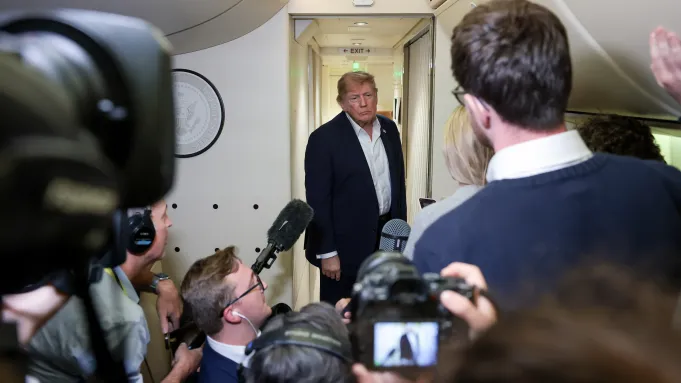
Just when everyone thought the dramatic showdown between the White House and major news outlets had settled down, another huge clash erupted at the airport tarmac.
CNN was scheduled to board Air Force One to cover President Donald Trump’s trip to Knoxville, Tennessee. Instead, White House officials blocked the news channel from stepping onto the presidential plane.
The unexpected decision came less than 48 hours after a federal judge ordered the administration to restore White House access for journalists. The move has thrown the national media landscape into chaos once again, leaving major television networks scrambling over how to handle presidential news coverage.
How the Air Force One Blockade Happened
The conflict escalated rapidly on a Friday evening right before President Trump’s weekend trip. CNN was assigned as the primary television pool reporter for the trip to Tennessee, where the president was scheduled to attend a major college football game between the University of Tennessee and the University of Texas.
Under standard white house protocol, official schedule guidance is sent to reporters detailing travel arrangements, departure times, and press seating. When the White House released its official press guidance for the flight, CNN’s name was missing from the list.
The $0 Secret To Launching Your Entire Online Empire
Why pay hundreds every month for separate software? Build funnels, send emails, and make sales with Systeme.io completely free.
Get Started For $0Free Forever • No Credit Card Needed • Beginner-Friendly
Instead of CNN, the White House assigned a seat on Air Force One to Real America’s Voice, a conservative news organization. The decision meant that CNN camera crews and journalists were left behind on the tarmac while the president took off.
This decision stunned media observers because CNN journalists had only just stepped back onto White House grounds on Thursday morning. The network had spent days locked outside the gates following an executive order banning them from official grounds.
While the court order allowed CNN reporters back inside the White House press room, it did not explicitly mention seat assignments on Air Force One. The administration took advantage of that legal loophole to keep CNN off the plane.
The Backstory: Why the White House Banned News Outlets
To understand why this drama keeps happening, you have to look back at what triggered the initial media ban. The entire dispute started when President Donald Trump announced that several major news organizations would no longer be permitted on White House grounds.
The administration targeted three major outlets: CNN, MS NOW, and Politico. The White House accused these organizations of reporting “fake news” and publishing overwhelmingly negative stories about administration policy.
Secret Service officers were instructed to confiscate press badges from reporters belonging to those three organizations. Staff members from the banned outlets were escorted off the premises, leaving empty seats in the briefing room.
In response to the ban, the White House launched its own 24-hour streaming service called “Trump TV” to stream official events directly to the public. You can read more details about how the conflict originally started in our breakdown of the White House media ban.
The administration defended the ban by claiming that certain journalists posed a threat to national security and were deliberately spreading false information. Critics and media rights groups argued that banning journalists because of critical coverage was an attack on the First Amendment.
To catch up on the full timeline of how networks initially reacted to the ban, check out our coverage of the White House media blackout.
How News Networks Boycotted White House Events
When CNN, MS NOW, and Politico were kicked out, the remaining major television networks took a stand. The five big broadcast networks—ABC, CBS, NBC, Fox News, and CNN—operate a joint sharing agreement for news coverage.
When CNN was barred from fulfilling its duties, the other four networks refused to step in and replace them. Instead, all five major networks decided to suspend joint television pool coverage of the president’s public events.
This collective boycott created immediate, highly visible consequences for White House public relations. During a high-profile ribbon-cutting event for a new White House helipad, network cameras were absent.
The official White House livestream had to rely on a distant camera setup. The loud sound of Marine One helicopters completely drowned out the president’s voice, making his public remarks almost impossible for viewers to hear.
Major print outlets and wire services also joined the protest movement. News outlets including the Washington Post, the New York Times, and the Associated Press refused to distribute official pool photographs taken during presidential appearances.
You can learn more about how television networks originally coordinated their coverage freeze in our deep dive on major networks suspending White House coverage.
Send, Spend & Hold Money Worldwide Without Hidden Fees
Transfer money internationally at the real exchange rate and hold 40+ currencies in one account.
Open a Wise AccountMid-market rate • Fast transfers • 40+ currencies
The Federal Court Order That Reset the Rules
Facing an ongoing media blackout, CNN, MS NOW, and Politico filed a joint lawsuit against the Trump administration in federal court. The news organizations argued that banning reporters based on their reporting violated the US Constitution.
U.S. District Judge Timothy Kelly heard emergency arguments from both legal teams. Department of Justice lawyers argued that the president has full authority to decide who enters executive grounds and travels on government aircraft.
Lawyers representing the news outlets argued that presidential access has been open to the press for decades to ensure government transparency. They pointed out that selective bans create a dangerous precedent where only favorable coverage is allowed.
Judge Kelly ruled in favor of the news organizations, issuing a temporary restraining order against the White House ban. The ruling required the White House to immediately restore hard passes and physical access for the banned journalists.
Reporters from CNN, MS NOW, and Politico returned to the White House press room on Thursday morning. However, the judge’s order focused specifically on access to the White House grounds, leaving travel logistics like Air Force One undecided.
For a complete breakdown of the legal battle and what the judge decided, read our detailed analysis on the court ruling against the White House media ban.
What Is a Press Pool and Why Does It Matter?
Many people hear the phrase “press pool” and wonder why one news channel being left off a plane causes such a massive uproar. The press pool system exists because space near the president is strictly limited.
Every news outlet in the world cannot fit inside the Oval Office, inside small conference rooms, or on board Air Force One. To solve this physical problem, major news organizations created a shared system decades ago.
Under the press pool agreement, a rotating group of reporters, photographers, and camera operators covers the president’s movements. On any given day, one network might handle the video cameras while another handles radio audio or print notes.
Whatever footage, audio, or notes the pool reporter collects must be shared immediately with every other participating news organization, including competitors. This ensures that the public receives independent information regardless of which channel they watch.
The $0 Secret To Launching Your Entire Online Empire
Why pay hundreds every month for separate software? Build funnels, send emails, and make sales with Systeme.io completely free.
Get Started For $0Free Forever • No Credit Card Needed • Beginner-Friendly
When the White House bans one network from its turn in the pool, it breaks the agreement that all networks rely on. If Fox News or CBS takes CNN’s spot on Air Force One after CNN is banned, they are effectively agreeing that the government can dictate who gets to report the news.
The Bigger Political Impact Ahead of Elections
This ongoing battle between the executive branch and major media companies comes at a delicate political moment. Political strategists on both sides of the aisle are watching how voters react to the press freedom dispute.
Supporters of the administration argue that mainstream news outlets have been unfair to the president and that the White House has every right to choose who gets special access. They believe alternative media outlets deserve equal representation on flights like Air Force One.
Critics argue that denying access to mainstream journalists sets a concerning precedent for government transparency. They believe that keeping press cameras away from public events prevents citizens from seeing complete, uncensored information about government actions.
Political analysts note that public disputes over media access can become a central talking point during election seasons. Voters who value press freedom may view the restrictions negatively, while voters who distrust traditional media may applaud the tough stance.
If you want to understand how broader political tensions are shaping national news, check out our report on why political strategists are watching voter reactions closely.
What Happens Next in Court?
The legal fight is far from over. Judge Timothy Kelly’s temporary order was only a short-term fix to grant reporters physical entry back into the building.
The judge gave the news organizations and the Department of Justice a strict deadline to submit additional legal briefs. A formal hearing for a preliminary injunction is set to take place soon, which will decide whether the press ban can be enforced while the full lawsuit proceeds.
Lawyers for CNN are expected to ask the judge to extend the court order to cover presidential travel, including press seats on Air Force One and official motorcades.
If the judge agrees with CNN, the White House could be legally required to restore CNN’s spot on Air Force One. If the judge rules in favor of the White House, the administration will keep full control over who gets to fly with the president on official trips.
Until a permanent ruling is issued, the television press pool remains in an unstable position. Networks must decide every single day whether to share coverage or suspend broadcasts when member outlets are excluded.
Frequently Asked Questions
Why did the White House block CNN from boarding Air Force One?
The White House excluded CNN from the press flight to Tennessee because the administration continues to accuse the network of unfair and inaccurate reporting. Although a court ordered the White House to let CNN reporters back onto White House grounds, the order did not explicitly cover flight seats on Air Force One.
What is the White House television press pool?
The press pool is a shared arrangement where major television networks (ABC, CBS, NBC, Fox News, and CNN) take turns sending one camera crew to cover the president. The footage captured by that crew is shared with all participating networks so every news channel can inform the public without crowding the president.
Did other news networks support CNN during the ban?
Yes. When CNN was originally banned from White House events, ABC, CBS, NBC, and Fox News joint-suspended pooled television coverage of the president in solidarity. They stated that no administration should restrict a news outlet simply because it dislikes its reporting.
What did the judge rule in the press ban lawsuit?
U.S. District Judge Timothy Kelly issued a temporary order requiring the White House to restore hard passes and physical access for journalists from CNN, MS NOW, and Politico. However, the temporary order did not address specific travel arrangements like Air Force One pool assignments.
Who replaced CNN on the Air Force One flight to Tennessee?
The White House assigned the available press pool seat on Air Force One to Real America’s Voice, a conservative news network, instead of letting CNN fulfill its scheduled turn.
The media landscape moves fast, and government press relations can change in a single day. Stay informed on all the latest national news, media developments, and trending topics by visiting our main hub at WhatsBuzzn.
Have questions, feedback, or a story tip to share with our editorial team? Reach out to us directly through our Contact Page.
For real-time updates, breaking stories, and engaging discussions, follow us across our social channels:
- Connect with us on Instagram
- Join our community on Facebook
- Follow our latest posts on X (formerly Twitter)
