
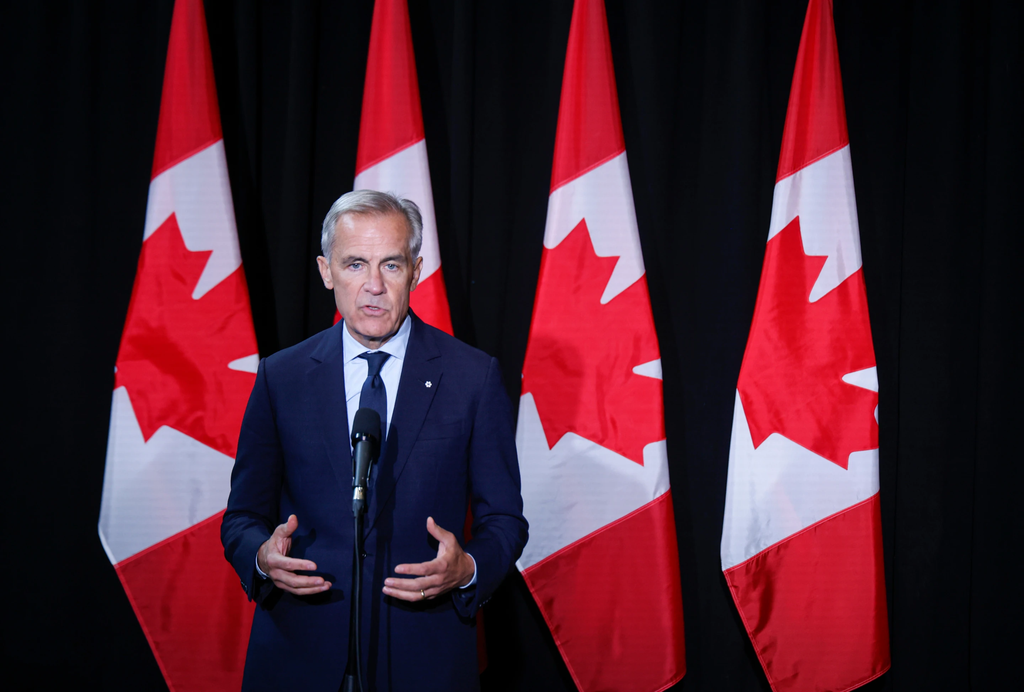
Canadian Prime Minister Mark Carney just gave businesses, workers, and everyday shoppers across North America a reason to breathe a little easier. Speaking to reporters in Manila, Philippines, on Saturday, November 14, 2026, Carney confirmed that Canada and the United States are finally making real progress toward a new bilateral trade agreement.
For months, trade relations between the two longtime neighbors felt stuck in a deep freeze. Punishing tariffs, angry press conferences, and a dramatic walkout from the negotiating table back in August had left many people wondering if Ottawa and Washington could ever get back on the same page.
Now, the tone is shifting. Carney revealed that he held a long, detailed phone conversation with U.S. President Donald Trump right before flying to Southeast Asia, signaling that both sides are actively trying to fix the rift—even if a final signature is still out of reach.
What Did Mark Carney Actually Say About the Canada-US Trade Talks?
Mark Carney stated that Canada and the United States are making progress toward a bilateral trade deal following a lengthy, substantive conversation with President Donald Trump, though no final agreement has been reached yet.
During his news conference at the Association of Southeast Asian Nations (ASEAN) summit in Manila, Carney was careful to balance optimism with realism. He wanted people to know that high-level talks are genuinely moving forward, without promising an overnight miracle.
The $0 Secret To Launching Your Entire Online Empire
Why pay hundreds every month for separate software? Build funnels, send emails, and make sales with Systeme.io completely free.
Get Started For $0Free Forever • No Credit Card Needed • Beginner-Friendly
Carney explained that his pre-trip call with President Trump included key figures from the American trade team. U.S. Trade Representative Jamieson Greer and White House Deputy Chief of Staff Stephen Miller both took part in the discussion.
Having top decision-makers on the line at the same time matters a great deal in trade diplomacy. When leaders and their chief negotiators speak directly, small misunderstandings can get cleared up much faster than through weeks of back-and-forth memos.
At the same time, Carney poured cold water on rumors that a splashy face-to-face signing ceremony is right around the corner. He told journalists that he does not expect to be in the same room with Trump in the short term, adding that regular phone calls and behind-the-scenes work are carrying the process forward for now.
Officials in Washington have echoed that cautious but hopeful mood. Just two days before Carney spoke in Manila, U.S. Trade Representative Jamieson Greer confirmed on CNBC that American and Canadian officials had spoken within the past few days.
Greer noted that Trump and Carney speak regularly and emphasized that getting the substance of the deal right is far more important than rushing to meet an arbitrary deadline. U.S. Treasury Secretary Scott Bessent also expressed optimism about reaching agreements with both Canada and Mexico, while U.S. Ambassador to Canada Pete Hoekstra suggested a deal could even come together before the end of 2026.
How Did the Canada-US Trade Dispute Get So Bad in the First Place?
To understand why Saturday’s update feels like such a big deal, it helps to look back at how rocky things became over the summer of 2026. For decades, Canada and the United States enjoyed one of the smoothest, most closely connected trading partnerships on the planet.
Factories, farms, energy grids, and small businesses on both sides of the border operated almost like a single neighborhood. Around 400,000 people crossed the border every single day, and goods moved back and forth with minimal friction.
The August 2026 Breakdown and 50% Tariff Shock
That smooth relationship hit a brick wall in late August 2026. After weeks of tense negotiations, Canada abruptly walked away from trade talks with the United States, saying Washington had introduced last-minute demands that would severely harm Canadian manufacturing.
At the time, Carney was unusually blunt with the public. He told reporters that Ottawa refused to sign a bad deal that would cripple core Canadian industries, especially autos, steel, and aluminum.
When talks collapsed, both countries rolled out painful new tariffs. Washington imposed steep duties—reaching up to 50% on Canadian vehicles, auto parts, steel, and aluminum—while Ottawa hit back with its own retaliatory tariffs on American products.
How Everyday Shoppers and Workers Felt the Squeeze
Trade wars are often talked about in dry economic terms, like import quotas and supply chain bottlenecks. In reality, the fallout landed directly on kitchen tables and local storefronts across both countries.
In Canada, several provincial governments pulled American beer, wine, and spirits right off liquor store shelves. Millions of Canadians also changed their personal habits, canceling weekend road trips to U.S. border towns and deliberately choosing Canadian-made groceries and household goods at the checkout line.
Meanwhile, American farmers, factory owners, and everyday consumers started feeling the pinch from higher costs on imported materials and lost Canadian buyers. When two economies are tied together as tightly as Canada and the United States, slapping heavy taxes on border crossings hurts people on both sides.
What Changed to Bring Ottawa and Washington Back to the Table?
If things were so bitter in August, what convinced both governments to start talking seriously again in November? Two major shifts helped break the deadlock: concessions on key deal-breakers from Washington and changing political pressure inside the United States.
Washington Dropped Two Major Deal-Breakers
Earlier in November 2026, Carney told reporters that trade talks had grown more intense because the U.S. side was finally “asking less and offering more”. Specifically, American negotiators quietly removed two major demands that had poisoned the atmosphere during the summer.
Send, Spend & Hold Money Worldwide Without Hidden Fees
Transfer money internationally at the real exchange rate and hold 40+ currencies in one account.
Open a Wise AccountMid-market rate • Fast transfers • 40+ currencies
First, Washington dropped its push against Canada’s cultural and language rules. Back in August, U.S. officials had challenged Canadian rules requiring bilingual product labeling and rules ensuring French-language shows and movies remain easy to find on global streaming apps like Netflix. For Canadians, language and cultural protections are deeply personal issues, not bargaining chips.
Second, the United States backed off from trying to restrict Canada’s freedom to sign trade deals with other countries. Ottawa had flatly rejected any rule that would let Washington veto Canada’s partnerships in Europe or Asia. Once those two hurdles were cleared off the table, real conversation became possible again.
The Impact of the U.S. Midterm Elections
Domestic politics in the United States also played an undeniable role. In early November 2026, American voters went to the polls for the midterm elections, and frustration over the high cost of living drove sweeping Democratic victories.
Throughout the campaign, critics blamed broad tariffs for pushing up prices on everyday goods, groceries, and vehicles. Newly elected Democratic members of Congress quickly called for an end to the trade dispute with Canada, warning that ongoing tariffs were costing jobs and squeezing family budgets.
Even so, Carney remains realistic about who holds the pen in Washington. Following the election, the Associated Press reported Carney’s clear assessment that President Trump’s administration is still the central decision-maker on trade agreements.
Carney noted that in any negotiation, you deal with the government in charge. That practical mindset explains why he has kept his direct line open to Trump, Greer, and Miller rather than waiting around for Congress to intervene.
Why Canada’s Auto Industry Remains the Biggest Hurdle
Even with better momentum and fewer side arguments, one massive issue is still holding up a final handshake: the automotive sector.
In Manila on Saturday, Carney drew an unmistakable red line around Canadian car manufacturing. He told reporters that while some people think Ottawa should grab whatever deal Washington offers, his government will never sign an agreement that leaves Canada without a strong, viable auto industry.
To see why Carney refuses to budge on cars, it helps to understand how North American vehicles are actually built. A single car sold in Toronto or Chicago is rarely made in just one place.
Raw steel and aluminum might start in Ontario or Quebec, get stamped into engine parts in Michigan, travel back to Ontario for wiring and assembly, and cross the border again before reaching a dealership. Parts often cross the Canada-U.S. border six or seven times during production.
The $0 Secret To Launching Your Entire Online Empire
Why pay hundreds every month for separate software? Build funnels, send emails, and make sales with Systeme.io completely free.
Get Started For $0Free Forever • No Credit Card Needed • Beginner-Friendly
When Washington imposes heavy tariffs on Canadian-built vehicles and auto parts, that entire assembly line gets thrown into chaos. Costs jump, factory shifts get cut, and workers on both sides of the Detroit River face uncertainty.
Carney emphasized that reaching a fair, stable automotive deal is not just good for Canadian workers—it is also vital for American auto workers and U.S. carmakers. He also sent a sharp warning to major automaker Stellantis, saying Ottawa is dissatisfied with the company’s partial approach in Canada and expects it to fully honor its commitments to local workers.
Canada’s Plan B: Looking Beyond the United States for Trade
One of the biggest reasons Carney can afford to stand firm in talks with Washington is that Canada is no longer putting all of its economic eggs in one basket.
For years, selling to the United States was the easiest path for Canadian companies because it was right next door. But the shock of 2026’s tariff battles convinced Ottawa that relying too heavily on a single customer leaves the entire country vulnerable.
Carney has set an ambitious national target: doubling Canadian exports to countries outside the United States by 2035. His November diplomatic tour across Europe and Asia shows that this goal is already turning into concrete deals.
Big Wins in Southeast Asia and the Philippines
While updating reporters on his call with Trump in Manila, Carney also announced major trade breakthroughs in Southeast Asia. Canada and the Philippines officially wrapped up negotiations on a bilateral free-trade agreement expected to be signed in 2027.
That pact covers more than 90% of tariff lines and is projected to triple Canadian exports to the Philippines by 2035. At the same time, Canada is advancing a broader trade agreement with the entire ASEAN bloc, which officials estimate could add nearly 2 billion Canadian dollars to Canada’s economy and create close to 14,000 jobs in agriculture and manufacturing.
Global Summits and a C$142.1 Billion Domestic Shield
Carney’s travel schedule underlines just how seriously Ottawa is pursuing new markets. Before arriving in Manila, he met European leaders at the European Political Community summit in Ireland. Next, he heads to Cambodia for the Francophonie summit and then to Shenzhen, China, for the Asia-Pacific Economic Cooperation (APEC) summit, where he is scheduled to meet Chinese President Xi Jinping.
Back home, the Canadian government is backing up its global outreach with serious financial muscle. Finance Minister François-Philippe Champagne introduced a C$142.1 billion national budget titled “Masters of our Destiny” aimed at making the Canadian economy more independent and resilient.
That spending plan invests heavily in critical mineral mining, domestic energy production, and housing, while providing direct financial support to auto and steel workers hit hard by U.S. tariffs. Simply put, Canada is building a safety net so it never has to accept a bad trade deal out of desperation.
Frequently Asked Questions About the Canada-US Trade Talks
Have Canada and the United States signed a new trade deal yet?
No, Canada and the United States have not signed a new trade deal yet. Prime Minister Mark Carney confirmed on November 14, 2026, that both countries are making progress after substantive talks with President Donald Trump, but key issues still need to be resolved before any agreement is finalized.
What is the biggest obstacle holding up a Canada-US trade agreement?
The automotive sector is the single biggest hurdle remaining in the negotiations. Carney has stated clearly that Canada will not sign any deal unless it protects a viable Canadian auto industry, while Washington has pushed for stricter rules favoring U.S.-based vehicle production.
Why did Canada-US trade talks collapse in August 2026?
Talks broke down in August 2026 after Washington introduced late demands that Ottawa said would severely damage Canada’s auto, steel, and aluminum industries. At the time, U.S. negotiators also challenged Canada’s French-language labeling and streaming rules and tried to limit Canada’s ability to sign trade deals with other countries—two demands Washington has since dropped.
Are U.S. tariffs on Canadian steel, aluminum, and cars still in place?
Yes, existing U.S. tariffs and Canadian retaliatory tariffs remain active while negotiators work toward a settlement. Reaching a bilateral agreement is expected to lower or replace those punitive duties with more predictable rules for businesses on both sides of the border.
When could a final Canada-US trade deal be reached?
Neither government has locked in an official deadline. U.S. Trade Representative Jamieson Greer emphasized that getting the details right matters more than speed, though U.S. Ambassador Pete Hoekstra suggested an agreement could potentially be reached before the end of 2026 if talks stay on track.
What Happens Next for Workers, Businesses, and Everyday Consumers?
Right now, the Canada-US trade story sits at a critical turning point. Both sides have stepped back from the brink of an all-out economic war, and removing irritants like language rules and third-party trade restrictions proves that practical compromise is possible.
Still, the hardest part of any negotiation always happens in the final stretch. Finding a formula for cars, steel, and aluminum that satisfies President Trump’s push for American manufacturing while protecting tens of thousands of Canadian factory jobs will test the patience of negotiators on both sides.
For everyday shoppers, small business owners, and factory workers, the message from Manila is cautiously encouraging. Progress on the phone between Ottawa and Washington means lower prices, calmer borders, and steadier jobs are back within reach—provided both leaders can turn good conversations into a fair deal on paper.
What do you think about Mark Carney standing firm on Canada’s auto sector while negotiating with Donald Trump?
