
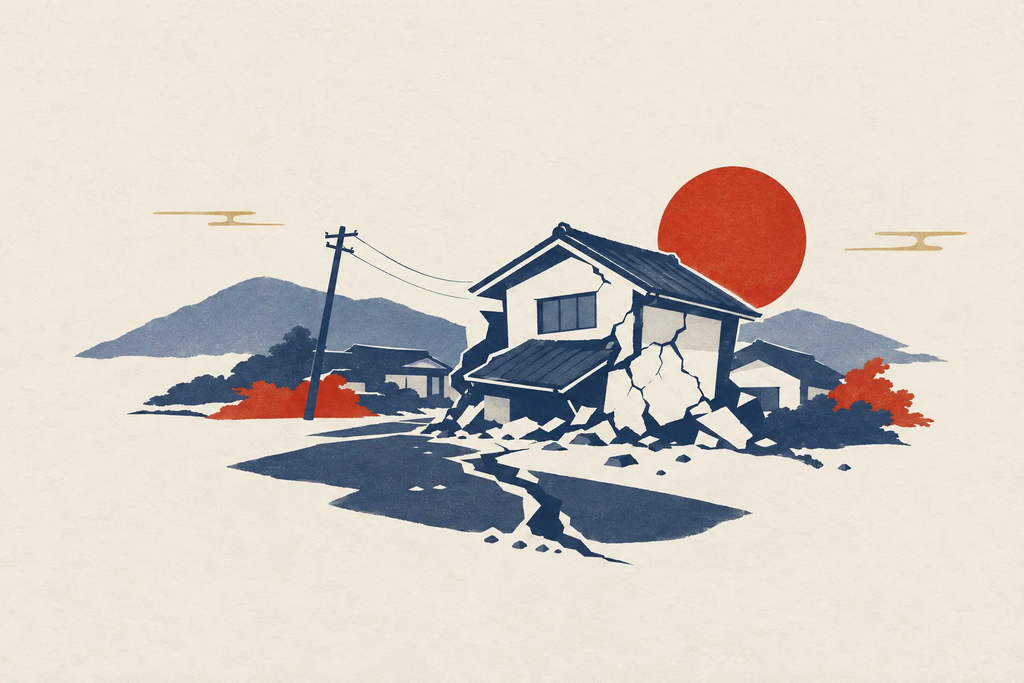
A powerful magnitude 5.7 earthquake struck central Japan in the early hours of Sunday, November 8, 2026, jolting millions of residents out of their beds, shattering glass across city streets, and leaving more than twenty people injured.
The violent tremor hit at 1:04 a.m. local time, centered in western Shizuoka Prefecture at a depth of roughly 40 kilometers. The shaking rumbled across major urban centers, including Nagoya and Hamamatsu, and was felt as far away as Kyoto, Nara, Gifu, and the foothills of Mount Fuji in Yamanashi Prefecture.
Sirens echoed down suburban roads minutes after the main jolt, while startled residents ran into chilly overnight streets in their pajamas. High-speed Shinkansen bullet trains were forced to slow to a crawl, and convenience stores saw products knocked clean off shelves.
Here is everything that happened on the ground, the full tally of injuries and damage, and what safety officials are warning about the coming days.
What Happened: The Anatomy of the Midnight Quake
The earthquake struck without warning while most people were sound asleep. According to official data released by the Japan Meteorological Agency (JMA), the tremor carried a preliminary magnitude of 5.7. The United States Geological Survey (USGS) recorded the event slightly lower, at magnitude 5.5.
The $0 Secret To Launching Your Entire Online Empire
Why pay hundreds every month for separate software? Build funnels, send emails, and make sales with Systeme.io completely free.
Get Started For $0Free Forever • No Credit Card Needed • Beginner-Friendly
The hypocenter sat approximately 40 kilometers (25 miles) beneath the surface in western Shizuoka Prefecture. Because the rupture happened relatively deep in the crust, the intense shaking radiated far across central Honshu rather than remaining locked in a single pinpointed town.
Japan measures earthquake impact using the seismic intensity scale known as shindo, which runs from 0 to 7. Unlike standard magnitude, which measures total energy released, the shindo scale measures how violently the ground actually shakes in a specific neighborhood.
This earthquake registered an “upper 5” on the shindo scale in the city of Chita in neighbouring Aichi Prefecture. At that intensity, walking becomes difficult without holding onto something solid, unanchored furniture can tip over, and dishes rattle right out of kitchen cupboards.
Parts of Gifu, Nagano, and northern Shizuoka recorded a “lower 5” intensity, while lighter tremors swept into Kansai to the west. Tokyo, sitting further to the northeast, did not feel the tremor.
Where the Damage Struck Hardest
The strongest ground movement occurred along the industrial and coastal corridor between Shizuoka and Aichi prefectures. While Japan builds its structures to withstand severe seismic shocks, the sudden violent snap created instant chaos inside homes and commercial plazas.
In Hamamatsu and Toyota City, storefronts took the brunt of the shockwaves. Television broadcasts showed floor-to-ceiling plate glass windows shattered across sidewalks, leaving shards scattered across downtown walkways. At an auto dealership in central Aichi, display windows cracked into giant spiderwebs.
Inside retail shops and local libraries, the mess was immediate. Bookstores woke up to mounds of paperbacks tossed into the aisles. Grocery stores reported broken bottles of sauces, sodas, and cooking oils pooling across tile floors.
Ceiling tiles shook loose in several municipal buildings and older office blocks. Water pipes developed minor leaks, but local utility teams isolated the breaks quickly to prevent major flooding.
Injuries and Medical Reports: Over 20 People Hurt
Emergency medical teams and fire departments across central Japan began taking calls within seconds of the shaking.
Authorities confirmed that at least 26 people suffered injuries across the region. The majority of the casualties occurred in Aichi Prefecture, where emergency rooms treated 23 people. Shizuoka Prefecture confirmed three additional injuries.
The injured ranged in age from 30 to 90 years old. Fortunately, emergency officials and local reporting from Kyodo News confirmed that none of the reported injuries were life-threatening.
The injuries fell into clear categories:
- Falls during evacuation: Several elderly residents tripped or fell down flights of stairs while attempting to escape shaking apartment buildings in total darkness.
- Falling household items: People were hit on the shoulders, arms, and head by heavy items tumbling from tall dressers, unbolted bookcases, and decorative wall mounts.
- Lacerations from broken glass: Residents stepping out of bed into dark rooms stepped directly on shattered mirror glass, fallen light fixture fragments, and broken picture frames.
- Stress and shock: Several people required observation after experiencing sudden heart palpitations and acute distress caused by the terrifying midnight alarm.
The casualty count highlights a lesson that Japanese safety experts repeat regularly: during moderate earthquakes, human panic and falling indoor objects often cause far more injuries than structural building collapses.
Bullet Trains, Highways, and Critical Infrastructure
Japan relies heavily on high-speed rail to keep workers and cargo moving across the Tokaido corridor, the busiest transit artery in the country. When the sensors tripped at 1:04 a.m., automated safety protocols kicked in immediately.
Bullet trains running on the Tokaido Shinkansen line slowed to reduced speeds while rail engineers dispatched safety inspection crews along the tracks. High-speed trains run on specialized tracks that cannot risk even microscopic alignment shifts. Crews walked sections of rail to inspect overpasses, bridges, and electrical catenary wires before clearing regular speeds.
Send, Spend & Hold Money Worldwide Without Hidden Fees
Transfer money internationally at the real exchange rate and hold 40+ currencies in one account.
Open a Wise AccountMid-market rate • Fast transfers • 40+ currencies
Regional train lines across Shizuoka and Aichi temporarily halted services for early morning safety checks, disrupting morning commutes before normal schedules resumed. You can read more about how unexpected system interruptions cause travel headaches in our breakdown of transportation chaos and mass cancellations across major transit hubs.
Highway authorities also sent road monitoring cars to inspect elevated expressways connecting Nagoya and Tokyo. Crews looked for cracks in concrete pillars, road surface shifts, and loose rock along mountain cuts.
Nuclear Power Plants Inspected
Whenever an earthquake strikes central Japan, public attention turns straight to nuclear energy sites along the coast.
The closest commercial nuclear facility to the epicenter is the Hamaoka Nuclear Power Station, operated by Chubu Electric Power Company in Omaezaki, Shizuoka Prefecture. Inspectors moved into action immediately after the tremor.
The Nuclear Regulation Authority confirmed that no abnormalities, radiation spikes, or equipment failures occurred at the Hamaoka plant or at any neighboring facilities across central Japan.
Was There Any Tsunami Threat?
The short answer is no. The Japan Meteorological Agency announced within three minutes of the earthquake that there was zero tsunami risk along the Pacific coastline.
Tsunamis usually require two specific conditions: an earthquake that ruptures very close to the ocean floor and significant vertical displacement of the seabed.
Because this earthquake occurred roughly 40 kilometers deep inside the crust beneath the landmass of western Shizuoka, it did not push or lift large volumes of seawater. Coastal warning sirens remained silent, and fishing ports along Suruga Bay continued normal operations.
Why Central Japan Shakes So Frequently
To understand why an earthquake can jolt cities like Hamamatsu and Nagoya without warning, you have to look at the ground beneath Japan.
Japan sits directly on top of the Pacific Ring of Fire, an active horseshoe-shaped belt that circles the Pacific Ocean. The Japanese archipelago is wedged at the meeting point of four massive tectonic plates:
The $0 Secret To Launching Your Entire Online Empire
Why pay hundreds every month for separate software? Build funnels, send emails, and make sales with Systeme.io completely free.
Get Started For $0Free Forever • No Credit Card Needed • Beginner-Friendly
- The Pacific Plate
- The Philippine Sea Plate
- The Eurasian Plate
- The North American Plate
These colossal slabs of rock constantly grind against each other at rates of several centimeters per year. Western Shizuoka and Aichi sit close to the Nankai Trough and the Suruga Trough, an underwater subduction zone where the Philippine Sea Plate slides beneath southwestern Japan.
Over decades, immense friction builds up along these fault boundaries. When the locked rock finally snaps, it releases pent-up energy in the form of seismic shockwaves that travel directly up toward the surface.
Japan experiences roughly 1,500 noticeable earthquakes every single year. That constant seismic activity is why Japanese engineering standards are among the strictest in the world. Modern high-rises rest on massive shock-absorbing rubber pads and hydraulic dampers that sway with the motion of the earth instead of snapping.
Understanding how communities build long-term resilience against natural risks is a huge part of Japanese culture. In fact, you can see how Japan balances extreme natural hazards with high quality of life in our look at how the world’s oldest country thrives and approaches longevity.
Aftershocks: The Real Danger in the Coming Days
While the main shock has passed, the danger is rarely over after an earthquake of this size.
The JMA issued an urgent warning advising residents across Aichi, Shizuoka, Nagano, and Gifu to stay on high alert for strong aftershocks over the next week. Officials emphasized that secondary tremors with an intensity of around lower 5 could easily strike within two to three days.
Why are aftershocks so dangerous?
- Weakened walls and roofs: Buildings that withstood the first shock may have micro-cracks in plaster, loose tiles, or strained joints that can fail during a second jolt.
- Loosened hillside soil: The initial shaking loosens soil and gravel on steep slopes. Even a moderate aftershock, combined with seasonal rain, can trigger sudden mudslides.
- Objects hanging on by a thread: Shelves, wall clocks, and light fixtures that shifted out of place during the first shock are prone to falling completely during smaller rumbles.
Japanese emergency disaster teams recommend keeping furniture safety brackets firmly checked and avoiding steep cliff trails or older brick walls until seismic activity quiets down.
When extreme natural events strike without warning, having the right mobile tools is critical. Make sure you check out our curated guide on the essential travel and emergency apps you need to install right now to ensure your phone receives instant local alerts no matter where you travel.
Emergency Survival Guide: What to Do During an Earthquake
If you live in an earthquake zone or are planning an international trip to Japan, knowing the right steps can keep you and your family safe.
1. Drop, Cover, and Hold On
When shaking begins, do not attempt to run outside. Running while the ground is pitching under your feet almost always leads to severe falls and head injuries.
- Drop down onto your hands and knees.
- Cover your head and neck under a sturdy dining table or desk.
- Hold on to your shelter until all shaking completely stops.
2. Protect Your Feet Immediately
After the shaking subsides, the biggest danger in your home is broken glass and sharp debris on the floor. Keep a pair of thick-soled sneakers or sturdy slippers right next to your bed. Never walk around your room in bare feet or thin socks after a midnight quake.
3. Check Gas Lines and Extinguish Open Flames
In past major disasters, fire caused just as much devastation as falling concrete. Once the shaking stops, immediately shut off your stove and check that gas valves are secure. Modern Japanese homes have automatic gas shut-off valves that trip when severe shaking occurs, but manual verification is always smart.
4. Keep an Emergency Go-Bag Ready
Every household in an active seismic belt should have a backpack packed with bare essentials:
- Two to three liters of bottled water per person
- Non-perishable food such as canned goods, nuts, and protein bars
- A reliable battery pack or hand-crank charger for your phone
- A bright LED flashlight with extra batteries
- A first-aid kit containing bandages, antiseptic, and essential personal prescriptions
- A small amount of hard cash, as card machines and ATMs often go offline during power cuts
Natural disasters can strike without warning on any continent, whether it is an earthquake in Asia or extreme climate emergencies in North America, like California declaring statewide emergencies during record-breaking storms. Preparedness is universal.
How Japan Prepares Its Population for Earthquakes
The fact that a magnitude 5.7 earthquake hit a densely populated urban corridor in the middle of the night without causing major loss of life is proof of Japan’s disaster preparedness system.
From preschool through high school, students participate in monthly earthquake drills. They learn how to duck under desks in seconds, how to locate evacuation routes, and how to operate fire extinguishers.
Offices and apartment complexes conduct regular disaster evacuation walks so residents know where community shelters and emergency water tanks are located.
On top of public training, Japan operates the world’s most advanced Earthquake Early Warning (EEW) system. The moment subterranean sensors detect fast-moving primary seismic waves (P-waves), automated networks send high-pitched alarm tones directly to every smartphone in the affected zone before the slower, more destructive secondary shear waves (S-waves) arrive.
Those extra five to fifteen seconds give residents enough time to step away from glass windows, turn off stove burners, and get under cover before the heavy shaking starts.
Frequently Asked Questions (FAQs)
What was the magnitude and depth of the earthquake?
The earthquake had a preliminary magnitude of 5.7 according to the Japan Meteorological Agency (JMA), while the U.S. Geological Survey measured it at magnitude 5.5. The tremor struck at a depth of roughly 40 kilometers (25 miles) beneath western Shizuoka Prefecture.
Were there any deaths or serious injuries?
No fatalities or life-threatening injuries were reported. Local authorities confirmed that at least 26 people sustained injuries, mainly in Aichi and Shizuoka prefectures. Most injuries were minor to moderate, resulting from falls on stairs, objects falling off shelves, and broken glass.
Was a tsunami warning issued for the coast of Japan?
No tsunami warning was issued. The JMA ruled out any tsunami risk within minutes of the quake because the hypocenter was 40 kilometers inland and deep below the earth’s crust, meaning it did not displace ocean water.
Was Tokyo affected by the earthquake?
No. Tokyo is located further northeast of Shizuoka, and residents in the capital city did not feel the tremor. The strongest shaking was concentrated in central Honshu across Aichi, Shizuoka, Gifu, Nagano, and Yamanashi prefectures.
Are bullet trains and transportation running normally?
Shinkansen bullet trains slowed their speeds immediately after the quake as safety crews inspected railway lines for track misalignments. Once engineers confirmed the tracks and power lines were completely secure, regular train operations resumed.
Should residents and tourists expect aftershocks?
Yes. The Japan Meteorological Agency warned that strong aftershocks, potentially measuring up to lower 5 on the Japanese seismic scale, could occur across central Japan over the coming days. Residents and visitors should remain alert and keep emergency supplies close at hand.
The magnitude 5.7 earthquake in central Japan is a stark reminder of how quickly the earth can shift beneath our feet. Thanks to strict building codes, rapid emergency response networks, and disciplined public awareness, Shizuoka and Aichi avoided severe structural devastation.
However, with aftershocks still possible across central Honshu, emergency agencies urge everyone in the area to keep their phones charged, check indoor spaces for falling hazards, and stay tuned to official government broadcasts.
