
Alberta is standing at a historic political crossroads, but the biggest casualties of the independence push might not be politicians in Ottawa or Calgary. Instead, the hardest hit could be the multi-generational family farmers across the province whose life work relies entirely on getting grain, canola, and cattle beyond provincial borders.
Behind all the fiery political speeches and rallies, a harsh economic reality is setting in across rural communities. Alberta agricultural producers shipped a staggering $17.1 billion worth of farm commodities and manufactured food products to international buyers last year. That massive trade engine feeds millions of people across Asia, Europe, and the United States.
Yet, as voters weigh ballots questioning Alberta’s place in the Canadian federation, farm operators are confronting a basic geographic fact that politics cannot change: Alberta has no coastline. It has no seaport of its own.
Every single bushel of wheat and every container of chilled beef heading abroad must cross another government’s land to reach ocean docks. If Alberta severs its ties with the rest of the country, those open rail corridors and guaranteed international trade treaties could evaporate almost overnight.
What Is Actually on the Ballot in Alberta?
To understand why tension is running so high in farm country, you have to look at what the referendum vote really does. Voters across the province are answering a series of ballot questions designed to gauge public appetite for provincial autonomy and possible separation.
The $0 Secret To Launching Your Entire Online Empire
Why pay hundreds every month for separate software? Build funnels, send emails, and make sales with Systeme.io completely free.
Get Started For $0Free Forever • No Credit Card Needed • Beginner-Friendly
The vote itself is non-binding. Passing these questions does not mean Alberta wakes up tomorrow morning as a brand-new country with its own passport and currency. Rather, it authorizes the provincial government to start the formal legal, constitutional, and logistical machinery required to prepare for a binding referendum down the road.
Political activists driving the independence effort have made it clear that they view this ballot as a crucial turning point. Even if political opponents push back, grassroots organizers behind the Alberta independence movement are treating this as an irreversible mandate to negotiate an exit.
Even without an immediate declaration of independence, the sheer uncertainty of the vote is already sending shockwaves through the agricultural economy. Banks, commercial lenders, equipment dealers, and grain elevators do not wait for a formal divorce before adjusting their risk models. When the basic legal framework of a province is thrown into doubt, interest rates on farm loans can creep up, land sales pause, and long-term capital investments grind to a halt.
Federal leaders are acutely aware of the stakes. High-profile national figures have traveled west to make the case for unity, with Mark Carney meeting remain campaigners to argue that Alberta’s economic security is inseparable from the Canadian economic union.
Inside the $17.1 Billion Agricultural Machine
Alberta is an agricultural powerhouse on a global scale. The province is famous for its energy sector, but its soil and ranches generate consistent, renewable wealth year after year.
According to provincial trade data, Alberta shipped $17.1 billion in primary agricultural commodities and value-added farm products to foreign buyers in 2025. This vast sum is driven largely by three powerhouse sectors:
- High-Grade Wheat: The Canadian Prairies produce some of the finest milling wheat on the planet, purchased by bakeries and pasta makers across dozens of nations.
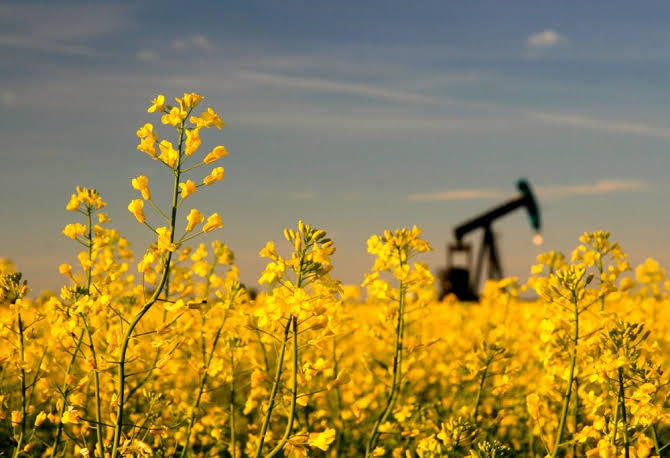
- Canola Seed and Canola Oil: Millions of acres of yellow blooms translate into cooking oil and meal exported extensively to North American and Asian markets.
- World-Class Beef: Alberta beef is an internationally recognized brand, supported by extensive feedlots and massive processing plants in southern Alberta.
Beyond direct global sales, interprovincial trade is just as vital. Billions of dollars in crops, feed, and livestock move seamlessly between Alberta and sister provinces like British Columbia, Ontario, and Quebec every single year. Manuel Juárez Davila, director of the Simpson Centre for Food and Agricultural Policy at the University of Calgary, has pointed out that domestic trade inside Canada forms the backbone of day-to-day cash flow for local producers.
Severing that connection does not just risk corporate profits. Research conducted by University of Calgary economist Trevor Tombe for the Calgary Chamber revealed that roughly 34,000 Alberta jobs in the agri-food sector depend directly on sales to other Canadian provinces. Those are truck drivers, packing-plant workers, agronomists, mechanics, and grain handlers who rely on an uninterrupted Canadian domestic market.
The Landlocked Dilemma: Moving Crops Without a Coastline
Farming is fundamentally a logistics business. You can grow the best durum wheat or breed the healthiest Angus cattle on earth, but if you cannot move them to market at a reasonable price, your business fails.
Geography is the single greatest obstacle facing an independent Alberta. The province is completely landlocked, boxed in by British Columbia to the west, Saskatchewan to the east, the Northwest Territories to the north, and the state of Montana to the south.
To reach high-value customers across the Pacific Rim, Alberta grain must travel hundreds of miles through the Rocky Mountains on Canadian Pacific Kansas City (CPKC) or Canadian National (CN) rail lines to reach the Port of Vancouver. Today, those trains operate under federal Canadian transportation laws that protect shippers from unfair pricing and guarantee common-carrier service.
If Alberta becomes a foreign nation, that guaranteed access disappears. British Columbia would hold immense leverage over Alberta’s entire export economy. An independent Alberta could not legally compel B.C. to maintain port capacity for its grain cars, nor could it prevent British Columbia or a Canadian federal government from levying heavy transit fees, environmental tariffs, or cross-border processing tolls.
Some separation proponents argue that Alberta could simply reroute its harvest south through the United States, utilizing American rail networks to reach ports in the Pacific Northwest or the Gulf of Mexico. However, agricultural economists warn that this idea ignores physical reality. American rail lines are already running near capacity hauling domestic U.S. corn, soybeans, and wheat. American logistics networks cannot easily absorb millions of additional tons of Canadian Prairie grain without charging exorbitant premiums.
Furthermore, relying on U.S. transit exposes growers to the shifting winds of Washington trade politics, where protectionist sentiment and aggressive tariffs can emerge overnight. You can see how quickly international trade barriers escalate by reviewing how the broader cross-border tariff disputes create turmoil for small- and medium-sized producers.
Losing International Trade Deals Overnight
The legal issues surrounding a potential exit are just as daunting as the physical rail bottlenecks.
Send, Spend & Hold Money Worldwide Without Hidden Fees
Transfer money internationally at the real exchange rate and hold 40+ currencies in one account.
Open a Wise AccountMid-market rate • Fast transfers • 40+ currencies
Currently, an Alberta farmer selling canola to Japan or beef to Mexico is protected by comprehensive multilateral trade treaties signed by Canada. These include:
- The Canada-United States-Mexico Agreement (CUSMA)
- The Comprehensive and Progressive Agreement for Trans-Pacific Partnership (CPTPP)
- The Canada-European Union Comprehensive Economic and Trade Agreement (CETA)
These international agreements ensure that Alberta agricultural products face zero or minimal tariffs, clear border inspections, and standardized health checks.
If Alberta separates from Canada, it does not automatically inherit Canada’s place in those international treaties. An independent Alberta would be a brand-new sovereign entity starting from scratch. Rejoining pacts like CUSMA or the CPTPP requires unanimous consent from existing member nations. Every single member country would have the legal right to demand concessions, impose quotas, or block entry to shield their own domestic farmers from Alberta competition.
Until new treaties are painstakingly negotiated—a process that routinely takes five to ten years—Alberta exports would fall back on default Most-Favoured-Nation (MFN) rules under the World Trade Organization. That means instant, double-digit import duties on beef and processed food entering key foreign markets.
There is also the matter of border clearance. Perishable goods like fresh beef cannot afford to sit in refrigerated trucks at a border checkpoint for days waiting for customs brokers to clear non-treaty paperwork. Similar legal barriers have surfaced in other sovereignty conversations, as seen when Quebec separation debates collided with the realities of treaties, borders, and indigenous land rights.
The Hidden Safety Net Crash: Who Pays for Farm Disasters?
Beyond trade routes and tariffs, separation threatens the vital financial safety nets that keep family farms solvent when nature turns hostile. Farming on the northern plains is inherently risky. Between hail storms, early freezes, severe droughts, and sudden insect infestations, revenue can drop dramatically from one season to the next.
To cushion these blows, Canadian agricultural producers rely on two core business risk management programs:
- AgriStability: A whole-farm program that pays out when a producer experiences a major margin decline caused by low prices, rising input costs, or crop loss.
- AgriInvest: A matching deposit account where government contributions build a rainy-day fund for investments or cash-flow relief.
These programs are not cheap to operate. They are cost-shared under the Sustainable Canadian Agricultural Partnership, with the federal government in Ottawa covering 60% of the cost and the provincial government covering the remaining 40%.
In an independent Alberta, Ottawa’s 60% funding contribution disappears entirely. The new nation would have to fund 100% of these multi-million-dollar safety nets out of its own treasury. If provincial coffers are already strained by the costs of standing up a new national tax agency, border force, and central bank, funding farm insurance could easily get squeezed.
Without robust, federally backed safety nets, private lenders will view agricultural operations as riskier investments. That pushes up borrowing costs for operating loans, machinery leases, and mortgages. Farm margins are already narrow due to input price spikes, like those currently hitting the livestock industry, as detailed in our report on how protective import taxes disrupt everyday farming operations.
The $0 Secret To Launching Your Entire Online Empire
Why pay hundreds every month for separate software? Build funnels, send emails, and make sales with Systeme.io completely free.
Get Started For $0Free Forever • No Credit Card Needed • Beginner-Friendly
Practical Steps Alberta Producers Can Take Today
Political rhetoric will continue to dominate the news cycle, but farm operators have to run businesses that survive through any political climate. For detailed reporting on the original CTV and Money.ca analysis of Alberta farm exports, the core finding remains simple: practical risk management must start now.
Here is a four-step action plan farm families and agricultural businesses can implement immediately:
1. Stress-Test Your Operating Budget Against a 5% to 8% Logistics Squeeze
Model out your numbers for next season under the assumption that freight rates, transit fees, and export tariffs increase by 5% to 8%. Knowing your exact operational breakeven per bushel or per hundredweight under higher shipping costs will help you determine how much working capital you need to keep in reserve.
2. Maximize and Protect Your AgriStability and AgriInvest Enrolment
Do not skip program deadlines or leave matching funds on the table. Ensure all your historical production margins, inventory reports, and tax filings are completely accurate and submitted on time. Building up your maximum allowable AgriInvest balance gives you liquid cash reserves that do not depend on bank approval.
3. Review Grain and Cattle Delivery Contracts for Disruption Clauses
Read the fine print on forward-pricing and basis contracts with grain elevators and feedlots. Look specifically for force majeure clauses, delivery-point change provisions, and tariff allocation language. You need to know in advance who pays the bill if rail shipments through British Columbia or southern border crossings encounter sudden bureaucratic or political delays.
4. Pause Headline-Driven Capital Decisions
Do not panic-sell assets, but avoid taking on massive, speculative debt for land expansion or brand-new machinery based on political optimism. Preserve liquidity. A farm with low short-term debt and solid cash reserves can easily outlast political debates, while overleveraged operations will feel every bump in borrowing costs.
Frequently Asked Questions
Is Alberta voting to become an independent country right now?
No. The current vote is a non-binding consultation asking whether the Alberta government should start formal negotiations and legal procedures toward potential separation. An actual declaration of independence would require a subsequent, legally binding referendum alongside extensive constitutional negotiations.
Can Alberta legally force British Columbia to allow grain trains to Vancouver?
No. International law does give landlocked nations a general right of transit to the sea under certain conventions, but the terms, transit fees, railway safety regulations, and environmental standards are entirely subject to negotiation between the sovereign countries involved. British Columbia and the federal government of Canada would hold legal jurisdiction over the rail corridors and port berths within their territory.
Could Alberta simply redirect all exports through the United States?
While southern routes exist, U.S. rail corridors and ports in Washington, Oregon, and the Gulf Coast are already heavily utilized by American grain and energy producers. Rerouting $17.1 billion worth of bulky agricultural commodities south would create severe logjams, incur higher freight expenses, and leave Alberta farmers exposed to U.S. agricultural protectionism.
What happens to federal farm subsidies if separation takes place?
Programs like AgriStability and AgriInvest are funded 60% by the Canadian federal government and 40% by the province. In the event of separation, federal transfers from Ottawa would cease, leaving an independent Alberta to fund the entire cost alone or reduce payout benefits for local farmers.
How would a separation vote impact everyday food shoppers?
When logistics costs rise for producers, those costs eventually ripple through the supply chain. If shipping wheat, canola, and cattle becomes more expensive due to border duties, rail fees, or customs processing, processing plants and retail grocers will pass those additional expenses down to consumers at the supermarket checkout.
The coming months will test the resolve of prairie communities as political debates intersect with agricultural economics. While political independence remains a popular ideological talking point for some, farming is an unforgiving craft rooted in geography, trade access, and predictable logistics. Protecting Alberta’s hard-won $17.1 billion agricultural export engine requires keeping shipping lanes open, trade partnerships stable, and farm balance sheets rock-solid.
