
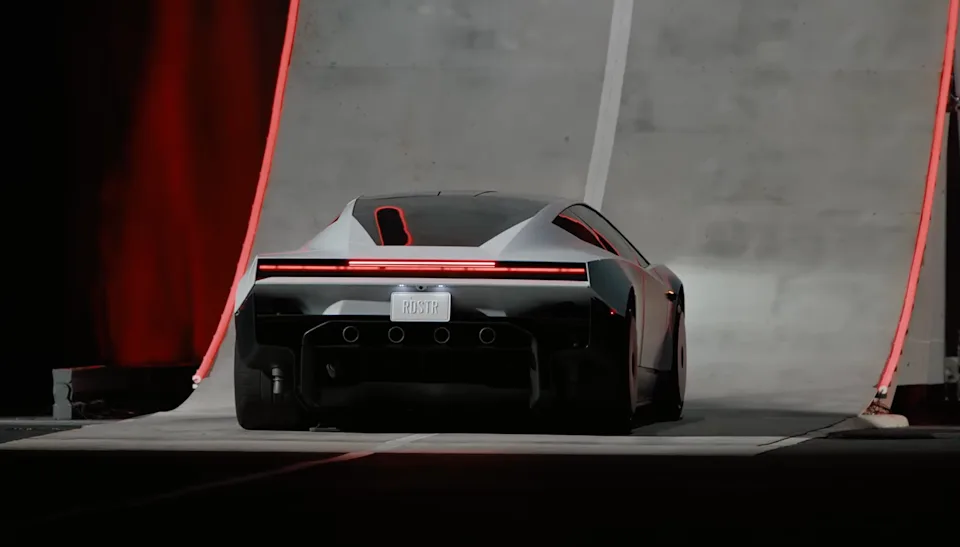
The rumors were wild, the internet memes were endless, and almost everyone thought it was just another exaggerated claim that would never see the light of day. But at a live demonstration at the SpaceX testing facility in McGregor, Texas, Tesla took the wraps off a redesigned version of the long-awaited next-generation Roadster. It was not just a shiny electric sports car sitting on a turntable. The machine fired high-pressure gas thrusters, lifted off a launch platform, rotated in mid-air, and clung completely upside down to an inverted test track using heavy-duty suction fans.
Elon Musk walked out with a massive grin and made an announcement that sent shockwaves across social media: flying cars are no longer science fiction. Production is officially targeted for 2028, nearly a decade after the original prototype was shown to the public.
For years, skeptics argued that building a rocket-assisted sports car was pure fantasy. Critics dismissed it as a distraction from manufacturing delays, shifting deadlines, and intense market competition. Yet seeing a full-sized, road-ready sports car leap off the asphalt and stabilize itself above the ground proved that Tesla and SpaceX engineers have been working on something far crazier behind closed doors than anyone anticipated.
The Wild McGregor Reveal: What Actually Happened on the Track
The event in McGregor did not look like a typical auto show. There were no sleek convention center carpets or corporate sales decks. Instead, Tesla set up an extreme obstacle course at SpaceX’s rocket testing grounds to put the Roadster’s new aerospace hardware through its paces.
The demonstration started on normal ground. The vehicle shot down the straightaway with explosive force, using an electric powertrain combined with rear cold-gas thrusters to blast from zero to 60 miles per hour in under one second. The acceleration was so violent that the tires barely seemed to grip before the car was already hundreds of feet down the track.
The $0 Secret To Launching Your Entire Online Empire
Why pay hundreds every month for separate software? Build funnels, send emails, and make sales with Systeme.io completely free.
Get Started For $0Free Forever • No Credit Card Needed • Beginner-Friendly
Then came the stunt that left the audience speechless.
The car accelerated toward an elevated, curved steel track designed like an inverted roller coaster loop. High-powered internal vacuum fans spun up with an ear-piercing whine, pulling thousands of pounds of air out from underneath the chassis. The suction generated an immense amount of artificial downforce, allowing the Roadster to drive completely upside down across the ceiling of the steel structure without falling.
Just when people thought the show was over, the vehicle raced off an angled launch ramp. Instead of tumbling back to earth, perimeter thrusters blasted jets of high-pressure air into the dirt below. The car lifted cleanly into the air, hovered for several seconds, performed a controlled 180-degree flat spin, and settled gently back onto all four wheels.
Musk claimed on stage that this vehicle marks the very first time aerospace cold-gas propulsion has been built directly into a production-bound road car. For an entrepreneur who turned impossible ideas into reality throughout his life, as covered in Whatsbuzzn’s look at how he went from broke college student to world’s richest man, this reveal might be his most outrageous flex yet.
How the Technology Works: Breaking Down the SpaceX Thrusters
To understand how a heavy electric vehicle can jump, hover, and drive upside down, you have to ignore the idea of wings and jet engines. The new Roadster does not sprout airplane wings or rely on spinning helicopter blades.
The vehicle borrows hardware straight from the Falcon 9 and Starship space programs. Here is how the systems function in plain language:
1. Ultra-High Pressure Cold-Gas Thrusters
Inside the body of the car sits a massive composite overwrapped pressure vessel, often called a COPV. This tank stores compressed inert gas at astronomical pressures, reaching up to 10,000 pounds per square inch.
Electric valves connected to the car’s central computer open and close in fractions of a millisecond. When opened, the gas rushes out through seamless nozzles hidden beneath the bodywork and behind the license plate holder. Because the gas is compressed air rather than burning fuel, there are no flames, no hot exhaust, and no risk of setting the road on fire. The sheer physical push of the escaping gas creates instant thrust in whichever direction the computer points it.
2. Multi-Mode Ground Suction Fans
Electric cars are notoriously heavy because of their battery packs. Getting a heavy car to stay upside down or corner at extreme speeds usually requires massive wings that create drag.
Tesla tackled this problem by installing high-speed electric suction fans underneath the floor. These fans suck the air out from beneath the car, creating a strong vacuum seal between the chassis and the asphalt. This suction creates massive downforce even when the car is barely moving. It allows the tires to stick to the road with immense grip, preventing spinouts and making inverted driving physically possible.
3. Steer-by-Wire Flight Control
When a vehicle leaves the ground, a traditional steering wheel connected to mechanical tie rods becomes useless. The Roadster relies on a fully digital steer-by-wire system.
Sensors read input from the driver’s yoke and immediately coordinate the wheels, the active aerodynamic wings, and the thruster bursts simultaneously. If the car starts to pitch sideways in the air, the stability software fires micro-bursts from the opposite thrusters to level the body out before the wheels hit the tarmac.
You can see the detailed hardware breakdown and reservation tiers directly on the official Tesla Roadster page.
Insane Speed Numbers: 0 to 60 MPH in Under One Second
For decades, getting a production car from zero to 60 miles per hour in less than two seconds was seen as the holy grail of automotive performance. Supercar makers spent millions shaving tenths of a second off their times.
Tesla claims the thruster-equipped Roadster shatters that barrier completely by reaching 60 miles per hour in less than 0.99 seconds.
Send, Spend & Hold Money Worldwide Without Hidden Fees
Transfer money internationally at the real exchange rate and hold 40+ currencies in one account.
Open a Wise AccountMid-market rate • Fast transfers • 40+ currencies
To put that speed into perspective, 0.99 seconds is faster than the pull of free-fall gravity. It matches the initial launch acceleration of a fighter jet leaving the deck of an aircraft carrier. The driver and passenger experience forces approaching 2.5 to 3 Gs, which is enough to pin your arms back and push the air out of your lungs.
Musk even joked during the reveal that launch mode with the SpaceX thrusters activated comes with a formal health warning: it is probably not a good idea for anyone with a heart condition or medical issues to mash the throttle.
Beyond the lightning launch, Tesla claims the vehicle can exceed a top speed of 230 miles per hour while delivering an estimated highway driving range of several hundred miles when operating in standard electric mode without using the thruster tanks.
Three Different Models: Which One Actually Takes Flight?
Tesla made it clear during the presentation that not every Roadster rolling off the assembly line will jump off ramps or hover in the sky. The company outlined three distinct versions of the vehicle to cater to different types of drivers:
The Base Roadster (Road Ready)
The entry-level model is built purely for the highway and track. It features a two-seater interior, an all-electric tri-motor powertrain, and active aerodynamic flaps that adjust based on your speed. It comes equipped with the multi-mode suction system to give drivers unbelievable grip in tight corners, but it does not have the rocket thrusters installed.
The SpaceX Package (Race Ready)
This mid-tier version steps into extreme performance territory. It keeps the two-seat setup but installs the high-pressure gas system and cold-gas thrusters along the rear bumper. This package is designed to unlock sub-one-second acceleration and mind-bending track lap times. While it cannot fly into the air, the rear thrust propels the car forward with rocket-like intensity.
The Air-Ready Edition (Invite Only)
This is the showstopper that everyone is buzzing about. To make room for the extra high-pressure tanks, plumbing, and perimeter thruster nozzles, Tesla removed the passenger seat, turning the vehicle into a single-seat cockpit. Thrusters are positioned around the entire perimeter of the chassis, giving the car upward lift, forward thrust, and rotational control.
Tesla explicitly confirmed on its website that this edition can hover and perform controlled aerial hops. However, the company also included an important disclaimer right beneath the description: this specific version is not approved for public road use.
Can You Actually Fly Over Traffic? The Brutal Legal Reality
The internet is already full of jokes about skipping rush hour traffic by flying over morning commuters, but the reality is far more complicated.
A road vehicle with rocket thrusters and short-flight capability faces a massive legal wall. Two separate government bodies oversee this kind of technology in the United States, and neither one has rules designed for flying cars:
The $0 Secret To Launching Your Entire Online Empire
Why pay hundreds every month for separate software? Build funnels, send emails, and make sales with Systeme.io completely free.
Get Started For $0Free Forever • No Credit Card Needed • Beginner-Friendly
1. The National Highway Traffic Safety Administration (NHTSA)
NHTSA sets strict safety rules for anything that drives on asphalt. Vehicles must have impact-absorbing bumpers, pedestrian safety crumple zones, specific headlight heights, and certified windshields.
Blasting ten thousand pounds of high-pressure compressed air out of a bumper at a red light creates obvious hazards for pedestrians, cyclists, and nearby vehicles. If loose gravel or debris gets kicked up by a thruster blast, it could shatter windows or injure bystanders. Getting street-legal certification for a car equipped with active compressed-air nozzles will be an uphill battle.
2. The Federal Aviation Administration (FAA)
The moment a machine lifts off the ground, it enters the jurisdiction of the FAA. The FAA regulates everything from drones to commercial passenger airliners.
Aircraft must go through intense airworthiness certifications that take years to complete. Furthermore, pilots must hold valid aviation licenses, follow strict flight corridors, and communicate with local air traffic control towers. You cannot legally lift your sports car ten feet into the air on a public road or in a residential neighborhood without violating federal airspace laws.
Because of these hurdles, the flight-capable version of the Roadster will almost certainly be restricted to private tracks, closed testing grounds, and private airfields when it first arrives.
Why Tesla Needs a Massive Win Right Now
The timing of this reveal is no accident. The global automotive landscape has shifted dramatically over the past two years, and Tesla is feeling intense heat from every direction.
For a long time, Tesla enjoyed complete dominance in the electric car space. But today, the competition is fiercer than ever. Chinese automakers are flooding international markets with high-tech, affordable electric options. In fact, Whatsbuzzn reported on how BYD beat Tesla in global EV sales, offering stunning designs and massive battery ranges at prices traditional automakers struggle to match.
At the same time, Tesla has had to rethink its broader strategy. The company has rolled out practical, larger options like the extended Tesla Model Y L to satisfy family buyers who want comfort and interior room over sports car thrills.
On the tech side, Musk has poured massive resources into autonomy, artificial intelligence, and supercomputing clusters. His companies are making historic moves, like dropping billions on advanced AI processing chips to train self-driving neural networks and power advanced hardware like the SpaceX AI device prototype.
Yet despite all these investments, car enthusiasts have been complaining that modern electric vehicles are beginning to feel like identical appliances on wheels. By unveiling a car that shoots compressed air, drives on ceilings, and literally lifts into the air, Tesla has recaptured the shock factor that made the brand a household name in the first place.
The Broader Flying Car Race: Who Else Is Building Them?
While Tesla’s approach uses cold-gas thrusters and ground suction, the rest of the tech and transportation industry is tackling personal flight from a very different angle.
Dozens of aerospace startups and major automotive brands are spending billions on electric vertical takeoff and landing aircraft, commonly known as eVTOLs. These vehicles look more like oversized passenger drones or sleek mini-helicopters than traditional sports cars:
- Alef Aeronautics: Backed by early venture investments from prominent tech figures, Alef is designing a street-legal electric car with a mesh-style body that rotates sideways in the air to reveal internal propellers. Unlike Tesla’s thruster hops, Alef is aiming for sustained forward flight across city skies.
- Joby Aviation and Archer: These aerospace companies are working closely with major airlines to build all-electric air taxis designed to ferry passengers between city centers and international airports. Instead of selling cars to regular consumers, they plan to run scheduled shuttle services to bypass highway congestion.
- Chinese Tech Giants: Companies like XPENG’s AeroHT division have already demonstrated flying modular vehicles featuring land-based vans carrying detachable dual-seat flight modules in the back.
The primary difference is purpose. Most companies in the flying car race are trying to solve urban gridlock and create quiet, efficient regional transit. Tesla, on the other hand, built a hypercar that uses rocket power as the ultimate performance enhancer.
The Engineering Hurdles Still Ahead Before 2028
Showing off a working prototype in a controlled environment is an incredible engineering feat, but turning it into a car that regular customers can buy and maintain is a whole different challenge.
Battery Weight vs. Thrust
Electric car batteries are heavy. Storing enough kilowatt-hours to give a car practical driving range adds hundreds of pounds of dead weight. Lifting that weight off the ground requires massive amounts of thrust, which drains energy quickly. Tesla engineers had to make the Roadster chassis out of ultra-light carbon fiber, titanium, and aerospace-grade alloys to keep weight down.
Keeping the Gas Tanks Full
Cold-gas thrusters consume a massive volume of compressed air in just a few seconds of operation. If you blast off or hover for a brief moment, your high-pressure COPV tank empties rapidly. Tesla says the vehicle includes an onboard high-pressure electric compressor that refills the gas tank over time using the car’s main battery pack. However, recharging a 10,000 PSI tank takes time, meaning you cannot fire the thrusters continuously back-to-back without waiting for the system to repressurize.
Noise and Public Safety
Compressed gas escaping at supersonic speeds makes an intense, deafening sound similar to a mini explosion or a pneumatic cannon blast. Testing this at an isolated rocket range in McGregor is fine. Firing it in a suburban neighborhood or a grocery store parking lot would set off car alarms and cause panic. Tesla’s software will need to lock out thruster functions automatically unless the GPS confirms the vehicle is situated on an approved private track.
Frequently Asked Questions
Can the new Tesla Roadster really fly?
The Invite-Only Air-Ready edition can lift off the ground, hover for brief intervals, and perform controlled mid-air spins using cold-gas thrusters developed alongside SpaceX. However, it does not fly long distances like an airplane or helicopter. It performs short, assisted aerial maneuvers and hops rather than sustained cross-country flight.
How does the car drive upside down?
The Roadster uses high-speed electric suction fans underneath the vehicle that pull air out from beneath the chassis. This creates a powerful ground-effect vacuum seal that generates thousands of pounds of artificial downforce, allowing the car to hold itself against an inverted steel track without falling.
When will the flying Tesla Roadster be available?
During the McGregor presentation, Tesla announced that production is planned to begin in 2028. However, given Tesla’s history of vehicle launch timelines, industry observers expect delivery dates could vary depending on testing progress and supply chains.
Is the flying version of the Roadster street-legal?
The base version of the Roadster is designed to be fully street-legal for regular public roads. However, the Air-Ready version featuring perimeter thrusters is not approved for public road use and is intended strictly for private tracks and closed courses.
How fast is the new Roadster from zero to 60 mph?
Tesla claims the SpaceX Package allows the Roadster to accelerate from zero to 60 miles per hour in less than 0.99 seconds, with a top speed exceeding 230 miles per hour.
The demonstration in McGregor proves that automotive engineering still has plenty of room to surprise the world. Whether the production model arrives on time in 2028 or faces further regulatory hurdles, Tesla has pushed the boundaries of what an electric car can physically do.
Watching a production-style sports car drive along a ceiling, blast high-pressure thrusters, and float above the asphalt feels like stepping straight into the next era of personal mobility. As regulators and engineers sort out the details over the coming years, one thing is certain: the conversation around sports cars and flying machines has changed forever.
What are your thoughts on Tesla’s flying sports car reveal? Do you think everyday flying cars will ever become practical, or will this always remain a high-priced playground toy for private tracks?
