
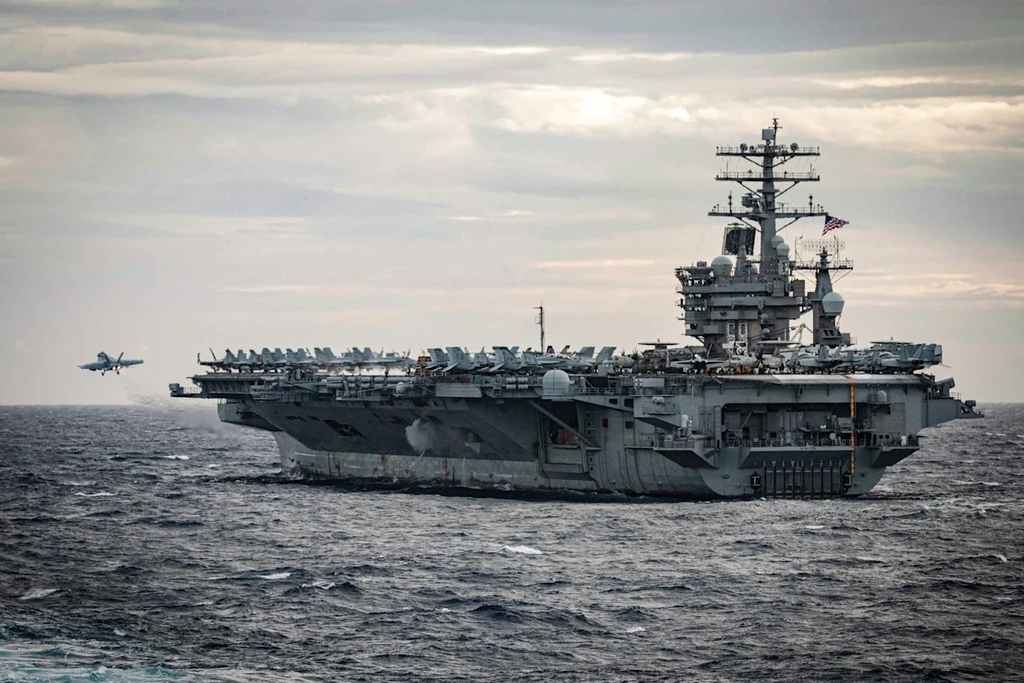
The United States military is making a massive show of strength in the Middle East. The Pentagon has officially ordered a third aircraft carrier strike group, led by the nuclear-powered USS Theodore Roosevelt, to deploy directly to the region.
Along with this massive warship, thousands of additional US Marines and naval personnel are heading toward the Arabian Sea. This sudden movement brings the total American military presence in the area to well over 50,000 troops, supported by hundreds of advanced fighter jets, warships, and missile defense systems.
This escalation comes at a moment when diplomatic talks between Washington and Tehran have stalled. With conflict already threatening vital shipping lanes and global energy supplies, sending a third carrier strike group signals that the United States is preparing for every possible outcome.
The Big Move: What Is Happening Right Now?
The Pentagon has confirmed that the USS Theodore Roosevelt departed from its Pacific homeport and is heading straight toward the US Central Command area of responsibility. Central Command oversees all American military operations across the Middle East.
The USS Theodore Roosevelt is not traveling alone. It is accompanied by a full carrier strike group, including guided-missile cruisers and destroyers designed to shield the carrier from air and missile attacks.
The $0 Secret To Launching Your Entire Online Empire
Why pay hundreds every month for separate software? Build funnels, send emails, and make sales with Systeme.io completely free.
Get Started For $0Free Forever • No Credit Card Needed • Beginner-Friendly
Simultaneously, the USS Makin Island Amphibious Ready Group and the 13th Marine Expeditionary Unit have also set sail. This combined force brings approximately 4,200 Marines and sailors, equipping American commanders with specialized landing forces, heavy armor, and amphibious assault capabilities.
These new forces will join two other supercarriers already operating in regional waters: the USS George H.W. Bush and the USS George Washington. Having three aircraft carrier strike groups in a single region is an extremely rare occurrence. The last time the US military assembled this level of naval firepower in the Middle East was during the opening weeks of major combat operations in the early 2000s.
This rapid reinforcement comes following months of unpredictable military exchanges. If you want to catch up on the earlier events leading to this buildup, read our full breakdown on how US and Iran trade air attacks in the Strait of Hormuz.
Why Is the United States Deploying Three Aircraft Carriers?
An aircraft carrier is much more than just a big ship. It is essentially a floating, heavily protected military airbase capable of launching dozens of strike aircraft within minutes. Placing three of these supercarriers in the Middle East gives the United States unmatched firepower and flexibility.
There are two main reasons behind this deployment strategy: deterrence and operational readiness.
First, Washington wants to send an undeniable message to Tehran and its regional allies. By positioning thousands of troops and advanced fighter squadrons right off the coast, the US hopes to deter further strikes against American personnel, commercial shipping vessels, and allied nations in the region.
Second, military planners are preparing for the possibility that diplomatic efforts completely collapse. Negotiations regarding nuclear capabilities, regional security, and maritime access have hit a standstill.
President Donald Trump recently indicated that the administration is weighing all options if a comprehensive deal cannot be reached soon. You can learn more about the diplomatic background in our analysis on how Trump revives calls for Iran regime change.
Meet the Flotilla: Inside the American Naval Fleet
Understanding the scale of this military buildup requires looking at the specific ships and units making their way to the region. Each component brings a distinct capability to the table.
USS Theodore Roosevelt (CVN-71)
The USS Theodore Roosevelt is a Nimitz-class nuclear-powered aircraft carrier. Named after the 26th president of the United States, this massive vessel stretches over 1,000 feet in length and carries a crew of roughly 6,000 sailors and airmen.
Its flight deck houses Carrier Air Wing 11, which includes F/A-18 Super Hornet strike fighters, EA-18G Growler electronic warfare aircraft, and E-2D Hawkeye airborne warning aircraft. The ship can launch and recover aircraft around the clock, giving commanders the ability to conduct continuous missions over vast distances.
USS George Washington and USS George H.W. Bush
The USS George Washington arrived in the region during late summer to relieve the USS Abraham Lincoln. The Lincoln had been stationed at sea for over 260 days straight, leading to severe fatigue among its crew.
Meanwhile, the USS George H.W. Bush has been operating in regional waters since spring. Having both of these supercarriers operating together alongside the incoming Theodore Roosevelt gives the US military unprecedented coverage over maritime choke points.
The Marines and Amphibious Power
Airpower is only one side of the equation. The arrival of the USS Makin Island and the 13th Marine Expeditionary Unit adds a ground assault dimension to the fleet.
Amphibious assault ships are designed to transport Marines, hovercraft, armored vehicles, and attack helicopters directly into contested coastal environments. They can perform rapid evacuations of civilian personnel, conduct targeted raids, or secure vital ports on short notice.
Send, Spend & Hold Money Worldwide Without Hidden Fees
Transfer money internationally at the real exchange rate and hold 40+ currencies in one account.
Open a Wise AccountMid-market rate • Fast transfers • 40+ currencies
According to reporting from The Guardian, military analysts view this combination of carrier air wings and Marine landing forces as a clear indication that the Pentagon wants every strategic option ready for immediate deployment.
What This Escalation Means for Global Oil Prices and the Economy
Whenever military tension rises in the Middle East, energy markets around the globe react immediately. The area surrounding the Arabian Sea and the Persian Gulf contains some of the most critical oil transit routes on Earth.
At the center of this economic concern is the Strait of Hormuz. This narrow waterway connects the Persian Gulf to the Gulf of Oman and the open ocean.
Approximately 20 percent of the world’s petroleum flows through this single bottleneck every day. If conflict disrupts tanker traffic or forces shipping companies to reroute their vessels around southern Africa, global oil supply drops instantly.
We have already seen warning signs of this economic strain. Commercial shipping insurance rates have skyrocketed, and international oil traders are closely watching every military movement.
When tanker traffic slows down, crude oil prices rise. That price increase quickly reaches local gas stations, driving up fuel costs for commuters and raising shipping expenses for consumer goods.
To understand how these maritime tensions impact your everyday expenses, check out our detailed report on how Iran sets its terms to reopen the Strait of Hormuz.
For a broader look at energy market instability, you can also read our coverage on how global oil crises escalate as attacks hit key pipelines.
Tehran’s Response: How Iran and Regional Powers Are Reacting
The decision to send a third aircraft carrier has not gone unnoticed in Tehran. Iranian political and military officials have responded with a mixture of defiance and strategic warning.
Iranian leadership maintains that the nation does not seek a broader conflict, but warns that any direct action against its territory or infrastructure will face an immediate response. Iranian defense forces have increased their patrol activities around key coastal regions and conducted military exercises testing anti-ship missiles and attack drones.
The $0 Secret To Launching Your Entire Online Empire
Why pay hundreds every month for separate software? Build funnels, send emails, and make sales with Systeme.io completely free.
Get Started For $0Free Forever • No Credit Card Needed • Beginner-Friendly
At the same time, regional powers are watching the situation with deep concern. Neighboring Gulf nations rely on stable trade routes and peaceful waters to maintain their economies. Many are actively pushing for diplomatic solutions to avoid an open war that could damage regional infrastructure.
Meanwhile, major global powers like China and Russia are keeping a close eye on American troop movements. Beijing relies heavily on Middle Eastern crude oil to fuel its economy, making maritime stability a top priority for Chinese leadership.
To explore how international relations are shifting because of this confrontation, read our breakdown on how China moves in as Xi Jinping challenges US power in the Middle East.
US Political Reactions and the Impending Midterm Elections
The deployment of a third aircraft carrier group is also creating massive debate inside American domestic politics. With the 2026 midterm elections fast approaching, lawmakers in Washington are sharply divided on the administration’s foreign policy strategy.
Supporters argue that displaying overwhelming military power is the best way to prevent a larger war. They believe that showing weakness or hesitation invites aggression from regional adversaries, making a strong naval presence essential for protecting national interests.
On the other side of Capitol Hill, critics are expressing concern over potential military overreach. Some lawmakers have introduced resolutions aimed at limiting the executive branch’s authority to engage in sustained combat without formal congressional approval.
These political debates reflect growing public concern over the long-term commitments of American forces overseas. You can read more about how Congress is handling these military decisions in our article on why the Senate blocks War Powers Resolution on Iran strategy.
Frequently Asked Questions (FAQs)
Why is deploying three aircraft carriers considered such a big deal?
Deploying three carrier strike groups to a single region is an extraordinary military move. A single carrier strike group provides immense firepower.
Bringing three together creates an overwhelming concentration of naval aircraft, missiles, and defensive capabilities. It usually indicates that the military is preparing for sustained operations or sending the highest possible level of strategic deterrence.
When will the USS Theodore Roosevelt arrive in the Middle East?
The USS Theodore Roosevelt and its accompanying ships departed from California in late September. Military officials estimate that the strike group will fully enter the Central Command operational area by late October or early November.
Could this military movement cause gas prices to go up?
Yes. Military tensions near major oil transit hubs like the Strait of Hormuz directly impact global crude oil markets. If traders fear shipping disruptions or military action against oil infrastructure, oil prices rise, which usually leads to higher gas prices at the pump.
Is the United States planning a ground invasion?
Current military deployments are focused primarily on naval and air power, along with quick-response Marine expeditionary units. Officials have not indicated any plans for a large-scale, long-term ground invasion.
The primary focus remains on maritime security, air defense, and strategic deterrence.
How many US troops are currently in the Middle East?
With the arrival of the USS Theodore Roosevelt strike group, the Makin Island Amphibious Ready Group, and additional support units, the total number of American service members in the region will exceed 50,000 personnel spread across naval vessels, airbases, and military installations.
Looking Ahead: Peace Deal or Extended Conflict?
The next few weeks will be crucial for the future of the region. As the USS Theodore Roosevelt makes its way across the ocean to join the USS George Washington and USS George H.W. Bush, diplomatic channels remain open, but the window for negotiation is shrinking.
Whether this massive buildup leads to a diplomatic breakthrough or a major conflict depends on decisions made in both Washington and Tehran over the coming days. Having three aircraft carrier strike groups in place gives American commanders maximum leverage, but it also elevates the stakes to their highest level in years.
To stay updated on breaking geopolitical news, industry trends, and deep dives into world events, visit our homepage at WhatsBuzzn. If you have questions or feedback on our reporting, feel free to reach out directly through our Contact Page.
You can also connect with our community and get real-time updates across all our social media channels:
- Follow us on Instagram
- Like our page on Facebook
- Join the conversation on X (formerly Twitter)
