
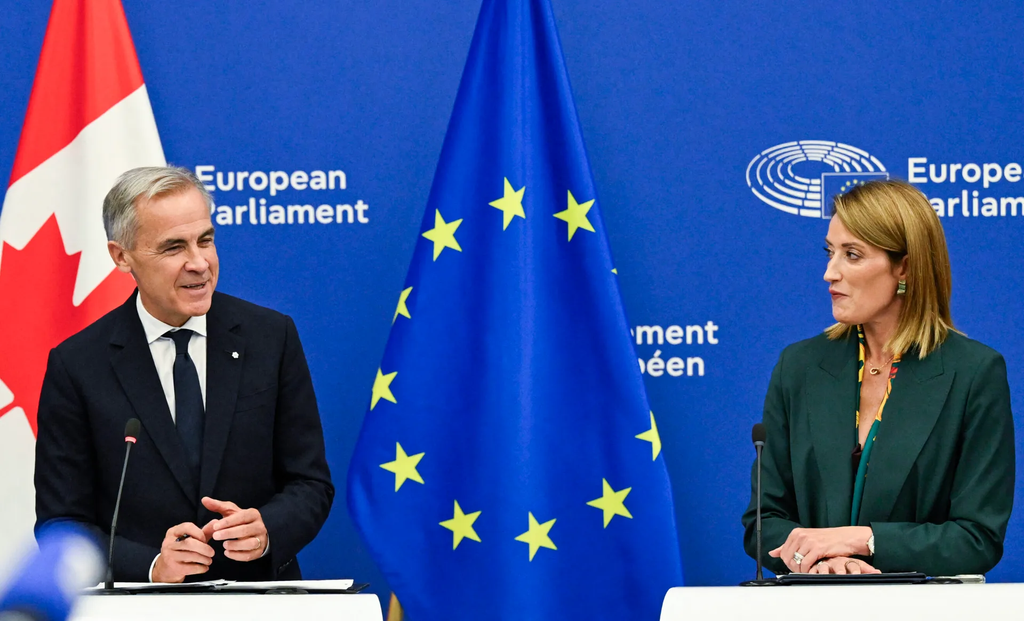
Canada and the European Union are getting ready to sign a massive new partnership pact that could completely reshape how the two global heavyweights do business, defend their borders, and handle climate disasters. A draft statement circulated among European diplomats ahead of an upcoming bilateral summit starting October 29 in Montreal reveals an ambitious plan to link the economies of Canada and Europe far tighter than ever before.
This draft agreement comes at a time when traditional global trade relationships are facing intense strain. With shifting political power, unpredictable tariff policies, and growing security challenges around the world, both sides have decided that working closely together is no longer just a good idea, it is an absolute necessity.
From buying massive fleets of firefighting planes to building joint stockpiles of rare minerals and unifying rules on artificial intelligence, this broad agreement covers almost every major modern industry. Here is a clear breakdown of what is happening, why it matters, and how it will affect ordinary people on both sides of the Atlantic.
What Is Included in the New Canada-EU Deal?
The scope of this upcoming agreement is huge. Rather than focusing strictly on standard tariff reductions like older trade treaties, this new pact targets high-tech collaboration, supply chain survival, green energy transition, and national security.
According to detailed reporting from sources like POLITICO, Canada and the EU intend to lock arms across several key operational areas. These areas represent some of the biggest challenges facing modern nations today.
The $0 Secret To Launching Your Entire Online Empire
Why pay hundreds every month for separate software? Build funnels, send emails, and make sales with Systeme.io completely free.
Get Started For $0Free Forever • No Credit Card Needed • Beginner-Friendly
Breaking Down Digital Barriers and Tech Cooperation
One of the central pillars of the agreement is removing roadblocks in digital trade and technology sharing. Technology companies in both North America and Europe often struggle with conflicting regulations when trying to expand overseas.
Under this new pact, Canada and the European Union plan to align their legal standards for artificial intelligence, quantum computing, cybersecurity, and battery technologies. By setting common ground rules, tech firms will be able to share data and software across borders much easier, making it faster to build new tech tools without facing double regulations.
This digital alliance also creates a united front on cybersecurity. Both sides intend to pool their technical knowledge to protect electrical grids, banking systems, and internet infrastructure from international hackers and cyber threats.
Securing Critical Minerals and Industrial Supply Chains
In recent years, global factory lines have suffered massive slowdowns whenever raw materials become scarce or get caught in foreign trade fights. Canada holds huge reserves of critical raw minerals like lithium, cobalt, nickel, and rare earth elements that are essential for producing smartphones, electric vehicles, medical devices, and solar panels.
Europe currently relies heavily on foreign imports to keep its tech and automotive industries running. Under the new agreement, European companies will speed up investments directly into Canadian mining and mineral processing operations.
In return, Canada and the EU will build joint strategic stockpiles of critical resources. Having reserve stocks of essential minerals means factories in North America and Europe can keep running smoothly even if sudden trade wars or market fluctuations interrupt normal shipments.
Fighting Wildfires Together with Heavy Aircraft
Climate disasters have become a massive burden for both North America and Europe. Severe forest fires now scorch millions of acres every summer, destroying towns, harming air quality, and straining local rescue teams.
To tackle this shared threat, Ottawa and Brussels are preparing a major joint response. The two sides plan to jointly purchase 50 De Havilland water bomber planes specifically built for aerial firefighting.
These specialized aircraft will be shared between Canada and European nations. When wildfire season hits North America, the fleet can operate across Canadian provinces. When fire risks shift to Southern Europe during their hottest months, the planes can be deployed across the Mediterranean region. Production is already planned so these water bombers will be ready for active duty starting around 2030.
Defense, Security, and Long-Term Ukraine Support
Beyond commercial trade and environmental emergency responses, this new partnership deeply strengthens military and diplomatic coordination. The draft statement stresses that both regions share core values around democracy, human rights, and international law.
Canada and the EU are preparing to expand their joint support for Ukraine. Ottawa is looking directly into participating in the European Union’s massive multi-billion loan program designed to rebuild Ukrainian infrastructure and keep its government functioning.
Additionally, Canadian Prime Minister Mark Carney and European leadership are setting up formal pathways for joint defense procurement, military training, and long-term security commitments. This level of defense integration between a North American country and European military structures marks a significant evolution in trans-Atlantic relations.
Why This Historic Partnership Is Happening Right Now
To understand why this sweeping deal is coming together so quickly, you have to look at what has been happening in global politics over the past few years. The world economy is becoming much more fragmented, and traditional trade relationships are no longer as predictable as they used to be.
Trade disputes, sudden import tariffs, and threats of commercial retaliation from major economic powers have made many countries nervous. Canada in particular has faced economic pressure from traditional trading partners, prompting leadership in Ottawa to search for reliable, like-minded allies elsewhere.
At the same time, European Union leaders have realized that relying on distant or politically unstable suppliers for energy and raw materials creates dangerous economic vulnerabilities. By forming a tighter alliance with Canada, Europe gains reliable access to a stable, friendly democracy rich in energy, minerals, and agricultural resources.
Send, Spend & Hold Money Worldwide Without Hidden Fees
Transfer money internationally at the real exchange rate and hold 40+ currencies in one account.
Open a Wise AccountMid-market rate • Fast transfers • 40+ currencies
European Commission President Ursula von der Leyen sparked widespread international headlines when she floated the idea of Canada becoming the first official “associate member” of the European Union. While full EU membership remains reserved for geographical European nations, the associate status concept shows just how eager European officials are to bring Canada closer into their economic fold.
This proposal drew immediate reactions and trade warnings from Washington, where political figures worry about losing commercial influence over North America. However, European Commission representatives quickly clarified that this growing partnership is not directed against any third party. Instead, it is focused purely on building stable trade channels that protect democratic nations from global shocks.
How This Huge Agreement Impacts Everyday People and Businesses
When world leaders sign agreements full of complex legal terms, it can be hard to figure out what it actually means for normal citizens. However, this partnership will likely have a direct impact on everyday life over the coming decade.
For Tech Workers and Small Businesses
If you work in software development, artificial intelligence, clean energy, or advanced manufacturing, this deal opens up major doors. Software developers in Canada will find it much easier to sell their digital platforms to European customers without having to jump through confusing foreign legal hoops.
Engineers and researchers will also benefit from smoother cross-border collaboration. Universities and tech labs in Europe and Canada will be able to share research grants, swap technical talent, and work on high-tech projects far more easily.
For Everyday Consumers
When global supply chains are protected by government stockpiles, prices on consumer goods tend to stay much more stable. During past supply chain panics, the cost of electronics, cars, and home appliances soared because basic components were trapped in distant ports.
By securing raw mineral supply chains and removing digital trade barriers, manufacturing companies can produce items faster and with less overhead. Over time, this helps prevent sudden price spikes on everyday electronics, batteries, and electric vehicles.
For Climate Safety and Local Communities
Wildfire smoke has caused severe air pollution across major cities in both North America and Europe over recent years. Having a dedicated fleet of 50 water bomber planes means emergency response crews will have much stronger tools to put out forest fires before they destroy entire towns.
Deeper green tech cooperation also means both regions will share environmental tools faster. That leads to cleaner energy grids, better public transport technology, and stronger protections for natural resources.
What Are the Main Challenges Facing the Deal?
While the draft agreement paints an optimistic picture of future cooperation, bringing this massive pact to life will require overcoming a few notable hurdles.
The $0 Secret To Launching Your Entire Online Empire
Why pay hundreds every month for separate software? Build funnels, send emails, and make sales with Systeme.io completely free.
Get Started For $0Free Forever • No Credit Card Needed • Beginner-Friendly
First, aligning legal rules across continents takes a lot of time. Matching European digital privacy laws with Canadian regulatory frameworks requires detailed legislative work on both sides. Government agencies will need to spend months working out the exact details for data security and technical standards.
Second, geopolitical pressure will remain strong. External global powers that rely on economic leverage may attempt to challenge or counter closer Canada-EU ties. Trade tariffs or diplomatic pushback could be used to try and slow down deeper integration.
Third, financial commitments require approval. Purchasing fleets of specialized aircraft and backing large international support packages requires votes from lawmakers and taxpayers across multiple nations. If economic pressures grow at home, political debates over international spending could create delays.
Frequently Asked Questions (FAQs)
When will the official Canada-EU partnership announcement take place?
The formal announcement is scheduled to take place during the landmark bilateral summit starting late October in Montreal. Leaders from both sides will meet to sign the official declarations and lay out the exact roadmap for execution.
Is Canada actually becoming an official member of the European Union?
No, Canada is not becoming a full EU member state. Full membership requires being a geographical European country. However, leaders are exploring an “associate member” style framework that allows Canada to participate directly in select EU economic programs, research funds, and security initiatives.
How does this deal affect existing Canada-EU trade agreements?
This new pact builds directly on top of existing frameworks like the Comprehensive Economic and Trade Agreement (CETA). While older treaties focused heavily on removing tariffs on physical exports, this new agreement targets high-tech integration, critical mineral supply security, defense collaboration, and wildfire response.
Why are Canada and the EU buying firefighting planes together?
Both regions have suffered destructive wildfire seasons that pushed local emergency teams to their limits. By purchasing a shared fleet of 50 De Havilland water bomber planes, they can deploy aircraft where they are needed most depending on which continent is experiencing peak fire danger.
Which business sectors will benefit the most from this pact?
The primary beneficiaries include companies working in artificial intelligence, software engineering, cybersecurity, critical mineral extraction, electric vehicle manufacturing, clean energy, and aerospace defense.
What Lies Ahead for Canada and the European Union
This upcoming Montreal summit represents a major shift in how modern democratic nations build security and trade alliances. As global politics grow more unpredictable, Canada and the European Union are demonstrating that strong economic ties can be forged outside traditional reliance on single dominant partners.
By combining Canada’s vast natural wealth with Europe’s massive industrial base and consumer market, both sides are creating a resilient framework capable of withstanding global economic shocks. Whether it is keeping supply chains moving, protecting digital privacy, or putting out dangerous wildfires, this sweeping agreement sets a new standard for international partnerships.
Staying informed on global developments like this helps you stay ahead of where economic opportunities and job markets are moving next. To discover more about our editorial mission and how we bring you real, easy-to-understand news, check out our about page. If you have thoughts on this story or want to get in touch with our team directly, head over to our contact page. You can also stay connected with us every day by following our official updates on Instagram, joining our online community on Facebook, and getting real-time news alerts on Twitter/X.
