
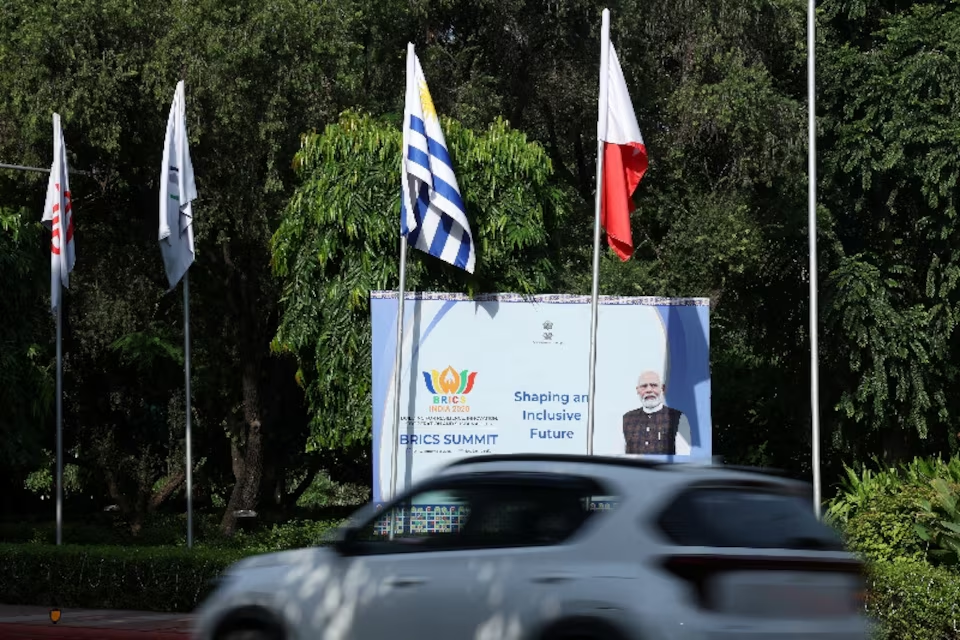
World leaders are gathering at the Bharat Mandapam venue in New Delhi as India hosts the 18th BRICS Leaders Summit on September 12 and 13, 2026. Indian Prime Minister Narendra Modi is welcoming top figures from across the globe, including Russian President Vladimir Putin, Chinese President Xi Jinping, Iranian President Masoud Pezeshkian, South African President Cyril Ramaphosa, and Indonesian President Prabowo Subianto.
This major diplomatic meeting comes at a tense moment for world politics. Military strikes involving the United States and Iran have sparked a widening crisis in the Middle East, putting global energy supplies at risk and creating serious friction between international powers.
As the host nation, India is trying to keep the focus on economic growth, food security, and technology sharing for developing countries. However, the conflict in West Asia is putting the unity of the expanded BRICS group to a severe test. Members hold vastly different political ties and economic interests, making it tricky to agree on a single path forward.
What Is Happening at the 2026 BRICS Summit in New Delhi?
The two-day summit in New Delhi is the culmination of India’s year-long chairship of the bloc. Throughout 2026, Indian officials have organized more than 350 preparatory meetings across 25 cities to build consensus on trade, technology, and sustainable development.
This year’s official theme is “Building for Resilience, Innovation, Cooperation, and Sustainability.” According to official statements from the Ministry of External Affairs of India, the agenda reflects a human-centered approach aimed at solving everyday problems for people living in the Global South.
Build Funnels, Email Lists & Sell Online With One Free Tool
Create funnels, send emails, and sell online using Systeme.io without paying for multiple tools.
Create Free AccountFree forever • No credit card • Beginner-friendly
The gathering marks a significant moment for BRICS because it is the first major summit since its recent expansions. Originally formed by Brazil, Russia, India, China, and South Africa, the group grew in 2024 to welcome Egypt, Ethiopia, Iran, the United Arab Emirates, and Saudi Arabia. Indonesia joined as a full member in 2025, alongside dozens of official partner nations from Africa, Asia, and Latin America.
Together, the expanded BRICS alliance represents nearly half of the world’s population, around 40 percent of global economic output, and more than a quarter of international trade. That massive combined footprint gives the bloc real weight, but it also means bringing together leaders with very different foreign policies.
The Heavy Shadow of the Middle East War on Global Markets
It is impossible to separate this summit from the military conflict currently shaking West Asia. Recent months have seen a dramatic dangerous escalation in the region, with retaliatory missile strikes and direct naval clashes.
The security situation in the Persian Gulf has deteriorated sharply following major incidents, including US airstrikes and Iranian responses across the Middle East as well as targetings of maritime traffic, such as when US strikes hit Iranian oil tankers in shipping lanes.
These military actions have raised fears over the safety of the Strait of Hormuz. This narrow waterway is one of the most critical energy bottlenecks on earth. A huge portion of the world’s daily petroleum supply passes through it every single day.
When shipping lanes in the Gulf are threatened, oil prices jump immediately. Higher oil prices mean higher transport costs, which leads directly to pricier groceries, electricity, and consumer goods everywhere. For energy-importing countries across Africa and Asia, a long conflict means rising inflation and severe strain on national budgets.
As diplomatic efforts founder and political rhetoric sharpens, including cases where calls for regime change in Iran have disrupted peace talks, the geopolitical situation has become a central worry for every leader sitting in New Delhi.
Why the Conflict Tests BRICS Unity
The BRICS group was built primarily as an economic partnership, not a military alliance. Unlike formal defence pacts, BRICS operates strictly on consensus. Every official statement or joint decision requires the approval of every single member country.
That rule makes action difficult when member states find themselves on opposing sides of a geopolitical crisis. The conflict in the Middle East highlights several clear splits within the expanded group:
Iran is actively seeking to use the New Delhi summit as a platform to rally diplomatic support against Western military actions. Teheran wants BRICS to release a strong joint statement condemning foreign intervention and demanding an immediate halt to economic sanctions.
The United Arab Emirates and Saudi Arabia take a much more balanced position. While they want an immediate end to regional violence to protect their infrastructure and commercial ports, they also maintain valuable economic and security links with Western nations. They prefer a cautious, neutral stance that emphasizes regional diplomacy rather than picking sides.
China is looking to expand its diplomatic influence across the Middle East. Over recent years, we have seen how Xi Jinping is challenging US influence in the Middle East by mediating peace talks and expanding trade investments. However, Beijing also relies heavily on stable oil imports to power its massive manufacturing sector, meaning prolonged instability in the Gulf hurts Chinese economic goals.
Russia, while aligned with Iran on pushing for a multipolar global system, has its own complex geopolitical objectives to manage. Meanwhile, India wants to maintain its long-standing principle of strategic autonomy.
India relies on West Asia for crucial energy imports and has millions of Indian citizens living and working in Gulf states. At the same time, New Delhi has built strong economic and technological ties with Western democracies. Indian diplomats are working hard to make sure BRICS does not turn into an anti-Western club, which would alienate key trade partners.
These internal strains show how hard it is to maintain unity in a growing international bloc. It is similar to how regional groups like ECOWAS face strain from internal political splits, showing that when alliances grow larger, keeping everyone aligned becomes a major challenge.
India’s Delicate Diplomatic Role as Host
Hosting a summit under these conditions requires careful management. Prime Minister Narendra Modi and his diplomatic team are spending much of the weekend conducting high-stakes bilateral meetings on the sidelines of the main summit events.
One of the most watched encounters is between Modi and Iranian President Masoud Pezeshkian. Their discussions focus on keeping commercial shipping lines safe, securing regional energy supplies, and exploring ways to end hostilities peacefully.
At the same time, Modi is holding detailed talks with Russian President Vladimir Putin. Their dialogue centers on long-term energy contracts, trade payments using national currencies, and defense cooperation.
The summit also provides a rare setting for direct dialogue between India and China. President Xi Jinping’s visit to New Delhi marks his first trip to India in seven years. The two leaders are taking the opportunity to review peace along their shared border, known as the Line of Actual Control, and discuss ways to normalize trade relations after years of standoff.
The ultimate test for Indian diplomacy is whether the host nation can craft a joint declaration at the end of the summit. Drafting a document that satisfies Iran’s demands for solidarity, respects the neutrality of Gulf members, and aligns with the economic priorities of India, Brazil, and South Africa is no easy task.
Economic Resilience, Local Currencies, and Supply Chains
While headlines naturally focus on war and diplomacy, the main work of the BRICS summit revolves around economic cooperation. Member countries are searching for practical ways to shield their domestic economies from global shocks.
A major topic on the table in New Delhi is the movement toward using national currencies for cross-border trade. Many developing nations want to reduce their dependence on the US dollar for international transactions.
When global trade relies heavily on a single currency, changes in foreign interest rates or international financial sanctions can hurt smaller economies overnight. By setting up direct payment mechanisms in local currencies, BRICS countries hope to lower transaction costs and protect their local businesses.
This push for financial independence is gaining momentum around the world as nations react to international trade disputes, much like how deepening trade wars impact global supply chains.
Another key priority is expanding the work of the New Development Bank. Based in Shanghai, this bank provides funding for infrastructure, clean energy, and transportation projects in emerging economies without the strict conditions often attached to traditional global lenders.
BRICS leaders are also discussing ways to secure food supplies and agricultural trade. With climate events and armed conflicts interrupting global farming, creating resilient food networks is vital for protecting low-income families from sudden price spikes.
Technology, Innovation, and the Future of Work
India has placed digital transformation at the heart of the 2026 summit agenda. Through the “Bharat Innovates Exhibition” set up at the summit venue, host officials are demonstrating how simple, scalable digital tools can improve public services.
Build Funnels, Email Lists & Sell Online With One Free Tool
Create funnels, send emails, and sell online using Systeme.io without paying for multiple tools.
Create Free AccountFree forever • No credit card • Beginner-friendly
Developing nations inside BRICS are eager to share technology in areas like digital payments, modern healthcare, disaster management, and artificial intelligence. Access to affordable digital tools allows emerging economies to modernize faster and create new job opportunities for young populations.
Understanding these global shifts in technology is essential for anyone building a modern career or business. If you are interested in exploring how artificial intelligence and new software tools are transforming modern industries, check out our insights on technology and AI innovations.
Similarly, technology is changing how creators and businesses build digital audiences globally. You can discover modern strategies for online content creation by reading our guide to YouTube automation trends.
How This Summit Impacts Everyday Life
It can be easy to view international diplomatic summits as distant meetings that have little to do with daily routine. However, the decisions made and the conflicts discussed at the BRICS summit in New Delhi affect people’s lives directly.
Here is how these global events ripple down to everyday households:
1. Fuel Prices and Transportation Costs
If BRICS leaders cannot find ways to encourage diplomatic calm in West Asia, ongoing threats to oil tankers will keep fuel prices elevated. Every time petrol prices go up, public transportation fares rise, and shipping goods costs more money.
2. Grocery Bills and Food Inflation
Energy costs are tied directly to agriculture. Farmers use fuel for tractors, and fertilizers require natural gas to produce. When global energy markets are volatile, food prices at local markets quickly follow suit.
3. Business Stability and Job Growth
Small business owners rely on predictable supply chains. When global trade routes are disrupted by war or currency swings, importing stock or raw materials becomes unpredictable and expensive. Stable cooperation among major economies helps keep trade moving smoothly, which supports local jobs.
4. Financial Security
When major developing nations agree on shared trade policies and financial tools, it creates economic stability across the Global South. That stability helps protect local currencies from severe devaluation, helping everyday people preserve their savings.
Frequently Asked Questions (FAQs)
When and where is the 2026 BRICS Summit taking place?
The 18th BRICS Leaders Summit is taking place on September 12 and 13, 2026, at the Bharat Mandapam venue in New Delhi, India.
Which countries are full members of BRICS in 2026?
BRICS currently consists of 11 full member states: Brazil, Russia, India, China, South Africa, Egypt, Ethiopia, Iran, Saudi Arabia, the United Arab Emirates, and Indonesia. Numerous other countries participate as official partner nations.
Why is the conflict in the Middle East testing BRICS unity?
The conflict pits member nation Iran directly against US military forces and creates security risks for Gulf members like the UAE and Saudi Arabia. Because BRICS requires complete consensus for all decisions, differing foreign policies make agreeing on a joint statement challenging.
What is India’s goal as host of the 2026 summit?
India aims to focus the bloc on practical economic priorities for the Global South, including supply chain resilience, local currency trade, food security, and digital technology sharing, while maintaining a balanced diplomatic stance.
How does BRICS make official decisions?
BRICS operates strictly on consensus. Every member country must agree on official declarations and policy initiatives, meaning a single member can block a proposal if it conflicts with their national interests.
Looking Ahead at Global Diplomacy
As the New Delhi summit unfolds, the world is watching closely to see whether BRICS can bridge its internal political differences and deliver a unified vision for economic growth.
While the military crisis in the Middle East presents serious challenges, the gathering offers a crucial space for direct dialogue between influential global leaders. Whether addressing energy security, trade routes, or digital innovation, the outcomes of this summit will shape economic policies across developing nations for years to come.
Staying informed about international developments helps you navigate economic changes in your own business and daily life. To learn more about our publication and editorial mission, visit our about page. If you have questions or feedback on our coverage, feel free to reach out through our contact page.
You can also join our growing online community and stay updated on trending global stories by following our official social media channels on Instagram, Facebook, and X (Twitter).
