
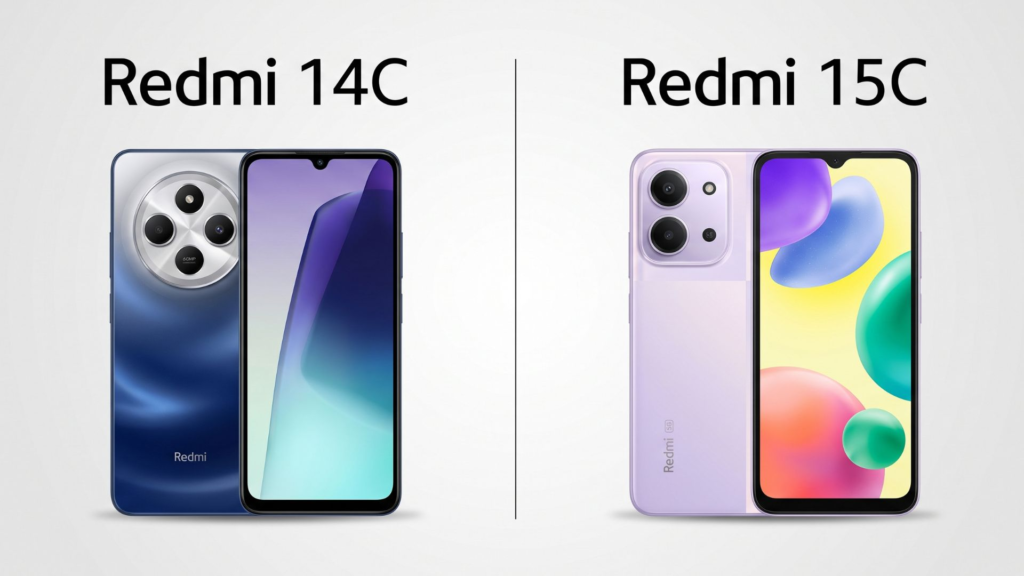
Xiaomi has officially updated its budget smartphone line, replacing the popular Redmi 14C with the newer Redmi 15C. For anyone shopping for a good phone without spending a small fortune, both options look very tempting on paper. They both offer massive displays, clean modern looks, and large batteries that can easily get you through a full day of work or school.
However, a closer look at the specifications reveals several key updates in the Redmi 15C. The newer model brings a bigger battery, faster charging speeds, stronger glass protection, and better resistance against water and dust.
Choosing between these two models comes down to what you actually need from your phone every day. Does the new model offer enough upgrades to justify paying extra, or is the older version still the smarter bargain?
This full side-by-side comparison breaks down design, screen quality, battery life, cameras, performance, and overall value in clear and simple terms.
Design and Build Quality: How Do They Feel in Your Hand?
When you place these two phones side by side, they share a very similar design style. Both feature flat sides, rounded corners, and a bold circular camera housing on the back cover. However, small hardware tweaks make a noticeable difference in daily durability and comfort.
The $0 Secret To Launching Your Entire Online Empire
Why pay hundreds every month for separate software? Build funnels, send emails, and make sales with Systeme.io completely free.
Get Started For $0Free Forever • No Credit Card Needed • Beginner-Friendly
Looking closely at the Redmi 14C
The Redmi 14C measures 171.88 mm tall, 77.8 mm wide, and 8.22 mm thick. It weighs around 205 grams, giving it a solid feel without being overly heavy.
One of the standout features of the Redmi 14C is its glass back option on select colorways, which gives it a surprisingly high-end look for an entry-level device. It comes with IP52 splash protection, meaning it can handle minor water splashes and dusty environments without breaking.
Upgrades on the Redmi 15C
The Redmi 15C steps things up in terms of real-world durability. It features an upgraded IP64 rating, giving it complete protection against dust and much stronger water resistance against accidental splashes.
Xiaomi also added Corning Gorilla Glass 3 on the front screen of the Redmi 15C to help prevent everyday scratches and accidental drops.
While the Redmi 15C is slightly wider at 79.5 mm, it is slightly thinner at 8.0 mm. It maintains the same overall weight of 205 grams. You can also choose between smooth glass finishes or a soft eco-leather back option that feels great to hold and resists fingerprint smudges.
Which design is better?
- Redmi 14C benefits: Available in glossy glass finishes with gradient color patterns, classic 3.5mm headphone jack, and a comfortable slim frame.
- Redmi 15C benefits: Stronger Corning Gorilla Glass 3 front protection, improved IP64 dust and water resistance, and an optional eco-leather back texture.
If you tend to drop your phone or work outdoors, the extra screen protection and water rating on the Redmi 15C make it the clear winner in build quality.
Display Comparison: Screen Size, Brightness, and Smoothness
Budget phones used to suffer from dim, sluggish screens, but both of these models offer big displays with high refresh rates. They make watching videos, reading articles, and scrolling through social media effortless.
Screen features on the Redmi 14C
The Redmi 14C sports a massive 6.88-inch IPS LCD panel. It has an HD+ resolution of 720 x 1640 pixels and supports a fast 120Hz refresh rate.
A high refresh rate means animations look much smoother when you swipe through apps or read web pages. The screen hits up to 600 nits of peak brightness, which works fine indoors or in normal outdoor shadow, but can struggle under direct sunlight.
Screen features on the Redmi 15C
The Redmi 15C expands the screen size slightly to 6.9 inches with an HD+ resolution of 720 x 1600 pixels. It also features a smooth 120Hz refresh rate.
The main improvement here is brightness. The display on the Redmi 15C reaches up to 810 nits in High Brightness Mode (HBM). That extra light makes text and images noticeably easier to see when standing directly under bright sunlight.
Everyday visual experience
Both devices come with TÜV Rheinland certifications for low blue light and flicker-free viewing. This means less eye strain during late-night reading sessions.
While both screens deliver punchy colors for watching movies on YouTube or Netflix, the Redmi 15C holds an advantage when you are outdoors. If you spend a lot of time outside, that brighter display will save you from squinting at your screen.
Performance and Hardware: Speed and Daily Multitasking
Nobody wants a phone that lags when opening simple apps or taking pictures. Both phones handle standard everyday tasks with ease, but their processors and memory setups differ depending on which regional version you pick up.
Redmi 14C processor options
The standard 4G version of the Redmi 14C runs on the MediaTek Helio G81 Ultra processor. It is an octa-core chip built for stable daily performance, web browsing, and simple casual games like Candy Crush or Subway Surfers.
Send, Spend & Hold Money Worldwide Without Hidden Fees
Transfer money internationally at the real exchange rate and hold 40+ currencies in one account.
Open a Wise AccountMid-market rate • Fast transfers • 40+ currencies
In some markets, Xiaomi released a 5G variant powered by the Qualcomm Snapdragon 4 Gen 2 chip, which provides faster app loading and extra processing power.
Redmi 15C processor options
The Redmi 15C uses an optimized version of the MediaTek Helio G81 Ultra chipset paired with updated system software.
While raw processor power is very similar to the older model, the software optimizations in HyperOS 2 help the Redmi 15C run slightly smoother when switching between multiple open applications.
Certain regional 5G models of the Redmi 15C feature upgraded chips like the MediaTek Dimensity 6300, which offers noticeably higher benchmark scores for light gaming and heavy multitasking.
Memory and storage options
Both smartphones offer flexible RAM and storage options to match different budgets:
- Redmi 14C storage options: 4GB RAM with 64GB storage, 4GB RAM with 128GB storage, and 6GB RAM with 128GB storage.
- Redmi 15C storage options: 4GB, 6GB, or 8GB of RAM paired with 128GB or 256GB of internal storage.
- RAM expansion: Both phones allow you to use virtual RAM extension technology to add extra virtual memory from unused storage.
- MicroSD support: Both feature a dedicated microSD card slot so you can expand storage up to 1TB without losing your second SIM slot.
Because the Redmi 15C starts with a baseline of 128GB storage and offers up to 8GB of real physical RAM, it is far better suited for long-term use. You will not run out of space for photo albums, video clips, and app updates anytime soon.
Camera Systems: How Good Are Your Photos and Videos?
Camera performance on budget phones has come a long way over the last few years. You can check official details on the GSMArena database to see full technical sensor specs, but here is how they perform in daily photography.
Primary rear cameras
Both smartphones feature a 50MP primary rear camera with an f/1.8 lens aperture, backed by an auxiliary lens for depth sensing and AI image processing.
In daylight conditions, both phones take clear photos with decent contrast and good color vibrancy. The Xiaomi Imaging Engine speeds up photo capture, meaning you can take quick snapshot after snapshot without long processing delays.
At night, both devices feature a dedicated Night Mode that pulls in extra light. Photos taken in dark settings will still have some visual noise, but they stay detailed enough for quick posts on social media.
The $0 Secret To Launching Your Entire Online Empire
Why pay hundreds every month for separate software? Build funnels, send emails, and make sales with Systeme.io completely free.
Get Started For $0Free Forever • No Credit Card Needed • Beginner-Friendly
Front selfie cameras
This is one area where the older model actually retains a slight technical advantage:
- Redmi 14C front camera: Features a 13MP selfie camera with f/2.0 aperture. It produces sharp skin tones and works well for video calls.
- Redmi 15C front camera: Uses an 8MP selfie sensor with screen flash support.
While 8MP is slightly lower in total megapixels, the Redmi 15C makes up for it with improved software processing and beautification algorithms that balance background lighting better during selfies.
Video recording features
Both devices support 1080p full HD video recording at 30 frames per second on both the front and rear cameras. They also come with classic film filter modes, letting you shoot creative videos with vintage color tints directly inside the default camera app.
Battery Life and Charging Speed: The Biggest Difference
If battery endurance is your highest priority, this section makes your buying decision very easy. The Redmi 15C brings a massive upgrade in both battery size and charging performance.
Redmi 14C battery performance
The Redmi 14C packs a 5160mAh battery. For most normal users, this provides plenty of power to get through a regular day of calls, messaging, social media scrolling, and music playback.
- Video playback: Up to 22 hours
- Voice calls: Up to 42 hours
- Charging speed: Supports 18W wired charging
Charging the 5160mAh battery from near empty to 100% with an 18W charger takes roughly 2 hours.
Redmi 15C battery performance
The Redmi 15C packs a huge 6000mAh battery. This extra capacity turns the phone into a true two-day device under light or moderate use.
- Battery life: Over 19 hours of continuous active screen time in battery stress tests.
- Charging speed: Upgraded to 33W fast charging.
With 33W charging, you can top up this larger battery significantly faster than the Redmi 14C. Getting a 50% charge takes roughly 30 to 35 minutes, making quick morning top-ups before heading out effortless.
Battery comparison summary
- Redmi 14C: Good 5160mAh capacity with basic 18W charging.
- Redmi 15C: Industry-leading 6000mAh capacity with fast 33W charging.
The battery and charging upgrades alone make the Redmi 15C a far superior choice for power users, drivers using navigation apps all day, or anyone who hates carrying power banks around.
Software and User Experience: HyperOS Breakdown
Software determines how pleasant a phone is to use every single day. Both devices run Xiaomi’s modern custom interface, but they ship with different base versions of Android.
Operating system out of the box
- Redmi 14C: Ships with Android 14 out of the box, running HyperOS 1.
- Redmi 15C: Ships with Android 15 out of the box, running HyperOS 2.
HyperOS is designed to be lightweight, fast, and light on system resources. It offers customizable lock screens, smooth control center transitions, and intelligent background battery management.
Because the Redmi 15C starts on Android 15, it will receive software updates and security patches further into the future than the Redmi 14C.
Extra hardware features
Both smartphones come equipped with practical extra features that budget buyers love:
- Side-mounted fingerprint scanner: Built directly into the power button for fast and reliable unlocking.
- Headphone jack: Features a classic 3.5mm audio jack so you can plug in wired headphones without adapters.
- NFC support: Available in select regions for quick contactless payments.
- Headroom volume boost: Allows you to boost speaker volume up to 150% for clearer sound in noisy environments.
Technology and Digital Creator Uses
Budget smartphones have become powerful enough to run modern productivity tools. Many online creators and entry-level digital workers use affordable devices like these to start their online businesses.
If you are exploring creative ways to generate income online, you can read our detailed YouTube automation guides to see how creators manage video channels right from their mobile phones.
Modern mobile chips and smart apps make tasks like video scripting, basic editing, and audio recording easier than ever. You can browse through our latest technology and AI articles to learn how software tools are making smartphone work faster and more efficient for everyone.
Pricing and Overall Value Comparison
Price is usually the deciding factor when choosing an entry-level smartphone. Exact prices vary depending on your country, local taxes, and retail discounts, but both phones target the budget segment.
Why buy the Redmi 14C?
The Redmi 14C is now older, which means stores often sell it at discounted prices.
It makes total sense to choose the Redmi 14C if:
- You find it on clearance or deep discount.
- You only need a basic secondary phone for calls, WhatsApp, and light video streaming.
- You want a sharp 13MP selfie camera on a budget.
Why buy the Redmi 15C?
The Redmi 15C generally costs slightly more because it is newer, but the added hardware value easily justifies the small price gap. You can check current pricing and official retail deals directly on the Official Xiaomi store.
It makes total sense to choose the Redmi 15C if:
- You want a massive 6000mAh battery that lasts two days.
- You want 33W fast charging to top up quickly.
- You want a brighter screen for outdoor visibility.
- You want stronger Gorilla Glass 3 screen protection and an IP64 rating against water and dust.
Frequently Asked Questions (FAQs)
Does the Redmi 15C come with a charger in the box?
In most regions, Xiaomi includes the compatible charging cable and power adapter inside the retail box, though package contents can vary depending on local country regulations. Always check with your seller before ordering.
Can you play heavy games on the Redmi 14C and Redmi 15C?
Both phones can run popular lightweight games like Candy Crush, Temple Run, and Free Fire smoothly. Heavy 3D games like Genshin Impact or PUBG Mobile will run on low graphic settings, but these are budget entry-level processors designed primarily for daily social media and web browsing.
Does the Redmi 15C support 5G networks?
The standard Redmi 15C model is a 4G LTE device. However, Xiaomi offers separate 5G-enabled variants in specific markets. Check the network specifications listed on the box or seller page if 5G connectivity is essential in your area.
Which phone has a better build for outdoor use?
The Redmi 15C is significantly better for outdoor use. It features an upgraded IP64 rating for dust and splash protection, Corning Gorilla Glass 3 front glass, and a brighter screen that reaches up to 810 nits in direct sun.
How long will these phones receive software updates?
The Redmi 15C launches with Android 15 and HyperOS 2 out of the box, giving it an extra year of software support over the Redmi 14C, which shipped with Android 14. Both devices typically receive security patches for up to three years.
If you are trying to pick between these two devices, the Redmi 15C emerges as the clear winner for most buyers. While the Redmi 14C remains a solid choice if you catch it on a big clearance discount, the Redmi 15C gives you a much bigger 6000mAh battery, faster 33W charging, a brighter display, better screen protection, and a higher dust and splash rating. Those practical hardware improvements directly upgrade your daily phone experience.
Want to learn more about our publication or share your thoughts on these budget phones? Visit our main about us page to read our story, or easily reach out to us on our contact our team page.
You can also join our growing online community and join the discussion across our social media channels on our official Instagram page, our active Facebook page, and our community on our X profile.
